Navigating the sprawling landscape of the Dallas-Fort Worth (DFW) Metroplex can be an intriguing exercise, especially when it comes to understanding local governance and geographical boundaries. Many newcomers, and even long-time residents, often assume that if their home is located within the city of Dallas, it must automatically fall within Dallas County. This seemingly logical assumption, however, couldn’t be further from the truth. In the DFW area, your home might be situated squarely within the city of Dallas but could simultaneously reside in Collin, Dallas, Denton, or even Rockwall County. This intricate tapestry of overlapping jurisdictions is a defining characteristic of the region, creating a unique set of circumstances for its millions of inhabitants.
The DFW metroplex is a prime example of urban growth that has often disregarded rigid jurisdictional lines. It’s not uncommon for neighbors to find themselves residing in entirely different counties, even if their properties are separated by just a fence line. Similarly, the children across the street might attend a different school district, despite living in what appears to be the same cohesive neighborhood. These convoluted and often irregular boundaries lead to fascinating, sometimes confusing, scenarios that impact everyday life: determining which schools children attend, identifying your elected local officials, knowing which police department to call in an emergency, or even understanding where to register your vehicle and pay your property taxes. This complex interplay of lines on a map defines much more than just a postal address; it dictates access to services, tax obligations, and civic participation.
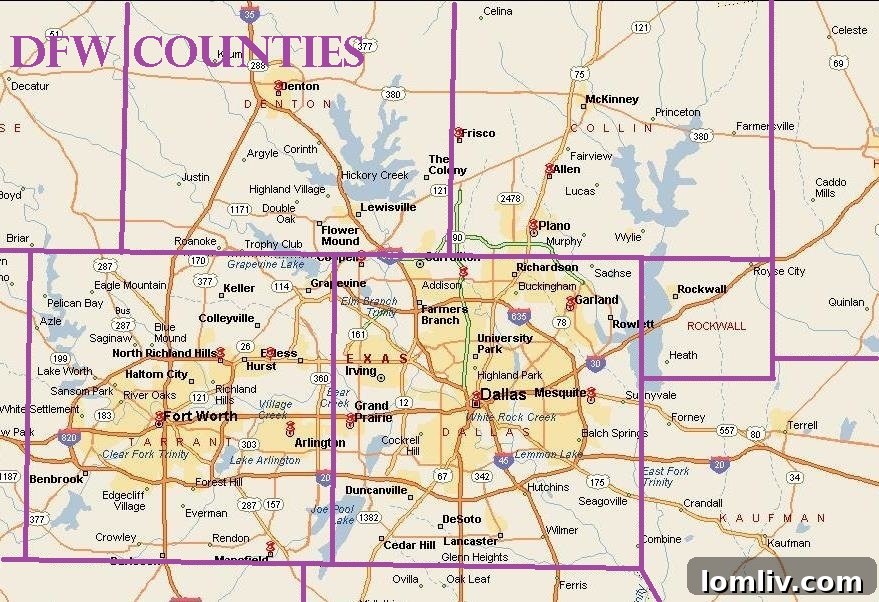
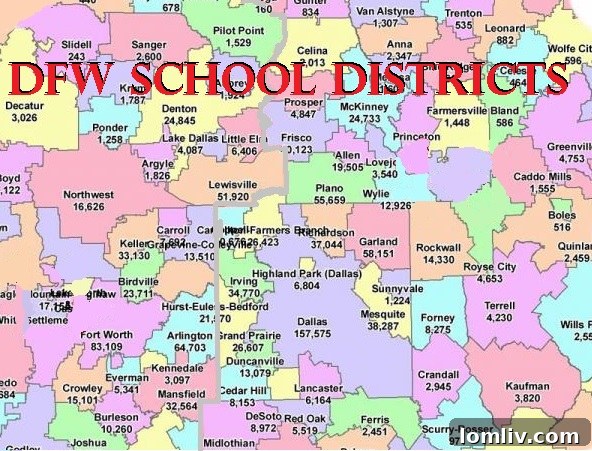
Texas, a state renowned for its vastness, holds the distinction of having 254 counties – more than any other state in the U.S. Complementing this, it also boasts an exceptional number of incorporated cities and independent school districts. Envision a detailed map of the DFW area: first, overlay the boundaries of its numerous counties. Then, meticulously place the borders of its many cities on top of that. Finally, add the intricate outlines of the various school districts. The resulting image is less like a neat grid and more like a vibrant, multi-layered jigsaw puzzle, challenging even the most seasoned cartographer to decipher without getting a little cross-eyed. This geographic complexity is not arbitrary; it’s a byproduct of historical development, economic forces, and legislative decisions that have shaped the region over centuries.
Unraveling the Mystery: Why County, City, and School District Boundaries Rarely Align in DFW
The non-congruent nature of governmental and educational boundaries in the Dallas-Fort Worth area is a result of historical evolution and practical considerations rather than a deliberate design for complexity. Understanding these origins provides clarity on why the lines on a map can often seem so disjointed.
When the Republic of Texas was founded and began establishing its counties, the initial boundaries were often imprecise and vaguely defined. Natural landmarks such as rivers, creeks, or prominent geographical features frequently served as rough delimiters. As the state matured and its population grew, the Texas Constitution began to codify policies aimed at creating more consistent sizes and shapes for new counties. The guiding principle evolved towards establishing counties of approximately 900 square miles, with an aspirational goal for them to be as square as possible. The underlying logic behind this ideal was to ensure that the county seat, typically located near the geographical center, was reasonably accessible to all residents within a day’s travel by horse and buggy. However, early surveying techniques and the sheer scale of the land meant that these ideals were not always perfectly realized, leading to initial irregularities that persist to this day. Furthermore, as new counties were carved out of existing ones, particularly in rapidly developing regions, pragmatic decisions often outweighed geometric perfection, contributing to the “jigsaw puzzle” effect we see today.
The evolution of town and city limits further complicates this intricate map. Over the decades, many municipalities within the DFW area have undergone significant transformations, driven primarily by economic considerations and growth imperatives. Cities frequently expand their boundaries through annexation – incorporating adjacent unincorporated areas to enlarge their tax base, control development, or extend services. Conversely, some municipalities have merged with larger ones, while others have fragmented or de-annexed certain areas. These changes are often fueled by the desire to attract businesses, manage urban sprawl, secure utility corridors, or respond to residents’ demands for specific services or zoning regulations. The result is a fluid and ever-changing municipal map where city lines can meander unpredictably, sometimes encompassing only portions of a neighborhood or even splitting individual properties.
Adding another layer to this complexity are Texas school districts. Unlike many other states where school districts align directly with city or county boundaries, Texas’s school districts are independent entities, often referred to as Independent School Districts (ISDs). This autonomy means they do not necessarily adhere to the borders of cities or counties. Historically, school districts were formed based on population centers and local communities, and over time, these entities have also undergone their own cycles of consolidation and division. Some smaller, rural districts might have merged into larger, more efficient units to pool resources and offer a broader curriculum. Others, especially in rapidly growing suburban areas, might have split to manage student populations and establish more localized control. These historical actions and ongoing adjustments have culminated in a distinct set of boundaries for educational governance that rarely, if ever, perfectly mirrors the lines drawn for municipal or county administration. This independence, while granting local control over education, undoubtedly contributes to the intricate boundary situation.
It’s also worth noting how specific developments contribute to this complexity. Many DFW subdivisions, especially those built on former farm and ranch land, cross over county lines. During the initial planning and development stages of these expansive neighborhoods, county representatives would negotiate and decide on the precise placement of boundary lines. This often involved discussions about which jurisdiction would claim specific homes, which would be responsible for providing public services, and crucially, which would levy property taxes on those residences. These agreements, made decades ago, continue to define the current jurisdictional anomalies, sometimes resulting in a single street having homes on one side in one county and the other side in a different county, each with its own set of local regulations and services.
Why These Overlapping Boundaries Significantly Impact DFW Residents
While the intricate map of DFW’s overlapping jurisdictions might seem like a mere cartographical curiosity, it has profound and practical implications for residents, affecting everything from their daily routines to their financial obligations and civic engagement. Understanding “why this matters” is crucial for anyone living in or considering a move to the Dallas-Fort Worth Metroplex.
Perhaps the most direct and significant impact of these complex boundaries is on property taxes. When you own a home in Texas, you are not simply paying taxes to a single entity. Instead, your property taxes are typically levied by multiple governmental bodies: your county, your city, and your independent school district. In many cases, you might also be paying taxes to other special districts, such as community college districts, hospital districts, or even specific water or utility districts, depending on your exact location. While your county tax assessor-collector might handle the collection of all these various property taxes on a single bill, providing a convenient one-payment solution, this is by no means a universal standard across the DFW area. Many homeowners in Dallas, Collin, Denton, and Rockwall counties find themselves writing two, three, or even more checks to different entities each year to fulfill their property tax obligations. This multi-faceted payment structure can be confusing, especially for new homeowners unfamiliar with Texas’s unique tax landscape. It necessitates a diligent understanding of which specific taxing authorities govern your property to ensure timely and correct payments.
Beyond who collects your taxes, these jurisdictional lines determine a vast array of local services and public infrastructure. The county you reside in dictates which county services you access, such as voter registration, motor vehicle registration, certain health services, and the county court system. It’s also where you’ll find information about a piece of real estate, as county clerks maintain vital property records, including deeds, liens, and ownership histories. When you need to delve deep into a property’s background, following the money trail of recorded transactions within the correct county office is the most reliable path. Moreover, the city you live in determines your access to municipal services like local police and fire departments, public works (trash collection, water, sewer), libraries, parks, and zoning regulations. For example, if your street forms a city or county boundary, emergency responders might need clarification on which jurisdiction is responsible, potentially causing critical delays. Similarly, the school district your property falls within dictates which public schools your children are eligible to attend, a factor often paramount for families choosing a home. These lines truly define the local support structure surrounding your home and community.
The complexities also extend to political representation and civic participation. Your county of residence determines which county commissioners represent your precinct, influencing decisions on county-level infrastructure, public safety, and budget allocation. Your city determines your local city council representatives, who shape ordinances, development projects, and local service delivery. Furthermore, these lines delineate state and federal voting districts, directly impacting who represents you in Austin and Washington D.C. For residents, understanding these boundaries is essential for informed voting and effective engagement with local government. It ensures you know which officials to contact for local issues, whose elections you vote in, and how your voice can be heard within the appropriate governmental body. This can be particularly challenging when a single neighborhood or even a property might fall under different sets of representatives for different levels of government.
For individuals involved in real estate transactions, these boundaries are of paramount importance. Real estate agents, buyers, and sellers must accurately identify the county, city, and school district associated with a property. This information directly impacts property tax assessments, potential school enrollment, zoning regulations, and the availability of specific municipal services. A misidentification could lead to incorrect tax estimates, enrollment issues for children, or even unexpected development restrictions. The due diligence required in a DFW real estate transaction often includes meticulous verification of these jurisdictional facts to avoid future complications. Whether it’s verifying school ratings based on district lines or understanding the specific tax rates applied by various entities, clarity on these boundaries is non-negotiable.
In conclusion, the seemingly haphazard arrangement of county, city, and school district boundaries in the Dallas-Fort Worth Metroplex is a unique feature born from a rich history of growth and adaptation. While it creates a complex administrative landscape, it’s a system that residents learn to navigate. From understanding who collects your property taxes and which schools your children attend, to knowing which local officials represent you and which emergency services respond to your call, these invisible lines on a map profoundly shape the daily experience of living in one of America’s fastest-growing and most dynamic urban centers. Ultimately, while the sheriff may not pursue you past the county line, rest assured that your school, city, and county tax collectors will certainly know exactly where to find you, irrespective of how many jurisdictional lines your property may straddle.
The opinions expressed are solely those of the individual author and are provided for informational purposes only. This content does not constitute legal, financial, or real estate advice. For any specific issue or problem, please consult with a qualified professional attorney, financial advisor, or real estate expert.