The Unseen Burden: How Housing Policies Target Vulnerable Families and Exacerbate Poverty
Life for individuals experiencing poverty is often a relentless series of challenges, both overtly visible and subtly insidious. Beyond the daily struggle for necessities, low-income communities frequently face societal judgments and systemic exploitation. A poignant example is the criticism often directed at those utilizing food stamps for purchasing perceived “junk food” or sugary beverages. While such judgments are swift, the underlying dynamics that influence these choices are frequently overlooked.
Recent investigative research, drawing upon data from the New York State Department of Health, provides a disturbing insight into this phenomenon. The study strongly suggests that food manufacturers strategically capitalize on the financial cycles of low-income shoppers. These companies appear to be acutely aware that food stamp benefits are typically disbursed monthly and often spent within the first week of issuance. Consequently, these initial days of the month become prime targets for aggressive soda sales campaigns aimed directly at poorer consumers.
The correlation unearthed by the study is striking. In more affluent neighborhoods with low food stamp usage, there is no statistically significant link between soda sales and specific dates within the month. However, in low-income communities, the probability of a soda sale occurring in the week food stamps are distributed surges by an alarming 4.35 times. This increase in promotions is notably concentrated on sugary drinks, with no corresponding rise in advertisements for healthier, low-calorie alternatives. This calculated and predatory marketing strategy, despite denials from grocery stores and beverage manufacturers, highlights a disturbing facet of economic exploitation, especially when juxtaposed with political discourse that seeks to legislate the purchasing habits of the poor.
Housing Hardship: A Parallel Narrative of Systemic Vulnerability
While the exploitation within the consumer goods market is a significant concern, our primary focus at Daltxrealestate.com remains firmly on the critical intersection of housing and real estate. In this sector, the targeting of vulnerable populations often unfolds with a similarly disquieting lack of empathy, frequently veiled under the guise of fiscal responsibility or the incentive to work.
Last month, we delved into the legislative proposals advanced by the Department of Housing and Urban Development (HUD), under its previous administration. These initiatives aimed at significantly increasing the financial burden on low-income individuals who rely on federal housing assistance. This month, the Center on Budget and Policy Priorities has released comprehensive research that meticulously details the projected costs and far-reaching impacts of these proposals, not only on a national scale but also at the specific state and municipal levels.
Decoding Proposed Federal Housing Assistance Reforms
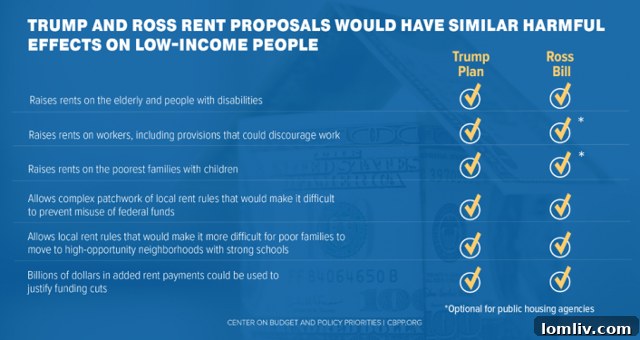
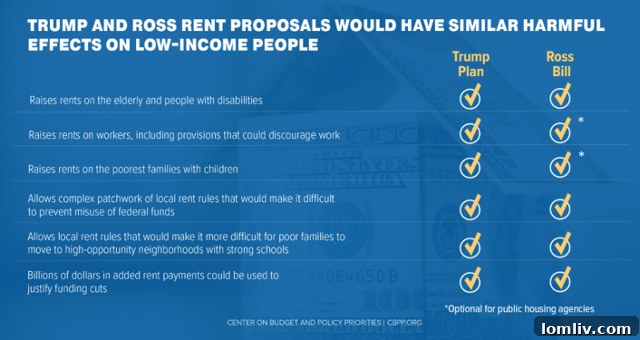
Currently, two principal legislative frameworks are under consideration, both designed to reform federal housing assistance programs, with significant implications for low-income populations. While these plans exhibit subtle differences in their methodological approaches, their ultimate outcomes, as vividly illustrated in the graphic provided, reveal a remarkably similar and deeply concerning trajectory. The administration’s plan dictates changes at the federal level, establishing national guidelines. In contrast, a parallel proposal spearheaded by House Financial Services Housing and Insurance Subcommittee Vice Chairman Dennis Ross (R-Florida) introduces a degree of flexibility, granting states more leeway in determining the intensity and specifics of implementing these more stringent measures against the poor.
The administration’s proposal projects an annual increase of $3.2 billion in rental costs nationwide for households receiving assistance. The Ross plan, while initially framed as potentially more restrained, ultimately allows for an even greater potential increase in rents, reaching up to $4.9 billion annually. These substantial figures compel us to critically examine the broader economic context: how do such proposed cuts to vital social safety nets for the nation’s most vulnerable align with the recent, substantial tax cuts primarily benefiting the wealthiest segments of society? The stark disparity in priorities is a central point of contention and ethical debate.
The Disputed Rationale: “Incentivizing Work” Versus Reality
Proponents of both housing reform plans frequently articulate that the primary objective behind these significant rent increases is to incentivize work among low-income individuals. This underlying philosophical premise suggests that the heightened fear of losing one’s housing and facing homelessness will serve as a potent motivator, compelling people to increase their work hours, irrespective of the quality, stability, or availability of suitable employment. This perspective often aligns with a broader, frequently criticized “bootstrap” ideology that tends to attribute economic hardship primarily to a lack of individual effort, often overlooking the complex, systemic barriers to employment, education, and upward mobility that many low-income individuals face.
Such an “incentive” argument raises profound ethical questions, particularly when examined alongside other controversial policies that rely on inflicting severe hardship as a means of social engineering. A recent and widely condemned example includes the practice of separating children from their families at borders as a deterrent to immigration. These approaches prioritize punitive measures over supportive solutions and fail to address the root causes of poverty and instability.
Furthermore, the justification for these rent increases often stands in direct opposition to prevailing economic realities. Despite frequent claims that the nation is at or near full employment, and the ubiquitous “help wanted” signs visible in communities across the country, the issue is not simply a lack of jobs or a desire to work. Rather, it points to the pervasive problem of stagnant wages, a significant shortage of jobs offering a living income, and the increasing cost of living, particularly housing.
It is crucial to understand that a substantial portion of individuals who qualify for housing assistance are already employed, often working multiple part-time jobs to make ends meet (this excludes those with disabilities or the elderly, who face distinct and often insurmountable challenges to employment). The proposed solution – to simply charge more rent – fundamentally misdiagnoses the problem. A genuinely effective and humane approach would involve implementing policies that ensure living wages, allowing full-time workers to earn enough to cover basic necessities, including housing, without needing assistance in the first place. Instead, the implicit message conveyed by these policies is often perceived as a directive to “spend less time with your kids and work more,” a narrative that ironically exacerbates existing social problems by increasing the likelihood of children being left unsupervised and, tragically, a higher propensity for involvement with the criminal justice system.
Devastating Outcomes: Impact on Children, Disabled, and Elderly at State and Local Levels
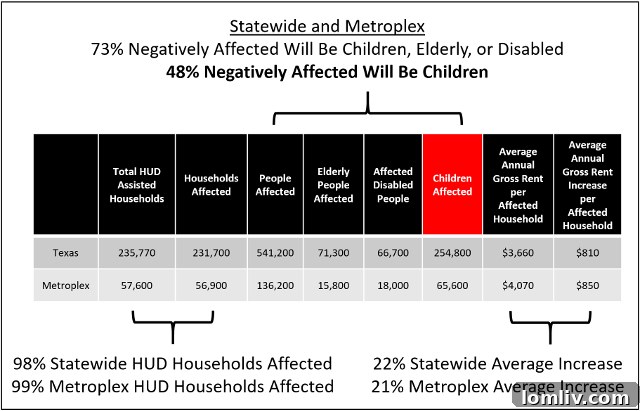
The human toll of these proposed housing policies is projected to be immense, with specific demographic groups disproportionately bearing the brunt of the burden. Children, in particular, are poised to be the most significant losers, comprising just under half of all individuals who will be adversely affected. This impact is especially heartbreaking given that these children often already contend with formidable obstacles in accessing quality education and securing future employment opportunities that could potentially break the intergenerational cycle of poverty. The fundamental goal of any compassionate social welfare policy should unequivocally be to foster upward mobility and provide pathways out of poverty, yet these proposed plans appear poised to achieve the precise opposite outcome.
In a striking revelation from the research, a staggering 73 percent of those who will be negatively impacted by these proposed rent increases fall into categories for whom the directive to “work more” is either physically impossible or profoundly challenging: children, individuals with disabilities, and the elderly. This demographic reality directly contradicts the central tenet and stated rationale of the policies, which is largely predicated on the assumption that affected individuals can simply increase their work hours to offset rising housing costs. For these vulnerable populations, the path to increased income through employment is either blocked or severely restricted.
Given that a substantial majority of affected individuals cannot realistically increase their income through additional work to meet higher rent obligations, the inevitable and tragic consequence will be a significant surge in homelessness. It is already an extraordinarily arduous task to escape the grips of poverty when one has the fundamental stability of a safe and consistent place to live. Attempting to navigate the challenges of poverty while living on the streets or in precarious, temporary shelters magnifies these difficulties exponentially, creating a brutal and often inescapable cycle of instability, desperation, and profound despair. The societal costs of increased homelessness, from public health to emergency services, are substantial and often outweigh any perceived savings from cuts to housing assistance.
“Criminalizing Poverty” or “Economic Cleansing”? A Critical Examination
I am occasionally asked to elaborate on why I choose to describe policies like these as “criminalizing poverty.” Upon deeper examination, perhaps a more accurate, albeit stark and uncomfortable, term would be “economic cleansing.” What other descriptor truly captures the essence of a situation where, in a major urban hub like the Metroplex, the average annual rent for a household receiving HUD assistance stands at approximately $4,070 – a figure that already consumes 30 percent of an average $13,000 annual adjusted income – and then proposed legislation seeks to elevate this rent by an additional $850? This increase represents a further 9.5 percent of their already meager remaining annual income of $8,930, leaving an already economically vulnerable population with even less to subsist on.
For the vast majority of us, even conceiving of a life lived on such a meager income is nearly impossible. The harsh reality is that if Congress proceeds with the implementation of these draconian measures, regardless of whether individuals purchase sugary sodas or not, the poor will simply find it impossible to “live” on what remains. These policies push families and individuals to the absolute brink, forcing them to make impossible and heartbreaking choices between fundamental necessities like food, critical medicine, and the basic human right of shelter. Ultimately, such policies do not incentivize work; they merely drive more people into destitution, exacerbating the very problems they claim to solve and deepening the chasms of social inequality.

Beyond the Headlines: A Commitment to Diverse Real Estate Insights
While the pervasive issues of poverty and federal housing policy are unequivocally a critical area of focus and advocacy, my core beat at Daltxrealestate.com extends to the dynamic and multifaceted world of high-rises, the intricacies of homeowners associations (HOAs), and the transformative potential of property renovation. I also hold a profound appreciation for both modern architectural innovations and historically significant structures, consistently evaluating these elements within the broader, impactful context of the YIMBY (Yes In My Backyard) movement. This movement passionately advocates for increased housing development as a crucial strategy to address pressing affordability challenges and alleviate chronic supply shortages in urban and suburban areas.
My unwavering dedication to delivering insightful, well-researched, and impactful real estate commentary has been formally recognized by the National Association of Real Estate Editors. In both 2016 and 2017, my writing was honored with prestigious accolades, including two Bronze awards (2016, 2017) and two Silver awards (2016, 2017). These distinctions underscore a steadfast commitment to producing high-quality content that thoroughly explores various dimensions of the complex real estate landscape, from policy impacts to architectural trends.
Do you possess a compelling story to share, a unique and insightful perspective on emerging real estate trends, or perhaps even an extraordinary marriage proposal that ingeniously intertwines with the world of property and development? I extend a warm invitation for you to connect with me. Please do not hesitate to send an email to [email protected]. While I encourage you to search for me on popular social media platforms like Facebook and Twitter, you might discover my online presence to be somewhat elusive – but rest assured, your valuable stories, perspectives, and insights are always genuinely welcomed and deeply appreciated.