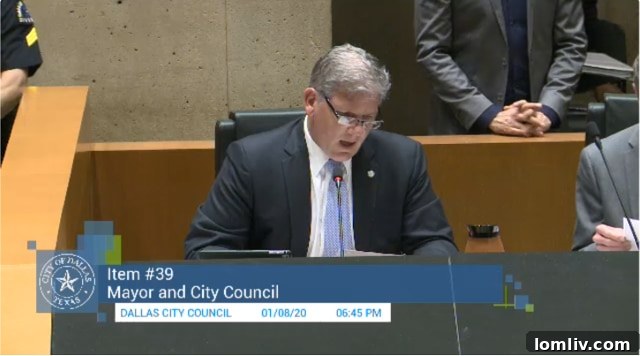
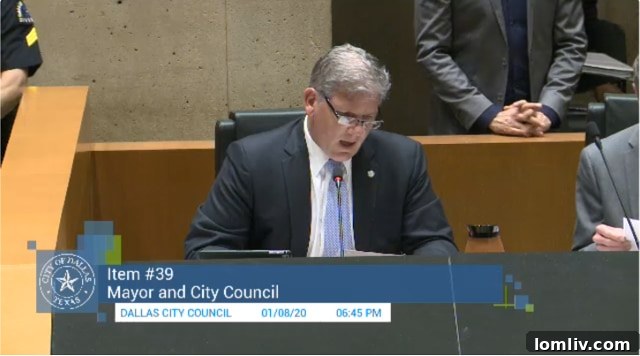
The recent Dallas City Council session regarding the proposed Reverchon Park redevelopment project left many observers with a distinct sense of unease. What should have been a straightforward civic process turned into a perplexing display of political maneuvering, raising serious questions about transparency and adherence to established ethical guidelines. At the heart of the matter was a contentious proposal led by Dallas Mavericks general manager Donnie Nelson’s group, aiming to significantly expand and reconstruct the Reverchon Park Ball Field.
The sequence of events was particularly striking. The public was first invited to present their arguments, either in support or opposition to the project. Following this public input, the council abruptly adjourned for a closed executive session. Upon their return, with remarkable speed, District 14 council member David Blewett swiftly presented a revised list of concessions and benefits, many of which carried significant financial implications. The critical observation here is that these “sweeteners” could only have been formulated and agreed upon through direct negotiation with Nelson’s entity, Reverchon Park Sports and Entertainment LLC., *prior* to their presentation in an open council meeting. This immediately begged a crucial question: Were direct discussions, potentially in violation of city statutes, taking place outside the public eye?
The cadence of these events resonated deeply with several individuals I spoke with post-meeting, echoing a vague sense of impropriety. This widespread discomfort prompted a closer examination of the city’s official ethics code, specifically concerning interactions between city council members and entities bidding on city contracts. The intent behind such regulations is to safeguard the integrity of public procurement processes, ensuring fairness, transparency, and an even playing field for all potential parties.
“SEC. 12A-15.8. RESTRICTED ACTIVITIES.
(g) Lobbying by bidders and proposers on city contracts.
(1) A person responding to a request for bids or request for proposals on a city contract shall not lobby a city council member either directly or indirectly (through a representative, employee, or agent) from the time the advertisement or public notification of the request for bids or request for proposals is made until the time the contract is awarded by the city council.
(2) A city council member shall not discuss a request for bids or a request for proposals on a city contract either directly (with the person or entity submitting the bid or proposal) or indirectly (with a lobbyist, representative, employee, or agent of the person or entity submitting the bid or proposal) from the time the advertisement or public notification of the request for bids or request for proposals is made until the time the contract is awarded by the city council. The department issuing the request for bids or request for proposals shall forward to all city council members any protest received and any response to that protest before city council considers awarding that city contract.
(3) This subsection does not prohibit a bidder or proposer from speaking at the city council meeting where the award of the contract is considered.”
At first glance, one might assume that after the initial Reverchon Park deal failed to gain approval on December 11, any restrictions on communication between council members and the applicant would have been lifted. This perspective suggests that council members would then be free to engage directly with the applicant until the moment the proposal was formally reintroduced onto the agenda by Council Member Blewett. However, this interpretation overlooks a critical detail: Blewett himself initiated the reconsideration process by filing the necessary document on December 13, a mere two days after the initial rejection. More importantly, the failure of the specific proposal on December 11 did not render the Request for Proposals (RFP) itself null and void. The 2019 RFP for Reverchon Park had been originally issued back in 2018, signifying an ongoing contractual opportunity rather than a closed chapter.
The Dallas City Ethics Code clearly outlines a strict prohibition on direct or indirect discussions between city council members and bidders on city contracts, from the time of public notification of the RFP until the contract is awarded. The very purpose of this regulation is to prevent backroom deals, ensure competitive fairness, and protect public trust in the integrity of government processes. The circumstances surrounding the Reverchon Park deal, particularly the speed and specificity of the “sweeteners” presented after a closed session, strongly suggest that interactions occurred that could easily fall under the definition of prohibited discussions.
Facebook Post Reveals Ongoing Negotiation with Proposer
Further compounding the ethical concerns was a Facebook post made by Council Member Blewett himself. After the Observer reported on January 3 that Blewett had filed for reconsideration of the deal, he took to social media to openly discuss his “prior and continuing negotiations.” His post, which provided a candid glimpse into the behind-the-scenes discussions, only served to intensify the scrutiny.
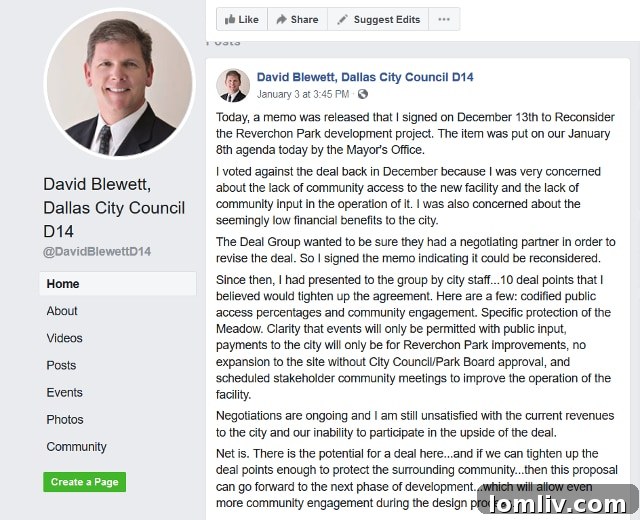
“The Deal Group wanted to be sure they had a negotiating partner in order to revise the deal. So I signed the memo indicating it could be reconsidered.
Since then, I had presented to the group by city staff … 10 deal points that I believed would tighten up the agreement. Here are a few: codified public access percentages and community engagement. Specific protection of the Meadow. Clarity that events will only be permitted with public input, payments to the city will only be for Reverchon Park improvements, no expansion to the site without City Council/Park Board approval, and scheduled stakeholder community meetings to improve the operation of the facility.
Negotiations are ongoing and I am still unsatisfied with the current revenues to the city and our inability to participate in the upside of the deal.”
Blewett’s own words appear to directly contradict the spirit and letter of the Dallas city ethics codes. By actively “negotiating a deal” with “The Deal Group” (Reverchon Park Sports and Entertainment LLC) in relation to an unawarded RFP, he seemingly engaged in the very type of restricted activity the code is designed to prevent. Similarly, the “Deal Group” may also have crossed ethical lines by “lobbying” Blewett for these negotiations, seeking a “negotiating partner” to revise their proposal outside of the formal, public process. The core issue here is not necessarily the content of the “deal points”—many of which, like codified public access and community engagement, address legitimate public concerns—but the *method* by which they were arrived at. This private negotiation process, conducted while the RFP was still technically active and unawarded, undermines the principle of fair and open competition.
However, the question arises: Is there a loophole? Some might argue that because the initial proposal failed, and Blewett merely filed for reconsideration, the RFP process was somehow paused or reset in a way that permitted such discussions. This argument, however, strains credulity when viewed against the clear language of the ethics code, which specifies restrictions until the contract is *awarded*. An unawarded contract, even one that has seen a previous proposal fail, still falls under these guidelines to ensure that all potential bidders have an equal opportunity and that the city secures the best possible outcome through a transparent process.
This situation also highlights another significant problem: the erosion of the “level playing field” principle inherent in all public procurement. When an RFP remains unawarded, the terms and conditions are expected to be consistent for all potential proposers. If the terms of a deal can be privately negotiated and “tweaked” with a single bidder before the award, what incentive do other potential bidders have to participate? And more critically, how can the public be sure that the city is receiving the most advantageous offer? In typical procurement processes, changes to an RFP’s terms require an official amendment, made public and available to all interested parties, precisely to maintain fairness. While it appears there might have been only a single bidder in this instance, does that diminish the importance of maintaining an ethical and transparent process? The potential for a perception of favoritism or undue influence remains, regardless of the number of participants.
What proved most surprising in the aftermath of these events was the apparent silence from more seasoned council members and even the mayor. Their lack of expressed concern or inquiry into the procedural irregularities left many wondering if the ethical implications were being overlooked, or perhaps, if there was a commonly accepted interpretation that somehow excused these actions. Given this ambiguity and the profound implications for public trust, I consulted with current and past ethics experts for their professional opinions. The responses were varied: one expert saw no immediate red flags, suggesting a nuanced interpretation of the code’s application in reconsideration scenarios. Another, however, unequivocally identified significant concerns, viewing the actions as a clear deviation from ethical conduct. A third expert went further, stating there was sufficient reason to file a formal complaint with the city’s ethics commission, emphasizing the importance of upholding the integrity of the procurement process, regardless of the perceived intent.
And so, we arrive at a critical juncture. The situation presents a distinct ethical fog, leaving the Dallas community to ponder: Is there enough “smoke” here to necessitate a thorough investigation into a potential “fire”? What are your thoughts on this critical matter of public integrity and transparent governance?

As an observer of Dallas’s dynamic urban landscape, my work often focuses on high-rise developments, HOA complexities, and the intricate world of property renovation. Yet, my broader interest lies in the delicate balance between preserving historical and modern architecture and the urgent demands of the YIMBY (Yes In My Backyard) movement. My commitment to insightful journalism has been recognized by the National Association of Real Estate Editors, earning me three Bronze awards in 2016, 2017, and 2018, alongside two Silver awards in 2016 and 2017, reflecting a dedication to clarity and depth in covering real estate and urban development issues. Your perspectives and stories are invaluable; please feel free to share them or any inquiries at [email protected]. While I maintain a somewhat elusive online presence, you are welcome to search for my work on Facebook and Twitter to connect with ongoing discussions on these vital topics.