

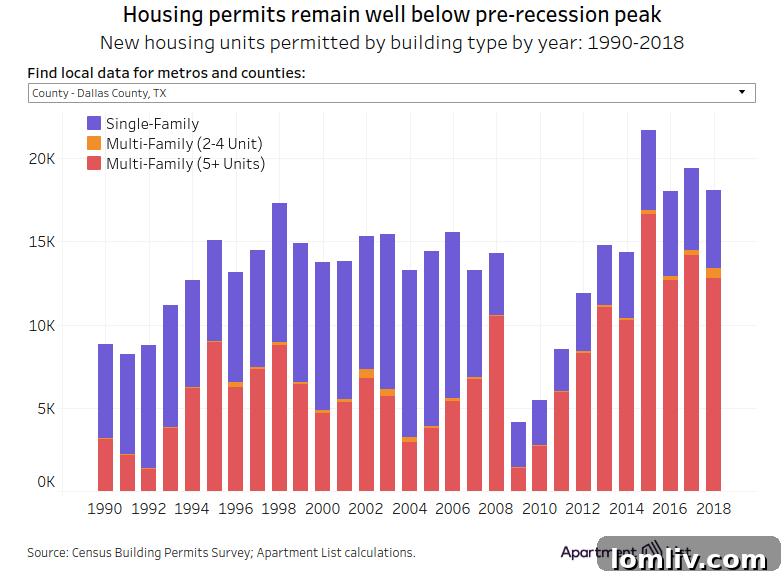
While the national housing market grapples with a recovery that leaves approved housing permits approximately 38 percent below their pre-recession peaks, the Dallas-Fort Worth metropolitan area stands out as a beacon of resilience and growth. Despite encountering various challenges that could otherwise hinder more robust development, Dallas continues its impressive stride in balancing significant job creation with a responsive, albeit evolving, housing supply. This dynamic interplay between economic expansion and residential development places DFW in a unique and enviable position among America’s largest urban centers.
Dallas-Fort Worth: A Powerhouse of Job Growth and Housing Development
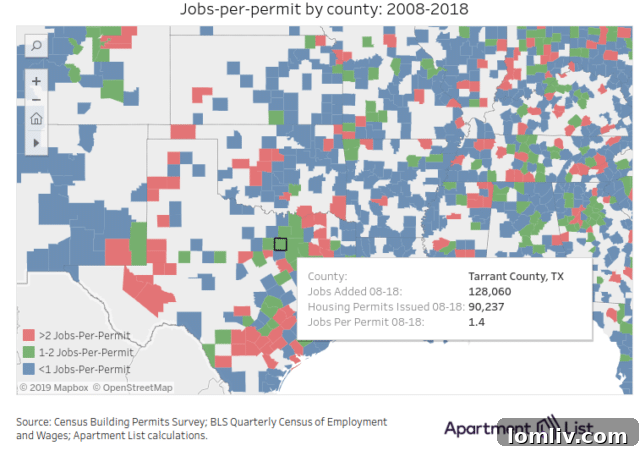
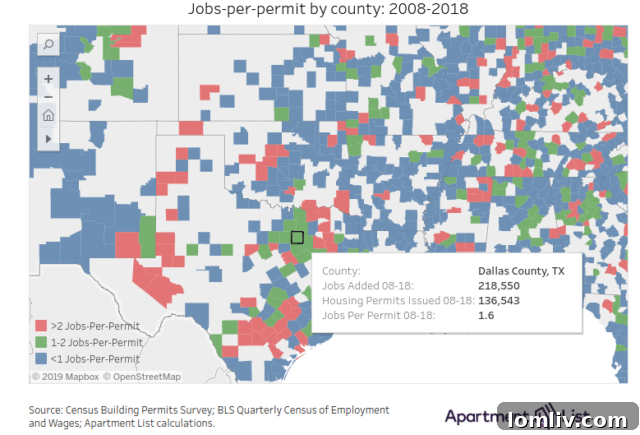
A comprehensive new study by Apartment List highlights Dallas-Fort Worth-Arlington (DFW) as a top-performing metropolitan statistical area (MSA) in the nation. Between 2008 and 2018, DFW permitted an average of 5.9 new housing units for every 1,000 residents, securing its rank as the seventh-highest among the 50 largest U.S. metros. This robust housing activity is a direct response to the region’s burgeoning economy. Over the same decade, DFW generated an impressive 8.3 new jobs per 1,000 residents, positioning it eighth nationally for employment growth. This translates to nearly one-and-a-half jobs added for every new housing unit constructed, a ratio that strongly indicates a healthy equilibrium between housing supply and demand. Such balance is crucial for maintaining affordability and preventing the kind of housing crises seen in other rapidly growing urban areas.
The sheer scale of this growth is remarkable: during the ten-year period from 2008 to 2018, DFW welcomed 589,514 new jobs, supported by the approval of 418,987 housing permits. These figures underscore the region’s economic vitality and its persistent efforts to accommodate an expanding population and workforce. The Dallas area has effectively navigated the post-recession landscape, demonstrating a capacity for sustainable growth that many other major U.S. cities struggle to achieve.
The Rise of Multifamily Housing in Dallas
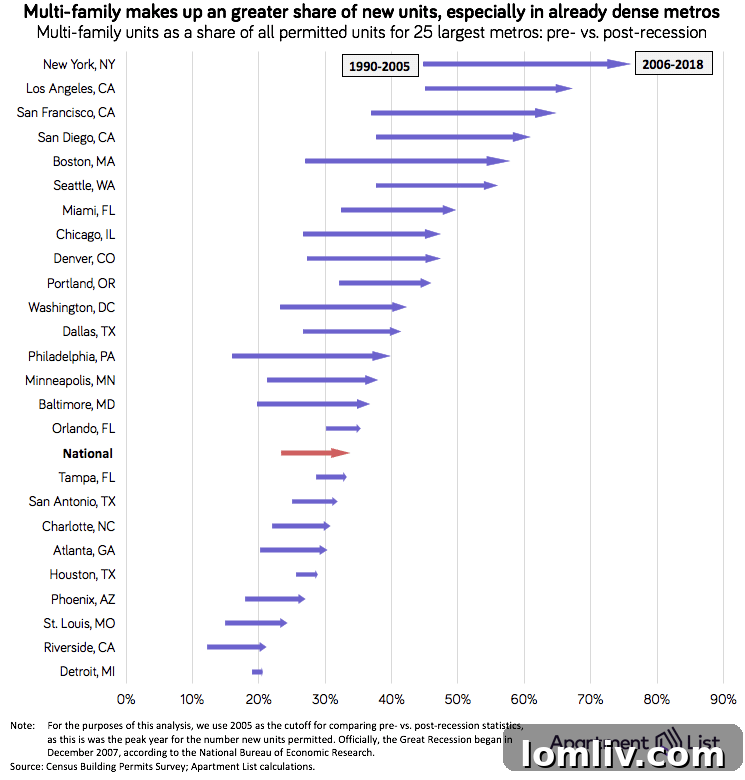
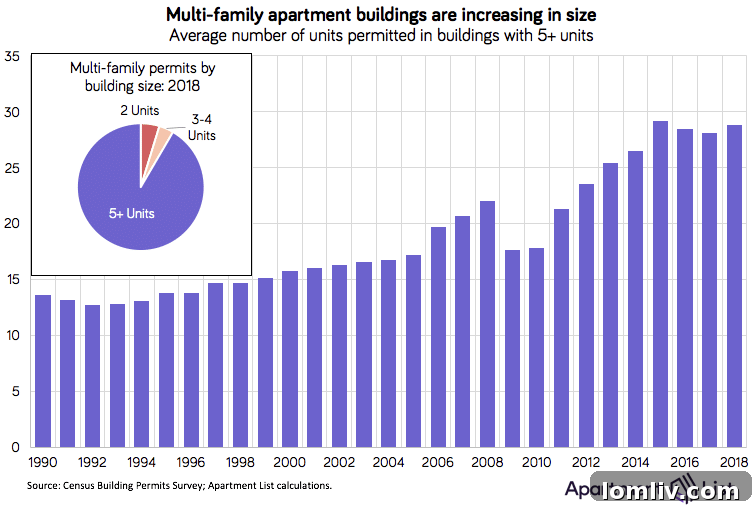
A significant trend defining Dallas’s housing landscape is the pronounced shift towards multifamily developments. Since 2006, new multifamily units have accounted for a substantial 42 percent of all housing permits in Dallas. This marks a considerable increase from the 27 percent share observed in the pre-recession era, far exceeding the national average of 33.9 percent for multifamily permit shares. This surge in apartment and condominium construction reflects a broader economic and demographic shift, catering to a growing demand for urban living, smaller households, and more attainable housing options in a market where single-family homes are becoming increasingly expensive.
Phil Crone, executive director of the Dallas Builders Association, corroborates these findings, acknowledging the compelling forces driving the market. “Near-record job growth, low unemployment, and favorable mortgage rates here are creating the perfect environment for new housing demand,” Crone explains. However, he also points to factors that have tempered new construction starts, particularly for single-family homes. These include local regulatory hurdles, which often result in longer lot development times, and environmental challenges such as a particularly wet spring, which can delay projects and increase costs.
Addressing Affordability: Builders Pivot to Lower Price Points
In response to evolving market dynamics and the growing challenge of affordability, homebuilders in Dallas are strategically adapting their approach. “Builders are pivoting to lower price points as fast as they can because that is where buyer demand is,” Crone states. This shift reflects a pragmatic understanding of the economic realities faced by many prospective homeowners. As wages struggle to keep pace with escalating home prices, the demand for more affordable housing solutions intensifies.
Multifamily housing emerges as a crucial component in filling this affordability gap. While it doesn’t diminish the fundamental desire for single-family homes, it provides a viable alternative for many. “Multifamily is filling that void to a certain extent in many areas. That’s mainly out of necessity. It doesn’t indicate that single-family homes are any less in demand, they are just less attainable,” Crone elaborates. This sentiment is underscored by stark statistics: new home prices in Dallas have surged by 25 percent since 2015, while average wages have only risen by approximately half that amount, creating a significant purchasing power deficit for many Dallas residents.
The Apartment List study further elucidates this divergence in recovery patterns. While multifamily construction demonstrated a remarkable rebound from recession-era lows, single-family construction continues to lag. The number of single-family housing units permitted in 2018 was barely half the volume seen in 2005, illustrating the slow pace of recovery in this segment. Consequently, multifamily units have comprised a significantly larger share of new housing in the post-recession period, increasing from 23.4 percent of all residential building permits issued between 1990 and 2005 to 33.9 percent from 2006 to 2018.
Dallas: A Sun Belt Outlier in Sustainable Growth
Dallas’s housing market dynamics position it as a notable outlier among the thriving Sun Belt metros. Unlike many densely populated coastal “superstar cities” that have struggled to build enough new housing overall, often exacerbated by restrictive zoning and high land costs, Dallas and its Sun Belt counterparts have managed to sustain economic growth while keeping housing development relatively in sync with job creation. This is largely attributed to the continued reliance on single-family homes as the dominant type of new housing in these regions, complemented by a steadily rising, but more muted, share of multifamily construction.
The Apartment List report emphasizes this distinction: “While we find that proportionally more multi-family housing has been built in recent years, the metros where it is most prevalent tend to be the coastal superstar cities that have struggled to build enough new housing overall. Meanwhile, fast-growing Sun Belt metros have continued to rely on single-family homes to maintain sufficient housing supply.” This observation highlights Dallas’s success in navigating market demands without fully sacrificing the single-family home market, which remains a cornerstone of the American dream for many families.
The ability of Dallas to foster a robust economy and accommodate its growing population speaks volumes about its balanced approach to urban planning and development. While regulatory challenges and market forces continue to shape the landscape, the commitment to providing a diverse range of housing options, from attainable multifamily units to new single-family homes in demand price points, is critical for sustained prosperity and quality of life.
The Future of Housing in Dallas: Balancing Growth and Affordability
The Dallas-Fort Worth metropolitan area exemplifies a dynamic urban region successfully managing significant job growth with a proactive approach to housing supply. However, the insights from the Apartment List study and local experts like Phil Crone suggest that continuous vigilance and strategic planning are essential. Addressing regulatory impediments, fostering innovation in construction to reduce costs, and ensuring that housing supply adequately matches diverse income levels will be crucial for maintaining Dallas’s competitive edge and ensuring long-term affordability for its residents. The ongoing shift towards multifamily housing and the strategic pivot by builders to lower price points are indicative of a market adapting to contemporary challenges, striving to balance robust economic expansion with the fundamental need for attainable housing.
For a deeper dive into these trends and comprehensive data analysis, the full report is available. We encourage you to explore the detailed findings and gain further insights into the evolving housing landscape across the nation and within high-growth metros like Dallas. To see the whole report, click here.