By Olive Talley
Special Contributor
For decades, the foundation of countless communities across Dallas has been the single-family home. These neighborhoods represent more than just houses; they embody a specific quality of life, a sense of community, and a significant personal investment for residents. However, a sweeping new proposal threatens to fundamentally alter this landscape, potentially reshaping the very fabric of our city’s residential areas.
A recent and controversial initiative is pushing for the widespread elimination of single-family home zoning throughout Dallas. This move, spearheaded by Dallas City Councilman Chad West, Chair of the Housing and Homelessness Solutions Committee, and his colleagues, seeks to reclassify single-family properties as multi-family duplexes citywide. The core of this proposal involves imposing a “by-right” edict, which would grant property owners the automatic right to add a second residence to their land, effectively bypassing existing community input mechanisms.
Understanding the Ramifications of Increased Urban Density
The implications of this proposed re-zoning are profound. Imagine your quiet, tree-lined street, currently characterized by single-family homes, suddenly experiencing a significant surge in population density. Under this new “by-right” framework, single-family neighborhoods across Dallas could realistically see their density double, predominantly through the proliferation of rental properties. This dramatic shift is not merely an architectural change; it promises to introduce a cascade of challenges that directly impact residents’ quality of life and the long-term stability of their communities.
Furthermore, the proposal places an onerous burden on existing communities. If residents object to this forced citywide overlay, which permits the construction of an Accessory Dwelling Unit (ADU) often overlooking their backyards, they are given an extremely tight window to act. Homeowners would have only 30 days to organize and achieve a consensus with a staggering 75 percent of their neighbors to “opt out” of this new zoning mandate. Such a requirement is not only challenging but, for many established neighborhoods, practically unattainable. It effectively transfers the responsibility and cost of preserving neighborhood character from the city to individual residents.
Questioning the Authority: A Challenge to Neighborhood Self-Determination
One must ask: by what inherent right does the city of Dallas impose such a transformative edict upon its neighborhoods? For generations, residents in communities across Dallas have dedicated significant time, effort, and resources to foster self-determination and reach carefully negotiated compromises regarding their local zoning. This is particularly true for Dallas’s vibrant conservation and historic districts, where the preservation of unique character and heritage is paramount.
In East Dallas alone, communities such as the Edgemont Park Conservation District, Junius Heights, Lakewood Heights, the M Streets, the Swiss Avenue Historic District, Munger Place, Peaks Addition, Hollywood Heights/Santa Monica, Little Forest Hills, and Lower Greenville have painstakingly built consensus and established protective measures for their unique identities. These districts represent a long-standing commitment to community-led planning, carefully balancing growth with preservation. The proposed “by-right” rezoning threatens to nullify decades of such painstaking work, undermining the very concept of neighborhood self-governance and the careful compromises that define these treasured areas.
Unpacking the Driving Force Behind This Sweeping Proposal
So, what exactly is fueling this aggressive push to dismantle established single-family zoning in favor of multi-family duplex reclassification? The timing of this initiative raises particular concerns, appearing to accelerate under the challenging conditions of the recent pandemic. During a period when Dallas residents were, understandably, preoccupied with critical issues such as health, employment, family care, and remote education, the city seems to have quietly advanced a plan that could have monumental long-term consequences for their homes and communities.
A closer examination reveals that the current system for creating Accessory Dwelling Units (ADUs) in Dallas is not only functional but also readily accessible. Let’s consider some key facts about the existing framework:
- Existing Right to Build: Homeowners in Dallas already possess the right to construct an ADU on their property. This is not a new concept or an unavailable option.
- Neighborhood Opt-In: Communities currently have the autonomy to “opt in” to allow for rentable or non-rentable ADUs, empowering them to tailor zoning to their specific needs and character.
- Clear Approval Paths: The city offers two well-defined pathways for ADU approval. Both involve a straightforward application process and an appearance before the Board of Adjustment (BOA) at a public hearing, allowing for crucial community input.
- Low Utilization, High Approval Rate: In the two years since the ADU ordinance was initially enacted, city staff data indicates that only SEVEN property owners filed applications. Critically, ALL SEVEN of these applications were approved. Only two were for rental purposes, with no clear data on whether these offered genuinely affordable rents.
- No Obstacles to Development: The data confirms that no property owner has been blocked or prevented from seeking an application or constructing an ADU if they desired to do so.
These facts directly counter any assertion that the current ADU process is burdensome or ineffective. City staff explicitly states there is no backlog of requests, nor is the process overly complex. Furthermore, it does not require expensive lawyers or zoning consultants, making it accessible to average homeowners. The $600 filing fee, a minimal cost compared to the potential $200,000 investment in building a new structure, ensures that applicants bear a reasonable share of the administrative expense associated with changing land use and impacting neighbors.
Unmasking the Real Motivations Behind the Proposal
If the existing system is not broken, what, then, is truly driving this push for radical zoning changes? Councilman West argues that the proposal is a strategy to increase affordable housing across Dallas. The intent, he suggests, is to allow residents to rent out detached garages, back houses, or “granny flats” to seniors, young adults, and low-to-moderate-income families.
While the goal of increasing affordable housing is undeniably laudable, the proposed “by-right overlay” approach is critically flawed as a solution. The long-term ramifications of destabilizing single-family neighborhoods far outweigh any perceived benefits. Consider the inevitable consequences: a significant increase in traffic congestion, exacerbated parking shortages, heightened noise pollution, and the introduction of a more transient renter population. These factors inherently strain local infrastructure, which is often not designed for such density, and place additional demands on an already thin city code enforcement staff. Such an approach is neither fair nor equitable for existing residents who have invested their lives and livelihoods in these communities.
Indeed, this appears to be a solution in search of a problem. There are no significant impediments preventing individuals from creating an ADU on their property under the current, working system. The proposed changes risk complicating an already efficient process and, more importantly, represent an inappropriate and ineffective strategy for addressing the complex challenge of affordable housing in Dallas.
If the city is genuinely committed to fostering affordable housing, alternative and more targeted approaches exist. Why not implement caps on rental prices for ADUs to ensure they serve their stated purpose, rather than becoming market-rate rental opportunities driven purely by profit? Moreover, a more impactful approach would be for the city to halt the issuance of permits that enable developers to demolish existing, naturally affordable housing units, thereby displacing lower-income residents from inner-city neighborhoods, only to replace them with prohibitively expensive condos and high-rise apartments. This cycle of displacement undermines true affordability and exacerbates the housing crisis rather than alleviating it.
A Recurring Battle: Dallas’s History of Up-Zoning in East Dallas
This isn’t the first time East Dallas communities have faced such pressures. Since the 1950s, various city initiatives have attempted to fundamentally alter the character of East Dallas through aggressive up-zoning. A stark example of this historical pattern is the rezoning of the Mt. Auburn neighborhood as multi-family without any prior public notice to property owners. It took decades of persistent community advocacy and legal battles for the neighborhood to claw its way back to single-family zoning. Today, with property taxes steadily rising, developers and investors are once again circling, eager to acquire land and displace long-term residents who can no longer afford the escalating costs. This creates a relentless, exhausting cycle for residents committed to preserving their homes and heritage.
Despite the weariness, the resolve of these communities remains unwavering. Residents will not cease their fight, nor will they remain silent. The destabilization of their neighborhoods through high-density zoning of this nature is simply unacceptable.
Preserving Essential Safeguards in ADU Ordinances
A crucial aspect often overlooked in discussions about the proposed “by-right” ADU overlay is the inherent strength of the existing ADU approval process. This current system incorporates vital safeguards designed to protect neighborhood integrity. These include essential provisions such as size and height restrictions, ensuring that new structures blend harmoniously with existing properties rather than overshadowing them. Crucially, the burden of seeking a “special exception” rightfully rests with the homeowner proposing the ADU. This process mandates that neighbors are duly notified and given the opportunity to provide input on zoning changes that directly affect their property investments, their daily lives, and the overall quality of their community. This collaborative approach fosters peace and helps neighborhoods find mutually agreeable solutions.
Furthermore, the current ordinance for ADUs intended for rental purposes includes a critical requirement: the property owner must actually reside in one of the houses on the lot. This “owner-occupancy” clause is a cornerstone of responsible neighborhood development. It ensures that the landlord has a direct, vested interest in the well-being, safety, and character of the neighborhood, fostering a greater sense of accountability and community stewardship. This contrasts sharply with absentee landlords who may prioritize profit over neighborhood harmony.
The Slippery Slope: ADUs Today, Short-Term Rentals Tomorrow
Without these fundamental safeguards, the city risks opening the floodgates to an influx of investor-owned properties, diluting the presence of homeowners who genuinely live, work, and contribute to the vibrant tapestry of Dallas. This concern is not hypothetical; another city task force is currently examining the pervasive issue of short-term rentals (STRs), which are already causing significant disruption in residential neighborhoods. These situations often pit long-term residents against investors who operate rental properties without residing in them, essentially profiting from the community without sharing in its responsibilities or challenges.
Many residents and community leaders harbor a strong belief that this proposed ADU overlay is, in essence, a strategic maneuver or a backdoor route to pave the way for increased density, primarily through the eventual widespread proliferation of short-term rentals. The pattern of ADUs being converted into STRs is a well-documented phenomenon in other cities, and Dallas residents are acutely aware of this potential trajectory.
Act Now: Protect Your Property Rights and Neighborhoods
The time for inaction is over. We urge all concerned citizens to join in a collective effort to stop this misguided proposal. Your immediate action is vital. Please contact your Dallas City Council members and City Plan Commissioners. Urge them to reject this initiative, which threatens to erode your property rights, destabilize cherished single-family neighborhoods, and fundamentally eliminate single-family zoning across Dallas. This is not only a profound waste of time but also a potential misallocation of hundreds of thousands of taxpayer dollars, diverting resources from truly effective solutions for Dallas’s housing challenges.
For your reference, here is an excerpt from a city staff report that was recently presented at the Zoning and Ordinance Committee:
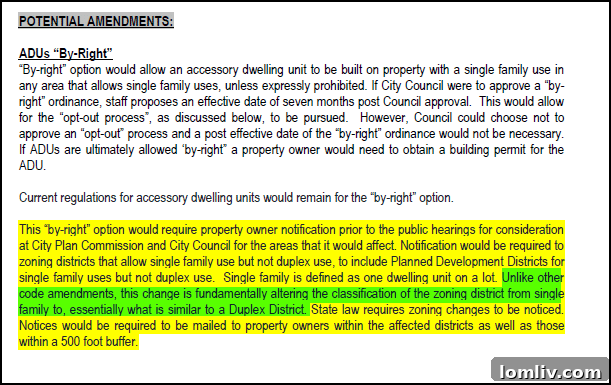
You can review the full report for comprehensive details here: https://dallascityhall.com/departments/sustainabledevelopment/planning/Pages/Accessory_Dwelling_Units.aspx
(Please note: Efforts to access recordings of past web meetings where this critical issue was discussed have proven challenging, as the city has not yet managed to post them. This lack of accessibility raises significant concerns about public transparency, particularly during a period when informed public engagement is more crucial than ever.)
To contact your Dallas City Council member and make your voice heard, please use the following link:
https://dallascityhall.com/government/Pages/contact_mcc.aspx
Olive Talley relocated to East Dallas in 1986, moving from Houston, a city often characterized as the “Wild West” due to its lack of zoning regulations. She has been a resident of her current home for 19 years and volunteers her time as the corresponding secretary for the Edgemont Park Conservation District. An acclaimed former journalist, Olive is a Pulitzer-Prize finalist and a three-time Emmy finalist, recognized for her impactful reporting across newspapers, radio, and network television. She is currently immersed in the production of her second feature-length documentary.