

The Dallas-Fort Worth metropolitan area stands as a vibrant hub of economic growth and population influx, making its real estate market a topic of significant interest for prospective homeowners, renters, and investors alike. Understanding the nuances of this dynamic market requires a deep dive into key indicators: the cost of homes, particularly in desirable school districts, the evolving landscape of single-family rental rates, and the homeowners’ inclination towards renovation and improvement projects. This comprehensive analysis will explore the latest trends and insights shaping the Dallas real estate scene, offering valuable perspectives on where the market is headed and what these shifts mean for residents and stakeholders. From assessing home affordability to dissecting rental market fluctuations and gauging the future of home remodeling, we aim to provide a clear and current picture of Dallas’s thriving property sector.
Unpacking Home Prices: Dallas’s Standing in Nationally Ranked School Districts
For many families, the quality of local schools is a primary determinant when choosing a new home, often outweighing other factors like commute times or proximity to downtown amenities. This critical aspect significantly influences property values, creating a premium for homes situated within highly-rated educational zones. In the competitive landscape of top U.S. metropolitan areas, Dallas-Fort Worth consistently emerges as a strong contender, offering a compelling blend of quality education and relatively accessible home prices. A detailed analysis conducted by JLL provides insightful data on how Dallas’s starting home prices in desirable school districts compare to those in other major metros across the nation.
The study specifically targeted the top 20 metro areas, encompassing both urban centers and their surrounding suburbs, to provide a holistic view of the housing market. Its focus was on establishing the entry-level price range for a standard three-bedroom, two-bathroom single-family home located within the attendance boundaries of a highly-rated school district. This methodology sought to capture the realistic cost for families seeking a foundational home in an educationally advantaged area.
One notable finding from the JLL analysis highlighted the geographical spread of these school-district-centric neighborhoods. On average, these areas were situated approximately 28 miles from their respective downtown cores. This distance often translates into a substantial daily commute for residents working in the key employment hubs, underscoring the trade-off many families are willing to make for access to quality education. The commute factor is an essential consideration for those balancing career demands with family priorities, yet the allure of a top-tier school district often tips the scales in favor of these suburban locales.
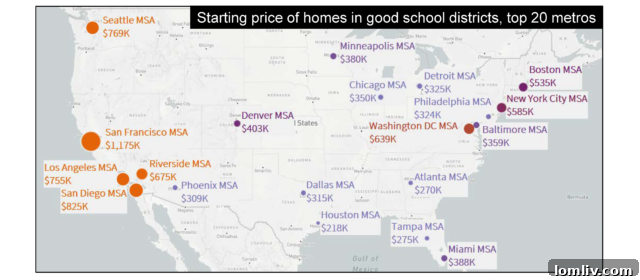
To meticulously identify homes within these sought-after zones, JLL leveraged GreatSchools ratings integrated into Zillow listings. This rigorous approach allowed researchers to pinpoint single-family homes falling within the attendance areas of schools boasting ratings of 9/10 or 10/10. Such a high rating threshold ensures that only truly excellent educational institutions were considered, reflecting the premium buyers place on superior academic environments.
The selection criteria further refined the pool of available homes, focusing on properties that were both affordable and in move-in condition. JLL specifically looked for the least expensive single-family homes that had been built within the last 35 years. Crucially, the analysis excluded properties requiring extensive renovation, such as “fixer-uppers,” “teardowns,” and those available through auctions or foreclosures. This deliberate exclusion aimed to reflect the cost of conventional listings that were either move-in ready or very close to it, providing a more accurate representation of what a typical family would pay for a functional home in a top school district.
When the numbers were tallied, the Dallas Metropolitan Statistical Area (MSA), which ranks as the fourth-largest among the 20 metros examined, presented a starting home price of $315,000 for a qualifying property. In comparison, Houston, another major Texas city, came in at a more affordable $218,000. These figures illustrate that while Dallas is competitive, it still offers a relatively decent bargain compared to many other major metro areas across the United States. This value proposition, combined with robust economic growth and a diverse job market, continues to attract a steady stream of new residents to the Dallas area, further solidifying its appeal in the national real estate conversation.
Dallas’s Evolving Rental Landscape: Single-Family Rent Trends
Beyond homeownership, the single-family rental market plays a pivotal role in the overall housing ecosystem, offering flexibility for residents and investment opportunities for landlords. The dynamics of rental rates often reflect broader economic conditions, population shifts, and housing supply. In Dallas, the single-family rental market has seen consistent growth, albeit with varying paces over recent years. A comprehensive year-over-year comparison conducted by CoreLogic offers a clear perspective on these trends, highlighting both acceleration and stabilization within the Dallas rental sector.
According to CoreLogic’s analysis, single-family rent rates in Dallas experienced an increase this year, a continuation of an upward trajectory. However, the pace of this growth has moderated compared to the previous year. In 2017, Dallas witnessed a robust increase of approximately 3 percent in single-family rents. Fast forward to the current year, the year-over-year comparison indicates a more subdued, yet still positive, increase of about 2 percent. This adjustment suggests a market that, while still expanding, is doing so at a more sustainable rate, potentially offering some relief to renters while maintaining healthy returns for property owners.
On a national scale, the CoreLogic Single-Family Rental Index (SFRI) reveals a consistent pattern of rent price increases over the past eight years. This sustained growth underscores the enduring demand for single-family rental properties across the country. However, the rate of increase has not been uniform. National year-over-year rent price increases peaked in February 2016 at 4.2 percent. Since then, the market has seen a gradual stabilization, with a monthly average hovering around 2.7 percent over the last year. In April 2018, specifically, single-family rents nationally increased by 2.9 percent year over year, marking a 1.3-percentage-point decline from the peak growth rate observed in February 2016.
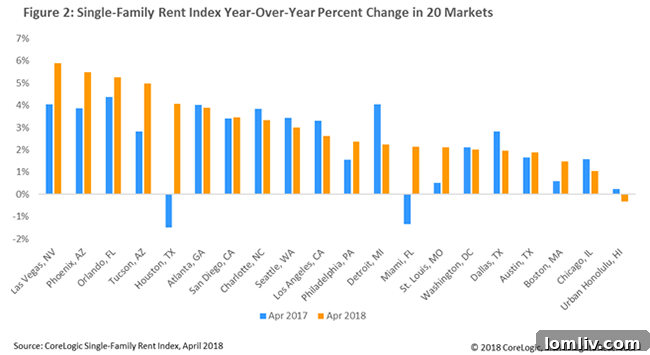
CoreLogic’s SFRI is a meticulously designed index that measures rent changes for the same rental properties over time, ensuring an accurate representation of true market shifts rather than being influenced by new construction or changes in the rental stock. It’s important to note that these single-family rental homes, for the purpose of this index, also include condominiums, reflecting a broader segment of the market available to renters seeking properties larger than traditional apartments.
Further insights from the same analysis highlight a fascinating divergence in rent growth across different segments of the market. The high-end rental property market, defined by higher rental prices, is currently experiencing an acceleration in rent growth. This segment saw an increase of 1.1 percentage points compared to the previous year, suggesting robust demand and pricing power at the upper end of the rental spectrum. Conversely, the low-end rental market, particularly in certain regions, is still contending with the lingering effects of natural disasters. For instance, in metro areas like Houston and Miami, the impact of hurricanes from the previous year continues to influence rent prices.
Economist Molly Boesel elaborates on this phenomenon, stating, “Rents continue to increase in metro areas such as Houston and Miami that were hit by hurricanes last year and left with tighter rental supplies.” She further notes that “Houston rents rose 4.1 percent year over year in April 2018 and Miami rents increased 2.1 percent. Prior to the 2017 late-summer hurricanes, rents had been decreasing in those two metro areas.” This stark reversal underscores how sudden disruptions to housing supply can dramatically alter market dynamics, creating heightened demand and driving up prices even in markets that were previously experiencing declines. For Dallas, while not directly impacted by these hurricanes, understanding these regional shifts provides valuable context for its own rental market trends and potential spillover effects from other Texas cities.
Bright Outlook for Home Remodeling: A Boost for the Economy
The health of the housing market isn’t solely defined by sales and rental rates; homeowners’ willingness to invest in their existing properties also serves as a crucial economic indicator. The act of remodeling and repairing homes not only enhances individual property values but also stimulates various sectors of the economy, from construction and skilled trades to retail and manufacturing. This week, the Leading Indicator of Remodeling Activity (LIRA) delivered an optimistic forecast, projecting a significant increase in homeowner spending on home improvements and repairs in the coming year.
The LIRA is a prestigious report compiled by the Remodeling Futures Program at the Joint Center for Housing Studies of Harvard University. It provides a valuable short-term outlook on national home improvement and repair spending specifically within owner-occupied homes. By focusing on this segment, LIRA offers insights into discretionary spending patterns and confidence levels among homeowners, making it a powerful tool for industry stakeholders and economic analysts.
Overall, analysts associated with the LIRA project that while the annual growth in remodeling spending might taper slightly in the first half of 2019, it is still expected to maintain a robust pace, holding steady at approximately seven percent. This projected growth rate is a testament to underlying economic strength and homeowner confidence, signaling a healthy and active home improvement market.
Chris Herbert, Managing Director of the Joint Center for Housing Studies, explains the driving forces behind this positive outlook: “A growing economy and stronger job market are boosting owners’ willingness to invest in home improvements.” He further emphasizes, “Rising home values and increased home equity levels are also encouraging more owners to do larger upgrade and replacement projects.” These factors create a powerful synergy: a stable job market provides disposable income, while appreciating home values and readily available equity make financing major renovation projects more accessible and appealing. Homeowners see these investments as enhancing their living spaces and securing their financial future.
However, despite these strong positive indicators, a counteracting force is somewhat tempering the potential for even larger gains: the persistent low inventory of existing homes for sale. Abbe Will, Associate Project Director in the Remodeling Futures Program at the Joint Center, points out this crucial detail: “The low inventory of existing homes for sale is holding back even larger gains, since significant remodeling and repair often occurs around the time of a sale.” This observation highlights a well-known phenomenon in real estate: many homeowners undertake major renovations either to prepare a home for sale to maximize its value or immediately after purchasing a new home to personalize it. With fewer homes changing hands, a portion of this sale-driven remodeling activity is naturally suppressed.
Even with this dampening effect, the forecast remains exceptionally strong. Will concludes, “Even so, annual spending on residential improvements and repairs by homeowners is expected to reach nearly $350 billion by the middle of next year.” This staggering figure underscores the sheer scale and economic importance of the home remodeling sector, projecting substantial investment by homeowners into their properties across the nation.
The LIRA report is a quarterly release, typically issued in the third week following the close of each quarter. This regular publication schedule provides timely updates on the evolving trends in home improvement spending, allowing homeowners, contractors, suppliers, and policymakers to stay informed about this vital segment of the housing market. The next release, anticipated in October, will further illuminate the trajectory of residential remodeling activity, offering fresh data and refined projections for the coming months. For Dallas homeowners, this national trend suggests a strong incentive to invest in their properties, potentially yielding increased comfort and long-term value.
Conclusion: A Dynamic Dallas Real Estate Market
The Dallas-Fort Worth real estate market continues to demonstrate remarkable resilience and dynamism across its various segments. From the competitive landscape of home prices in highly-rated school districts to the evolving patterns of single-family rental rates and the robust outlook for home remodeling, the region presents a complex yet promising picture. Dallas’s ability to offer relatively affordable homes in excellent school zones, even with significant commutes, highlights its attractive value proposition compared to other major U.S. metros. Meanwhile, the moderated but steady growth in single-family rents reflects a maturing market, providing stability for investors and predictable costs for renters, albeit with regional variations influenced by external factors like natural disasters.
The strong forecast for home remodeling spending, driven by a healthy economy, job growth, and increasing home equity, signals a continued investment by homeowners in their properties. This trend not only enhances living standards but also contributes significantly to local economies, underscoring the interconnectedness of housing market health and broader economic prosperity. While challenges such as low existing home inventory may temper some aspects of growth, the overall momentum suggests a robust and active market for the foreseeable future.
For anyone involved in the Dallas real estate market—whether as a potential buyer, an existing homeowner, a renter, or an investor—staying abreast of these trends is crucial. The insights from JLL, CoreLogic, and Harvard’s Joint Center for Housing Studies provide a valuable compass for navigating this vibrant market, empowering individuals to make informed decisions that align with their personal and financial goals. Dallas remains a compelling place to live, work, and invest, with its real estate market poised for continued evolution and growth.