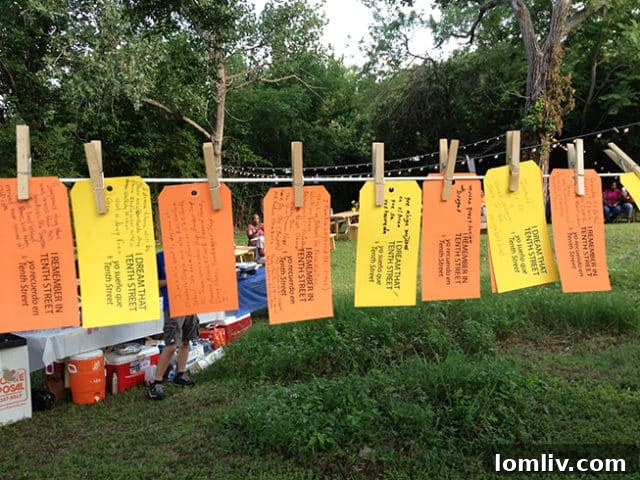
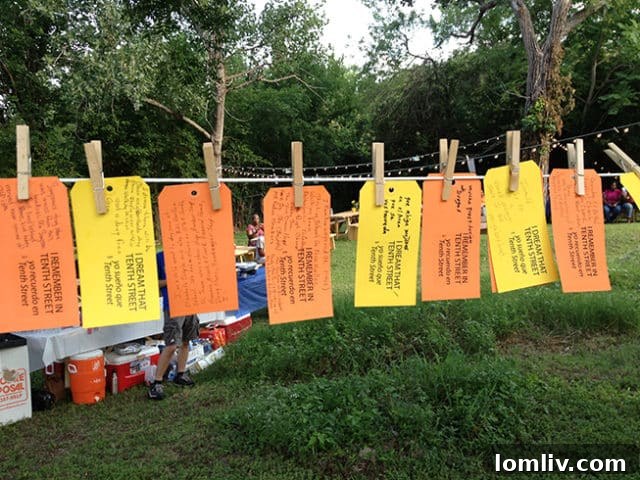
Editor’s Note: Preserving the historic neighborhoods that have profoundly shaped Dallas’s unique identity should be an unwavering priority. However, despite gaining historic district designations, many Black neighborhoods, which have been home to Dallasites for generations — long before, during, and after the era of redlining — are experiencing an alarming surge in demolitions. Residents in these communities vehemently contend that these homes would undoubtedly be saved if they were located within other, predominantly white historic districts across the city.
Over the coming weeks and months, we will embark on an in-depth exploration of two such vital neighborhoods: Tenth Street and Wheatley Place. Last week, our focus was on three homes facing imminent demolition. This week, we delve into a powerful strategy the Tenth Street community is employing to protect its heritage and future.
Tenth Street Dallas: A Fight for Preservation and Justice in a Historic Freedmen’s Town
The lawsuit recently filed by the residents of Tenth Street against the City of Dallas is nothing short of a direct and unequivocal challenge to decades of systemic inequality. Its language is precise, its accusations are sharp, and it pulls no punches in exposing historical injustices that have shaped this vital Dallas community.
“Tenth Street has historically been subject to de jure racial segregation by the City of Dallas,” the lawsuit unequivocally states. “The City has a history of enforcing racial segregation in some neighborhoods by ordinance through direct decisions of its City Council.” This bold assertion lays bare a painful truth: the city’s policies, through design or neglect, have actively contributed to the marginalization of its Black communities.
Much of this deeply troubling history is extensively documented, often found within the government’s own archives. The insidious practice of redlining, for instance, systematically confined Black families to specific, often underdeveloped sections of town. These areas typically lacked the robust amenities and essential services readily available in white-only neighborhoods, or in many cases, lacked them entirely. This discriminatory practice created enduring disparities in wealth, infrastructure, and opportunity that continue to impact these communities today.
The Enduring Legacy of Redlining in Dallas
This stark historical reality is something Jorge Jasso, a dedicated staff attorney with Legal Aid of NorthWest Texas, can readily demonstrate with concrete evidence. Jasso and his fellow attorneys at Legal Aid are representing the Tenth Street Residential Association in their critical lawsuit against the city. Their aim is not just to prevent further demolitions but to address the root causes of systemic discrimination.
Jasso frequently references a pivotal 1930s Home Owners’ Loan Corporation (HOLC) map, now digitized by the Kirwan Institute at Ohio State University. This map vividly illustrates the pervasive redlining practices that were institutionalized across Dallas, explicitly designating areas deemed “hazardous” for investment, often based solely on the racial composition of their residents. These designations starved Black neighborhoods like Tenth Street of crucial capital, leading to persistent disinvestment and decay.
Genesis of a Freedmen’s Town: Tenth Street’s Unique History
To fully grasp the significance of Tenth Street, it’s crucial to understand its origins. This remarkable community has served as home to Black Dallasites for over a century and proudly stands as one of the few remaining intact Freedmen’s towns in the entire nation. Established by freed slaves in the challenging years following the Civil War, Tenth Street became a beacon of hope and self-determination. Many of these founding families and their descendants continue to possess the very homes and parcels of land that their newly freed ancestors were undoubtedly immensely proud to own. This deep, generational connection to the land underscores the profound cultural and historical value of the neighborhood.
The neighborhood’s genesis can be traced back to the 1880s, when it began to take shape south of the Trinity River. This was one of the rare areas where the Black community was permitted to own land, a testament to the persistent struggles against racial barriers of the era. Today, the Tenth Street community would be recognized as occupying the northeastern edge of Oak Cliff, strategically bounded by major arteries such as Interstate 35, East Eighth Street, and Clarendon Drive. Its geographical location further highlights its historical isolation and subsequent challenges.
A Century of Systemic Discrimination: Zoning, Highways, and Neglect
The city’s discriminatory practices against Tenth Street were not confined to redlining; they evolved and persisted through various official policies. In 1944, the City of Dallas formally designated the Tenth Street community as a “Negro only” area, solidifying its racial segregation. Just three years later, in 1947, the neighborhood was zoned exclusively for duplex and single-family residential use, ostensibly a protection but still within a segregated context.
However, to add insult to injury, as the movement for desegregation gained momentum in the 1960s, the construction of Interstate 35 was strategically routed directly through the heart of the neighborhood. This infrastructure project, framed as urban progress, had devastating consequences for Tenth Street, physically severing the community and displacing many residents.
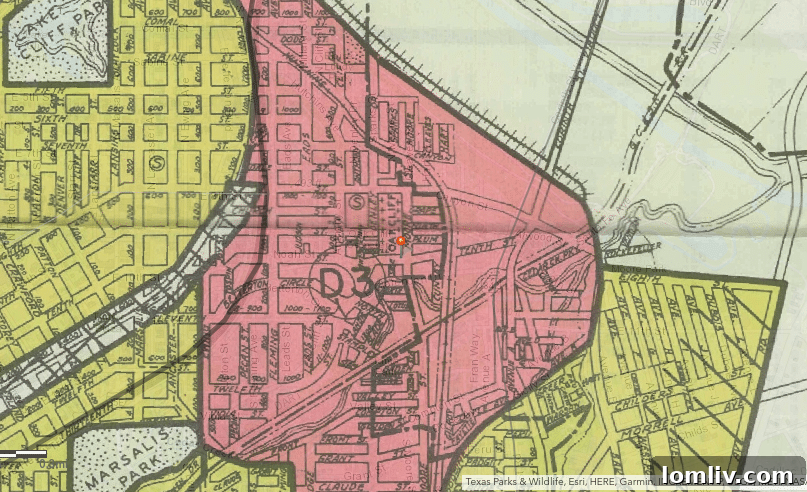
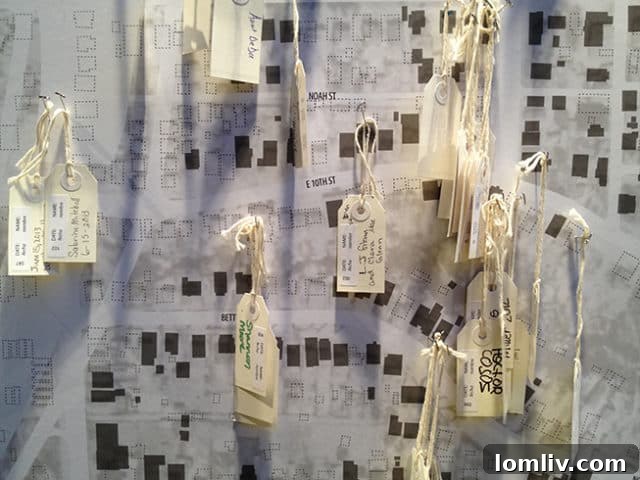
Jasso highlights the insidious connection between redlining and infrastructure development. “If you zoom in, you can make out some of the street names in the Tenth Street Historic District,” he observes. “Notice also how the redlined area interacts with the placement of I-35.” This observation underscores the deliberate nature of urban planning decisions that further entrenched racial segregation and disadvantage.
The lawsuit further clarifies the profound impact of these changes: “Not only did the construction of I-35 sever the majority-Black Tenth Street community from a predominantly-White Oak Cliff, but in demolishing homes and businesses along the way, the 1961 zoning change made the single family homes in Tenth Street non-conforming uses.” This re-designation was critical, as it stripped properties of their original protections. Critically, the lawsuit points out, “At this same time, similarly-situated White historic neighborhoods kept their residential zoning,” highlighting a clear pattern of discriminatory treatment.
The City of Dallas had a crucial opportunity to rectify these historical zoning injustices in 1984, when a new set of comprehensive planning policies were introduced, ostensibly prioritizing neighborhood stabilization and quality of life. These new policies were also enacted with the stated goal of protecting residential neighborhoods across the city. Yet, for Tenth Street, the outcome was precisely the opposite.
Instead of restoring its residential zoning, Tenth Street, due to its nonconforming use status from the 1960s, was alarmingly designated a “Future Growth Corridor.” This designation dramatically altered the neighborhood’s character, opening it up to a broad range of undesirable developments, including commercial enterprises, regional retail, industrial manufacturing, and multi-family townhomes – a stark departure from the single-family residential fabric of its neighboring communities. This decision effectively paved the way for further encroachment and destabilization.
“The adverse commercial and industrial zoning and uses continue to injure the Tenth Street neighborhood,” the lawsuit unequivocally states, describing the ongoing detrimental effects of these policies.
The Illusion of Protection: Landmark Status vs. Reality
Even more damning is the fact that the city was aware of the potential destructive consequences of its own decisions. City documents from that era cautioned: “This area has been found to hold a high level of cultural and historic significance for the black community. However, the existing Regional Retail (RR) and Commercial Service (CS) zoning in the area could destroy the neighborhood. Recent designation by the city will bring attention to the area, which it deserves, but it also could ultimately destroy it through inappropriate development.” This prescient warning, tragically, was largely ignored.
Despite these warnings, the Tenth Street neighborhood did eventually achieve its much-anticipated Landmark designation in 1993. However, this designation has, dishearteningly, proved to be hardly a shield against the forces threatening its existence. Since its landmark status was granted, a staggering 72 out of 260 homes within this historic neighborhood have been demolished, painting a grim picture of failed protection.
A stark comparison in the lawsuit reveals the deeply unequal treatment: substantially fewer demolitions have occurred in predominantly white historic neighborhoods across Dallas. Between 1993 and 2017, Peak’s Addition saw five demolitions; Winnetka Heights and Munger Place experienced four each; Junius Heights recorded three; Swiss Avenue and State-Thomas each had two; South Boulevard-Park Row had one; and Lake Cliff Park reported zero. This statistical disparity powerfully underscores the argument of systemic inequity in historic preservation efforts.
It’s also crucial to note that many of these more affluent neighborhoods were never redlined, consistently enjoying higher property values and greater investment. Other communities on that list, even if originally redlined, have since become highly desirable and gentrified over time, further widening the gap in resources and protection.
Discriminatory Policies: The 3,000 Square Foot Rule
Caught between the divisive impact of Interstate 35 and the lingering effects of historical redlining, Tenth Street began to suffer from profound neglect. However, Jasso points out that current city policies only exacerbate the demise of what remains a resilient, tight-knit community. He specifically cites a city code that permits the demolition of homes less than 3,000 square feet, irrespective of whether they are located within a designated historic district.
This critical change to the demolition ordinance, specifically Dallas City Code 51A-4.501(i), allows the city to circumvent the protections typically afforded to historic homes if they fall below the 3,000-square-foot threshold. This seemingly innocuous rule has a devastatingly disproportionate impact on Tenth Street, where virtually none of the historically modest homes exceed this size.
Codes like this, Jasso argues, are not accidental. They serve as glaring indicators that a segregation mindset, perhaps even subliminally, remains a driving force in urban planning and policy decisions. “The redline area coincides directly with the construction of I-35,” he explains, drawing a direct line between past and present. “It’s almost like they used the same redlining map from the 1930s to construct I-35 and its boundaries, and you know today the historic district and the demolitions and the neglect, I think it seems like a continuation if you see this story as it unfolds. And it’s just a continuation of the redlining history that the neighborhood has suffered.” This powerful narrative illustrates a cycle of systemic disadvantage.
A simple glance at the neighborhood’s vibrant Facebook page reveals a robust and deeply caring group of neighbors, actively engaged and proud of their community. Yet, the city’s historical policies have consistently subjected them to immense hardship.
“The 3,000 square foot rule, in conjunction with everything that’s been going on historically – the neglect by the city, the lack of resources – it can diminish neighborhood pride,” Jasso reflects. “It’s all kind of a big melting pot of actions that have happened along the way,” creating a cumulative burden on the community.
Fighting Back: The Lawsuit’s Demands for Equity and Preservation
The lawsuit addresses several multifaceted issues, but the overarching goal for the Tenth Street Residential Association (TSRA) and its legal team is clear and critically simple: to protect the historic landmark designation, to halt the summary demolition of homes, and to ensure the district receives the same equitable resources and consideration afforded to other historic districts within the city.
“One of the biggest things we want to see is the city either voluntarily repealing that ordinance or a court saying that it’s in violation of the Fair Housing Act,” Jasso emphasizes. “Because that ordinance that allows for demolition of homes with an area of less than 3,000 square feet makes it very easy to demolish in Tenth Street. And we have seen a rapid intensification of demolition since that ordinance was adopted in 2010.” This direct challenge to the ordinance highlights its discriminatory impact.
Another crucial objective, Jasso states, is to solidify the district’s landmark status and provide an ironclad guarantee that it will not be revoked, securing its long-term future. “Another goal is just for the city to just provide the same resources to the neighborhood that it provides to other historic non-minority neighborhoods in the city, providing the equity and treatment basically to Tenth Street that it deserves,” Jasso passionately argues. “It’s been lacking for a long time I think.”
A Community’s Unyielding Spirit and Future Outlook
The battle for Tenth Street is more than just a fight over buildings; it’s a profound struggle for recognition, justice, and the preservation of a vital cultural legacy. It highlights how historical injustices continue to manifest in contemporary urban policies, threatening the very fabric of communities built on resilience and heritage. The residents of Tenth Street, with the support of Legal Aid of NorthWest Texas, are drawing a line in the sand, demanding that Dallas honor its past and commit to an equitable future for all its historic neighborhoods.
Next week, our focus will shift to the proposed I-35 Southern Gateway Deck Park, exploring its potential implications for the fate of Tenth Street and its residents. In the coming weeks, we will also engage directly with the families of Tenth Street, hearing their personal stories and perspectives. Additionally, we will turn our attention to Wheatley Place, as its community grapples with the potential sale of the historic school within its neighborhood, another critical fight for preservation in Dallas.