Dallas 2024 Bond Election: Navigating the Path to a Prosperous Future
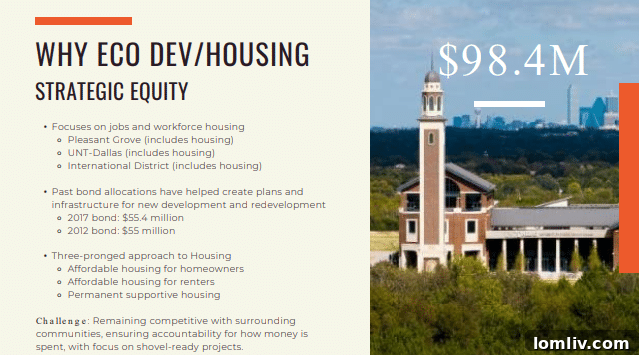
The highly anticipated 2024 Dallas bond election looms large, promising to shape the city’s infrastructure, housing, and recreational spaces for years to come. With a substantial $1.1 billion in potential funding on the table, city officials, community advocates, and residents are engaged in a complex dance of negotiation and prioritization. While final project lists are far from settled, recent insights from Assistant City Manager Robert Perez offer a preliminary look at how a foundational $60 million could be allocated for critical housing initiatives, igniting a crucial debate over the future of Dallas.
According to Perez’s detailed memorandum, a proposed $60 million housing bond, if approved by Dallas voters, would be instrumental in funding six vital multifamily housing projects. This ambitious plan aims to deliver a total of 1,150 new housing units, addressing a significant need within the city. This figure, however, represents a delicate balance struck between various stakeholders, each with differing visions for housing investment in the upcoming bond program.
The road to this $60 million proposal has been anything but straightforward. Housing advocates, keenly aware of Dallas’s affordable housing crisis, initially pushed for a more substantial $200 million allocation. In contrast, the Community Bond Task Force (CBTF), a key advisory body, initially suggested a more conservative $25 million. City staff had previously put forth a proposal of $70 million, while an average sentiment among City Council members, based on preliminary feedback, leaned towards $150 million for housing from the total $1.1 billion bond package, as outlined in a December CBTF presentation. The $60 million figure, therefore, emerges as a strategic compromise, attempting to bridge the gap between these diverse and often competing demands.
The Art of Compromise: Balancing Priorities in Dallas’s $1.1 Billion Bond Election
A Dallas bond election is a pivotal moment for the city, a challenging “horse-trading game” where numerous worthy projects vie for finite funds. The last such comprehensive bond program was approved in 2017, underscoring the significance of the 2024 election in shaping Dallas’s trajectory for the next half-decade or more. The total $1.1 billion pot of bond funds available presents both immense opportunity and formidable allocation challenges.
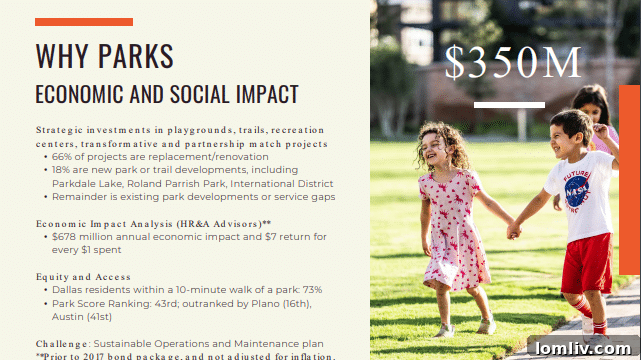
One of the most vocal advocates for specific funding allocations has been Dallas Mayor Eric Johnson. Following his re-election in May, Mayor Johnson took a firm stance on prioritizing funding for parks in his inaugural address. This mayoral emphasis is reflected in the composition and recommendations of the Community Bond Task Force (CBTF), which includes a significant representation of parks board members and is chaired by Dallas Park and Recreation Board president Arun Agarwal. Consequently, while city staff initially proposed $225 million for parks, the CBTF suggested a much higher allocation of $350 million, highlighting the strong advocacy for green spaces within the city.
The December 15 Perez memo, while not making specific recommendations for parks funding, offers a detailed breakdown of the potential costs associated with various park upgrades. This provides valuable transparency into the practical implications of different funding levels. For instance, the memo estimates that athletic field lighting alone costs approximately $1.5 million per field, and establishing a standard new park typically requires about $300,000. These figures illustrate the significant investment needed to maintain and enhance Dallas’s recreational infrastructure.
Beyond housing and parks, other vital city services also demand attention and funding. Task force member Courtney Spellicy aptly pointed out that while areas like streets and drainage may not have highly organized advocacy groups or generate public demonstrations, they represent fundamental urban infrastructure needs that cannot be overlooked in the upcoming bond program. The proper maintenance and development of these areas are crucial for the daily lives of residents and the city’s overall functionality.
The decision-making process for the 2024 Dallas bond election is ongoing and rapidly approaching critical deadlines. The next capital bond program briefing is scheduled for 2 p.m. on January 19, a crucial meeting where further details and potential revisions to funding proposals will be discussed. The official deadline for ordering a May 4 election is in mid-February, though some council members have raised the possibility of pushing the election back to November to allow for more deliberation and alignment, particularly concerning the city’s pension deficit.
Allocating Housing Bond Funds: Specificity, Need, and Community Acceptance
The allocation of bond funds for housing projects in Dallas is a particularly intricate matter, compounded by several factors. Housing initiatives often already receive significant subsidies from various federal programs, leading to questions about the optimal role of city bond funds. A recurring concern raised by officials is a perceived “lack of specificity” regarding proposed housing bond projects. Critics argue that without clear, detailed plans for specific developments, the allocation of funds can feel somewhat arbitrary, like “throwing money at a problem” rather than strategically investing in precisely defined projects, such as a multifamily development with 191 units designed for an underserved community.
Another significant hurdle in proposing new multifamily housing units, despite the well-established need, is the issue of community acceptance. While the demand for affordable rental housing was comprehensively detailed in a report by the Child Poverty Action Lab (CPAL), not all existing neighborhoods are enthusiastic about welcoming such projects. The “Not In My Backyard” (NIMBY) phenomenon often creates local opposition, complicating efforts to build much-needed housing in areas that could benefit most from it.
The context surrounding Assistant City Manager Perez’s memo is also important. It was released just weeks after Mayor Johnson publicly criticized City Manager T.C. Broadnax. The mayor’s critique stemmed from Broadnax’s suggestion that staff recommendations should serve as the primary baseline for bond discussions, rather than the recommendations put forth by the City Council-appointed Community Bond Task Force. This exchange underscores the political tensions and differing philosophies on how best to approach the bond allocation process.
In his memo, Perez clarified the process, noting that the Office of Bond and Construction Management meticulously coordinated with various City construction departments. Their objective was to develop a “high-level summary of the improvements that would be realized through the funding amounts proposed by the Community Bond Task Force and City staff.” This collaborative effort was designed to provide a comprehensive and objective overview of what each funding level could achieve.
“Therefore, the purpose of this memorandum is to provide City Council with general metrics, by funding level, for the various activities, projects, or programs being considered in the 2024 Bond,” the memo explicitly states. This highlights the memo’s role as a tool for informed decision-making, offering council members clear data to evaluate the impact of different financial commitments across the entire bond program.
A $60 Million Housing Bond Proposal: Addressing Dallas’s Housing Gap
The proposed $60 million housing bond, as detailed in Assistant City Manager Perez’s memorandum, is designed to be a significant catalyst for addressing Dallas’s housing challenges. It projects the funding of six multifamily housing projects, which would collectively add 1,150 new units to the city’s housing stock. However, the memo currently lacks specific details regarding the exact locations of these proposed projects or whether interested developers are already on board and prepared to undertake their construction. These details will be crucial for public and council scrutiny as the bond discussions progress.
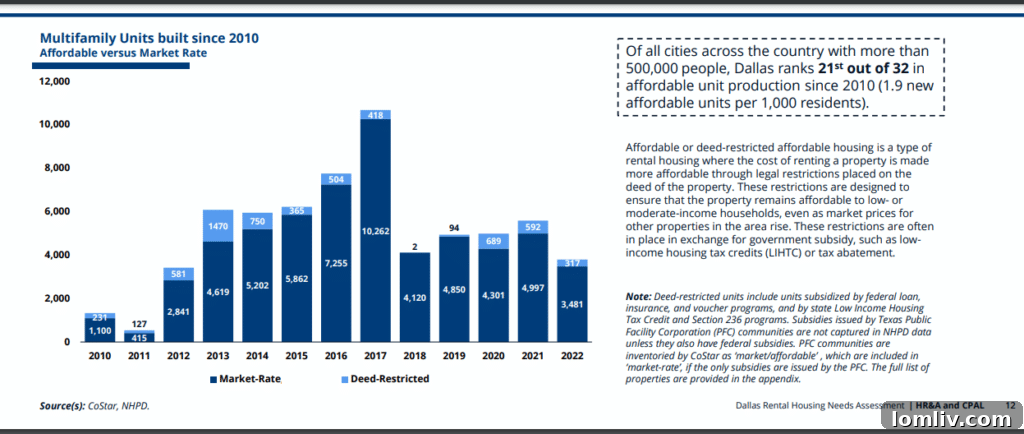
To contextualize the proposed investment, Perez’s memo references an analysis by the Dallas Housing and Neighborhood Revitalization Department. This review of recent development project requests indicates that the average cost for new multifamily construction is approximately $52,150 per unit. This metric is vital for understanding the scope and limitations of the various funding proposals. For instance, if the Community Bond Task Force’s initial recommendation of a $25 million housing bond were to be adopted, it would only be sufficient to fund approximately two projects, yielding a mere 479 units. This stark comparison underscores why the $60 million proposal, while still a compromise, offers a considerably greater impact on housing supply.
The urgency of addressing Dallas’s housing needs is further emphasized by comprehensive reports. A spring 2023 study by the Child Poverty Action Lab (CPAL) revealed a staggering rental unit supply gap of more than 33,600 units for households earning at or below 50 percent of the area median income. This substantial deficit means tens of thousands of Dallas residents struggle to find affordable rental options. Compounding this challenge, the city also faces a deficit of 16,000 affordable single-family homes, according to insights from buildingcommunityWORKSHOP, an organization dedicated to community-based design and planning.
Beyond the sheer numbers, housing advocates consistently stress the crucial importance of *where* these new homes are built. As the CPAL report articulates, “Locating housing in high-opportunity areas, with access to schools, transportation, and jobs, empowers families with tools to achieve future success, improve their health outcomes, and realize upward economic mobility.” This strategic approach to housing development is not merely about increasing supply, but about fostering equitable access to resources and creating pathways out of poverty. The 2024 Dallas bond election presents a critical opportunity to make targeted investments that can significantly impact the lives of countless Dallas families and strengthen the city’s social and economic fabric.