The Unseen Boom: High-Income Earners Fueling the Luxury Rental Market
In an evolving economic landscape, a compelling trend is reshaping the housing market: a significant rise in high-income individuals opting for rental properties over homeownership. While economists have long noted a general increase in renting across various demographics, a recent groundbreaking study by Apartment List reveals a particularly striking phenomenon: the booming segment of high-income renters. This unexpected shift challenges traditional notions of financial success and property investment, pointing towards deeper structural changes in urban living and economic priorities.
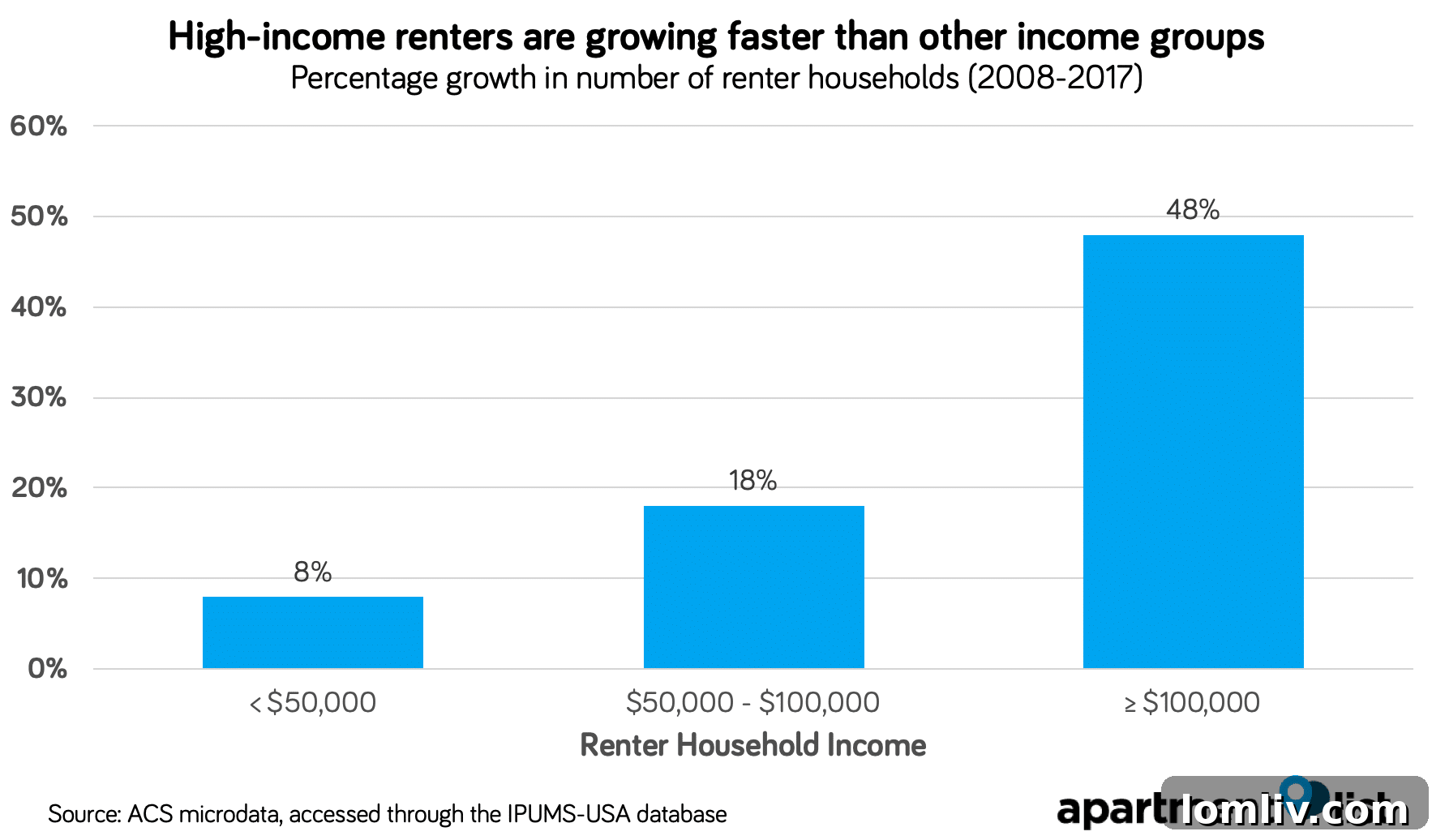
The Apartment List report defines “high-income renters” as households earning six-figure incomes annually. This affluent group is increasingly choosing to lease rather than buy their homes. On a national scale, the period between 2007 and 2017 witnessed an astonishing nearly two million high-income households — representing 48 percent of this demographic — transitioning into the rental market. This trend is not uniform across the country; certain metropolitan areas are experiencing this surge more intensely, indicating localized factors at play.
Dallas Leads the Charge: A 91% Surge in High-Income Renters
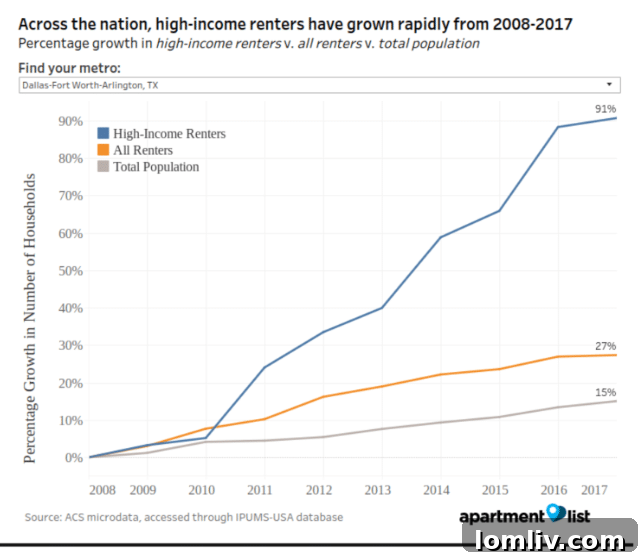
Dallas, Texas, stands out as a prime example of this emerging trend. According to Rob Warnock, a research associate at Apartment List, “In Dallas specifically, high-income renters grew 91 percent from 2008-2017.” This remarkable growth rate positions Dallas as a focal point for understanding the dynamics driving this national shift. The city’s unique economic conditions, combined with a robust development pipeline, offer critical insights into why affluent individuals are increasingly embracing rental living.
So, what accounts for this significant surge, particularly in cities like Dallas? A major contributing factor, at least in the Dallas-Fort Worth metroplex, appears to be the sheer volume and quality of luxury apartments inundating the market. Developers, responding to a growing demand for amenity-rich, flexible living spaces, have poured investments into upscale rental communities, particularly in urban cores and desirable suburban areas. These properties often feature state-of-the-art facilities, prime locations, and a lifestyle that appeals to high-earning professionals.
The Luxury Apartment Boom and Its Appeal
This focus on luxury rental properties isn’t a new phenomenon but has accelerated significantly. Greg Willett, chief economist at RealPage, highlighted this trend at a conference at the Federal Reserve Bank of Dallas. He noted that most apartment completions during a recent cycle were indeed luxury communities. This indicates a deliberate strategy by developers to cater to a demographic willing to pay a premium for convenience, services, and modern design without the long-term commitment of ownership.
Willett elaborated on the changing landscape of apartment construction: “Today’s typical suburban project is a mid-rise building with garage parking, rather than a low-rise development with surface parking. Urban core projects account for a bigger share of the total building than in the past. Urban land costs drive up the rents, and high-rise construction pushes the numbers even higher.” This shift reflects a move towards denser, more sophisticated urban living, even in traditionally suburban settings, driven by the preferences of high-income renters who value proximity to work, entertainment, and cultural amenities. The cost associated with prime urban land and high-rise construction naturally results in higher rental prices, yet these are willingly absorbed by this growing segment of the market.
Interestingly, while luxury often implies higher costs, the premium paid for luxury rentals varies geographically. In Dallas, luxury renters pay a premium of approximately 30 percent compared to standard rentals, while in Fort Worth, this figure is 34 percent. Both are notably lower than the national average premium of 38 percent. In contrast, Austin and Houston exhibit even higher premium percentages, at 53 percent and 45 percent respectively. These regional disparities suggest that while luxury features are desirable everywhere, the relative affordability of these upscale options in markets like Dallas and Fort Worth might be an additional draw for high-income individuals. This means that a six-figure earner might find a luxurious rental more accessible in Dallas than in other major U.S. cities, making renting a highly attractive and financially sensible choice.
Willett further clarified the relationship between income and rent-to-income ratios: “U.S. rent-to-income ratios are inversely correlated to apartment product class. Those who opt for Class A apartments rarely face affordability constraints — affordability gets somewhat more challenging when moving to those lower end product segments.” He added, “Certainly it’s always been true that those living in luxury spend lower shares of income on rent.” This insight is crucial: high-income individuals, even when paying premium rents for luxury properties, are typically not stretched financially. This financial flexibility allows them to prioritize lifestyle benefits, convenience, and location over the traditional commitment of homeownership. The fact that luxury apartments in Dallas remain relatively more affordable than in many other parts of the country further strengthens the argument for renting as a preferred option for this demographic.
Beyond Dallas: A National Phenomenon with Regional Hotspots
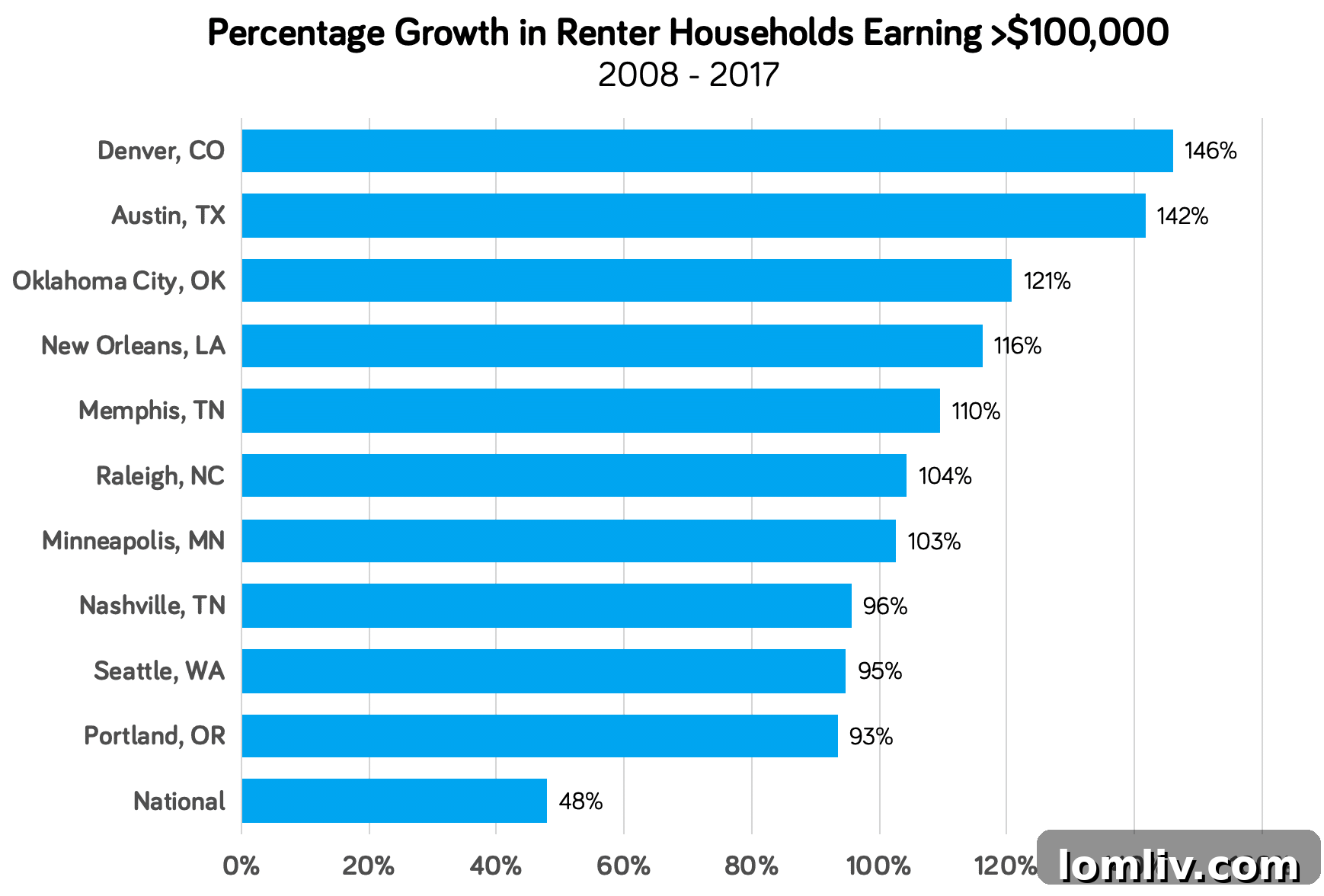
While Dallas exhibits remarkable growth, the trend of increasing high-income renters is a national phenomenon, particularly pronounced in rapidly developing, mid-sized metropolitan areas. The Apartment List report highlighted several other cities experiencing dramatic shifts: “The rise of high-income renters has been most dramatic in mid-size, growing metropolitan areas, particularly Denver (146 percent growth), Austin (142 percent), and Oklahoma City (121 percent).” These cities share characteristics such as robust job markets, growing populations, and significant investment in urban infrastructure and amenities. In stark contrast, growth is slower in historically expensive and established markets like New York and Los Angeles, where the cost of living and existing housing stock already present substantial barriers to entry, even for high earners.
Over the ten-year period analyzed by the study (2007-2017), the total U.S. population grew by six percent, while average incomes saw a seven percent increase. Despite income growth, the shift towards renting among the affluent intensified. Denver and Austin, in particular, lead the nation in the rate of high-income renter growth. These metros “housed nearly 2.5 times more six-figure renter households in 2017 than they did in 2008,” according to the report. This exponential growth underscores a fundamental change in housing preferences and market dynamics in these vibrant urban centers.
Understanding the Drivers: Supply, Demand, and Economic Shifts
On a national level, Apartment List attributes this surge in the high-income rental segment to a confluence of factors, primarily an increased supply of diverse rental options following the Great Recession. The economic downturn of 2008 significantly altered the housing landscape, creating conditions ripe for this rental market evolution.
Post-Recession Rental Market Evolution
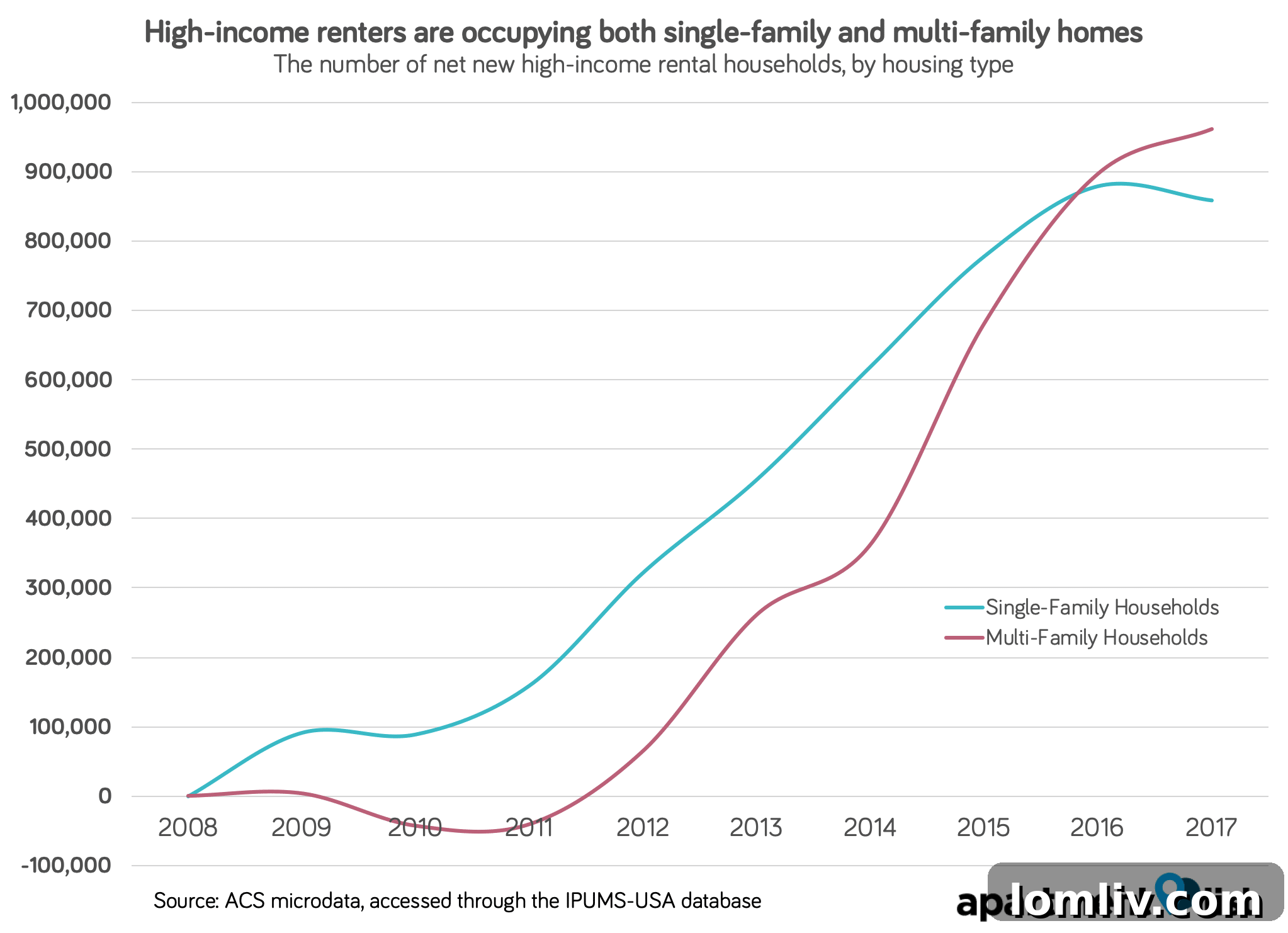
“Since the Great Recession, new supply in the marketplace has provided high-earners with abundant rental options,” the report states. This supply came in two distinct waves. Initially, “An initial wave of single-family vacancies catered to those who value the comfort of suburbia, whereas a subsequent wave of multi-family construction catered to those who value centrality and urban living.”
Prior to the recession, the U.S. was experiencing a significant housing construction boom, largely focused on homeownership. However, with the onset of the recession, new home sales plummeted, and foreclosures surged. This led to a glut of single-family homes on the market, many of which were acquired by investors and subsequently converted into rental properties. This created an additional 4 million single-family rentals during that period, offering spacious living options without the burden of ownership.
“This new inventory enabled more high-income households to enjoy the extra space of single-family homes without needing to buy,” the report explains. For a period, high-income renters gravitated towards these single-family options, seeking more space and a suburban lifestyle without the commitment of a mortgage.
However, the market shifted again around 2011. Multi-family housing construction experienced a powerful resurgence, bringing a fresh wave of rental units, particularly to urban areas where density and access to amenities were paramount. This new wave of multi-family developments, often high-rise and amenity-rich, appealed strongly to high-income individuals valuing urban centrality and a vibrant lifestyle. In fact, after initially favoring single-family rentals during the early recession years due to abundant vacancies, high-income renter households quickly moved back into multi-family dwellings as new stock became available, overtaking single-family rentals by 2016. By 2017, the figures were clear: there were a total of 1.8 million new high-income renter households, with 960,000 occupying multi-family units and 860,000 in single-family homes. This indicates a robust demand for both types of rental experiences, catering to different lifestyle preferences within the high-income bracket.
Challenges to Homeownership and Shifting Preferences
Beyond supply-side dynamics, broader economic challenges also contribute to the rising number of high-income renters. By 2017, housing inventory in many areas was significantly below the six months generally considered a sign of a balanced market. This scarcity has naturally driven up home prices, making homeownership more expensive and competitive. Combined with more stringent mortgage requirements put in place after the financial crisis, slower growth in real incomes for many, the burden of student loan debt, and other financial hurdles, even high-income wage earners are feeling the strain when attempting to purchase a home. The traditional path to homeownership has become increasingly arduous, pushing even those with substantial earnings towards renting as a more practical solution.
“Until the economic landscape changes, renting may remain the most financially feasible option for many high-earners,” the report concludes. This suggests that the current trend is not merely a temporary blip but a response to deep-seated economic realities. The demand for rentals is further amplified by factors such as company relocations bringing new talent to growing cities, as well as a broader societal shift in popularity towards vibrant urban cores, where amenities, culture, and job opportunities are concentrated.
The Future of Housing: Redefining Financial Success
What does this profound shift mean for the future of the housing market and societal norms surrounding homeownership? The implications are far-reaching and multifaceted.
In the short-term, Apartment List projects that “we expect the influx of high-earning households into multi-family rentals to continue, as multi-family construction remains strong and workers value the job opportunities and amenities of living in urban areas.” This sustained demand from affluent renters will likely continue to drive development in urban centers, focusing on high-quality, amenity-rich rental communities. These households, with their higher incomes, will inevitably demand new amenities and services from their homes and neighborhoods, pushing developers and urban planners to innovate further.
In the medium-term, as high-income earners continue to face challenges in purchasing homes and potentially grow weary of the rental cycle, this trend may precipitate significant policy changes. If homeownership becomes purely aspirational and increasingly unattainable for even the financially comfortable, there could be mounting pressure for governments and local authorities to address housing affordability, supply issues, and the structural barriers that prevent people from owning property.
Looking further ahead, “In the long-term, this decade’s trend may be indicative of changing norms around how we pay for our housing,” the report thoughtfully concludes. The traditional paradigm, which often positions homeownership as the paramount metric for financial success and stability, may be evolving. If today’s high-earning families increasingly prioritize the centrality and convenience of urban living, or the flexibility and reduced maintenance responsibilities that come with renting, the definition of what constitutes a successful and desirable housing situation could fundamentally shift. This could lead to a re-evaluation of personal finance goals, investment strategies, and the very concept of the “American Dream” as it pertains to housing.
To delve deeper into the comprehensive findings and analysis presented in this pivotal report, you can access the full document by clicking here: Rich and Renting: Understanding the Surge of High-Earning Renters.