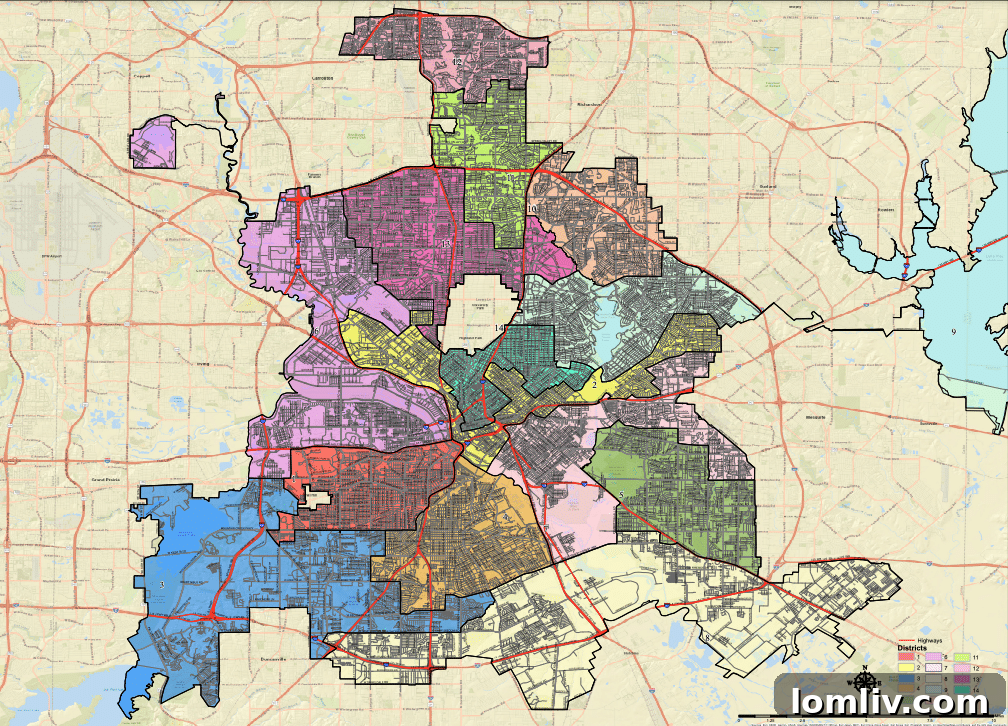
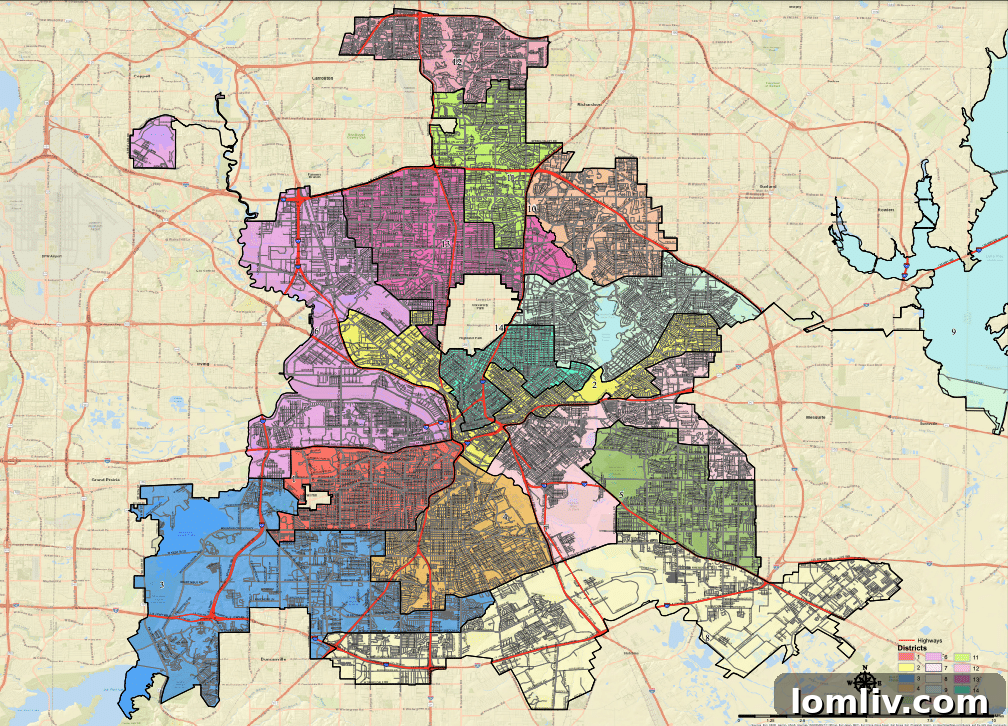
Dallas is currently navigating a pivotal moment in its local governance, grappling with the intricate and often contentious process of redrawing its 14 city council district boundary lines. After an extensive review period—which some critics have characterized as exclusive and lacking transparency—an appointed Redistricting Committee officially announced its decision to move forward with Map 041-B on a Tuesday. This announcement has immediately sparked widespread discussion and concern among Dallas residents, community leaders, and former elected officials, all keenly observing how the future of political representation in the rapidly growing Texas metropolis will be shaped for the next decade.
The impetus for this decennial redistricting process is rooted in the latest data from the U.S. Census. Mandated by federal law every ten years, this crucial exercise requires municipalities nationwide to adjust their electoral districts. The primary goal is to accurately reflect shifts in population distribution and growth, thereby ensuring that each resident’s vote carries roughly equal weight. This principle of “one person, one vote” is a fundamental cornerstone of democratic governance. In Dallas, a city celebrated for its diversity and dynamic growth, the redistricting process holds particular significance. It aims to meticulously balance demographic changes, uphold crucial voting rights, and foster genuinely fair representation across the city’s myriad communities. An earlier deep dive into the redistricting process underscored the complex and delicate balancing act inherent in this civic duty.
The journey for Map 041-B is far from complete. Upon its formal presentation to the Dallas City Council, the city’s elected officials will enter a critical 45-day window during which they possess the authority to propose amendments, debate its merits, and ultimately vote on its approval. Should the City Council grant its endorsement, the map will then face another vital hurdle: securing final approval from the U.S. Justice Department. This federal oversight step is designed to ensure that the electoral practices adhere to federal standards and comply with the landmark Voting Rights Act, particularly in protecting minority voting strength. These newly drawn boundary lines, if approved, are slated to become effective for the highly anticipated May 2023 city council election. Their impact will be profound, directly influencing who is eligible to run for office, who can cast a ballot, and, most importantly, which neighborhoods and communities will have their voices adequately represented in Dallas’s civic discourse for the foreseeable future.
The Origins and Endorsement of Map 041-B
Map 041-B, now at the epicenter of Dallas’s redistricting discourse, originated from the efforts of District 14 Redistricting Commissioner Norma Minnis. Minnis initially conceptualized and drafted the map, which subsequently underwent a series of modifications and refinements. These amendments were the result of a collaborative process involving Minnis herself, alongside other prominent community leaders: Randal Bryant, Brent Rosenthal, and Bob Stimson. This collaborative effort aimed to craft a district configuration that effectively responded to population shifts while also attempting to accommodate diverse community interests across the city. Despite the extensive review and collaborative input, the map’s final approval by the Redistricting Commission was far from unanimous. It passed with a 10-5 vote, a clear indication of the inherent contention and the diverse viewpoints surrounding its proposed adjustments. For those wishing to delve deeper into the commission’s deliberations and the specifics of the vote, archived footage of the meeting is publicly available.
Widespread Criticisms and Community-Driven Concerns
Even prior to its formal presentation to the Dallas City Council, Map 041-B has encountered a significant surge of opposition and meticulous criticism from various segments of the Dallas community. Many residents and former city officials are actively vocalizing deep-seated concerns regarding the map’s fundamental methodology, its potential adverse impact on minority representation, and its perceived failure to adhere to established, fair districting principles. The overwhelming majority of these criticisms converge on crucial questions of transparency, equitable representation, and the geographical integrity of the proposed districts, reflecting a broader public desire for a truly fair and representative electoral map.
Addressing Transparency and Accessibility Challenges
A persistent and recurring complaint voiced by a considerable number of residents centers on the perceived lack of transparency and accessibility that characterized much of the redistricting process. Significant concerns have been raised regarding the timing of notifications for crucial public hearings and the distribution of proposed plans. Many community members reported being informed late in the process, severely limiting their capacity to provide timely and meaningful input. Furthermore, a particularly salient point of contention has been the notable absence of vital information distributed in Spanish. This oversight has been highlighted as a considerable barrier, potentially disenfranchising a substantial segment of Dallas’s vibrant Hispanic population and fundamentally undermining the stated goal of achieving truly inclusive and representative local governance.
Navigating Challenges to Minority Representation
Perhaps the most profound and emotionally charged criticisms surrounding Map 041-B stem from its implications for Dallas’s diverse minority communities. Critics vehemently argue that the proposed map falls significantly short in establishing an adequate number of “Hispanic opportunity districts.” These districts are considered essential electoral configurations designed to ensure that the city’s rapidly growing Hispanic population has a genuine and fair opportunity to elect candidates of their choice, thereby securing proportional representation. Beyond this specific concern, strong assertions have been made that the map inadequately represents “Black, indigent, and people of color.” These claims suggest that the new boundaries may have been drawn in a manner that inadvertently, or perhaps deliberately, dilutes their collective voting power rather than amplifying it, directly challenging the fundamental promise of redistricting to create equitable political landscapes for all residents regardless of their background.
The “One Person, One Vote” Principle Under Intense Scrutiny
Peter Kurilecz, a dedicated records management officer, precisely articulated a significant concern regarding the foundational principle of “one person, one vote” in his detailed comments submitted on a redistricting comment page. Kurilecz contended that the selection criteria for the finalist district configurations appeared to prioritize race as a primary consideration, seemingly at the expense of established best practices. These best practices include creating districts that are as compact as possible and maintaining a population count closely aligned with the ideal number of 93,169 residents per district. He specifically highlighted that deviations from this ideal population figure by as much as 10% could, in his “humble opinion,” directly violate the core tenet of “one person, one vote.” This principle unequivocally demands that districts be roughly equal in population size to ensure fair representation and prevent any form of voter dilution or enhancement based solely on geographic location. This adherence to population equality is not merely a guideline; it is a fundamental requirement rooted in U.S. election law, safeguarding the integrity of the democratic process.
Examining Geographical Integrity and District Cohesion
The geographical shape, spatial coherence, and overall integrity of the proposed districts have emerged as another major flashpoint of contention. John Botefuhr, a former District 9 Dallas City Council candidate, publicly conveyed his profound dismay over Map 041-B, directing particular concern towards the impact on his own neighborhood. On various social media platforms, Botefuhr lamented, “And now our little neighborhood shall compete with Harry Hines, The Hospital District, Downtown around Industrial, Deep Ellum, and out to Mesquite for a voice. It’s the most screwy geographical district in the city.” His statement vividly paints a picture of perceived fragmentation among communities of interest, where disparate areas with potentially conflicting needs and priorities are unceremoniously grouped together, making effective and responsive representation an arduous, if not impossible, task.
Further amplifying these critical observations regarding geographical anomalies, Casa View resident John Burton, who also resides within District 9, strongly articulated his disapproval of the approved map. Burton unequivocally emphasized that “Districts should be compact and contiguous, and this new district is neither.” He provided a particularly striking and illustrative example by detailing the proposed changes to District 2. He described how it “now stretches from Casa View by the Mesquite border in Northeast Dallas down to Deep Ellum, while excluding a chunk of the Ferguson Road Initiative area. Then, down by Riverfront, it makes a huge turn up Harry Hines to Love Field.” Burton famously characterized this dramatically reconfigured area as “sort of a boomerang shape district from Northeast Dallas to West Dallas now.” He concluded his poignant critique by stating, “Personally, I love all these parts of Dallas, but if you look at the rest of the districts, it’s clear who was not a priority.” This sentiment powerfully suggests that the map may have been deliberately drawn to dilute specific voting blocs or to subtly favor certain political outcomes, rather than genuinely uniting communities with shared interests and fostering equitable representation across the city.
The Profound Broader Implications of Redistricting in Dallas
Redistricting transcends the mere act of redrawing lines on a map; it is a profoundly impactful exercise that fundamentally sculpts the political landscape for an entire decade. The creation of fairly drawn maps is absolutely essential for the robust functioning of any democracy, as it ensures that diverse voices across all communities are heard and that elected officials remain genuinely accountable to their constituents. When districts are drawn in ways that fragment established communities of interest, diminish the collective voting power of minority groups, or result in convoluted, non-compact shapes, the predictable outcome is a significant erosion of public trust in the electoral system and a palpable weakening of local representation. The intense and widespread debate currently unfolding in Dallas serves as a powerful testament to these larger stakes, as residents across the city demand a redistricting process that authentically reflects Dallas’s impressive growth and complex demographic evolution, rather than succumbing to politically motivated maneuvering.
The Road Ahead for Map 041-B: Critical Steps and Future Impact
With Map 041-B now formally in the hands of the Dallas City Council, the ensuing weeks will prove to be absolutely crucial. Public scrutiny is expected to intensify significantly, and various advocacy groups will undoubtedly redouble their efforts to influence individual council members. The City Council faces the unenviable yet vital task of meticulously weighing the Redistricting Commission’s proposal against the extensive and often passionate community feedback, all while navigating complex legal precedents. Their ultimate decision will not only precisely define the city’s political geography for years to come but will also establish a significant precedent for how Dallas approaches and upholds the principles of fair and equitable representation in the future. The subsequent review by the U.S. Justice Department will introduce another critical layer of scrutiny, providing assurance that the final approved map fully complies with all federal voting rights laws, with a particular emphasis on safeguarding and strengthening minority voting power.
Staying Informed and Actively Engaged in Dallas’s Redistricting Process
For Dallas residents who are eager to fully comprehend the intricate details of this vital process and ensure their voices are heard, a wealth of resources is readily available. Archived footage of all past hearings, coupled with a comprehensive collection of related documents, are meticulously organized and publicly accessible on the city’s official redistricting website. Actively engaging with these invaluable resources provides residents with deep insight into the exhaustive discussions, various proposals, and critical decisions that have collectively shaped Map 041-B and the broader redistricting endeavor. Continued community participation remains absolutely vital, as informed and engaged residents form the very cornerstone of a truly representative and responsive government. This dynamic and evolving story will be diligently updated as more pertinent information becomes available, consistently reflecting the ongoing and highly significant nature of this civic undertaking.
In conclusion, the current Dallas redistricting effort, culminating in the proposed Map 041-B, represents an undeniably critical juncture for the city’s democratic future. It vividly underscores the inherent complexities and significant challenges in meticulously balancing principles of population equality with the preservation of community integrity and the achievement of truly equitable representation. As this pivotal process moves forward, Dallas’s enduring commitment to transparency, inclusivity, and unwavering adherence to fundamental democratic principles will be rigorously tested. The outcomes of these deliberations will ultimately shape not just the city’s political landscape, but also its very identity and the efficacy of its local governance for the entire upcoming decade.