Dallas-Fort Worth Tops Investor Charts: Unpacking North Texas Real Estate’s Unrivaled Appeal
The landscape of real estate investment is undergoing a significant transformation, with traditional powerhouses ceding ground to dynamic emerging markets. In a surprising but highly anticipated shift, Dallas-Fort Worth (DFW) has emerged as the premier destination for real estate investors, outperforming even the notoriously vibrant market of Austin. This groundbreaking revelation comes from a comprehensive survey conducted by PricewaterhouseCoopers (PwC) and the Urban Land Institute (ULI), which polled 1,500 real estate industry professionals across the nation. The consensus? North Texas is where the real estate “moolah” is to be made, prompting a strategic re-evaluation of investment portfolios nationwide.
For years, major “gateway” cities such as New York City, Chicago, and Washington D.C. have dominated investor sentiment, considered safe havens for substantial capital. However, the latest findings indicate a distinct waning of their luster. Investors are now actively seeking higher yields and robust growth opportunities, leading them to cast their nets wider, with DFW firmly at the top of their list. This signals a broader trend in the real estate sector: a strategic pivot towards secondary and tertiary markets that promise greater returns and more sustainable growth cycles.
What Makes DFW Irresistible? The Core Drivers of Growth
A Magnet for Jobs and Talent
The primary catalyst behind Dallas-Fort Worth’s meteoric rise as a real estate investment hotspot is its unparalleled job creation story. Mitchell Roschelle, the PwC real estate advisory leader who spearheaded the report, succinctly encapsulated this phenomenon: “It’s a job creation story. Jobs chase the people. As employment rises, more people come, more jobs come, so it’s really a good cycle.” This virtuous cycle is vividly playing out across the DFW metroplex, attracting a diverse range of companies and industries. From major corporate relocations to the expansion of existing businesses, the region’s economic engine is firing on all cylinders.
DFW has become a preferred destination for corporations seeking a favorable business climate, lower operating costs, and a vast talent pool. Major employers in sectors ranging from technology and finance to logistics and healthcare are continuously expanding their footprint here, fueling a consistent demand for skilled professionals. This robust employment growth is not just about quantity; it’s about the diversity and stability it brings to the local economy. Unlike markets reliant on a single industry, DFW’s diversified economic base provides resilience against sector-specific downturns, offering investors a more secure and predictable environment for their capital.
Unprecedented Population Boom and Urbanization
Hand-in-hand with job growth is the dramatic influx of new residents to the Dallas-Fort Worth area. Attracted by the abundance of job opportunities, a relatively lower cost of living compared to coastal giants, and a high quality of life, people are migrating to North Texas in droves. This population surge creates an inherent and sustained demand for housing, both rental and for-sale, as well as for commercial spaces that support these growing communities.
The urbanization trend within DFW is particularly strong, with downtown Dallas and surrounding urban cores experiencing significant revitalization and development. This includes the creation of mixed-use developments that blend residential, retail, and office spaces, fostering vibrant, walkable communities. Investors are keenly aware that population growth translates directly into sustained demand across all real estate asset classes, from residential to industrial, ensuring long-term value appreciation and rental income stability.
The Apartment Revolution: Fueling Commercial Real Estate
A significant component of DFW’s real estate success story is the booming apartment market, particularly in urban Dallas. This phenomenon is largely driven by a demographic shift, notably the preferences of younger generations, especially millennials. As Roschelle noted, employment growth from smaller companies makes secondary and tertiary cities more appealing than higher-cost, larger markets. This appeal extends to living preferences, with many younger professionals opting for the flexibility and amenities of renting over the long-term commitment and financial burden of homeownership.
This trend has catalyzed an explosion in multi-family housing construction throughout DFW. Developers are responding to the demand for modern, amenity-rich apartment complexes in prime locations, offering urban living experiences that appeal to this demographic. For investors, this translates into strong occupancy rates, consistent rental income, and significant appreciation potential in the commercial real estate sector. The sustained demand for rental units ensures that investments in apartment developments remain highly lucrative, transforming the urban fabric of Dallas and Fort Worth.
Beyond the Gateway: Why Secondary Markets Shine
The PwC/ULI report underscores a pivotal shift in investor mentality. “’Gateway’ markets that were viewed really largely as defensive plays by investors have sort of fallen by the wayside, and opportunities to enhance yield in more offensive plays really got in the spotlight,” Roschelle explained. This means investors are moving away from markets where capital preservation was the primary goal, towards those where significant growth and higher returns are achievable.
High-cost, saturated markets like New York, Boston, and Washington D.C. often present limited opportunities for substantial yield enhancement. The sheer cost of entry and existing market maturity can cap upside potential. In contrast, secondary and tertiary markets like Dallas-Fort Worth offer a more compelling value proposition. Here, investors can acquire assets at more favorable prices, benefit from robust economic and population growth, and achieve higher yields through strategic development and management.
This “rotation toward secondary and tertiary markets” is a deliberate strategy “to try to free up some of that sideline capital” and put it to work more effectively. DFW, with its dynamic economy and comparatively more affordable real estate, stands out as a prime example of an “offensive play” where capital can generate impressive returns. The report highlights that investors are actively seeking markets that are in a growth phase, rather than those that have already reached peak saturation.
Key Takeaways from the PwC/ULI Report
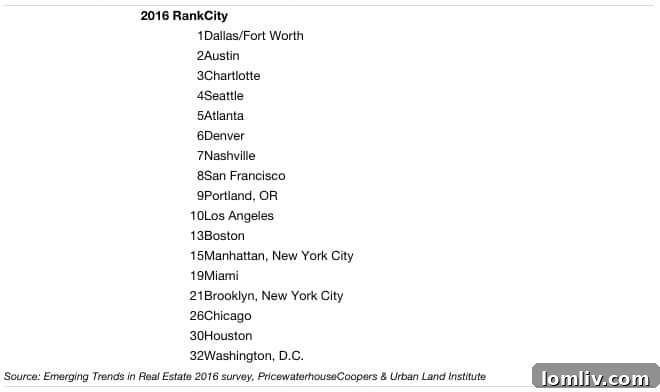
While Dallas-Fort Worth firmly secured the top spot, the survey unveiled several other notable trends and surprises. Houston, which held the coveted No. 1 position in the previous year’s report, experienced a significant drop to No. 30. This sharp decline can be attributed to various factors, including fluctuations in the energy sector, which heavily influences Houston’s economy, prompting investors to seek more diversified markets.
Conversely, Nashville, a city not traditionally recognized as a top-tier real estate investment hub, impressively cracked the top 10. This signals a broader recognition of cities exhibiting similar growth drivers to DFW, such as strong job creation, increasing affordability, and a vibrant cultural scene. Nashville’s ascent underscores the evolving criteria investors are using to identify promising markets.
Further emphasizing the shift away from traditional gateway cities, Washington, D.C., Boston, and Chicago notably failed to secure a spot in the survey’s top 10. This indicates a collective reassessment of their investment potential compared to the more dynamic growth found elsewhere. Meanwhile, San Francisco and Los Angeles managed to retain their positions in the top 10, ranking No. 8 and No. 10 respectively. Their resilience likely stems from the unparalleled strength of their tech and entertainment industries, which continue to draw high-income earners and significant capital, despite their notoriously high costs.
The Millennial Factor: Reshaping Housing Demands
Beyond the immediate economic indicators, the real estate market is profoundly influenced by demographic shifts. The trend towards millennial renters, who are increasingly eschewing the traditional homebuying process, is a pivotal force shaping investment strategies in markets like DFW. This generation, often burdened by student debt and valuing flexibility, tends to delay homeownership or opt out entirely, preferring the lifestyle offered by rental properties.
This preference fuels the burgeoning commercial real estate investment in apartments, a market that is not just growing but booming in urban Dallas and other vibrant DFW submarkets. Millennials and younger demographics seek urban amenities, proximity to work and entertainment, and a community-centric living environment, all of which are increasingly offered by modern multi-family developments. For investors, understanding and catering to these evolving lifestyle preferences is crucial for long-term success, ensuring continued demand for well-located, high-quality rental housing.
Investing in the Future: The North Texas Advantage
The continued success of Dallas-Fort Worth as a premier investment destination is not a temporary anomaly but rather a testament to its robust economic fundamentals and strategic advantages. As North Texas navigates its annual sales cycle, the insights from the PwC/ULI report provide a strong vote of confidence for investors who are still sitting on inventory or looking to deploy new capital.
The “good cycle” of job creation leading to population growth, which in turn fuels real estate demand, positions DFW as a resilient and future-proof market. Its diversified economy, strong infrastructure, and proactive approach to urban planning ensure that it can sustain this growth momentum for years to come. For those seeking opportunities that offer both stability and substantial growth, the North Texas real estate market presents an unparalleled proposition.
Your Thoughts on DFW’s Real Estate Dominance?
Dallas-Fort Worth’s ascent to the top of the real estate investment rankings marks a significant turning point in the industry. As investors pivot from traditional “gateway” cities to dynamic, growth-oriented markets, DFW stands as a shining example of where smart money is heading. What are your insights on Dallas/Fort Worth topping this prestigious list, and how do you see this trend influencing future investment decisions?