

The integrity of local governance is a cornerstone of public trust, and in Dallas, a significant debate is unfolding that could reshape how city officials are held accountable. The Dallas Inspector General’s Office is advocating for pivotal amendments to the city’s Code of Ethics, specifically targeting the evidentiary standard required to file charges against city officials. This proposed change, designed to streamline the prosecution of misconduct, has met with considerable resistance from several city council members, sparking a crucial discussion about transparency, accountability, and the protection of public servants’ reputations.
On a recent Wednesday, the Dallas City Council convened to review a comprehensive briefing on proposed amendments to the Dallas Code of Ethics. This essential document, last updated in December 2021, serves as the ethical compass for all city employees and elected officials. The proposed revisions encompass a broad spectrum of critical areas, including nuanced language and updated definitions pertaining to conflicts of interest, regulations governing campaign activities, and the imperative for responsible disclosure of confidential information. While many of these updates aim to clarify and strengthen existing guidelines, the most contentious proposal centers on altering the burden of proof in ethics investigations.
The Wednesday briefing provided a vital platform for council members to engage publicly with the Inspector General’s Office and the Ethics Advisory Commission. Central to this discourse was the thorny issue of the evidentiary standard currently in place for prosecuting alleged ethical violations by city officials. This particular aspect of the proposed ethics code amendments holds profound implications for the future of accountability within Dallas city government, influencing everything from investigative processes to public perception.
For those seeking a deeper dive into the detailed proposals, the entire presentation, meticulously prepared by Laura Morrison from the City Attorney’s Office, is available here. This document offers an invaluable resource for understanding the intricacies of the proposed changes and the rationale behind them.
Dallas Inspector General’s Vision for Ethics Enforcement
The crux of the current debate revolves around a proposed shift in the evidentiary standard, which would effectively lower the burden of proof required to formally file charges against city officials. District 14 Councilmember Paul Ridley articulated a common concern among his colleagues, questioning the necessity and practical impact of such a change. “What problems are we solving by changing the standard of evidence?” he pressed, seeking concrete examples. “Which specific case do you think would have gone the other way that you think should have been different based upon the existing standard of evidence?” His inquiries highlighted the council’s desire for specific, data-driven justifications rather than theoretical arguments.

Inspector General Bart Bevers, who assumed his role approximately a year ago, presented his perspective, underscoring a historical pattern of misconduct within Dallas city governance. He cited the sobering statistic that five Dallas city council members had been convicted of felonies over a 16-year period, suggesting a systemic issue that demands more robust ethics enforcement. Bevers also emphasized the demand from the general public – “John Q. Public and Jane Taxpayer” – for comprehensive ethics reform and more decisive enforcement. He elaborated on his philosophy, stating, “They want ethics reform addressed. They want ethics enforcement addressed. The way that you do that is, I guess you could say you create a culture at a thought level. The things that I look at are the things that I think about, and the things that I think about are the things I meditate on. The things that I meditate on bear out in my action. My action forms my character, and my character delivers the destiny.”
While Bevers’ explanation aimed to articulate a holistic approach to fostering an ethical environment, its somewhat abstract nature left some council members perplexed. District 1 Councilmember Chad West openly expressed his confusion, remarking, “I felt like the entire answer was incredibly arbitrary. I felt like I was sitting in the Twilight Zone as I was listening to that explanation.” This reaction underscores the communication challenge between the Inspector General’s office and city officials regarding the practical implications of the proposed changes.
The core of Inspector General Bevers’ argument for lowering the evidentiary standard rests on the premise that Dallas’s current requirement of “clear and convincing” evidence is uniquely stringent and counterproductive. He contends that this high threshold, unlike the more common “preponderance of the evidence” standard used in many jurisdictions nationwide for similar ethics cases, effectively discourages the filing of legitimate charges. Bevers posited that maintaining such a high bar results in fewer substantiated cases, inadvertently creating an “incentive to violate” for those considering unethical behavior. He firmly believes that “all these revisions are steps in the right direction,” and that “when people start to see allegations getting substantiated, that raises the thought level and that’s where the transformation begins.” His assertion points to the psychological deterrent effect of consistent and credible enforcement.
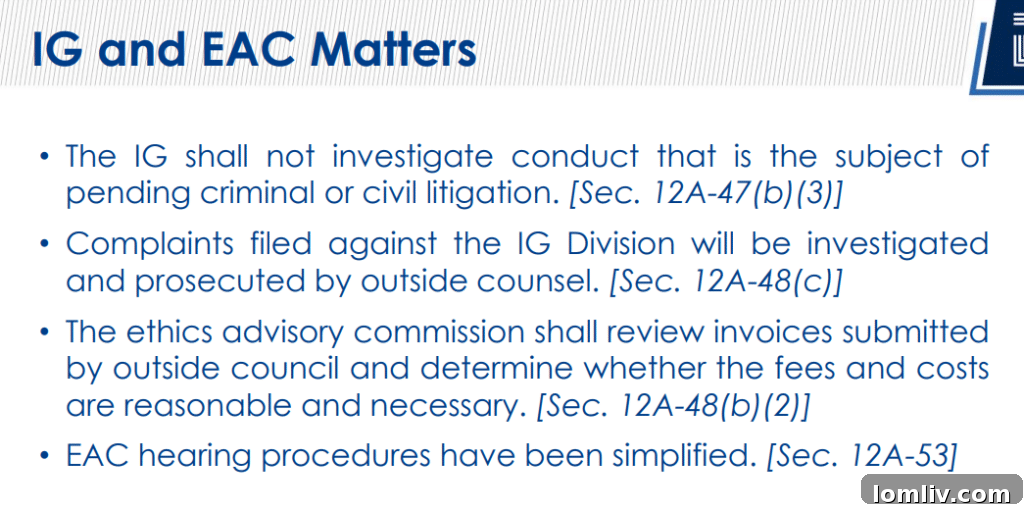
Laura Morrison of the City Attorney’s Office further supported Bevers’ position by revealing that approximately a dozen ethics cases last year could not proceed due to Dallas’s exceptionally high burden of proof standard. This statistic provided concrete evidence of the practical challenges faced by the Inspector General’s Office under the current rules. However, Councilmember Ridley remained unconvinced, countering that perhaps some of those cases were, in fact, not strong enough to warrant prosecution, regardless of the standard. He emphasized the profound personal and professional risks involved: “We’re talking about high stakes here. We’re talking about people’s reputations. Their careers are at stake. I think we need that higher standard of evidence.”
Deputy Mayor Pro Tem Omar Narvaez and Councilmember Chad West echoed Ridley’s sentiments, highlighting the importance of a rigorous process when an official’s reputation and career are on the line. “I think it should be a high burden of proof,” West asserted. “If we’re going to be putting people on the chopping block and their reputations, I think it should be a rigorous process. I absolutely won’t support changing that.” This strong opposition from key council members indicates a significant hurdle for the Inspector General’s proposed amendment, emphasizing the delicate balance between robust accountability and safeguarding individual rights within municipal governance.
Other Key Amendments and Their Impact
Beyond the contentious evidentiary standard, the Dallas City Council also reviewed several other significant amendments aimed at bolstering the integrity of city operations. Clarifications were introduced regarding the council’s policy on accepting gifts, an area consistently scrutinized to prevent undue influence and maintain transparency. Stricter guidelines and clearer definitions aim to eliminate any ambiguity surrounding what constitutes an acceptable gift versus a potential conflict of interest, ensuring that decisions are made solely in the public’s best interest.
Equally important were the updates to financial disclosure requirements. These amendments seek to enhance transparency by requiring more comprehensive and timely reporting of council members’ financial interests. Such disclosures are crucial for identifying and mitigating potential conflicts of interest, thereby building greater public confidence in the impartiality of city officials. By making these financial interests more transparent, the city aims to reduce the risk of decisions being swayed by personal gain rather than public good.
Laura Morrison also briefly addressed revisions concerning the disclosure of confidential information. This matter gained particular relevance recently when council members were advised by the City’s Communications Office to limit their public comments following a ransomware attack on city systems. While unauthorized disclosure of confidential information has always been a breach of the Code of Ethics, the proposed amendments formalize this infraction into a prosecutable offense. Morrison explained, “An unauthorized disclosure of confidential information has always been a violation of the Code of Ethics, but we are now creating an offense for that conduct. So now if you commit an unauthorized disclosure of confidential information … you could be prosecuted in Municipal Court for a Class C misdemeanor.” This change signifies a stronger stance on protecting sensitive city information, which is critical for operational security and maintaining public trust, especially in an era of heightened cyber threats.

District 12 Councilmember Cara Mendelsohn, who chairs the Government Performance and Financial Management Committee, emphasized the dynamic nature of ethics codes and the need for continuous refinement. She encouraged all stakeholders to provide feedback on the proposed changes, framing the process as a commitment to ongoing improvement. “This is going to be a continuous quality improvement process,” she stated. “As loopholes or other areas of concern are brought up, they can be addressed so the public can have confidence in what happens here at all of City Hall, not just around the horseshoe.” Mendelsohn’s remarks highlight a broader commitment to systemic integrity, extending beyond elected officials to every level of city government. She concluded with a powerful call for renewed faith in democratic institutions: “This isn’t just about us. I think that’s important. I think we all need a little more faith in government these days.” Her sentiment resonates deeply, underscoring that effective and trusted governance relies on a robust ethical framework that is continuously evaluated and strengthened to meet evolving challenges and uphold public trust.