Unlocking Homeownership: What Salary Do You Truly Need in Today’s Market?
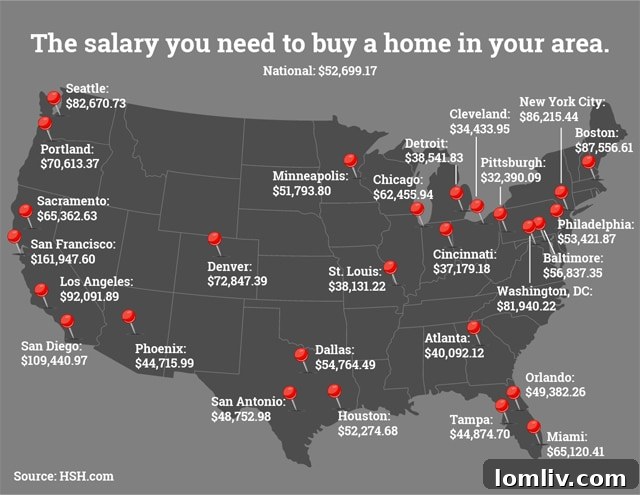
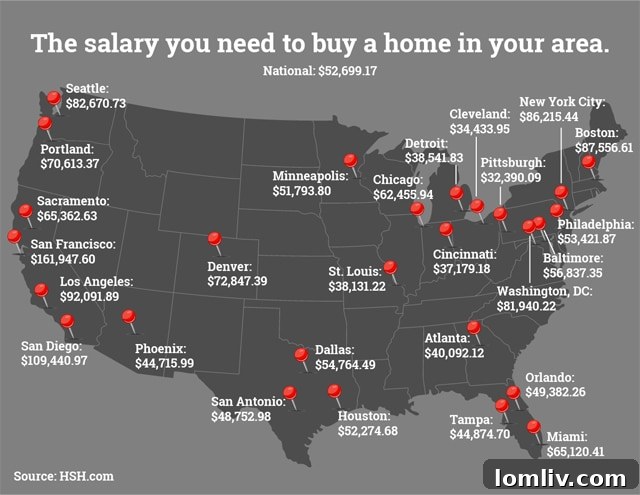
Since 1979, long before the internet became a household staple, HSH.com has served as an invaluable resource for mortgage research, providing essential information and user-friendly calculators to aspiring homeowners. Much like its contemporary, Bankrate.com, HSH.com empowers individuals with the financial insights needed to navigate the complex world of real estate. Recently, this veteran platform published crucial data highlighting the salary required to afford a median-priced home across the United States’ top 27 metropolitan markets by population. This research offers a sobering look at the financial hurdles faced by many in their pursuit of homeownership, emphasizing the growing disparity between income levels and property values in major urban centers.
The aspiration for an affordable and secure lifestyle is a fundamental desire, particularly in dynamic metropolitan areas where economic opportunities often attract a diverse populace. Last September, we delved into this very topic in our article, “How Much Money Does it Take to Live Like a Human in Dallas?” Drawing upon comprehensive research from the Economic Policy Institute, we found that a household consisting of two adults and two children renting in the Dallas metroplex would require an annual income of $61,150 after taxes to maintain a “secure yet modest living standard.” This figure encompassed critical expenses such as transportation, childcare, healthcare, food, and utilities. However, HSH.com’s latest findings reveal an even more challenging financial reality for those looking to transition from renting to homeownership, suggesting that the journey to owning a home is becoming increasingly arduous for many families.
Dallas Homeownership: A Deep Dive into the Costs
The allure of owning a home in a rapidly growing economic hub like Dallas comes with a significant financial commitment. HSH.com’s calculations, meticulously derived from data provided by the National Association of Realtors, paint a clear picture of this challenge. To afford a median-priced home in the Dallas metro area, currently valued at $232,200, a prospective buyer would need an annual salary of approximately $54,764.49. This calculation assumes a standard 30-year fixed-rate mortgage with a healthy 20 percent down payment, covering the essential monthly costs of the mortgage principal and interest, property taxes, and homeowner’s insurance. These baseline expenses are merely the initial step into the long-term financial journey of homeownership.
The Critical Role of the Down Payment
The size of the down payment is often the most formidable barrier for first-time homebuyers and profoundly influences the overall affordability of a home. For individuals able to make only a 10 percent down payment—a common scenario for many entering the housing market—the required annual salary escalates considerably to $62,663. This significant increase underscores the financial leverage that a larger down payment provides, not only by reducing monthly mortgage payments but also by potentially eliminating the need for private mortgage insurance (PMI). Moreover, aspiring to a 15-year mortgage, while offering substantial long-term interest savings and faster equity build-up, often translates into monthly payments that are simply out of reach for many. As the original piece succinctly notes, aiming for a 15-year term can feel like a “Dream on” scenario, highlighting the tough choices and financial constraints faced by today’s homebuyers.
Beyond Mortgage: The True Financial Picture of Home Life
While the mortgage, taxes, and insurance constitute the core of homeownership costs, they represent only a portion of a household’s total monthly expenses. After these essential housing payments are met, a family earning the required salary in Dallas would be left with approximately $1,850 per month to cover all other living costs. This includes fundamental necessities such as transportation, childcare, healthcare, food, and utilities. The article humorously, yet tellingly, mentions “beer and skittle money,” illustrating how even small discretionary expenses often get squeezed from an already tight budget. Such financial limits leave minimal room for savings, emergency funds, or investments in personal enrichment, depicting a household operating very close to its financial boundaries.
HSH.com’s analysis reveals that housing consumes a considerable 41 percent of an average homeowner’s after-tax income in the Dallas metro. To contextualize this figure, the federal government categorizes housing as “cost-burdened” when it accounts for 30 percent of income, and “severely cost-burdened” when it exceeds 50 percent. Dallas falls squarely between these two definitions, indicating a substantial and often challenging financial strain on homeowners. Living under such conditions can profoundly impact other areas of life, potentially hindering retirement savings, limiting educational opportunities, or even diminishing overall quality of life. It signifies a lifestyle far from the carefree ease often associated with the “life of Riley,” challenging conventional notions of the benefits of homeownership.
The Extreme Reality: San Francisco’s Unattainable Housing Market
While Dallas presents its own set of housing affordability challenges, the situation in certain other major metropolitan areas reaches an entirely different level of severity. The San Francisco Bay Area stands out as a stark example of an extreme housing market, where the financial requirements for homeownership are nothing short of astronomical. To achieve an “equally uncomfortable life” in this technology-driven epicenter, an individual would need an annual salary exceeding $100,000 more than what is required in Dallas. This formidable financial demand is a direct consequence of the Bay Area’s sky-high median home price, which hovers around an astounding $885,600—a figure that witnessed a nearly 10 percent increase in the past year alone.
The sheer scale of this disparity becomes even more pronounced when considering down payments. For someone managing a 10 percent down payment in the Bay Area, an additional $140,000 would need to be added to a Dallas-equivalent salary just to make the purchase, rendering homeownership a distant dream for many. This astronomical cost is fueled by a unique convergence of factors: a flourishing tech industry attracting highly compensated professionals, an extremely limited housing supply due to geographical constraints and restrictive zoning laws, and intense competition among an ever-growing pool of affluent buyers. The San Francisco phenomenon vividly illustrates a broader trend in many global gateway cities, where rapid economic prosperity inadvertently creates an insurmountable barrier for middle-income residents and essential service workers, often compelling them to endure lengthy commutes or relocate entirely from the region.
Exploring Alternatives: The Appeal of the Upper Midwest and Beyond
For those grappling with the formidable housing costs in markets like Dallas and San Francisco, relief and greater affordability can often be found by shifting focus towards different regions. The Upper Midwest, for instance, offers some compelling options for homebuyers looking to save “cold cash” on their housing investment. While these areas might indeed require an investment in “snow shovels and parkas” due to their climate, the potential savings in homeownership costs can be substantial and life-changing. Markets in states such as Michigan, Wisconsin, and parts of Ohio frequently boast significantly lower median home prices, more manageable property tax rates, and a less frenzied, competitive buying environment compared to their coastal counterparts.
The enhanced affordability in the Upper Midwest and other emerging markets stems from various factors, including generally slower population growth, more diversified economies not solely reliant on high-paying tech sectors, and often greater availability of land for new residential development. While these regions may not always offer the same rapid job growth or the extensive array of cultural amenities found in larger, more expensive metropolitan areas, they undeniably present a viable and often more accessible path to homeownership for a broader segment of the population. Exploring such alternatives requires a thoughtful balance of financial prudence, lifestyle preferences, and career opportunities. It encourages prospective buyers to expand their horizons beyond traditional real estate hotspots and carefully consider the overall value proposition that different metropolitan areas across the nation have to offer.
The Pervasive Housing Affordability Crisis: A National Challenge
The detailed data from HSH.com and the striking comparative analysis between diverse cities underscore a pervasive national concern: the escalating housing affordability crisis. This is not merely an isolated, localized issue but a systemic challenge with far-reaching implications for economic stability, social mobility, and the very fabric of community development across the United States. Numerous factors contribute to this intricate crisis, including a chronic shortage of housing supply failing to keep pace with demand, rising construction material and labor costs, increasing land values, and the impact of large-scale investor activity in certain markets. Compounding these issues, wage growth, while present in some sectors, frequently lags significantly behind the rapid escalation of home prices, leaving countless individuals and families struggling to bridge the gap.
The consequences of widespread housing unaffordability are profound and multifaceted. It often manifests as longer commutes, increased personal stress, significantly reduced disposable income, and a tangible decline in the overall quality of life for affected residents. Economically, this crisis can impede labor mobility, negatively impact local businesses that depend on a diverse and accessible workforce, and exacerbate existing wealth inequalities. Policymakers, urban planners, and community leaders are continuously striving to address these complex issues, exploring and implementing a range of solutions. These include incentivizing the development of more affordable housing units, reforming restrictive zoning laws to encourage denser development, and investing in crucial infrastructure that supports the creation of more accessible and equitable communities. Understanding these broader market trends and policy discussions is paramount for anyone navigating the current real estate landscape, whether they are a first-time homebuyer embarking on this journey or a seasoned investor seeking opportunities.
Insights from an Industry Expert and Community Advocate
As a dedicated observer and active participant in the ever-evolving real estate landscape, my professional focus frequently centers on the intricate dynamics of high-rises, the governance of homeowners’ associations (HOAs), and the transformative trends in renovation. I hold a deep-seated appreciation for the delicate balance required to preserve both modern and historical architectural legacies, while simultaneously championing the principles of the YIMBY (Yes In My Backyard) movement, which advocates for increased housing density and responsible urban development to meet growing demand. Fostering strong community engagement is a cornerstone of my work, and I enthusiastically welcome opportunities to host a Candysdirt.com Staff Meeting event, providing a vibrant platform for insightful discussions and expert perspectives on local real estate matters.
My unwavering commitment to impactful real estate journalism has garnered professional recognition within the industry. In 2016, my writing was distinguished with both Bronze and Silver awards from the highly respected National Association of Real Estate Editors (NAREE). These accolades underscore a consistent dedication to delivering insightful, accurate, and relevant reporting that informs and inspires. Whether you possess a compelling story to share, a unique perspective to offer, or even an imaginative marriage proposal intertwined with the world of real estate, I encourage you to connect. Please feel free to reach out and share your thoughts by emailing me directly at [email protected]. Your valuable insights and narratives play a crucial role in enriching our collective understanding of this complex and perpetually changing market.