Navigating the Texas Housing Market: Dallas vs. Austin Affordability Showdown
The Lone Star State continues to draw in new residents with its robust economy, diverse culture, and expanding job opportunities. Within this dynamic landscape, the housing markets of its two major metropolitan hubs—Dallas and Austin—stand out as particularly vibrant, yet complex. For anyone considering a move or investment in Texas real estate, understanding the nuances of affordability, from mortgage payments to total living costs, is paramount. This comprehensive guide delves into a detailed comparison of Dallas and Austin, offering insights into homeownership, renting trends, and the financial implications for prospective residents in these bustling Texas cities.
Dallas: The Financial Landscape of a Thriving North Texas Metropolis
Dallas, a powerhouse of commerce and culture, presents a compelling yet financially demanding environment for its residents. The city’s economic strength, fueled by sectors like finance, technology, and logistics, contributes to a highly competitive real estate market. Potential homeowners must contend with significant upfront and ongoing costs that reflect this prosperity, making careful financial planning an absolute necessity.
The High Cost of Homeownership in Dallas
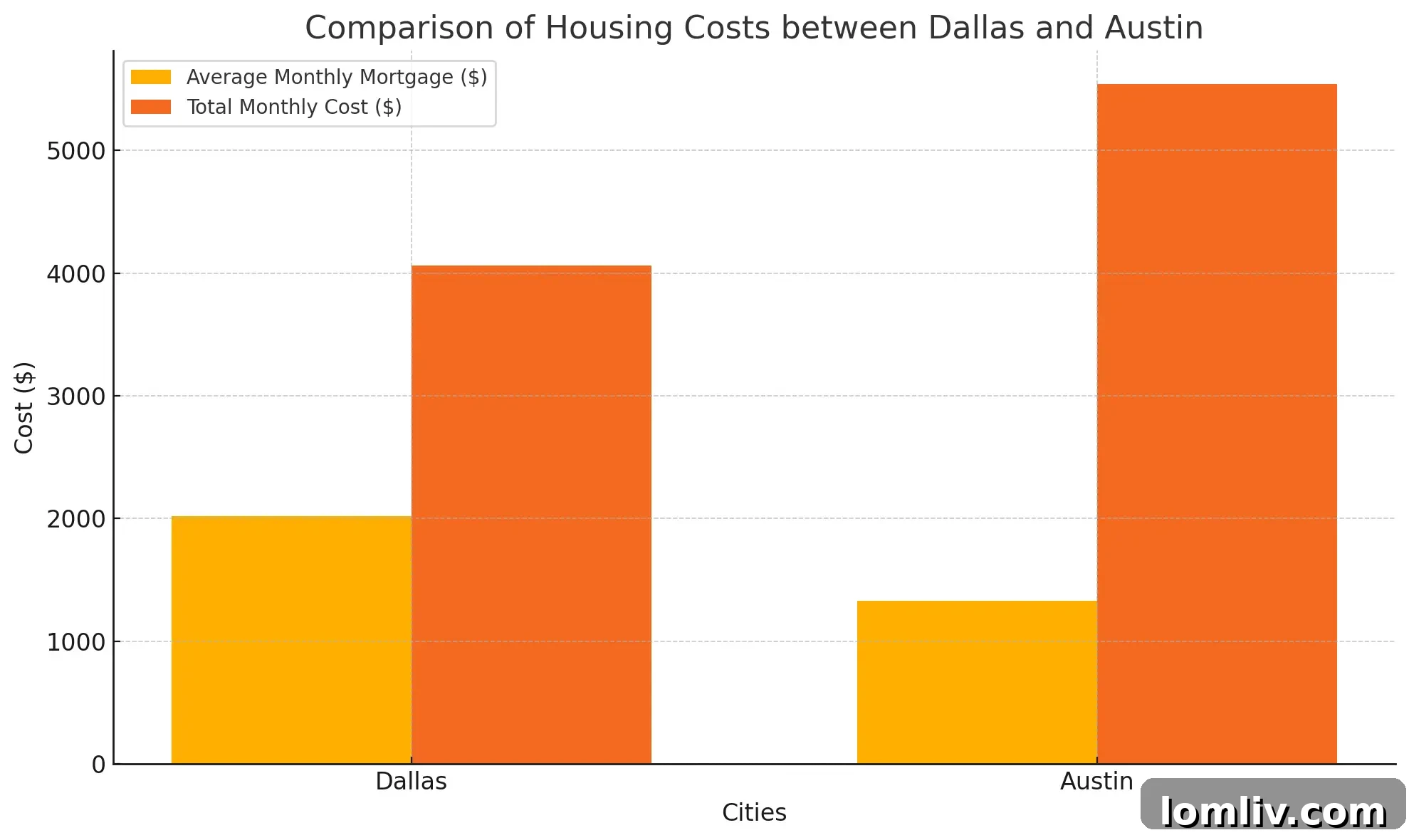
For those aspiring to own a home in Dallas, the financial commitment is substantial. Data indicates that Dallas registers some of the highest mortgage payments among major U.S. cities. The average monthly mortgage payment in Dallas typically hovers around $2,022. This figure alone underscores the significant barrier to entry for many potential buyers. When factoring in all other essential living expenses—such as utilities, groceries, transportation, and discretionary spending—the overall monthly cost of living in Dallas climbs to approximately $4,059. To comfortably sustain this lifestyle, individuals or households are generally advised to earn a minimum annual income of $100,000. This high income threshold is a direct reflection of the city’s robust economy and the premium associated with living in such a desirable urban center. The demand for housing, driven by continuous population growth and strong job creation, consistently pushes property values and mortgage costs upward, presenting a distinct financial challenge for many.
Renting in Dallas: A More Accessible Option?
Given the elevated costs of homeownership, renting often emerges as a more accessible and flexible housing solution for many Dallas residents. On average, the monthly rent in Dallas is around $1,710. When considering other housing-related expenses for renters, the total monthly cost typically rounds out to about $3,747. While still a significant sum, this is notably lower than the total cost of living associated with homeownership. The Dallas housing market, like many large metropolitan areas, has witnessed a persistent trend of increasing costs for property ownership over recent years. Industry analysts have projected a potential slight decrease in this premium to purchase a home over the next few years. However, experts do not anticipate this minor adjustment to lead to a significant decline in the population of long-term rental dwellers. Renting offers flexibility, lower upfront costs, and freedom from property maintenance, making it an attractive option, especially for those new to the city, seeking temporary residence, or preferring not to tie up large amounts of capital in a down payment.
Austin: Navigating the “Live Music Capital” Housing Market
Austin, celebrated for its vibrant culture, booming tech industry, and unique blend of urban sophistication and natural beauty, presents another compelling, albeit challenging, housing market in Texas. Often dubbed “Silicon Hills,” Austin’s rapid growth has led to a distinctive affordability landscape, where certain costs are lower, but overall expenses can still be substantial. This dynamic environment requires careful consideration for anyone contemplating a move to the state capital.
Austin’s Unique Affordability Equation
When comparing Austin’s living costs, the picture becomes quite nuanced. While some aspects might seem more manageable than in Dallas, other expenses can drive the total monthly average significantly higher. The overall monthly average cost of living in Austin, encompassing housing (whether rent or mortgage), utilities, transportation, food, and other necessities, equates to approximately $5,538. This figure, notably higher than Dallas’s total cost of living, reflects Austin’s rapid economic expansion, its status as a magnet for high-paying tech jobs, and the subsequent high demand for goods and services. Despite this higher overall cost, it’s essential to dissect the individual components to understand where potential savings or increased expenditures lie. The city’s immense popularity and continuous influx of residents contribute to a premium on lifestyle, which manifests across various sectors, from dining to entertainment and, critically, housing.
Mortgage vs. Rent in Austin
One of the striking differences in Austin’s housing market is the relative affordability of mortgage payments compared to Dallas. The average monthly mortgage for a house in Austin stands at roughly $1,450. This figure is significantly lower than Dallas’s average mortgage payment, making homeownership in Austin appear “ever so slightly more doable” from a monthly mortgage perspective. This discrepancy in mortgage costs can be attributed to various factors, including the types of properties available, different property tax structures, and possibly varying average home prices in specific segments that influence the mortgage calculation. However, despite the lower mortgage payments, the higher overall cost of living (as noted by the $5,538 average) suggests that other expenses in Austin are considerably higher. This could include higher property taxes, insurance, utility costs, or a significantly higher cost for non-housing goods and services. Consequently, while the direct cost of servicing a mortgage might be less demanding, the total financial outlay for an Austin resident can still be considerable. This unique balance between a relatively cheaper mortgage and potentially higher overall living expenses means that prospective homebuyers in Austin might find opportunities for homeownership more appealing, provided they factor in the broader spectrum of daily expenditures.
Dallas vs. Austin: A Tale of Two Texas Cities
The differences in housing costs and overall living expenses between Dallas and Austin offer a sharp contrast, vividly illustrating the varied economic landscapes within Texas. Both cities represent thriving hubs, yet their approaches to growth, industry focus, and lifestyle preferences have carved out distinct financial realities for their inhabitants. Understanding these contrasts is crucial for anyone making a decision about where to live, work, or invest in the dynamic Texas real estate market.
Contrasting Economic Landscapes and Housing Realities
Dallas, with its deeply established corporate presence, robust financial services sector, and significant logistics industry, typically presents a higher cost of living and homeownership. This environment can pose a substantial financial challenge for many potential buyers, often compelling them to consider renting as a primary alternative. The demand for prime real estate in Dallas is consistently high, driven by a mature job market and ongoing business expansion, which naturally inflates property values and, consequently, mortgage payments. On the other hand, Austin, often seen as a magnet for tech startups, innovation, and a vibrant cultural scene, offers a different financial equation. While it is relatively cheaper to service a mortgage in Austin, suggesting more accessible pathways to homeownership in that specific regard, the overall cost of living can be significantly higher. This paradox highlights Austin’s premium lifestyle, where excellent amenities, a bustling social scene, and a desirable urban environment contribute to elevated expenses beyond just housing. The influx of high-income tech professionals further fuels demand for services and luxury goods, driving up the general cost of daily life.
Implications for Homebuyers and Renters
For homebuyers, the choice between Dallas and Austin often boils down to a trade-off. In Dallas, while homeownership comes with higher monthly mortgage payments, the broader cost of living might be comparatively lower than Austin’s total, depending on individual spending habits and the specific neighborhoods. This means a larger portion of income might go directly to housing, but other expenses could be more manageable. Austin, conversely, might offer a lower mortgage burden, making the dream of homeownership seem more attainable on paper. However, prospective residents must be prepared for potentially higher costs across other categories, such as utilities, property taxes (which can be substantial in Texas), insurance, and the general price of goods and services. Renters also face distinct considerations: Dallas offers relatively stable and lower average rents, providing a practical entry point into the market, even with the projected slight decrease in ownership premium not significantly impacting rental demand. In Austin, while specific rental prices can vary widely, the overall higher cost of living suggests that renters, too, will face significant monthly outlays when all expenses are accounted for. Both cities maintain a strong base of long-term rental dwellers, indicating that the decision to rent versus buy is often a strategic one, influenced by financial capacity, lifestyle preferences, and long-term investment goals.
Making Prudent Financial Decisions in the Texas Housing Market
The vibrant and rapidly expanding Texas housing market, particularly in powerhouses like Dallas and Austin, demands a comprehensive and strategic approach from anyone looking to buy or rent. Making informed financial decisions goes far beyond simply comparing listed home prices or average rents; it requires a deep dive into the total financial picture.
Beyond Mortgage Payments: The Holistic View of Affordability
Affordability calculations should always extend beyond just the monthly mortgage or rent payment. Prospective homeowners or renters must critically consider the total cost of living, which encompasses a wide array of expenses. This includes property taxes (which are notoriously high in Texas), homeowners insurance, utility costs (electricity, water, internet), transportation expenses (gas, public transport, car maintenance), groceries, healthcare, and leisure activities. For homeowners, additional considerations like Homeowners Association (HOA) fees, potential repair and maintenance costs, and fluctuating interest rates on adjustable-rate mortgages can significantly impact the true monthly outlay. Similarly, renters need to factor in potential renter’s insurance, utility bills, and the often-overlooked costs of moving and security deposits. A truly prudent financial decision is made when individuals calculate their complete monthly budget against their income, ensuring that their chosen housing option does not compromise other essential financial goals or lead to financial strain. Understanding the interplay between these various costs is paramount to ensuring sustainable living in either Dallas or Austin.
Future Outlook and Strategic Planning
The Texas housing market is constantly evolving, influenced by national economic trends, population shifts, and local development policies. While industry analysts project a slight decrease in the premium to purchase a home in some areas, the overarching trend of demand exceeding supply is likely to persist in desirable metros like Dallas and Austin. Interest rates, while subject to change, play a critical role in mortgage affordability. Therefore, staying informed about economic forecasts and real estate market projections is vital for strategic planning. For prospective homeowners, this might mean exploring various financing options, considering different neighborhoods, or even delaying a purchase to save for a larger down payment. For renters, it involves understanding rental market trends, lease terms, and potential rent increases. Regardless of whether one chooses to buy or rent, proactive financial planning, including saving, budgeting, and consulting with real estate and financial professionals, will be invaluable. The goal is not just to secure housing but to build a stable and prosperous financial future within the dynamic and rewarding Texas real estate landscape.
In conclusion, while Dallas presents a higher initial cost for homeownership and a significant overall cost of living, Austin offers a lower average mortgage payment but potentially a higher total cost of living due to other expenses. Both cities present unique opportunities and challenges. The decision to settle in either Dallas or Austin must be a well-researched one, taking into account not only the direct housing costs but also the broader financial implications of lifestyle and economic environment. By adopting a holistic view of affordability, individuals can navigate the complexities of the Texas housing market and make sound financial decisions that align with their long-term goals.