Discovering Texas’s Best Family Cities: A Deep Dive into WalletHub’s Insights
Texas, often dubbed the Lone Star State, has been a magnet for growth and opportunity, consistently outperforming many other regions across the United States economically. This robust economic landscape, fueled by a booming job market across diverse sectors like technology, finance, and manufacturing, attracts countless individuals and families seeking a better quality of life and professional advancement. Major corporations such as Toyota’s North American headquarters in Plano, JPMorgan Chase, and Liberty Mutual Insurance have established significant presences, drawing skilled professionals to the Dallas-Fort Worth (DFW) Metroplex and beyond.
For families considering a move to this dynamic state, or those already residing within its borders looking to relocate, the choice of city is paramount. It involves balancing career prospects with critical factors such as education quality, safety, affordability, and the availability of family-friendly amenities. To assist in this crucial decision-making process, personal finance website WalletHub conducts annual in-depth analyses, providing valuable insights into which Texas cities offer the most conducive environments for families.
Unveiling the 2016 WalletHub Study: Texas’s Family-Friendly Landscape
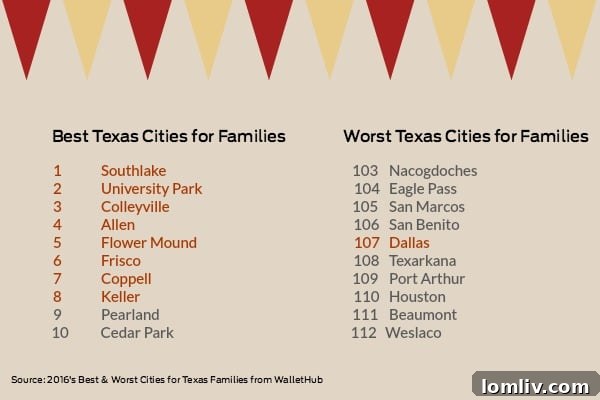
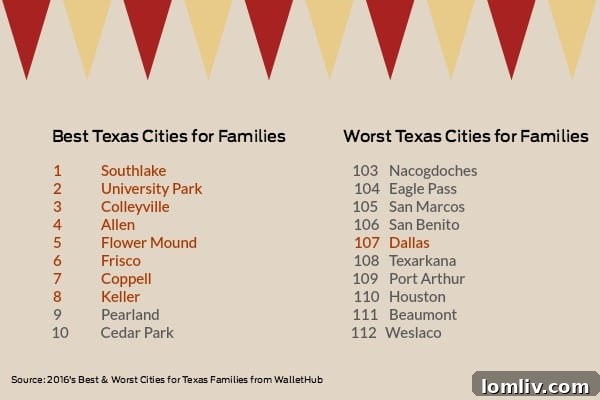
In a comprehensive study titled “2016’s Best Texas Cities for Families,” WalletHub meticulously evaluated 112 cities across the state. The findings offered both promising news and significant challenges for various urban centers. A standout revelation was the impressive performance of North Texas communities, with a remarkable eight cities from this region securing spots within the top ten. This indicated a strong concentration of family-centric environments in the DFW suburbs. Conversely, the study highlighted the struggles faced by larger metropolitan areas, most notably Dallas, which regrettably ranked 107th out of 112 cities.
Methodology: What Makes a City Family-Friendly?
WalletHub’s analysts employed a rigorous methodology, comparing the 112 cities based on 21 key metrics grouped into four overarching categories designed to capture the multifaceted aspects of family life. These categories included:
- Family Life & Fun: This category assessed the availability of recreational opportunities, community events, and overall quality of life for families. Metrics might include the number of playgrounds per capita, parks, family-friendly attractions, and cultural institutions.
- Education, Health, & Safety: Critical for any family, this section evaluated the quality of local school systems, access to healthcare facilities, and public safety. Specific metrics could involve school ratings, hospital accessibility, crime rates (violent and property), and the presence of safe neighborhoods.
- Affordability: The economic burden on families is a significant concern. This category scrutinized housing costs, median family incomes adjusted for cost of living, and other financial aspects that impact a family’s budget.
- Socioeconomic Environment: This broader category examined the social fabric and stability of a community. Metrics here might include divorce rates, poverty rates, job growth, and other indicators of a stable and supportive environment for raising children.
The extensive data set, ranging from practical indicators like the number of playgrounds per capita to more complex sociological statistics such as violent-crime rates and divorce rates, allowed WalletHub to create a detailed and nuanced picture of family life in Texas cities.
Dallas’s Dilemma: The Challenges for Urban Family Living
The relatively low ranking of Dallas, a bustling economic hub and cultural center, prompted many to question the specific factors contributing to its struggles in being deemed family-friendly. Jill Gonzalez, a WalletHub analyst, shed light on the primary issues faced by the city, particularly when compared to its thriving suburban counterparts.
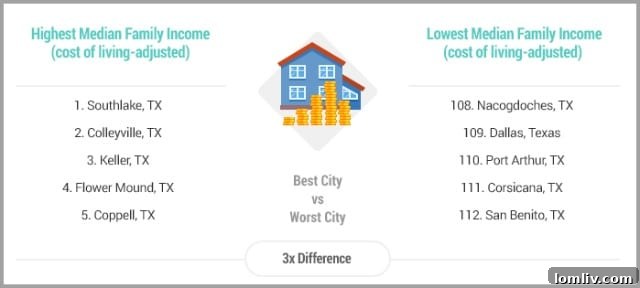
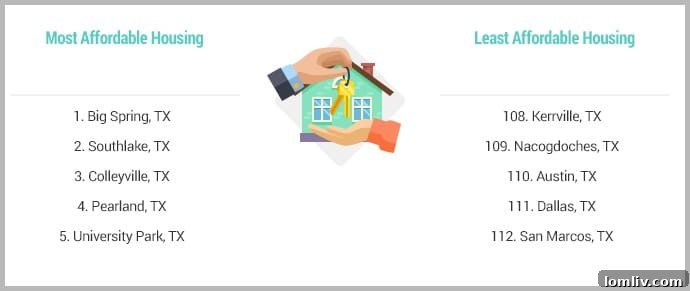
“Many big cities struggle in being family-friendly, especially depending on the size of the family,” Gonzalez noted. Dallas’s poor performance was attributed to a combination of economic and social factors. The city was identified as having the second most expensive housing market in the state, making homeownership or even rental costs a significant burden for families. Furthermore, Dallas recorded the fourth lowest median family income when adjusted for the cost of living, standing at just $47,428 per year. This disparity between high living costs and relatively lower incomes places considerable financial strain on families.
Beyond economics, safety and community stability were also major concerns. Dallas exhibited both a high crime rate and a high divorce rate, which stood at 27.18 percent, ranking it 99th in this metric. These factors collectively contributed to a challenging environment for families seeking security and a stable upbringing for their children.
Dallas’s Performance Across Key Categories: A Closer Look
Delving deeper into Dallas’s category-specific rankings paints a clearer picture of its challenges:
- Family Life & Fun: Dallas ranked No. 41 out of 112. While not at the very bottom, this mid-range score suggests that despite its vibrant cultural scene and numerous attractions, the city might lack the specific day-to-day amenities or community-focused recreational opportunities that cater directly to families as effectively as other cities.
- Education, Health, & Safety: A significant concern, Dallas scored No. 97 out of 112. This low ranking points to considerable deficiencies in school quality, access to robust healthcare services, or, more prominently, higher crime rates that impact families’ sense of security.
- Socioeconomic Environment: The city’s ranking of No. 96 out of 112 in this category further reinforces concerns about community stability, potentially reflecting higher divorce rates, income inequality, or other factors that can disrupt family life.
- Affordability: This was Dallas’s weakest point, ranking No. 111 out of 112. Only San Marcos fared worse in this critical category, underscoring the severe financial pressure placed on families due to high housing costs and a cost of living that often outpaces median incomes.
Despite these challenges, Gonzalez offered a path forward, emphasizing that “By investing in education, local officials could help to eventually improve the city’s crime rate and family income levels.” She also acknowledged that not all parts of a large city are equal: “Families can assume that parts of Dallas would be better for children than others, like those with better [schools] and nearby parks or amenities to take advantage of.” This highlights the importance of neighborhood-level research even within a less-than-optimally-ranked city.
The Allure of the Suburbs: North Texas Excellence
In stark contrast to Dallas, many of its surrounding suburbs, particularly within the mid-cities and northern reaches of the DFW Metroplex, scored exceptionally well. These communities often combine the benefits of proximity to major job centers with the advantages of suburban living: strong community ties, excellent schools, lower crime rates, and a generally higher quality of life tailored for families.
Colleyville: A Haven of Safety and Stability
Colleyville emerged as a prime example of a family-friendly city, demonstrating remarkable statistics in key safety and community metrics. The city boasted the lowest property-crime rate per 1,000 residents, an impressive 5.70. This figure is a staggering 12 times lower than that of Weslaco, which recorded the highest rate at 70.83. For families, a low property crime rate translates directly into peace of mind, knowing their homes and possessions are secure. Furthermore, Colleyville registered the lowest divorce rate in the study, at just 6.7 percent. This is five times lower than Big Spring, which had the highest rate at 32.9 percent. A low divorce rate can often indicate a community with strong social cohesion and stable family structures, contributing to a supportive environment for children.
Southlake: Where Prosperity Meets Premium Education
Southlake stood out for its economic prosperity and unwavering commitment to educational excellence. It reported the highest cost-of-living-adjusted median family annual income, an impressive $132,345. This income level is three times higher than San Benito, the city with the lowest, at $45,099, indicating significant economic opportunity and financial stability for its residents. Beyond income, Southlake also achieved the highest school-system quality ranking, an accolade that is six times higher than Odessa, the city with the lowest quality. For families, particularly those prioritizing top-tier education and long-term financial security, Southlake presents an exceptionally attractive option.
Other North Texas cities frequently lauded in such rankings include Frisco, Plano, Allen, and McKinney, all known for their well-regarded school districts, master-planned communities, abundant parks, and robust local economies that support a high quality of life for families.
Why North Texas Suburbs Excel for Families
Jill Gonzalez succinctly summarized the appeal of these successful suburban areas: “Dallas suburbs ranked highly due to the wealth of services they offer to families, including great education, health and safety systems. These cities also boast some of the highest incomes in the state.” This combination of factors creates an environment where families can thrive, benefiting from secure neighborhoods, excellent educational opportunities for their children, access to quality healthcare, and the financial stability that comes with strong local economies and higher median incomes.
The intentional planning of many North Texas suburbs, with an emphasis on community development, recreational facilities, and well-funded public services, plays a crucial role in their consistent high rankings. These areas are often designed with families in mind, offering a slower pace of life than the bustling city center, without sacrificing access to amenities or career opportunities.
Making an Informed Decision: Your Family’s Future in Texas
The WalletHub report serves as an invaluable resource for anyone navigating the complex decision of where to raise a family in Texas. Whether you are an existing resident considering a move or a newcomer drawn by the state’s economic vitality, understanding these rankings and the underlying metrics is essential. “Families already residing in Texas or the ones planning on joining the Lone Star state can use our report’s information to find out which city offers the best opportunities for setting down roots,” Gonzalez advised.
When choosing a city, it’s crucial for families to consider their unique priorities. If affordability is paramount, a city with lower housing costs and a reasonable cost of living might be a better fit, even if it means slightly compromising on other metrics. For those who prioritize top-tier education and are willing to invest more financially, cities like Southlake stand out. Safety is a universal concern, making cities like Colleyville particularly appealing. Beyond the numbers, prospective residents should also consider factors like commute times to work, local culture, community engagement opportunities, and the proximity of friends and family.
Ultimately, the best family city in Texas is subjective and depends on individual needs and preferences. However, studies like WalletHub’s provide a data-driven foundation to begin the search, highlighting the critical factors that contribute to a high quality of life for families and guiding them towards communities where they can truly flourish and lay down lasting roots in the diverse and opportunity-rich landscape of the Lone Star State.