DFW Real Estate & Economic Trends: Unpacking Migration, Affordability, and Key Influencers
The dynamic landscape of Dallas-Fort Worth (DFW) continues to capture national attention, driven by a thriving economy and a burgeoning population. Understanding the intricacies of this market requires a close look at several pivotal factors: who is moving into and out of Dallas County, how the housing market is adapting to demand for more affordable options, and the influential voices shaping the broader economic dialogue. This week, we delve into a comprehensive roundup of the latest real estate news and economic insights affecting the heart of Texas, offering clarity on the trends defining one of the nation’s most vibrant metropolitan areas.
From significant population shifts revealed by recent census data to the strategic pivots of local homebuilders, and the spotlight on a prominent local journalist at a major financial conference, these stories collectively paint a vivid picture of DFW’s ongoing evolution. Whether you’re a long-time resident, a potential new arrival, or an investor eyeing the opportunities in this bustling region, staying informed about these developments is key to navigating the opportunities and challenges ahead. The confluence of demographic changes, housing market adjustments, and leadership in financial discourse collectively shapes the economic narrative of this vital Texas hub.
Dallas County Experiences Significant Population Flux: A Hub of In-and-Out Migration
Texas has long been a magnet for new residents, a testament to its robust job market, favorable business climate, and attractive lifestyle. Recent data from the U.S. Census Bureau underscores this trend, revealing that the Lone Star State boasts the second-highest domestic in-and-out migration numbers across the entire country. Within Texas, Dallas County stands out as a primary epicenter for this population movement, sharing the spotlight with Harris County in experiencing some of the most substantial influxes of new residents nationwide, illustrating the potent draw of its major urban centers.
The 2017 American Community Survey meticulously detailed these demographic shifts, highlighting Dallas County’s remarkable appeal. A staggering 117,129 individuals chose to make Dallas County their new home, contributing significantly to the region’s diverse and expanding population base. Harris County, home to Houston, saw an even larger surge, attracting 175,286 new residents during the same period. These figures are not merely statistics; they represent thousands of families and professionals seeking new opportunities, higher quality of life, and contributing to the economic and cultural fabric of these major urban centers, reinforcing Texas’s reputation as a destination for growth.
However, the narrative of migration in Dallas County is one of constant flux, reflecting the natural ebb and flow of a highly mobile society. While the county welcomes a significant number of newcomers, it also sees a considerable portion of its population depart. The same census data reported that 134,843 individuals moved away from Dallas County, indicating a dynamic environment where people relocate for various reasons, including job changes, family reasons, or seeking different living environments that better suit their evolving needs. Similarly, Harris County recorded 168,936 outbound movers, showcasing a similar pattern of high mobility that suggests a highly active and responsive population.
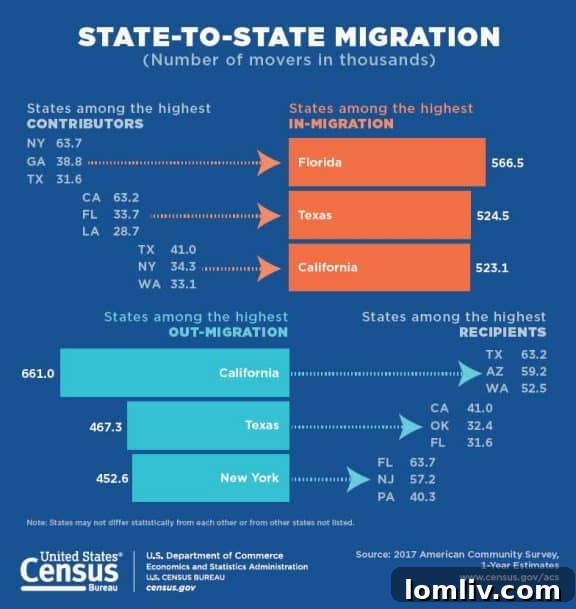
On a broader statewide scale, Texas continues to be a net beneficiary of domestic migration, demonstrating its strong appeal. A remarkable 524,511 people relocated to Texas from other states, cementing its status as a top destination for inter-state movers. A significant portion of these new Texans—approximately 63,200 individuals—hailed from California, often drawn by the promise of more affordable living, lower taxes, and abundant career opportunities in diverse sectors. In a reciprocal movement, Texas contributed about 41,000 new residents to California. Overall, Texas experienced the second-highest outbound migration nationally, with 467,338 people moving away, yet its robust inbound numbers ensured continued substantial population growth and a vibrant, evolving demographic profile. This continuous population churn underscores the state’s economic vitality and its role as a major player in national demographic trends.
The implications of such high migration numbers for Dallas County are far-reaching and complex. A steady influx of residents fuels demand across various sectors, particularly in housing, infrastructure, public services, and the labor market. New arrivals bring diverse skills, entrepreneurial spirit, and cultural richness, contributing to economic expansion and innovation across industries from technology to healthcare. However, this robust growth also presents significant challenges, including the imperative for continuous investment in transportation networks, utility services, educational facilities, and social amenities to adequately accommodate an ever-growing population. The high turnover also suggests a competitive job market and a dynamic housing landscape, where individuals are constantly evaluating their options for career advancement and overall quality of life.
Understanding these intricate migration patterns is crucial for urban planners, policymakers, and businesses alike to make informed decisions. It helps in accurately forecasting future needs, allocating resources effectively to address growth pressures, and developing proactive strategies to maintain Dallas County’s appeal as both a premier destination for economic growth and a place where residents can truly thrive. The dynamism reflected in these census figures highlights Dallas County’s position as a vibrant, evolving urban center at the forefront of national demographic shifts, requiring adaptive planning and strategic foresight.
Source: U.S Census Bureau
DFW Homebuilders Pivot to Affordability Amidst Evolving Market Demands
The Dallas-Fort Worth metropolitan area has long been recognized as a powerhouse in the nation’s new home construction sector, consistently ranking among the top markets for new home starts. This robust activity reflects strong economic growth, consistent job creation, and sustained population influx, making DFW a prime location for real estate investment and development. However, recent trends indicate a significant recalibration within the DFW housing market, driven by a critical and growing need for affordability. According to Metrostudy’s comprehensive 2019 first-quarter report, while Dallas maintains its leading position, quarterly new home starts experienced a slight dip of 1.4 percent compared to the first quarter of 2018 levels. This minor contraction signals a strategic shift in developer focus rather than a market downturn, as builders adapt proactively to evolving buyer preferences and economic realities across the region.
A notable and impactful development is the observed drop in DFW’s median new home price. Far from indicating a devaluation of properties or a weakening market, market analysts, including those at Metrostudy, interpret this decrease as a direct and strategic response to consumer demand. Buyers in the DFW area are increasingly seeking smaller, more attainable homes with price points that align better with their household budgets and financial capacities. This trend underscores a broader economic reality: while the region attracts high-income earners and corporate relocations, there’s a growing segment of the population, including first-time homebuyers, young professionals, and those with moderate incomes, who require more accessible and affordable housing options to establish roots in the thriving metroplex.
This pivot toward affordability, while essential for market health, is not without its challenges for developers. The Metrostudy report highlights a critical tension point: “To address affordability concerns, developers need to winnow lot sizes.” This strategy, which involves building more homes on smaller, more efficiently utilized plots of land, directly aims to reduce overall construction costs and, consequently, the final selling prices of homes. Yet, many of DFW’s 212 distinct municipalities express strong opposition to increased density, often citing concerns that such development could potentially devalue existing homes in established neighborhoods or place undue strain on local infrastructure, such as roads, schools, and public utilities that may not be equipped for rapid expansion.
The report insightfully counters this municipal resistance by emphasizing the long-term, overarching benefits of diversified housing options. “What the cities do not recognize is that well-designed, affordable housing strengthens communities by diversifying its demographic composition,” it added. Creating a wider and more accessible range of housing options ensures that essential workers, young professionals, and growing families can afford to live comfortably in the communities where they work, fostering a more balanced, resilient, and inclusive local economy. This diversity not only prevents the exodus of key demographic groups but also supports a vibrant social fabric and a sustainable future for DFW.
Locally, builders initiated 34,361 new homes over the past year, showcasing a significant volume of construction. In the first quarter of 2019, 7,459 starts were recorded, marking a 7.7 percent decrease compared to the previous quarter. Several factors contributed to this temporary slowdown, including adverse weather delays that impacted construction schedules and a general cooling of sales activity observed in the latter half of 2018. Despite these headwinds, the market showed signs of resilience and underlying strength. Closings increased by 1.2 percent compared to Q1 2018, demonstrating continued buyer interest, although the annual rate for closings saw a slight decrease of 0.8 percent. Over the preceding 12 months, DFW successfully closed 32,312 homes. Quarterly closings did experience a noticeable drop of 14.9 percent quarter-over-quarter, yet builders are reporting sales figures in Q1 2019 that were stronger than initially anticipated, suggesting a renewed momentum as the market strategically adjusts.
Paige Shipp, the Regional Director of Metrostudy’s Dallas region, provided critical insight into these nuanced market adjustments. “Based on last year’s slowdown, there was concern that the market cooled,” Shipp explained. “Many builders responded by shifting their product offering to more affordable homes and decreasing base prices. These shifts more closely match DFW’s new homes with what buyers can afford.” This strategic adaptation by builders is directly addressing the core issue of housing attainability, a factor that profoundly influences buyer behavior, market health, and overall regional growth prospects.
Shipp further elaborated on the profound significance of the median new home price drop. “Additionally, DFW’s median new home price has dropped since last year. The decrease in price is not a devaluation; rather it is a clear indication that buyers are actively purchasing smaller, more efficiently designed, and more affordable homes.” She underscored the positive implications of this trend: “In a market where new and resale price appreciation significantly outpaced wage growth, a lower median price indicates that more homebuyers will be able to afford new homes.” This development is particularly encouraging for first-time homebuyers and those looking to enter the market, as it signifies a more accessible entry point into homeownership.
The median resale home price in DFW, at $251,000, stood one percent higher than the previous year, according to Shipp. This trend, combined with the strategically decreasing median new home price, leads to a crucial market dynamic: “As the median new home price drops and resale price increases, the delta between new and resale narrows,” Shipp observed. “Currently, the difference between the median resale and new home price is 23.1 percent. The greatest difference in price was 50 percent in 2015.” A shrinking price gap makes new construction a more attractive and competitive option for buyers who might have previously been priced out, driving demand for fresh inventory and offering more choices.
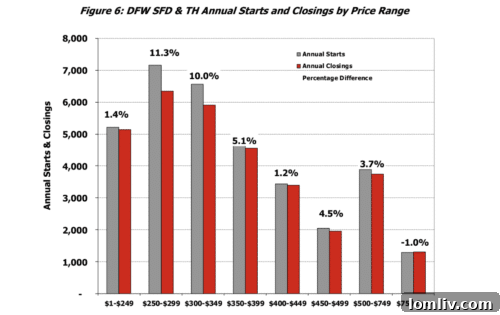
The 2019 Q1 data strongly reinforced the belief that builders are actively tackling the region’s housing affordability crisis with concerted efforts. The report indicated a higher number of annual starts outpacing closings by 10.7 percent specifically in the crucial $250,000 to $350,000 price range. This significant “delta”—the difference between starts and closings—is a key indicator of robust market expansion and healthy inventory growth. The study revealed that this difference represents a market average of starts exceeding closings by 6.3 percent, signaling strong underlying growth. “The greater the delta, the more rapidly the market is expanding,” the report stated, adding, “The 10.7 percent delta points to a growing supply of affordably priced homes in DFW.” This trend is a welcome relief for a market that, between 2010 and 2017, saw new home price appreciation soar by over 67 percent, an annual average rate of 7.7 percent, which was widely deemed unsustainable and detrimental to fostering an affordable housing environment.
The strategic shift by DFW builders toward creating more affordable housing options is a profoundly positive development for the region’s long-term economic health and social equity. By aligning new construction with the financial realities of a broader segment of the population, the DFW market is moving towards a more sustainable and inclusive growth trajectory, ensuring that the dream of homeownership remains within reach for more residents and reinforcing the region’s economic stability.
Source: Metrostudy
WFAA’s Dale Hansen to Keynote National Financial Services Expo: Advocating for Inclusion

In a notable announcement from the Council for Inclusion in Financial Services (CIFS) last week, WFAA’s highly respected and often outspoken sports anchor, Dale Hansen, has been tapped as a keynote speaker for the prestigious 2019 National Financial Services Expo. Hansen is scheduled to deliver his address on June 4, as part of the three-day event held from June 3-5 in Irving, Texas. His inclusion signifies a deliberate and impactful effort by the financial services industry to engage with broader societal issues and embrace diverse perspectives, moving beyond traditional financial discourse.
Dale Hansen is renowned across North Texas and beyond for his compelling and often courageous commentary on a wide range of social and political topics, extending far beyond the realm of sports. His willingness to address bold and sometimes controversial subjects with conviction, integrity, and a distinctive blend of earnestness and wit, has earned him a reputation as a trusted, influential voice for truth and community values. John Darden, President of the CIFS Board, articulated the profound significance of Hansen’s participation, stating, “Dale Hansen has a track record of bravely addressing the bold topics of our day, and has shown consistent support of Diversity & Inclusion causes. We are excited to have his unique brand of intellect and influence as our 2019 FinServ Expo keynote speaker.” Hansen’s ability to connect with diverse audiences on complex and often sensitive issues makes him an ideal figure to champion the critical themes of diversity and inclusion within the financial sector, a field increasingly recognizing its societal impact.
The National Financial Services Expo itself is a pivotal event, strategically designed to address some of the most pressing challenges and opportunities within the financial services industry today. Its overarching mission is multifaceted and ambitious: to actively help the industry attract, retain, and sustain an inclusive workforce, ensuring that the sector mirrors the rich diversity of the communities it serves and draws from a wider talent pool. Beyond workforce development, the expo aims to increase access to financial services and capital for small businesses, empowering them with the crucial resources and knowledge needed for robust growth and stability. Furthermore, it seeks to actively promote transformative technology initiatives that are rapidly reshaping how financial services are delivered, consumed, and regulated. Crucially, a core objective is to educate the public about complex financial processes, products, and services, thereby enhancing financial literacy and empowerment across all demographics, particularly those historically underserved.
Organizers have meticulously crafted the expo to be a comprehensive and interactive forum, bringing together all key players across the vast spectrum of finance. This includes seasoned professionals and cutting-edge innovators from vital segments such as housing, which is intrinsically linked to the broader economic health and wealth creation; the insurance sector, providing essential risk management and security; banking institutions, foundational to economic activity and capital flow; and wealth management, guiding individuals and families toward long-term financial security and prosperity. By convening such a diverse group of stakeholders, the National Financial Services Expo facilitates crucial dialogue, fosters cross-sector collaboration, and drives forward initiatives that are essential for a more equitable, efficient, and robust financial future. Hansen’s keynote address will undoubtedly serve as a powerful catalyst for these important discussions, inspiring attendees to consider their unique and collective roles in shaping a more inclusive and responsible financial landscape for all.
Conclusion: DFW’s Resilient and Evolving Economic Narrative
The latest insights into Dallas-Fort Worth’s real estate and economic landscape reveal a region in constant motion, dynamically adapting to new challenges and embracing opportunities for sustainable, inclusive growth. From the robust in-and-out migration that continuously reshapes its demographic fabric and economic demands to the strategic pivot of homebuilders towards more affordable housing options, DFW demonstrates remarkable resilience, foresight, and forward-thinking adaptability. These shifts are not just statistics; they represent fundamental changes that impact the daily lives of residents, the strategic decisions of businesses, and the overall trajectory of one of America’s fastest-growing and most influential metropolitan areas.
The commitment of DFW’s homebuilders to actively address affordability concerns, as evidenced by Metrostudy’s comprehensive reports, signifies a healthier, more inclusive market. By providing homes at more accessible price points, the region is working diligently to ensure that its economic prosperity translates into tangible benefits for a wider segment of its population, fostering long-term stability, community strength, and equitable opportunities. Simultaneously, the inclusion of influential voices like Dale Hansen at national financial forums underscores a broader recognition within the industry of the paramount importance of diversity, inclusion, and engaged community leadership. These elements are vital not only for achieving social equity but also for driving innovation, enhancing consumer trust, and ensuring the financial sector remains relevant, responsible, and responsive to societal needs.
Collectively, these trends highlight DFW’s dynamic nature—a region that is not only growing rapidly but also thoughtfully evolving to meet the complex and multifaceted needs of its diverse population. As Dallas-Fort Worth continues to attract top talent, substantial investment, and new residents, its ability to successfully integrate these new arrivals, provide attainable housing solutions, and champion inclusive economic practices will be paramount to its sustained success and continued leadership on the national stage. The future of DFW promises continued vibrancy, driven by an adaptive market, forward-thinking leadership, and a community deeply committed to progress and prosperity for all its inhabitants.