Dallas at a Crossroads: The Intense Battle for Fair Representation in City Council Redistricting
With the U.S. Justice Department’s critical deadline looming just one week away, the Dallas City Council found itself in a deadlock on Wednesday, unable to reach a definitive consensus on the new boundaries for the city’s 14 council districts. The only point of agreement among the deeply divided panel was to schedule yet another special meeting, set to reconvene on Monday at 3:30 p.m., in a frantic last-ditch effort to finalize the crucial redistricting map. This ongoing struggle highlights the immense pressure and the profound implications these decisions will have on the political landscape of Dallas for the next decade.
The council’s Wednesday session stretched for hours, marked by contentious haggling over a series of proposed modifications to the Redistricting Commission’s initially approved map. These proposed changes were meticulously outlined in a comprehensive 23-page memo submitted by various council members, each advocating for their constituents and specific community interests. The stakes are extraordinarily high: if the council fails to agree on a revised map by the impending June 29 deadline, the redistricting map previously approved by the Redistricting Commission will automatically become the city’s default submission. This default outcome could potentially override extensive council deliberations and resident feedback, underscoring the urgency of finding common ground.
The new district boundaries, once finalized, are not merely administrative adjustments; they will fundamentally reshape Dallas’s political future. These boundaries are slated to become effective for the pivotal May 2023 city council election and will remain in force for a full ten years. This ten-year cycle aligns with the national census, requiring adjustments every decade to accurately account for shifts in population as recorded by the U.S. Census data. These shifts necessitate a redraw to ensure equitable representation and equal population distribution across all districts, a process mandated by federal law and aimed at upholding democratic principles. The implications extend far beyond election results, influencing resource allocation, infrastructure development, and community identity across the city.
(Click here to view an enlarged version of the previous district map for historical context.)
Resident Feedback: The Voice of Dallas Communities
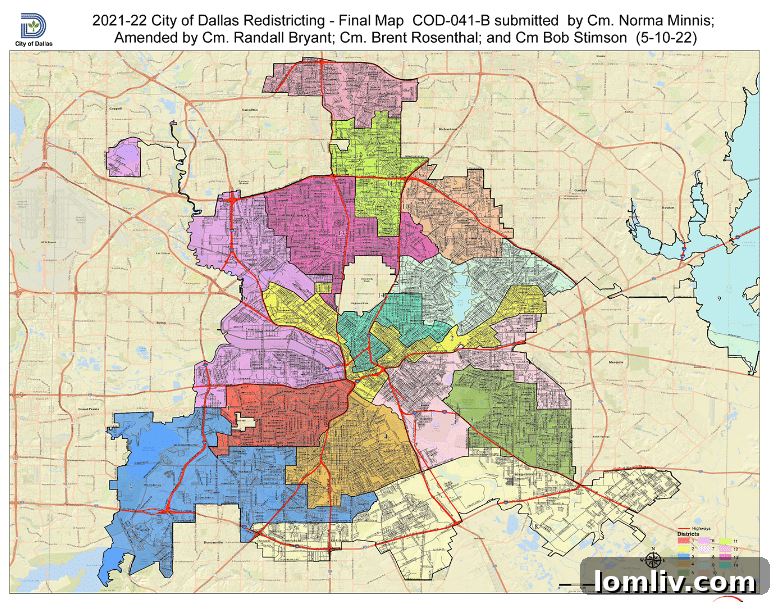
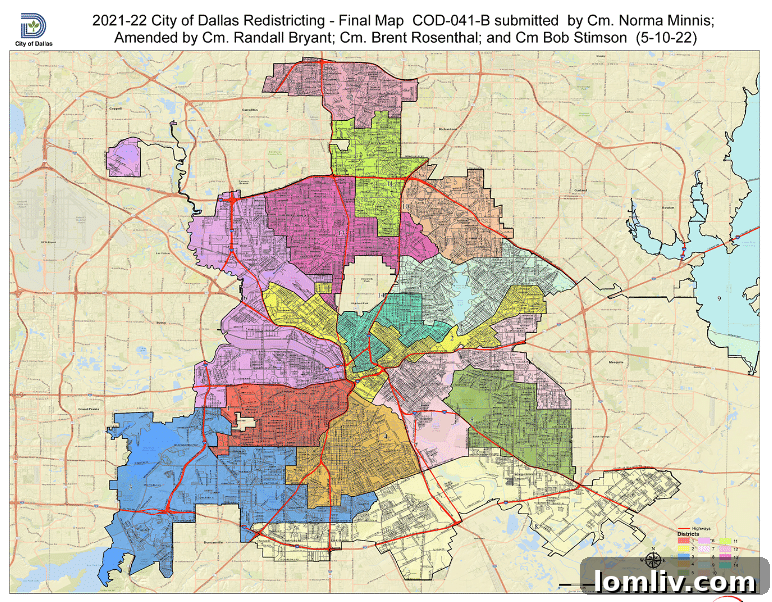
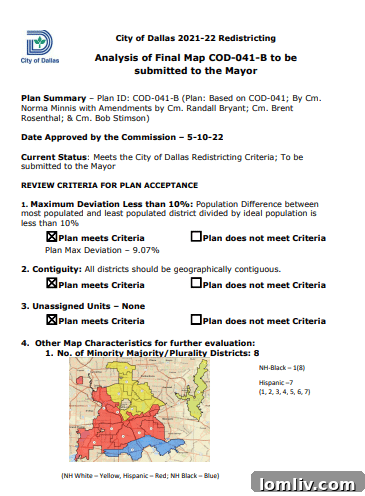
The Redistricting Commission’s selection of Map 041-B, approved in a decisive 10-5 vote on May 10, was immediately met with significant resistance and vocal opposition from various residents across Dallas. Many community members expressed profound concerns, asserting that the map was not only racially divisive but also politically motivated, failing to uphold the fundamental purpose of redistricting: to evenly distribute population while preserving the integrity and cohesion of established neighborhoods. These accusations underscore the delicate balance required in drawing district lines, where demographic shifts and political aspirations often clash with the desire for community continuity and fair representation.
During the public comment period, one particularly impassioned resident, identifying himself as the sole Black speaker who submitted alternative maps to the redistricting commission, articulated a critical concern: the importance of retaining “four winnable Black council seats.” He specifically highlighted Districts 3, 4, 7, and 8 in South Dallas as crucial areas for ensuring robust Black representation. He warned that some of the proposed amendments, despite their stated intentions, would inadvertently “dilute the Black vote,” thereby undermining the political influence and electoral power of African American communities in Dallas. His plea to the council was clear and direct: “Please approve map 041-B, which was presented to you by the Redistricting Commission,” emphasizing the importance of a map that he believed best served the interests of minority voters.
Conversely, numerous other residents voiced their strong support for the council-initiated amendments to Map 041-B. A recurring theme in their testimonies was a fervent desire to maintain the Parkdale neighborhood within District 7, a sentiment strongly echoed and advocated for by Councilman Adam Bazaldua. This particular modification underscored a broader demand from residents: that redistricting prioritize the preservation of established communities, allowing them to continue to share resources, services, and a collective political voice.
Melanie Vanlandingham, a landscape architect and Lakeshore Drive resident, who generously volunteered her expertise in drawing some of the proposed maps, reflected on the extensive and often arduous journey of the redistricting process. “As this redistricting process is wrapping up, I wanted to take this opportunity to thank you all… for your attention, your sense of balance, collaboration, and care through this process, and it’s taken a while,” she stated, highlighting the dedication required from all involved. She expressed particular gratitude to the citizens who actively participated: “I especially want to thank all the citizens… They all came together to help create this new redistricting map to make sure of its fair representation for the next 10 years. I’ve been really proud to be part of this.” Her words encapsulated the spirit of civic engagement that characterized much of the redistricting debate, despite the underlying disagreements.
Navigating the Labyrinth of Modifications: Proposals and Outcomes
The Redistricting Commission’s Map 041-B, which formed the foundational blueprint for the council’s discussions, was originally conceived by District 14 Redistricting Commissioner Norma Minnis. The map later underwent significant amendments and refinements collaboratively undertaken by Minnis and a distinguished group of community leaders: Randal Bryant, Brent Rosenthal, and Bob Stimson. This collaborative effort aimed to create a map that balanced diverse community needs with the technical requirements of redistricting, though it ultimately proved to be a starting point for further debate.
On June 8, the council initially reached an agreement on a significant proposal put forth by District 5 representative Jaime Resendez. This modification aimed to extend the southeastern border of District 5 to encompass the River Ranch and The Texas Horse Park, areas of growing importance to the district. However, this approval proved to be provisional. The agreement failed to achieve the necessary twelve votes for a *comprehensive* map, meaning individual modifications, while passed, could not be formally integrated without an overarching consensus. This highlights a critical procedural hurdle: the council’s inability to rally sufficient support for a complete, integrated map, despite approving individual changes.
Similarly, additional modifications to the Redistricting Commission’s Map 041-B were approved by the city council on Wednesday. Yet, these too remain inoperative until the panel can coalesce around and approve a unified, comprehensive map. This procedural bottleneck continues to delay the finalization of the district boundaries, creating uncertainty and extending the high-stakes negotiations.
Among the successful individual modifications was District 4 Councilwoman Carolyn King Arnold’s impactful proposal. Her modification sought to “put Kiest Park and the community back together [in District 4] to enhance unity.” This move was specifically designed to consolidate communities with shared interests and identities, ensuring they remain within a single representative district. The measure also strategically shifted the boundaries of the area defined by Hampton to Illinois to Rugged to Kiest Boulevard from District 3 to District 4. Concurrently, it adjusted the boundaries from R.L. Thorton Freeway to Ledbetter Drive to Marsalis Avenue to Laureland Road, moving these areas from District 4 to District 3. This successful modification demonstrated a council majority’s willingness to prioritize community cohesion in certain instances.
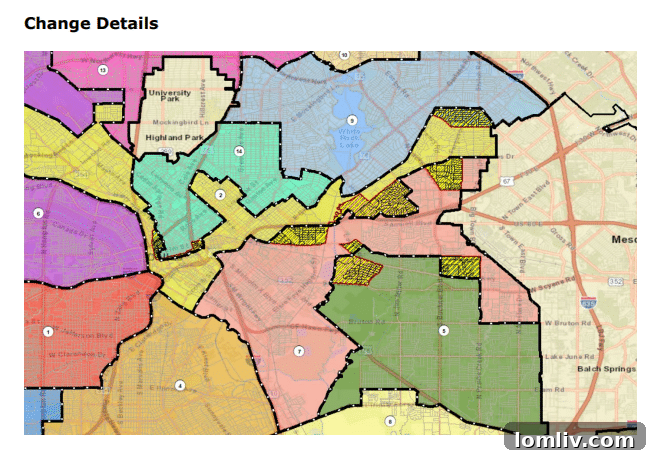
In contrast to Arnold’s success, a joint modification proposed by District 2 Councilman Jesse Moreno and District 7 Councilman Adam Bazaldua failed to garner the necessary support. This comprehensive proposal, which aimed to keep Owenwood within District 2 and Casa View in District 9, needed twelve votes to pass but ultimately only secured eleven. The full scope of this modification was extensive, designed to amend district lines for districts 2, 5, 7, 9, and 14. Its proponents argued that it would “maintain communities who share similar interests such as Owenwood, Parkdale, Ash Creek Greenbelt, Claremont, Hillridge, Old Buckner Terrace, and Lakeland Hills.” The rationale was that redesigned borders would foster continued collaboration among neighborhoods and community stakeholders on vital ongoing and future capital improvement projects, corridor studies, and the development of parks and recreation centers in the area. Specific examples included existing collaboration and funding for capital improvement projects in the Parkdale and Ferguson corridor study, as well as Lawnview public improvements. The map was meticulously crafted to keep the neighborhood of Parkdale/Lawnview intact with Parkdale Lake and to retain this community within District 7, recognizing decades of advocacy by residents to keep their community together. Furthermore, it aimed to preserve the integrity of Deep Ellum Bark Park, Harwood Park, and Lubben Park by keeping them unified. Proponents asserted that adjusting these lines would prevent disruptions to ongoing progress and maintain strong community ties. The changes in District 9, similarly, were “adjusted to keep the Casa View neighborhood together.”
Councilman Moreno passionately articulated the motivation behind his and Bazaldua’s proposal, stating, “Let’s do what’s right by the people and the city of Dallas.” However, this proposal faced significant opposition. Councilman Jaime Resendez expressed his inability to support the change, explaining that it would reduce his District 5 by a substantial 5,000 residents, potentially leading to the lowest population and lowest voter turnout among the city’s 14 districts. This concern highlighted the critical need for population parity across districts to ensure equitable representation and resource distribution. District 1 Councilman Chad West also voiced opposition, asserting that he would only support a modification if it had unanimous council backing, underscoring the deep divisions and the quest for broad consensus.
Following the failure of the joint proposal, Councilman Resendez presented his own modification. This proposal sought to extend the northwestern boundary of District 5 to specifically include Parkdale Lake. Resendez argued that this change would have minimal impact on overall population or demographics, yet it too failed to receive the required twelve votes, further illustrating the challenge of achieving broad council agreement on specific boundary adjustments.
Amidst the series of setbacks, a modification jointly proposed by District 13 Councilwoman Gay Donnell Willis and District 6 Councilman Omar Narvaez successfully passed. This approved measure strategically uses Lenel Place as the definitive border between District 6 and District 13 within the Midway Hollow area (specifically south of Walnut Hill, east of Marsh Lane, north of Northwest Highway, and west of Midway Road). Furthermore, it moves the neighborhood situated between Northaven Road and Royal Lane, west of Webb Chapel, into District 6. Concurrently, it ensures that neighborhoods located south of Forest Lane, between Josey Lane and Webb Chapel (north of Royal), remain within District 13. This successful resolution demonstrated that, despite broader impasses, specific, well-defined modifications could still achieve the necessary council support.
As the clock ticks down to the Justice Department deadline, Dallas council members affirmed their unwavering commitment on Wednesday to continue negotiating and fighting tirelessly for the communities they represent. This resolve underscores the profound responsibility they feel towards their constituents and the long-term impact of these boundary decisions on the future of Dallas. The ongoing negotiations reflect a critical moment for democratic representation, community identity, and political power within one of America’s largest cities.