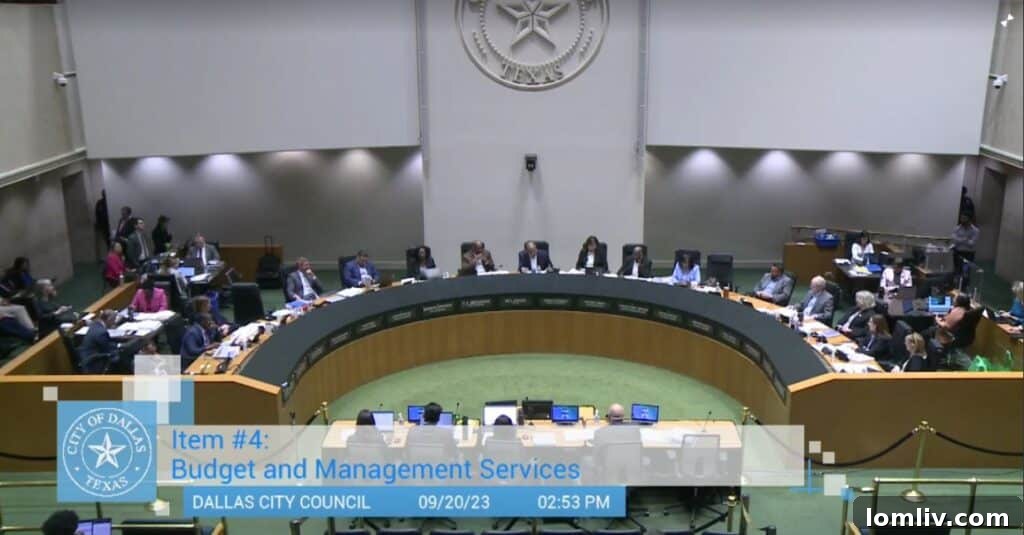
In a significant decision shaping the fiscal future of one of America’s largest metropolitan areas, the Dallas City Council officially adopted its comprehensive $4.89 billion budget. This pivotal financial plan is underpinned by a property tax rate set at 73.57 cents per $100 of assessed valuation, a figure that has sparked considerable debate and division among city leaders and residents alike. The vote, taking place on a Wednesday, marked the culmination of extensive discussions, public hearings, and internal deliberations focused on balancing essential city services with the growing demand for property tax relief amidst a challenging economic landscape.
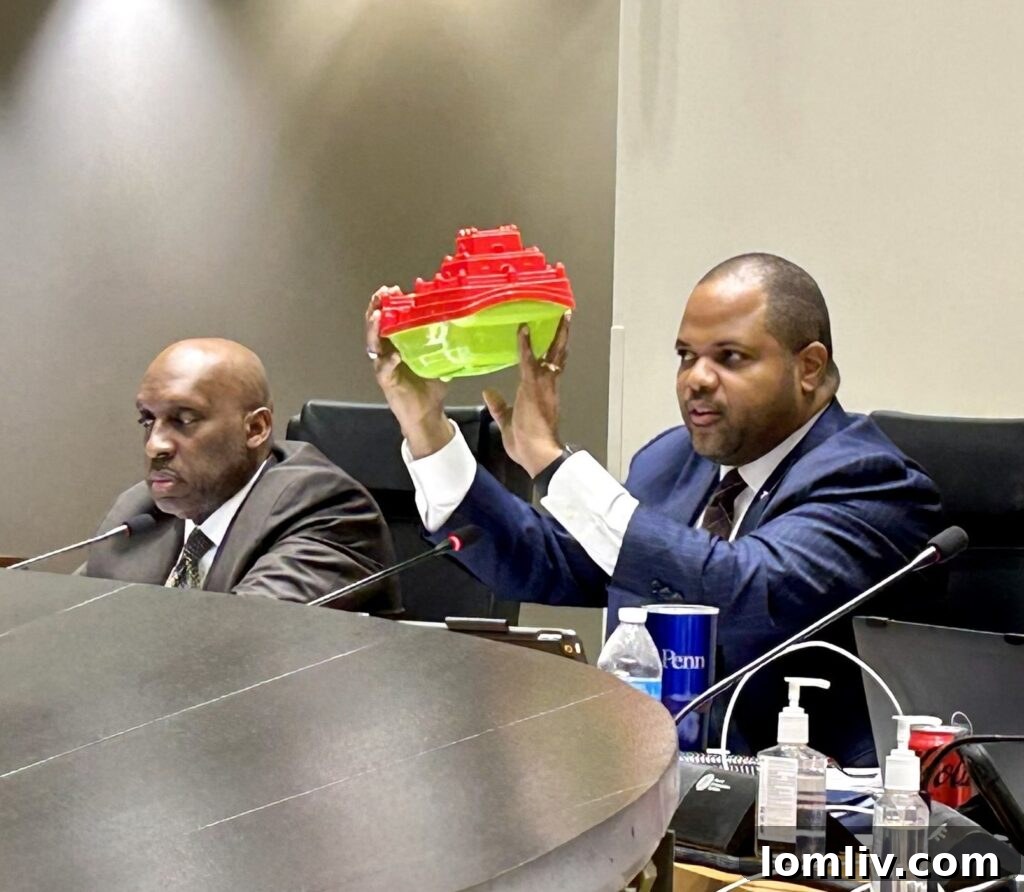
Dallas Mayor Eric Johnson emerged as a prominent voice of opposition to the adopted budget, emphasizing his mandate to serve the entire city and expressing his inability to support the proposed financial framework. His stance was rooted in a belief that the budget did not adequately address the pressing need for genuine property tax reduction for Dallas residents. Joining Mayor Johnson in voting against the budget were Council members Cara Mendelsohn, Paul Ridley, Gay Donnell Willis, and Kathy Stewart, signaling a notable dissent within the council regarding the city’s fiscal priorities and the burden placed on taxpayers.
Mayor Johnson articulated his position with conviction, stating, “The idea that we should lower the tax burden on Dallas residents—not lower an imaginary number or rate, a variable and a calculation—didn’t just come to me from nowhere. It came to me from the residents of the City of Dallas. It’s actually what the residents want. It’s what they need.” He further underscored the tangible economic pressures facing families, pointing out that “Interest rates are a real thing. Inflation is a real thing.” The Mayor also highlighted the broader strategic implications for the city, asserting that the budget impacts “the competitiveness of the City of Dallas and other places people could be. That’s why I keep bringing it up and pushing it.” His arguments reflect a deep concern for the financial well-being of Dallas citizens and the city’s attractiveness as a place to live and conduct business.
Delving deeper into the socioeconomic impact of the property tax rate, Mayor Johnson provided crucial data suggesting that the city’s “most economically challenged” populations are precisely those most in need of tax relief. He specifically cited the disproportionate burden on minority communities, stating, “It’s African Americans and Latinos who are begging for property tax relief because it represents a larger portion of their income.” While acknowledging the undeniable importance of city services, which he noted as the very reason for the council’s existence, the Mayor stressed the necessity for “an honest reckoning and coming to some understanding… about what we really think are the essential functions of city government.” This statement opened a critical dialogue about the core responsibilities of municipal government versus the financial capacity of its residents.
The final votes on the Dallas City budget were cast around 3:30 p.m. following what was described as a lengthy and intense discussion. The session also saw the introduction of five last-minute proposed amendments, reflecting the ongoing attempts by various council members to fine-tune the budget and address constituent concerns right up until the final moment. This flurry of activity underscored the contentious nature of the budget process and the significant stakes involved for Dallas residents and city operations.
For those interested in a deeper dive into the city’s financial planning, all official city budget documents are readily accessible online. Residents and stakeholders can view these detailed reports by visiting the Dallas City Hall website’s financial transparency page. Furthermore, the complete video recording of the council meeting discussion, offering full insights into the deliberations and speeches, is available to view online, ensuring transparency and public accountability in the governmental process.
City Manager T.C. Broadnax provided a comprehensive breakdown of the budget in a September 22 memorandum. The total budget amounts to $4.6 billion, encompassing critical components such as the General Fund, Enterprise Funds, and Capital Funds, which collectively finance the vast array of city services and infrastructure projects. In addition to this substantial sum, the budget ordinance, which received approval on September 20, allocated an extra $247.9 million. These appropriations are specifically earmarked for Internal Service Funds and the Employee Retirement Fund operations, both of which are accounted for separately to ensure fiscal clarity and proper management. Consequently, the grand total for the budget appropriation ordinance amounted to an impressive $4.9 billion, representing a significant financial commitment to the city’s future.
Council Members React to Adopted Budget: A Spectrum of Views
The adoption of the Dallas budget ignited a spectrum of reactions from City Council members, highlighting the diverse priorities and political landscapes within the city. Deputy Mayor Pro Tem Carolyn King Arnold delivered an impassioned plea to her colleagues, urging them to honor the commitments made during their campaign trails. She reminded them of the dual promise: to steadfastly continue offering essential core services to all residents while simultaneously working towards meaningful property tax relief. Her argument underscored the evolving nature of Dallas, stating, “We’re the ninth largest city and of course, our budget should be going up. Why would it go down when we’re attracting folks to come here daily?” This perspective champions growth and the necessary investment to sustain a thriving, expanding metropolis.
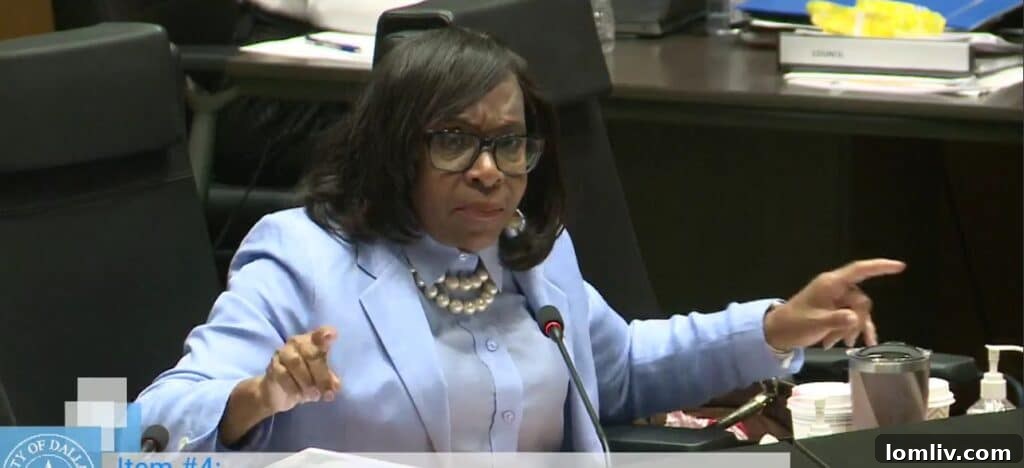
Arnold further emphasized the council’s inherent obligation to support the dedicated city employees and the vital services they provide. She critically observed the rhetoric surrounding equity, noting, “It’s a good political statement when you say, ‘I’m about equity. We want to support the historically underserved.’ It’s good when you’re campaigning, but when you begin to put the dollars behind the programs, then folks start doing the moonwalk. You want to back it up. We’re not going to back it up…” Her powerful words called for tangible action beyond mere political posturing, insisting that the council must not abandon its most vulnerable populations. “What we cannot do today is we cannot let our people down. The historically underserved communities need you. Let’s work through it. Let’s handle up on our business,” she concluded, advocating for unwavering commitment to equity and community support in the Dallas budget.
As chair of the council’s Government Performance and Financial Management Committee, District 1 Councilman Chad West was called upon to make the motion for approval. Despite this procedural role, West’s support for the budget was not without reservation, reflecting the internal struggles many council members faced. “I am going to support this, obviously, but it’s with a heavy heart,” West confessed. His statement underscored the complex challenges of urban governance, where difficult compromises are often necessary. He expressed a desire for a more collaborative and year-long evaluation process for future budgets, suggesting, “I think we’ve got a hard year ahead of us where we all have to sit down and not do this all right here next year but do it throughout the course of the year, where we re-evaluate the departments and our mission.” This sentiment pointed towards a need for continuous strategic planning rather than reactive, annual budget battles.

In stark contrast to some of her colleagues, Councilwoman Cara Mendelsohn articulated a more pessimistic view of the adopted budget’s impact. She argued that what appeared to be a “teeny-tiny tax rate decrease” was, in reality, nothing short of an approximate 8 percent property tax increase. This seemingly paradoxical outcome, she explained, was primarily due to the significant hikes in both residential and commercial property valuations across Dallas. Mendelsohn raised a critical point regarding housing affordability, a pressing issue for many Dallas residents. “There are so many people on this council that care about housing affordability, but this vote will actually increase the rent for our tenants across the city,” she warned. Her forecast was grim for renters, as she predicted, “It won’t be the landlords that are going to absorb the 8 percent tax increase. Renters, prepare yourselves.” This direct appeal highlighted the potential for the budget to exacerbate existing housing challenges and disproportionately affect a large segment of the population.
Offering a more balanced perspective, Councilman Omar Narvaez acknowledged that while the tax rate decrease was not as substantial as some advocates had hoped, it still represented a tangible reduction. He pointed out that it amounted to a one-cent drop over the current fiscal year, a detail that, while modest, reflected a move in the desired direction for tax relief proponents. Narvaez framed this outcome as a product of compromise, a necessary element in any complex governmental decision-making process. “That’s part of compromise,” he stated, suggesting that no single faction emerged as a complete victor or loser. He maintained an optimistic outlook regarding the budget’s long-term benefits, noting, “There’s no losers here. As our programs continue to grow and our staff is able to get stronger and implement more, the big winners are our residents…” He even lightened the mood by contrasting this budget cycle with previous, more acrimonious ones, remarking, “It wasn’t as Hunger Games as it typically is,” implying a degree of cooperation that might have been absent in prior years.
Housing Advocates Rally at City Hall Prior to Council Meeting: A Push for Affordable Homes
The urgency of housing affordability in Dallas was brought sharply into focus even before the City Council began its budget deliberations. Prior to Wednesday’s council meeting, a significant rally took place at City Hall, drawing together numerous housing advocates and concerned citizens. Several speakers subsequently took advantage of the open microphone session during the meeting to passionately advocate for increased investment and focus on housing initiatives within the city’s financial plan. Their presence and testimonies underscored the critical nature of the housing crisis for many Dallas residents, urging council members to prioritize this foundational issue in their budget decisions.
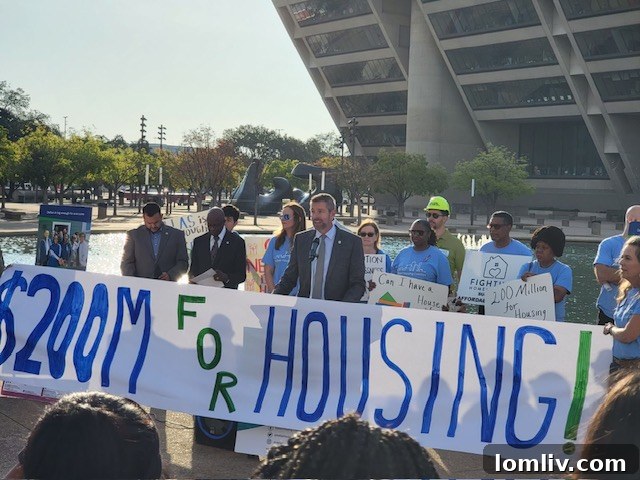
Among the compelling voices heard was Raul Reyes, a resident of West Dallas, who made a powerful statement emphasizing the foundational importance of stable housing. Reyes highlighted the pre-meeting rally organized by the Dallas Housing Coalition, demonstrating the collective concern within the community. His testimony resonated deeply as he explained, “Stable housing is the most critical issue to me and my neighbors because it serves as the foundation for familial stability, educational achievement, and economic growth.” Reyes eloquently distilled the essence of the issue, concluding, “A home is more than just a shelter. It’s the cornerstone for opportunity and prosperity.” His words painted a vivid picture of how housing insecurity can destabilize lives and impede progress across multiple societal dimensions.
Adding a vital institutional perspective, Ashley Brundage from United Way of Metropolitan Dallas, a founding member of the influential Dallas Housing Coalition, implored council members to elevate housing as a top priority. Her advocacy extended beyond the immediate biennial budget, calling for significant investment in the upcoming 2024 bond election as well. Brundage reported on the success of the morning’s demonstration, stating, “We had a great rally out in front of City Hall this morning with over 100 people chanting their support for housing,” underscoring the broad community backing for this cause. She then delivered a stark statistic, pointing out the disproportionately low allocation for housing in the current budget: “As you vote on this year’s budget, which allocates less than 1 percent toward housing…” This figure highlighted a significant disconnect between stated priorities and actual financial commitments.
Brundage further emphasized the critical need for change by revealing historical underinvestment and future demands. She stated, “we also want to point out that Dallas has yet to invest more than $6.3 million in bond funding toward housing since 2003.” This historical context illustrated a long-standing pattern of insufficient commitment. Looking ahead, she presented a daunting yet crucial target: “Dallas needs 100,000 new or refurbished affordable homes by 2033 to meet the housing demand.” This ambitious goal highlights the immense challenge facing the city in addressing its housing crisis and the necessity for robust, sustained financial commitment in upcoming budgets and bond packages. The collective voice of housing advocates served as a powerful reminder that while fiscal balances are essential, the human element of housing stability remains paramount for the city’s overall well-being and equitable growth.