The employment contract of Dallas City Manager T.C. Broadnax has been thrust into the spotlight, with the Dallas City Council deferring a critical decision until next week. This delay comes amid intensified scrutiny and persistent concerns over Broadnax’s leadership, particularly his role in the city’s costly and protracted permitting crisis. The debate surrounding his future underscores a broader conversation about accountability and effective governance within one of Texas’s largest and most dynamic urban centers.
The path to this deferred decision began when Council members Paula Blackmon (District 9), Cara Mendelsohn (District 12), and Gay Donnell Willis (District 13) formally requested that Broadnax’s employment contract be placed on the agenda for a special meeting. Initially scheduled for June 15, this crucial gathering, which would have allowed the council to potentially discipline or even remove the city manager, was subsequently canceled and rescheduled for June 23. This rescheduling signals the complex political dynamics at play and the council’s desire for a comprehensive and transparent review process.
Explaining the postponement, Councilwoman Mendelsohn posted on her District 12 Facebook page, “After listening to our colleagues, we have requested the city secretary cancel Wednesday’s special-called meeting. We believe it is important for all colleagues to feel this process is fair and transparent and we are looking forward to a frank performance review discussion.” This statement highlights the council’s commitment to due process, ensuring all members have the opportunity to engage thoughtfully with the significant implications of this decision.
Dallas Mayor Eric Johnson, who has publicly expressed his desire for Broadnax’s termination, concurred with the delay, stating in an email, “I do not mind taking another week to ensure my Dallas City Council colleagues can get comfortable with the process. I look forward to discussing our city’s direction and future next week.” The Mayor’s stance sets a clear tone for the upcoming discussions, emphasizing a need for decisive action and a new direction for the city’s administration. Although the council met in a closed session at the conclusion of a regularly scheduled briefing to discuss Broadnax’s performance, no formal action was posted for that meeting, further building anticipation for the June 23 session.
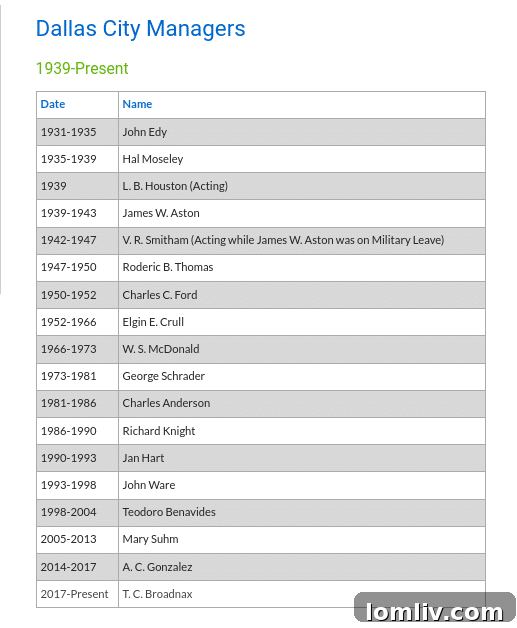
The Dallas City Council holds significant authority, overseeing the hiring and firing of key municipal leadership positions, including the city manager, city attorney, city auditor, city secretary, and administrative judge. City Manager Broadnax’s current annual salary stands at $410,919, a substantial sum reflecting the immense responsibilities of the role. The history of this position in Dallas shows periods of both stability and transition. For instance, former City Manager A.C. Gonzalez retired in January 2017 after three years of service, while his predecessor, Mary Suhm, Dallas’s second female city manager, resigned in 2013 after an eight-year tenure, having faced potential termination. These precedents underscore the high stakes and the demanding nature of leading Dallas’s sprawling municipal operations.
The Dallas Permitting Problem: A Crisis of Confidence and Cost
As the chief administrative officer, the city manager is responsible for all municipal departments, presiding over a workforce of 13,000 employees and managing a formidable $3.8 billion budget. When systemic issues arise, the spotlight invariably falls on the individual at the helm. Over Broadnax’s five-year tenure, several significant challenges have emerged, leading to widespread criticism and a palpable sense of dissatisfaction among residents and key stakeholders. While a range of issues has been brought to the fore, the city’s persistent permitting problems have become a central point of contention, impacting a broad spectrum of the Dallas community.
Beyond the permitting woes, Broadnax has faced scrutiny for several high-profile failures. He admitted to not acting on early warnings regarding a city employee’s deletion of millions of police files, a blunder that has resulted in critical evidence being lost from criminal cases within the Dallas County District Attorney’s Office. His administration has also been criticized for its handling of the city’s ongoing homelessness crisis, the chronic issues plaguing the 911 call center, and various public safety matters. Moreover, during recent council briefings, residents voiced strong disapproval over the proliferation and misuse of short-term rental properties, alleging they are transforming neighborhoods and being exploited for illegal activities like sex trafficking. While these issues paint a broad picture of administrative challenges, the permitting debacle has arguably garnered the most intense focus due to its direct and devastating economic consequences.
For Daltxrealestate.com, the permitting crisis stands out due to its profound and costly impact on an extensive network of professionals and residents, including builders, real estate agents, homeowners, and businesses. The problem escalated significantly during the COVID-19 pandemic in 2020, leading to a backlog of over 10,000 permits. Despite the passage of time, substantial progress in resolving this issue has been elusive, leading to significant delays for builders and contractors attempting to complete projects on schedule. The economic fallout is staggering: according to Linda McMahon, head of The Real Estate Council, the city loses an estimated $31 million in tax revenue for every three months that permitting delays persist.
The Dallas Builders Association (DBA) has been a vocal critic of the crisis, with Executive Officer Phil Crone issuing a strong letter to the Dallas City Council on behalf of more than 1,100 companies representing the city’s residential housing industry. Crone’s letter underscored the dire need for immediate action and a change in leadership. He stated, “With your continued leadership, we can find a better way forward for our city and, finally, a path through this crippling crisis. It is our sincere hope that the transition process is dignified, respectful and results in a new city manager who values housing advocates as critical stakeholders.”
Crone elaborated on the profound impact of the crisis, writing, “Over the past two years, residents, businesses and home builders have been crippled by incomprehensible permitting delays resulting from a foreseeably flawed transition to an online permitting system, poor customer service, as well as overburdened and poorly equipped staff. The city manager’s sustained inattention to the severity of the problem, lack of empathy for those affected, and failure to consider, let alone implement, reasonable solutions have led us to the conclusion that Dallas needs a respectful yet decisive transition at that position in order to move forward.” He highlighted the rapid decline in efficiency, noting that “In early 2020, residential builders could obtain a permit in a matter of hours. For the past two years, most have waited several months.” The financial burden is equally alarming: “Each and every day that a home is delayed adds $200 to $300 to its cost. Every $1,000 increase in the price of a new home renders it unaffordable for 20,000 Texas families. This situation makes it impossible for us to build the affordable housing our city so desperately needs and has prevented countless working-class families from calling Dallas home.”
Crone also took issue with Broadnax’s perceived dismissal of the problem, specifically his reported statements that the permitting crisis was merely a “PR problem” and something he was “tired of hearing about at parties.” Such remarks, Crone argued, demonstrated a profound disconnect from the real-world suffering caused by the administrative failures. He further emphasized the broader economic ramifications: “The city manager’s inability to prioritize and proactively solve this problem has resulted in the loss of hundreds if not thousands of jobs not only from the permit applicant, but also the trades, suppliers and subcontractors they employ. Others have simply left Dallas and gone to work in surrounding cities. Many professional service providers refuse to do work in Dallas due to the Development Services Department’s inefficient and inconsistent processes.” Crone lamented the avoidable nature of the crisis, recalling, “It did not have to be this way. In 2018-19, we expressed concerns that the online permitting system (ProjectDox) was not ready for prime time. Our offers to provide user testing were refused. Even city staff were unsure how to use the program. Unsurprisingly, while every other city in our region transitioned to efficient and effective virtual permitting within weeks of the pandemic’s arrival and throughout the subsequent housing boom Dallas was (and is still) unable to do so.” The contrast with neighboring cities highlights Dallas’s unique struggle and the perceived lack of effective leadership in adapting to modern challenges.
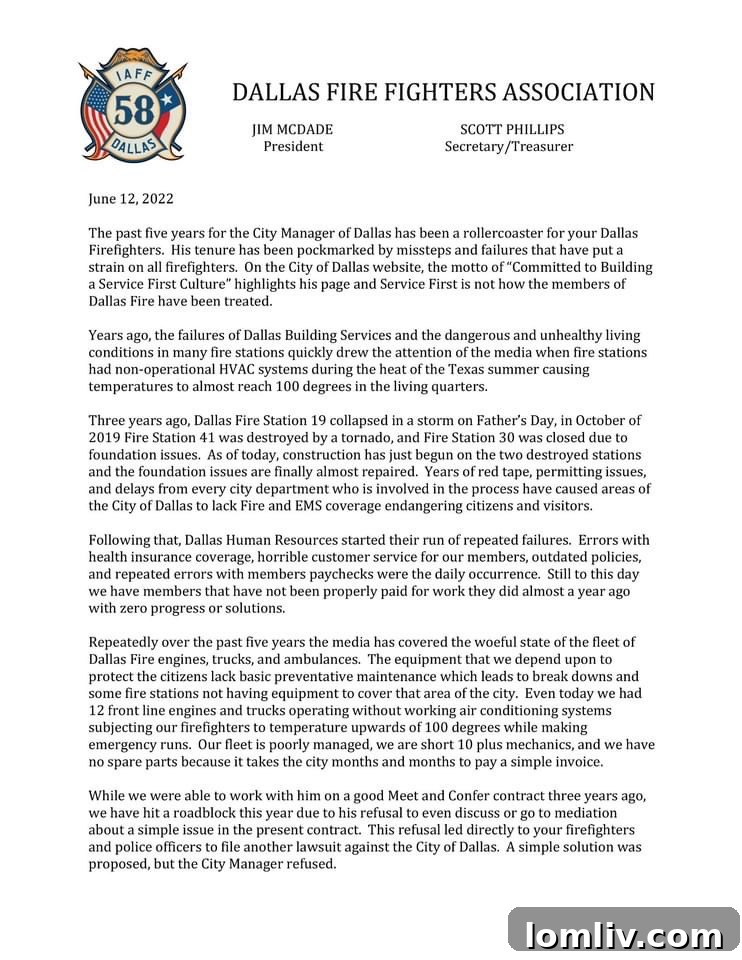
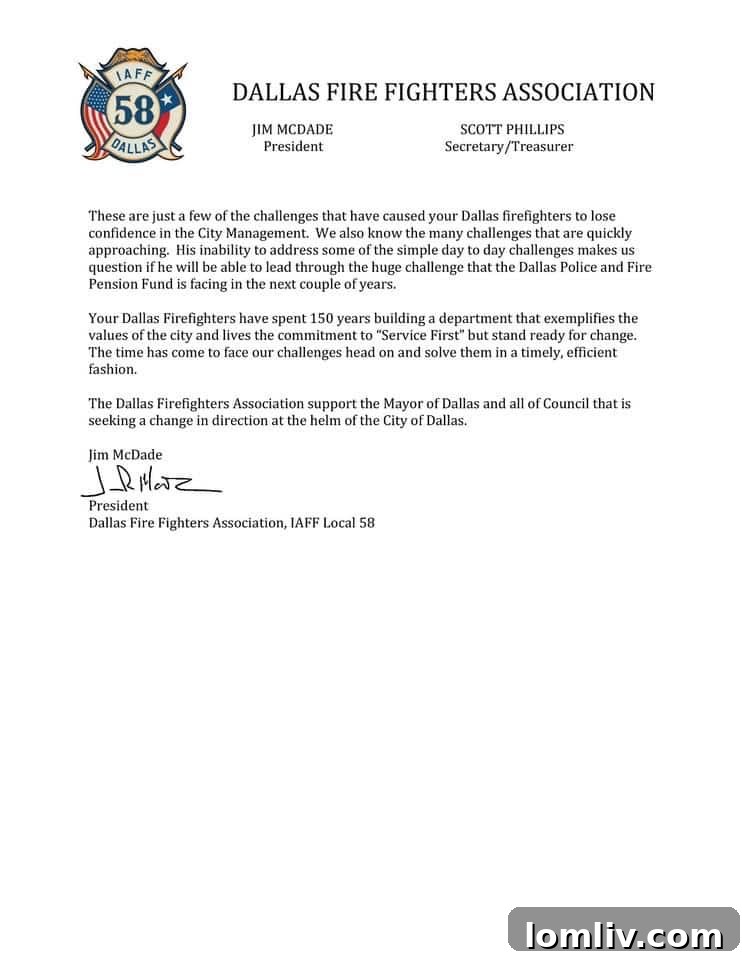
The Dallas Fire Fighters Association (DFFA) has also joined the chorus of criticism, publicly declaring a loss of confidence in the city manager’s leadership. In a powerful letter addressed to the city council and signed by DFFA President Jim McDade, the association drew a direct link between the city’s administrative inefficiencies and compromised public safety. The letter outlined specific examples of delayed essential infrastructure projects: “Three years ago, Dallas Fire Station 19 collapsed in a storm on Father’s Day; in October 2019 Fire Station 41 was destroyed by a tornado; and Fire Station 30 was closed due to foundation issues.” The critical point being that “As of today, construction has just begun on the two destroyed stations and the foundation issues are finally almost repaired. Years of red tape, permitting issues, and delays from every city department who is involved in the process have caused the city of Dallas to lack fire and EMS coverage, endangering citizens and visitors.” This chilling assessment underscores how administrative failures under Broadnax’s watch have tangible and dangerous consequences for the lives and safety of Dallas residents.
What’s Next: A Defining Moment for Dallas City Leadership
The upcoming council meeting promises to be a defining moment for Dallas, as the city’s leadership faces a complex and highly scrutinized decision regarding T.C. Broadnax’s employment. The precise alignment of council members on Broadnax’s future remains somewhat ambiguous, reflecting a division within the 15-member panel. Reports indicate that Broadnax was previously offered an opportunity to resign voluntarily but declined, signaling his intent to remain in his position. A faction of the council has publicly voiced support for Broadnax, with members Paul Ridley (District 14), Carolyn King Arnold (District 4), Jaime Resendez (District 5), and Omar Narvaez (District 6) explicitly stating their opposition to his removal. District 11 Councilwoman Jaynie Schultz even praised him as an “outstanding city manager,” highlighting the contrasting views among the city’s elected officials.

For Broadnax to be removed from his role as city manager, a significant majority of the council must vote in favor of termination, specifically requiring eight votes from the 15 representatives. Mayor Eric Johnson has made his position unequivocally clear, stating that if the matter proceeds to a vote, he will advocate for the immediate termination of Broadnax’s contract. In a direct newsletter email to residents, Mayor Johnson articulated his stance, emphasizing a call for greater accountability within city hall: “It’s time for accountability. That means change at the top of the city bureaucracy.” This declaration sets the stage for a potentially contentious vote, underscoring the high political stakes involved.
As of now, the official agenda for the crucial June 23 meeting has not yet been posted, leaving many to speculate about the specifics of the discussions and the potential outcomes. However, the public can follow the proceedings live, as Dallas City Council meetings are streamed online at dallascityhall.com. This transparency ensures that residents and stakeholders can witness firsthand the critical deliberations that will shape the future direction of Dallas’s administrative leadership. The decision on Broadnax’s contract is not merely about an individual’s employment; it is a referendum on the city’s approach to persistent challenges in public services, urban development, and governance, ultimately impacting the quality of life and economic prosperity for all Dallasites.