

A new era for the Dallas Mavericks and potentially for Texas’s entertainment landscape began with a significant transaction. Dallas Mavericks owner Mark Cuban recently finalized the sale of a majority stake in his beloved professional basketball team to the Dumont and Adelson families. These prominent casino magnates, widely recognized for their ownership of Las Vegas Sands Corp. (LVS), are making an unmistakable statement about their intentions in the Lone Star State. This strategic partnership and a series of substantial land acquisitions suggest a clear ambition: to bring resort casino gambling to Texas.
The first major indicator of this grand vision emerged last July when the casino group purchased a sprawling 100-acre parcel northeast of the former site of Texas Stadium in Irving. Valued at $22.4 million, this acquisition immediately raised eyebrows and fueled speculation about the future of gaming in a state notoriously resistant to it. For seasoned observers of Texas politics and real estate, the message behind these moves is clear and compelling.
Mark Cuban’s Strategic Play: A Partnership for Greater Ambition
For years, Mark Cuban has been a vocal proponent and active lobbyist for the legalization of resort casino gambling venues in Texas. His advocacy has been persistent, driven by a vision of integrated resorts that could transform the state’s entertainment and tourism industry. However, the path to legalization in Texas is arduous, requiring nothing less than an act of the state legislature, often necessitating a constitutional amendment approved by voters.
The decision to sell a majority stake in the Mavericks, though surprising to some, was a calculated move. In a recent Q&A with theDallas Morning News, published shortly after the NBA Board of Governors unanimously approved the sale, Cuban articulated his rationale. “It’s a partnership, right?” Cuban explained. “They’re not basketball people; I’m not a real estate person. That’s why I did it. I could have gotten more money selling it to somebody else. Obviously, I’m really excited about everything, but this was a great partnership. I’ve known these guys for a long time. They’re great at the things I’m not good at.”
This statement underscores the synergistic nature of the alliance. Cuban brings his deep understanding of sports operations, brand management, and the Dallas market, while the Adelson and Dumont families, through Las Vegas Sands Corp., bring unparalleled expertise in developing and operating world-class integrated resorts. This strategic alignment suggests a long-term vision that extends far beyond the basketball court, aiming to create a comprehensive entertainment destination that could host a new Mavericks arena as its centerpiece, alongside a lavish resort casino.
Las Vegas Sands’ Growing Footprint: More Than One Purchase
The 100-acre acquisition in Irving was not an isolated incident. The Dallas Morning News further reported that Sands Corp. made another significant land purchase of over 12 acres. This property, located on Stemmons Freeway at Inspiration Drive within Dallas’ vibrant Design District, was valued at approximately $42.9 million. Its strategic location directly across the freeway from Victory Park, home to the American Airlines Center, is particularly noteworthy. The property also includes a building that currently serves as the Mavericks practice facility. These two distinct yet strategically located parcels—one expansive, the other centrally positioned—paint a picture of an ambitious multi-faceted development strategy designed to maximize visibility, accessibility, and economic impact within the North Texas region.
Will The Texas Legislature Gamble on Resort Casinos?
As a billionaire businessman and former “shark” on the popular ABC series “Shark Tank,” Mark Cuban is renowned for his astute understanding of speculative investment. His recent moves, alongside the Adelson and Dumont families, strongly indicate he is betting on a significant regulatory victory in the upcoming 89th legislative session, slated for January 2025. This anticipation stems from the immense economic potential that legalized gambling, specifically resort casinos, could unlock for Texas.
The national casino industry already contributes nearly $329 billion annually to the U.S. economy, according to a 2023 study conducted on behalf of the American Gaming Association. This staggering figure highlights the industry’s capacity to generate massive economic activity, tax revenue, and employment opportunities. For a state as large and economically powerful as Texas, the introduction of resort casinos could translate into billions in new investment, tens of thousands of jobs, and a significant boost to state and local coffers.
Despite these compelling economic arguments, the path to legalization remains politically challenging. Conservative opposition to gambling has historically been a formidable hurdle in Texas. DALTXRealEstate.com reached out to key legislative figures, including Texas Rep. Terry Meza, D-Irving, and Texas Sen. Nathan Johnson, D-Dallas, for comment on the prospect of resort casinos. Rep. Meza did not respond to the inquiry, and a spokeswoman from Sen. Johnson’s office indicated the senator would decline comment at this time. This reticence underscores the sensitive and contentious nature of the issue within the state’s political landscape.

In the previous legislative session, Fort Worth State Rep. Charlie Geren, a Republican, filed a bill that aimed to empower Texas voters to decide on legalizing sports betting and expanding casino gaming to a limited number of “destination resorts.” Although that bill ultimately did not pass, many advocates, including Mark Cuban, express confidence that similar legislation will resurface in future sessions. The proponents believe that with the right political will and public support, North Texas could indeed evolve into a premier tourist destination, anchored by world-class resort casinos that offer far more than just gambling.
What a Resort Casino Would Mean to Irving’s Economy
The city of Irving, Texas, is no stranger to hosting major tourist attractions and, at times, drawing significant economic activity away from its larger neighbor, Dallas. This historical dynamic provides a compelling backdrop for the current discussions surrounding a potential resort casino. One cannot delve into the historical rivalry and economic competition between Irving and Dallas without recalling the saga of Texas Stadium.
The Dallas Cowboys, an iconic NFL franchise, called the Cotton Bowl home from their inception in 1960. However, in 1967, founding owner Clint Murchison Jr. announced ambitious plans to construct a new, state-of-the-art Texas Stadium in Irving. This move was not without controversy. According to reports, Murchison “felt that the Fair Park area of the city had become unsafe and downtrodden, and did not want his season ticket holders to be forced to go through it.” His request to then-Mayor Erik Jonsson to build a new stadium in downtown Dallas as part of a municipal bond package was denied, leading to Irving becoming the Cowboys’ new home. This historical precedent demonstrates Irving’s capacity and willingness to embrace large-scale developments that bring significant economic and cultural impact, even at the expense of its larger neighbor.
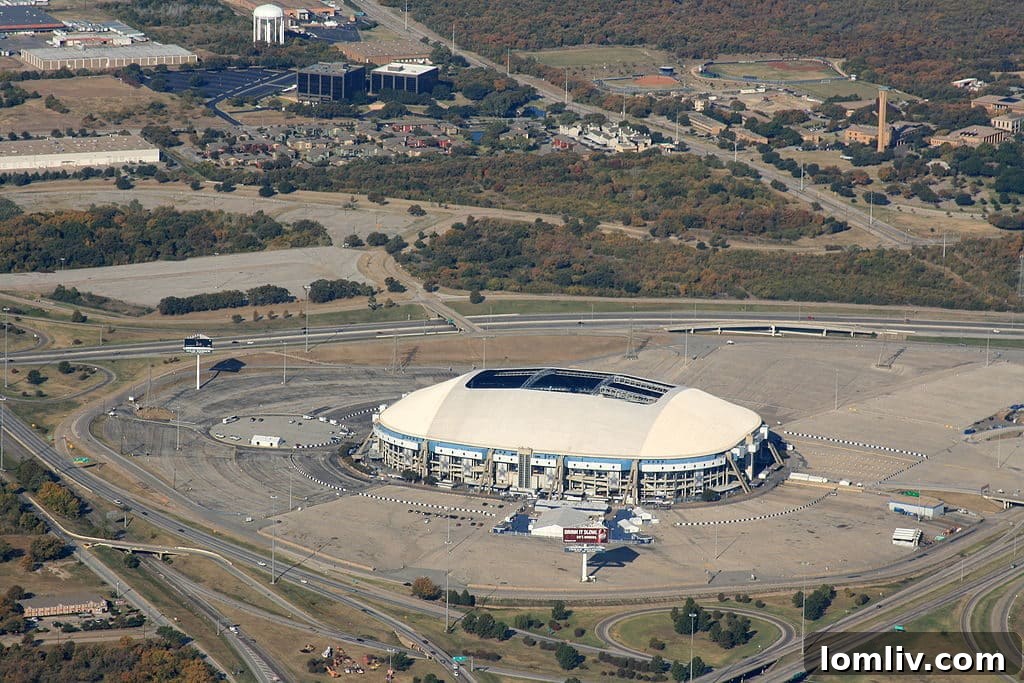
Texas Stadium remained the Dallas Cowboys’ cherished home in Irving until 2009, when the colossal $1.3 billion AT&T Stadium opened its doors in neighboring Arlington, further cementing North Texas as a hub for premier sports entertainment. This continuous evolution of sports venues highlights the region’s dynamic growth and its readiness for large-scale, privately funded projects.
The reported $3.8 billion purchase of the Mavericks by the Adelson and Dumont families is not merely a change of ownership; it’s a strategic investment designed to place the professional basketball team “in a better position to compete.” Mark Cuban himself articulated concerns about dips in traditional media revenue, a trend impacting many sports franchises. A new, state-of-the-art arena integrated into a resort casino complex would offer diversified revenue streams, enhance the fan experience, and provide unparalleled opportunities for sponsorships and ancillary businesses, thereby increasing the team’s long-term value and competitive edge. NBC DFW reported on December 27 that the transaction granted the Adelson and Dumont families a 77 percent share of the team, with Cuban intelligently retaining the remaining 23 percent and crucial operational control.
The land purchased for $22.4 million by Village Walk RE 2 LLC at 2615 Spur 482, near the former home of the Dallas Cowboys, is a prime location for such a transformative development. Irving, as a city, is already recognized as an “economic powerhouse in North Texas,” proudly hosting the region’s largest office park where more than 10 percent of Fortune 500 companies either have their headquarters or a significant presence, according to the city website. Recent announcements, such as Wells Fargo’s new corporate campus development in Irving, set to relocate a majority of its Dallas employees by 2025, further solidify Irving’s reputation as a robust and growing economic center. This existing strong economic base makes Irving an ideal candidate to capitalize on the vast economic benefits a resort casino could bring.
The American Gaming Association study further emphasizes that, beyond its massive national economic impact, the gaming industry generates an impressive $52.7 billion in tax revenue for federal, state, and local governments annually. Moreover, it provides jobs for a substantial workforce of 1.8 million individuals across the country. Should Texas choose to embrace resort casinos, Irving stands poised to reap substantial rewards, including thousands of new jobs in construction, hospitality, and entertainment, a significant boost to its local tax base, and an elevated profile as a premier destination for business and leisure. The high stakes are evident, and the potential rewards for the Lone Star State are undeniably compelling, making the upcoming legislative session one of the most anticipated in recent memory for those hoping to see Texas join the ranks of states benefiting from integrated resort developments.