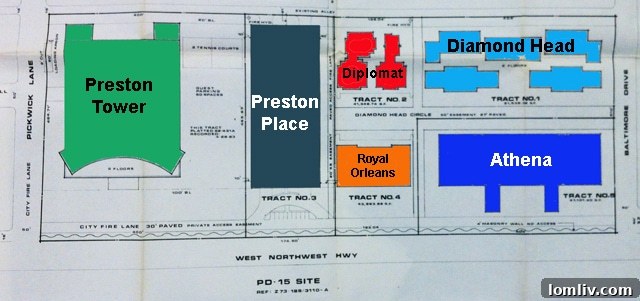
The vibrant real estate landscape of Dallas, particularly within the highly coveted Preston Hollow area, is once again buzzing with whispers of significant redevelopment. Sources close to the community, often referred to as “behind the Pink Wall,” indicate a growing restlessness among residents and a strategic maneuver by certain property owners. Specifically, two prominent neighboring condominium complexes located at 6307 and 6306 Diamond Head Circle—the elegant Royal Orleans and the Diplomat—are reportedly seeking a real estate agent to market their properties to potential developers. This move could signal a transformative shift in one of Dallas’s most established neighborhoods, presenting both immense opportunity and significant challenges for urban planning and community dynamics.
Speculation is rife regarding developer interest, with one credible source revealing that Providence, the renowned firm behind successful projects like Preston Hollow Village, extended an offer for the Diplomat complex. This property, comprising 14 units situated on a substantial 41,349 square feet of land, received a bid of $110 per square foot, totaling approximately $4.55 million. However, this offer was reportedly deemed a “low-ball” and subsequently rejected. For context, industry insiders recall rumors of an earlier bid by Transwestern for its on-again, off-again development project nearby, which was reportedly at least one-third higher. This indicates a clear expectation from property owners for a valuation that truly reflects the prime location and development potential of these parcels.
Meanwhile, Tract 4, known as the Royal Orleans, commands a prime frontage along Northwest Highway. This complex features 20 units spread across 43,994 square feet, complemented by valuable underground parking. As of now, specific bids for this particular parcel have not been publicly disclosed or confirmed. However, its strategic location and features make it an equally attractive target for developers eyeing high-density projects in the area. Given the presence of towering neighbors such as Athena and Preston Tower, a developer might naturally envision a new structure reaching 20 stories or more. Yet, city planners are quick to temper such aspirations, clarifying that current zoning and historical precedents within this specific Planned Development District (PD-15) would render such a vision approximately 18 stories too tall.
Unpacking PD-15: A Journey Through Dallas’s Urban Planning History
To fully grasp the intricacies and potential hurdles of redevelopment in this area, a deep dive into the historical context of Planned Development District 15 (PD-15) is essential. My investigation at City Hall revealed that the region, stretching from Preston Tower on Pickwick Lane to Baltimore, and extending two lots deep from Northwest Highway (culminating mid-block in the alley between Bandera and Diamond Head Circle), is indeed governed by PD-15. This specific designation dates back to 1947 when the land underwent its initial conversion from agricultural use, marking the beginning of its urban evolution. For those tracking Dallas’s expansive development history, it’s worth noting that the city currently manages an impressive 375 Planned Development Districts, each with its own unique regulations and history.
The journey of PD-15 from its origins reflects broader shifts in Dallas’s urban planning philosophy. Initially, the area was zoned for commercial use (C-2). However, in the 1960s, a significant reclassification occurred, transitioning the district to residential zoning, specifically for apartment developments. This change accommodated the growing need for housing in a rapidly expanding city. An important nuance for historical accuracy is the existence of exemptions for the commercial operations situated on the first two floors of Preston Tower, a testament to the adaptive nature of urban planning in response to existing structures and community needs. These historical precedents play a crucial role in understanding current development limitations and opportunities.
PD-15 encompasses a substantial 14.2 acres, thoughtfully subdivided into six distinct tracts. Within these tracts reside the iconic Preston Tower and Athena high-rises, alongside four projects that originally began as apartment complexes and have since transitioned into two and three-story condominium buildings. The Royal Orleans, strategically positioned with frontage on Northwest Highway, is separated from the Diplomat by the curving expanse of Diamond Head Circle. This layout is not merely geographical; it’s fundamental to the regulatory framework. City Planners emphasize that every element within a PD is approved as part of a holistic project. Therefore, these properties aren’t zoned in a conventional manner (e.g., C-2 or MF-3). Instead, their “zoning” is inherently defined by the component projects that collectively form the entire PD-15. Consequently, under the existing PD-15 framework, both the Royal Orleans and Diplomat buildings are strictly limited to their current height and unit density.
Lessons from the Past: Construction, Community, and Density Debates
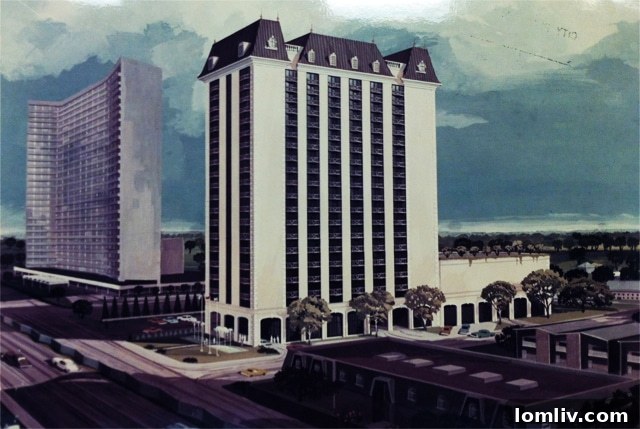
The history of development within PD-15 is replete with cautionary tales and vivid examples of community influence. A particularly illuminating chapter unfolded in 1973 when developer Raymond F. Ratcliff sought approval for a third high-rise project on Tract 3. His ambitious proposal envisioned a 19-story residential tower, complete with ground-floor amenities and extensive parking facilities. However, this vision encountered significant resistance. The collective efforts of City Planners, the formidable “Pink Wall” residents, and the broader Preston Hollow community rallied against the proposed high-rise. Their concerns, primarily centered on increased density, traffic congestion, and potential impacts on neighborhood character, ultimately prevailed. The proposed 19-story edifice was scaled down dramatically, resulting in the comparatively modest three-story, 60-unit Preston Place we see today, occupying 77,315 square feet.
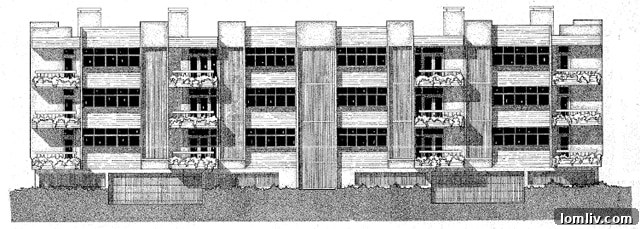
Given the contemporary concerns surrounding urban traffic and population density, any renewed attempt to introduce a high-rise in this sensitive location today would undoubtedly ignite an even more intense public outcry. The community’s response would likely eclipse the spirited debates of 1973, transforming what was then a “spat” into an epic confrontation, demonstrating how much the stakes have risen with increased urbanization and infrastructure strain. This historical precedent serves as a powerful reminder of the community’s capacity to shape its surroundings and the significant obstacles developers face when proposing projects that deviate from established neighborhood expectations.
The “Poison Pill”: Navigating Access and Ownership on Diamond Head Circle
As previously established, increasing the density of any tract within PD-15 requires explicit approval from City Planning, and any proposed alteration to the components of the PD would trigger intense public scrutiny and potentially widespread opposition. Interestingly, discussions with City Planners suggest that, purely on paper and without considering external input, they might conceptually favor a high-rise proposal for these particular tracts. This inclination stems from the existing precedent set by the Athena and Preston Tower high-rises within the same district. This theoretical openness, however, is dramatically complicated by a critical stipulation within the original PD-15 documents—a veritable “poison pill” for any developer seeking to combine and build upon the Diplomat and Royal Orleans parcels.
A fascinating side note: Any high-rise proposal on these tracts would, unlike many other development controversies in Preston Center, directly impact Laura Miller, granting her a personal stake in the outcome. The panoramic views from her and Steve’s rental property in Athena would be significantly altered. (Full disclosure: My own views would also be affected, requiring me to be more mindful of my attire at home!)
The core challenge lies in a specific clause: “Permanent vehicular access must be provided from the proposed apartment building on Tract 3 to Diamond Head Circle (a private street). Diamond Head Circle must be designated as a perpetual access easement. (Ord. Nos. 14241; 24637)” This clause effectively means that while it might be legislatively possible to upzone either the Royal Orleans or Diplomat properties individually, the prospect of combining both tracts for a unified, connected development becomes exceedingly difficult, if not impossible, under current conditions. The private nature of Diamond Head Circle and the perpetual access easement represent formidable barriers to consolidation.
Developers face a two-pronged battle. First, they would need to gain outright ownership of the relevant portion of Diamond Head Circle. Drawing lessons from the complex ownership structure of the Preston Center West garage, it’s highly probable that this street’s ownership is convoluted, potentially requiring unanimous approval from all five buildings within PD-15 that rely on its access. Securing such widespread consent, especially from the established high-rises like Athena and Preston Place, would be a monumental, almost unattainable, task. The diverse interests and potential impacts on current residents make consensus a distant dream.
Secondly, a developer would be compelled to nullify the perpetual access easement clause pertaining to Tract 3. While this might initially seem less daunting than acquiring street ownership, it presents its own set of significant hurdles. A closer examination of the photograph depicting the unbuilt 1973 high-rise suggests that this access clause might have been specifically incorporated to serve that particular unrealized building. To nullify it, a developer would need to conclusively prove that Preston Place (Tract 3) no longer requires access via Diamond Head Circle. Considering the potential scenario of a sheer high-rise wall rising just an alley’s width away, Preston Place residents would undoubtedly fight such a proposition with unwavering determination, defending their current access and quality of life vigorously. The convergence of these two formidable requirements—acquiring private street ownership and nullifying a perpetual easement—renders the odds of a seamless, combined high-rise development exceptionally low.
Proactive Engagement: A Call to the Preston Hollow South Neighborhood Association
My proactive communication with residents of the Preston Hollow South Neighborhood Association earlier in April highlighted a crucial foresight: the increasing pressure on low-rise buildings along Northwest Highway, particularly those surrounding Athena, to sell out due to potential upzoning. I previously emphasized that approving Transwestern’s proposed four-story development on the corner could inadvertently establish a “cap” for future higher buildings along Northwest Highway. This perspective gains further credence when observing nearby developments, such as the five-story Sorrento at Turtle Creek and Bandera, and its adjacent, under-construction neighbor, illustrating a trend toward moderate-density infill projects rather than towering structures in similar contexts.
It’s vital to clarify my stance on these developments. I am not inherently opposed to these two buildings (Royal Orleans and Diplomat) being sold and their density potentially increasing. Indeed, with 14 and 20 units respectively on an acre of land, their current density is remarkably low, and the Royal Orleans building, frankly, is not renowned for its aesthetic appeal. Furthermore, I would not object to the Diamond Head condos (Tract 1) undergoing redevelopment to achieve a higher density, provided it is done responsibly. My fundamental opposition, however, lies in irresponsible and unfair development practices, particularly the “boxing-in” of one building by another. More specifically, I am strongly against the introduction of high-rises in this area, primarily because the existing interior roads—some barely wider than a single lane—are fundamentally incapable of being expanded to adequately support the dramatic increase in traffic generated by such high-density projects. Sustainable urban planning demands infrastructure that can accommodate growth, and in this instance, the current road network falls significantly short.
The city planner I consulted offered valuable advice, commending my initiative to conduct thorough research before any formal proposals were on the table. She lamented that too often, residents rush to react after a decision has been made, metaphorically “dashing into the barn after the horse is gone.” Embracing this wisdom, I believe it is imperative that the Preston Hollow South Neighborhood Association prepares its “permission slips” and organizes a field trip to City Hall. A direct engagement with city planners, allowing residents to articulate their thoughts, concerns, and vision for the neighborhood, is not just beneficial—it’s critical. Failure to do so risks seeing that conceptual 1973 high-rise drawing metaphorically “rise from the dead,” potentially transforming the character of Preston Hollow in ways the community might not desire. Proactive dialogue is the most effective tool for shaping the future of our urban spaces.
We Want to Hear From You! Do you have an intriguing HOA story to share? Perhaps a piece of Dallas high-rise history that’s rarely told? Realtors, is there a listing in need of a visionary renovation you’d like to feature, or a stunning completed project that deserves the spotlight? How about hosting a Candy’s Dirt Staff Meeting in your exceptional space? Send us an email – even marriage proposals are now legally accepted! Reach out to our team at [email protected]. Your insights and stories help shape the conversation around Dallas real estate.