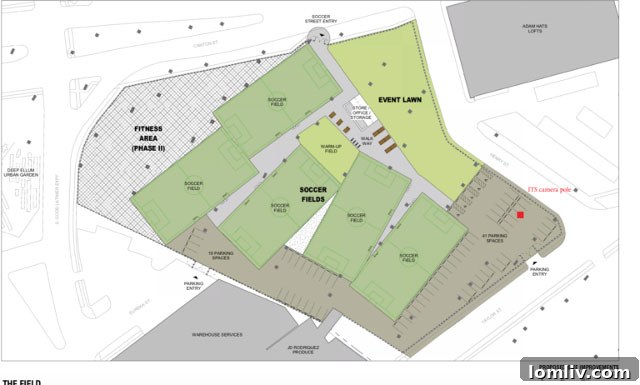
The intricate landscape of urban development in Dallas frequently brings to light complex proposals that challenge the balance between economic growth, community needs, and existing infrastructure. One such recent saga revolved around a controversial plan to construct five soccer fields beneath the sprawling IH-345 overpass, near Canton Avenue. This ambitious project, spearheaded by Roddrick West, son of State Senator Royce West, aimed to transform underutilized public land into a vibrant sports complex. However, its journey through the Dallas City Council was fraught with political maneuvering, community opposition, and ultimately, a decisive rejection that underscored the critical importance of thoughtful urban planning.
Back in June, the Dallas City Council found itself at a pivotal juncture, poised to vote on relinquishing development rights for key parcels of land. These parcels, situated beneath IH-345 and along Canton Avenue, were central to an agreement with the Texas Department of Transportation (TXDoT) that would facilitate West’s soccer field initiative. The proposal itself was not without its advocates, promising significant economic benefits and recreational opportunities for the community. Yet, it quickly became entangled in broader discussions about Dallas’s urban future, particularly concerning the long-debated fate of IH-345.
For years, IH-345 has been a focal point of urban planning discussions in Dallas. The debate, often framed as “tear down or rebuild,” has drawn considerable attention from developers, residents, and city planners alike. Organizations like AARP and TREC have even commissioned studies, such as the “CityMAP” initiatives, to explore various scenarios for congestion mitigation and urban revitalization in the Dallas city core. These discussions highlight the highway’s critical role in regional connectivity but also its divisive impact on downtown Dallas, creating physical barriers and limiting walkable urban spaces. The soccer field proposal, by seeking to utilize land directly under this contentious highway, inherently became part of this larger conversation about how Dallas should evolve.
Adding another layer of complexity to the proceedings was the political strategy employed by District 8 representative Tennell Atkins. Atkins became a central figure in the debate when he deliberately held up a crucial vote on Carpenter Park, a beloved urban green space. His tactic involved refusing to separate the Carpenter Park resolution from the more contentious soccer field proposal, effectively attempting to force the latter through by leveraging the former’s popularity. This procedural maneuver drew significant ire from many council members and community groups, highlighting the frustrations that can arise when unrelated urban development projects are bundled together in an attempt to sway votes. The initial vote on these intertwined issues was consequently held over, pushing the final decision to a later session, creating an atmosphere of heightened anticipation and political tension.
Strategic Separation: Unbundling Dallas’s Urban Development Issues
The rescheduled council meeting, held last Wednesday, opened with a sense of guarded anticipation. Immediately following the reading of the resolutions for the three original, bundled cases—all highway-adjacent issues that TXDoT had combined—a decisive moment unfolded. District 11 representative Lee Kleinman, recognizing the strategic importance of independent evaluation, promptly introduced a motion to separate these cases. After a palpable, pregnant pause, the motion passed swiftly, signaling a significant procedural victory for those advocating for clarity and proper due diligence in urban planning decisions. This separation allowed the council to consider each project on its individual merits, free from the political leverage of other proposals.
With the cases now separated, the council first turned its attention to Carpenter Park, a vital urban amenity that had become an unwitting pawn in the soccer field debate. The resolution concerning Carpenter Park was addressed with remarkable speed and consensus. The only notable interruption came from a council member, affectionately dubbed a “grammar policewoman,” who sought to ensure the final resolution was precisely worded—a testament to the importance of meticulous detail in legislative documents. The swift approval brought welcome news for parkgoers, confirming the allocation of resources for much-needed new restrooms in that section of the park. This seemingly small improvement carries significant weight for the user experience, enhancing accessibility and comfort in one of Dallas’s important public spaces. Furthermore, this addition contributes to the citywide total of 149 public restrooms, reflecting Dallas’s ongoing efforts to improve its park infrastructure and earn higher grades for its public lands, a metric often scrutinized by organizations like the Trust for Public Land.
Kicking the Soccer Fields to the Curb: A Unanimous Rejection
With Carpenter Park’s fate swiftly and positively resolved, the council then moved to the second item on the agenda: the controversial parcel designated for the proposed soccer fields. This project, which had been a topic of debate and discussion since its inception in 2018, now faced its ultimate reckoning. After a brief period of linguistic refinement, similar to the Carpenter Park discussion, the resolution to reject the soccer fields came to a vote. The outcome was decisive and, perhaps for many, not entirely unexpected: it passed unanimously, effectively killing the project. Notably, District 8 representative Tennell Atkins, who had previously been a vocal proponent and had used parliamentary tactics to support the proposal, remained silent throughout this pivotal vote. His silence underscored the perceived shift in council sentiment and the widespread annoyance that had accumulated from his earlier attempts to bundle the projects. Observers of the June council meeting had already noted the growing frustration among many members regarding the holding up of Carpenter Park for what many considered an ill-conceived and “off-smelling” soccer plan.
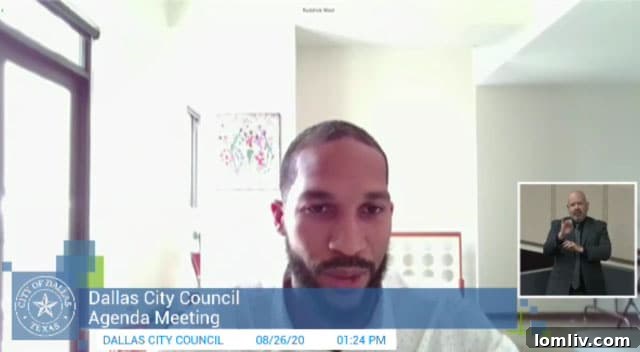
Prior to the vote, the council heard from several speakers, both in favor of and against the proposed soccer fields, each presenting their perspectives on this significant urban development project. Roddrick West himself addressed the council, advocating passionately for his vision. He emphasized the economic benefits, projecting the creation of over 120 jobs in the area surrounding the five proposed soccer fields. Beyond job creation, West also highlighted the potential for substantial revenue generation for the city, estimating an annual influx of $500,000 in sales taxes. To put this into perspective, if the city were to receive $500,000 in sales tax revenue annually, it would imply that the soccer fields were generating approximately $6 million in total taxable revenue each year. While these figures painted an attractive picture of economic uplift, they also raised questions and skepticism among some council members and city staff. The city had always expressed a degree of reticence regarding this particular project, not just because of the direct financial projections but also due to concerns about the potential for other commercial uses that might arise. The proposal hinted at future possibilities for events and other “boozier, revenue-generating” activities, which could introduce unforeseen challenges related to noise, traffic, and neighborhood character. While two other individuals spoke in support of West’s plan, their presentations were notably rambling and ultimately ran out of time before their key arguments could be clearly articulated, further diminishing the persuasive power of the proponents’ side.
The Critical Flaw: Deep Ellum’s Exacerbated Parking Crisis
In stark contrast to the often vague and financially optimistic arguments put forth by the proponents, the opposition to the soccer field plan was remarkably focused and impactful. Beyond a brief, wistful non-sequitur comparing the project to soccer’s significance in the Vatican (which did little to sway opinion), the arguments against the proposal were grounded in practical, pressing urban challenges. The most prominent and damning critique centered on the project’s utterly insufficient parking provisions. Opponents meticulously pointed out that the proposed facility would offer a mere 61 parking spaces to support five simultaneously operational soccer fields. This figure became a central point of contention when considering the sheer volume of people such a complex would attract: potentially ten teams playing at once, their associated coaches, referees, and an untold number of fans. The fundamental question that resonated through the council chambers was clear: where would all these vehicles park?
This parking dilemma was not an isolated issue but rather exacerbated a pre-existing, severe challenge in the vibrant Deep Ellum district. Deep Ellum, renowned for its lively music venues, eclectic shops, and diverse restaurants, already grapples with chronic parking shortages during normal, pre-pandemic times. The district transforms into a veritable “congestion nightmare” on weekends and evenings, with visitors often circling for extended periods in search of a spot. Introducing a major sports complex, with its inherent demand for vehicular access, without providing adequate, integrated parking solutions, was widely viewed as an irresponsible and unsustainable plan. The additional influx of thousands of people—not even accounting for the 120-plus jobs the fields were projected to create, each demanding a parking space—would undoubtedly push Deep Ellum’s already strained infrastructure past its breaking point. This would lead to increased traffic congestion, frustration for local businesses and residents, and potentially deter visitors who are unwilling to endure the parking ordeal.
Moreover, representatives from the Deep Ellum Foundation and numerous local business owners delivered powerful testimonies, echoing concerns they had raised for over a decade. They highlighted their consistent, yet consistently ignored, requests to lease available land in the area from TXDoT specifically to increase parking capacity. Their pleas had fallen on what they described as TXDoT’s “deaf ears,” revealing a systemic disconnect between the needs of the local community and the priorities of state transportation authorities. This long-standing frustration further intensified the opposition to the soccer field proposal, which seemed to prioritize a new, ill-equipped development over the documented, urgent needs of an established cultural and commercial hub. The council, acknowledging these persistent concerns, recognized that the soccer fields would not only fail to address Deep Ellum’s parking crisis but would actively worsen it, creating significant negative externalities for the entire district.
The final parcel of the trio of separated cases, a piece of land situated further down the road just west of IH-345 between South Boulevard and Pennsylvania Avenue, received a different resolution. Recognizing that significant planned work was already underway in the vicinity of this parcel, the council prudently voted to table its discussion indefinitely. This decision reflected a sensible approach to urban planning, ensuring that any future development on that specific site would be carefully considered in conjunction with ongoing infrastructure projects, minimizing disruption and optimizing integration.
In conclusion, the two-year saga surrounding the proposed five-plex of soccer fields under IH-345 ultimately concluded with the Dallas City Council making what many considered to be the right decision. The unanimous rejection of the plan underscored the council’s responsiveness to deeply rooted community concerns, particularly regarding infrastructure, traffic, and the sustainable use of public land. This outcome serves as a powerful reminder of the importance of robust public discourse, procedural integrity in local governance, and a willingness to prioritize the long-term well-being of existing communities over potentially short-sighted development schemes. While some might view this as an exception that proves the rule of cynical urban politics, it also offers a glimmer of hope that thoughtful, community-centric planning can indeed prevail in Dallas’s ever-evolving urban landscape. The city continues to face complex decisions regarding IH-345’s future and the revitalization of its core, and this decision sets a precedent for how such challenges might be navigated with greater transparency and a commitment to genuine public benefit.