Collin County’s Growing Affordability Crisis: Unpacking the MoneyGeek Report on Soaring Homeownership Costs
For many residents of Collin County, Texas, the dream of affordable homeownership may be slipping further out of reach. A recent insightful analysis by personal finance website MoneyGeek reveals a stark reality: this vibrant North Texas county is increasingly becoming unaffordable for its current inhabitants. This comprehensive study, which crunched critical financial data such as median home prices and median incomes, positions Collin County among the nation’s most challenging housing markets.
The findings paint a clear picture of an escalating affordability crisis, driven by a confluence of factors that have reshaped the local real estate landscape. As the region continues to experience robust economic growth and an influx of new residents, the demand for housing has surged, pushing property values to unprecedented levels. This dynamic has created a significant disconnect between what residents earn and what they need to spend to secure a home, challenging the long-term financial stability of many families and individuals within the county.
The Alarming Reality: Collin County’s Unaffordable Housing Market
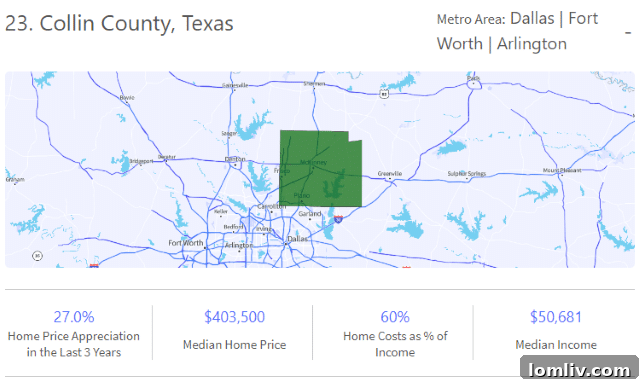
MoneyGeek’s methodology meticulously examined key financial metrics to assess housing affordability across the United States. Their analysis unequivocally demonstrates that Collin County’s housing market has undergone a dramatic transformation. Over just the past three years, housing prices in the county have surged by a staggering 27 percent, a rapid escalation that far outpaces income growth for many households.
The financial burden on residents is substantial. Home costs now consume an estimated 60 percent of the median income in Collin County. With a median home price hovering around $403,500 and a median income reported at $50,681, the disparity is stark. This ratio highlights a significant challenge for potential homebuyers and places considerable strain on existing homeowners. While MoneyGeek’s report focuses on the core homeownership costs, it’s imperative to acknowledge that rising property taxes, a frequent consequence of appreciating home values in Texas, further compound the financial pressure on current homeowners, a crucial detail not explicitly addressed but widely felt by local residents.
This situation directly impacts the quality of life, economic mobility, and community fabric of Collin County. Young professionals, growing families, and individuals working in essential service sectors often find themselves priced out of the market, forcing them to commute from neighboring, more affordable areas or abandon their aspirations of homeownership within the county altogether. The long-term implications for local businesses seeking to attract and retain talent, as well as for the diversity and vibrancy of the community, are significant and warrant careful consideration.
A Wider Trend: Collin County in the National Context
Collin County’s experience is not isolated; it reflects a broader national trend of increasing housing unaffordability in high-growth areas. Nationally, Collin County ranks 23rd among the most unaffordable counties. This position underscores the severity of the local market challenges when benchmarked against other highly competitive regions across the U.S.
Texas, in particular, features prominently in MoneyGeek’s findings. The rapidly expanding Austin-Round Rock metropolitan area, encompassing Travis and Williamson counties, ranks even higher, securing third and fourth positions nationally, respectively. The analysis attributes the soaring homeownership costs in this south-central Texas region to intense demand coupled with limited housing inventory. Additionally, a significant influx of new residents migrating to Austin’s burgeoning suburbs further exacerbates the supply-demand imbalance, driving prices upward at an unsustainable rate for many.
Beyond Texas: Other High-Cost Hotspots
The phenomenon of high-growth metro areas becoming increasingly unaffordable is evident in other parts of the country as well. Douglas County, located within the greater Denver metropolitan area, serves as another prime example. Since 2019, house price appreciation in Douglas County has reached an astonishing 43 percent, making it one of the nation’s most challenging markets for prospective homeowners. Similarly, Snohomish County, situated just outside Seattle, boasts some of the highest median home prices nationwide, recorded at an eye-watering $555,495.
These examples highlight a consistent pattern: regions experiencing robust economic expansion, job growth, and population influx are often those grappling most severely with housing affordability issues. The appeal of these areas, while beneficial for overall economic development, simultaneously creates an intense competitive environment for housing, pricing out many who contribute to their very success.
Ada County, Idaho: The Nation’s Least Affordable
The MoneyGeek report also identifies Ada County, Idaho, as the least affordable county in the nation. In Ada County, home costs consume an astounding 81 percent of the median income. This extreme figure illustrates the peak of housing market imbalance, where the cost of living has dramatically outpaced the earning capacity of its residents, leading to profound financial distress and challenging the very notion of sustainable community development.
Understanding the Drivers of Unaffordability
The core of the affordability crisis, as illuminated by MoneyGeek, lies in a fundamental imbalance between supply and demand, intensified by demographic shifts and economic factors. The period from 2019 to 2022 was particularly volatile, characterized by unprecedented housing market activity and price surges across many U.S. counties. MoneyGeek’s analysis meticulously tracked changes in homeownership costs, home-price appreciation, and median incomes during this critical window to pinpoint the 26 counties where the housing market has become critically unaffordable.
The Demand-Supply Imbalance
A primary driver is the chronic shortage of housing supply relative to booming demand. Years of underbuilding, coupled with increased competition from remote workers relocating to desirable areas, and low interest rates (during parts of the study period) fueled a frenzy of buying activity. In places like Collin County and the Austin metro, available homes are quickly snatched up, often with multiple offers above asking price, creating an intensely competitive market that benefits sellers but significantly disadvantages buyers.
Influx of New Residents and Economic Growth
Economic prosperity, while generally positive, often comes with the side effect of increased housing costs. Collin County’s robust job market, excellent schools, and high quality of life have attracted thousands of new residents annually. This population growth creates sustained pressure on the housing supply. As more people move into the area seeking employment and a better lifestyle, the demand for housing units, both rental and owned, increases exponentially. Without a corresponding surge in new housing construction—especially for middle-income earners—prices will continue their upward trajectory.
Broader Implications for Residents and Regional Economies
The escalating housing unaffordability has far-reaching consequences that extend beyond individual household budgets.
Economic Strain and Quality of Life
When a significant portion of income is dedicated to housing, households have less discretionary spending for other goods and services, which can dampen local economic activity. Moreover, the stress of financial insecurity related to housing can negatively impact mental and physical health, reduce savings for retirement or education, and limit opportunities for wealth building, particularly for first-time homebuyers.
The Property Tax Burden
While MoneyGeek’s report focuses on home prices and income, it’s crucial for Texas residents to also consider property taxes. As home values appreciate, so do property tax assessments. In Texas, where there is no state income tax, property taxes are a primary source of local government revenue. This means that even if a homeowner purchased their property at a relatively affordable price years ago, their ongoing costs can increase significantly due due to rising tax bills, potentially making it challenging to remain in their homes, especially for those on fixed incomes.
MoneyGeek’s Methodology and Insights
MoneyGeek, a reputable San Francisco-based personal finance website, designed its report to provide clarity on a critical economic issue. Their comprehensive study analyzed data from 2019 to 2022, focusing on three core metrics: changes in homeownership costs, home-price appreciation, and median incomes. By comparing these figures, they were able to identify areas where the cost of owning a home has outpaced the ability of residents to afford it.
How the Study Was Conducted
The detailed approach involved processing vast datasets to calculate key ratios and identify trends. The ability to track changes over a multi-year period allowed the researchers to capture the dynamic shifts in housing markets rather than just static snapshots. This temporal analysis is crucial for understanding the trajectory of affordability challenges.
Expert Perspectives and Data Visualization
The report is further enhanced by an “Expert Insight” section, offering deeper qualitative analysis and context to the quantitative findings. MoneyGeek also provided practical tools for engagement, including an interactive, searchable “Full Data Set” section. This allows users to sort categories from high to low, facilitating personalized exploration of the data. The report’s user-friendly interface and detailed mapping of each county signify a commitment to accessible and actionable financial information, making it a valuable resource for policymakers, residents, and anyone interested in housing market trends.
Navigating the Future: Potential Paths Forward
Addressing the affordability crisis in Collin County and similar high-growth regions requires a multi-faceted approach involving local government, developers, and community stakeholders. Strategies could include:
- Increasing Housing Supply: Encouraging the construction of diverse housing types, including more affordable and medium-density options.
- Streamlining Development: Reducing bureaucratic hurdles and zoning restrictions that inflate construction costs and timelines.
- Affordable Housing Initiatives: Implementing programs such as down payment assistance, land trusts, or inclusionary zoning policies.
- Infrastructure Investment: Investing in public transit and infrastructure to make more distant, affordable areas more accessible.
- Property Tax Reform: Exploring mechanisms to mitigate the burden of rapidly increasing property taxes on long-term residents, especially seniors and low-income homeowners.
Conclusion: Addressing the Affordability Puzzle
MoneyGeek’s analysis serves as a critical wake-up call for Collin County and other rapidly growing regions across the United States. The data clearly indicates that while economic prosperity brings many benefits, it also creates significant challenges in housing affordability. For Collin County residents, the rising costs of homeownership demand urgent attention and collaborative solutions. Understanding the drivers of this crisis and exploring innovative strategies will be essential to ensure that the county remains a place where all residents, not just a privileged few, can afford to live, work, and thrive. The future of Collin County’s vibrant community depends on its ability to balance growth with equitable access to safe and affordable housing.