As Dallas continues its rapid expansion, the heartbeat of its urban core faces a persistent challenge: traffic congestion. The CityMAP initiative emerges as a critical blueprint, proposing audacious solutions to alleviate the gridlock that chokes our streets and divides our neighborhoods. If you’re new to this vital conversation, we recommend reviewing Part One of our deep dive into CityMAP. Overall, the scenarios and analyses presented by CityMAP are remarkably logical and forthright, primarily advocating for the strategic submersion of key highways encircling Dallas’s downtown. This approach aims not only to enhance traffic flow but also to foster significant neighborhood revitalization, transforming concrete barriers into vibrant urban spaces.
Among the various proposals, two stand out for their radical nature and potential for controversy: one suggests rerouting I-30 significantly to the south, and another controversially calls for the outright removal of a segment of I-45 and US-75. While the concept of submerging and capping existing highways resonates as a highly promising path forward for Dallas’s unique urban landscape, my conviction falters dramatically when considering these more extreme alternatives. This article will delve deeper into these contentious proposals, offering a critical analysis of their feasibility and long-term implications for the future of Dallas.
The Audacity of I-45/US-75 Removal: A Recipe for Urban Chaos?
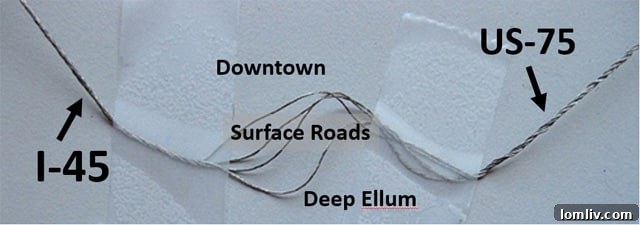
The proposal to remove the section of I-45 stretching from Martin Luther King Jr. Blvd to Woodall Rodgers is, without mincing words, a plan that demands intense scrutiny. On the surface, the allure is undeniable: it promises to heal the historical “schism” that brutally separates central Dallas from vibrant districts like Deep Ellum and Fair Park, fostering a more unified urban fabric. This reconnection could unlock immense potential for development and community cohesion, transforming areas currently blighted by highway infrastructure into pedestrian-friendly zones and valuable real estate.
However, the potential downside is catastrophic. This scenario, vividly illustrated above, would unleash what can only be described as the “CF of all CFs” – a monumental traffic nightmare. Thousands of vehicles currently traversing US-75 or I-45 would be abruptly funneled onto already strained surface streets, including Good Latimer and Cesar Chavez, before eventually attempting to reconnect with the highway system further north or south. This dramatic influx would not only cripple local traffic but also severely impact emergency services and commercial logistics. Alternatively, a significant portion of traffic would be forced onto circuitous regional routes, using I-20/30 to loop over to I-35E, perhaps eventually rejoining US-75 via I-635 – adding considerable time, fuel consumption, and frustration to daily commutes.
During the CityMAP discussions, State Senator Royce West voiced profound concerns regarding this scenario. His worries extended beyond mere side-street congestion, highlighting the severe implications for South Dallas residents seeking to access employment opportunities in North Dallas. The removal of this crucial artery could effectively create a logistical barrier, exacerbating existing socio-economic disparities and placing an undue burden on commuters who rely on these highways for their livelihoods. The economic ripple effect on businesses dependent on efficient transport within the city would also be substantial, potentially leading to increased costs and reduced accessibility.
Proponents of highway removal often cite compelling examples, such as Portland, Oregon’s transformation after the removal of Harbor Drive in 1974. This roadway once carved through downtown Portland, isolating it from its picturesque waterfront. Its removal famously revitalized the city, creating a more vibrant and connected urban environment, widely regarded as a poster child for urban freeway removal. Moreover, numerous well-documented case studies from urban areas globally demonstrate how removing unsightly highways can lead to attractive, reinvigorated neighborhoods, often sparking significant economic growth and improved quality of life.
However, Dallas’s situation presents unique challenges that differentiate it from these success stories. While examples like Portland are inspiring, I prefer to look at Boston’s Big Dig as a more applicable model for Dallas’s specific context. The Big Dig successfully rerouted significant volumes of traffic underground and even beneath Boston Harbor, while cleverly retaining a functional surface roadway for local city traffic above. Despite its well-publicized issues with being “HUGELY over-budget” and “plagued with problems” during its construction, the project ultimately achieved its core objectives, delivering a less congested and more unified city by essentially making the highway disappear from view without eliminating its capacity.
The critical difference lies in urban density and existing infrastructure. The most successful instances of highway removal have occurred in city cores possessing a robust network of existing surface streets capable of adequately absorbing the diverted traffic without collapsing into gridlock. Downtown Dallas, and certainly the narrower street grids of Deep Ellum and Fair Park, simply do not possess this inherent capacity. The existing street patterns are insufficient to handle the colossal volume of through-traffic that I-45 and US-75 carry daily without creating untenable congestion. Therefore, the only viable path I envision for this type of transformation in Dallas would involve submerging the highway entirely for through-traffic, while a thoughtfully designed, smaller surface roadway is installed directly above for local, city-bound traffic – a solution that avoids the infamous double-decker visual blight of cities like Austin, opting instead for a completely integrated, submerged design that prioritizes both connectivity and aesthetics.
Exploring Viable Alternatives for I-45 / US-75 Infrastructure
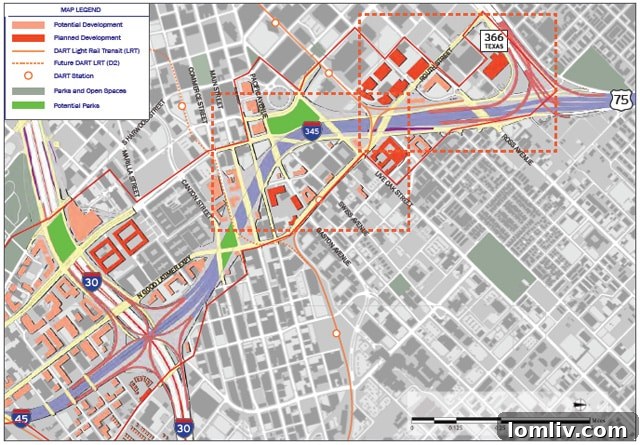
Beyond the radical removal proposal, CityMAP also explored two other principal options for this critical stretch of concrete, along with a “crazier” one that, I believe, warrants serious consideration as a truly innovative solution for Dallas.
Option 1: Cosmetic Enhancements and Local Traffic Diversion
One less ambitious proposal involved what could be termed “putting lipstick on the pig” – essentially, making minor adjustments to highway exits and entrances to create a visually “prettier” highway, while simultaneously forcing some downtown-bound traffic onto adjacent surface roads. This approach aims for a moderate improvement in aesthetics and local circulation without the massive disruption of a full removal. However, while this option presents fewer catastrophic downsides compared to complete removal, it would still lead to “significant increases” in traffic within sensitive urban areas like East Dallas, Deep Ellum, and The Cedars. Though not as severe as the full removal scenario, these localized increases could still undermine quality of life, business accessibility, and neighborhood character in these growing and historically significant districts, pushing congestion from the highway onto already busy local routes.
Option 2: Below-Grade Highway (Uncovered)
A more promising alternative involves dropping the roadway below grade, thus creating continuous surface connectivity between the previously divided areas. This option holds significant appeal for its potential to physically reconnect communities without the severe traffic disruption of outright removal, while still preserving crucial highway capacity. It boasts the least downside in terms of immediate traffic impact compared to the removal scenario. However, a major drawback is the lack of covering. Without a cap over the sunken highway, the pervasive noise pollution and visual blight from the continuous flow of traffic would persist, significantly detracting from the newly reconnected surface areas. Furthermore, the invaluable opportunity to create new public green spaces, parks, or developable land atop the roadway would be lost – a missed chance for maximizing urban amenity and property value. A consultant at the CityMAP meeting raised a critical engineering concern, stating that this option was “impossible” from a practical perspective due to the complex network of underground utilities and waterways (potentially related to the Trinity River basin and its flood plain).
Yet, my experience suggests that in engineering, “impossible” often translates to “too expensive.” Consider the monumental achievement of Boston’s Big Dig, which successfully rerouted a major highway not just underground but under an entire harbor. Similarly, countless underwater tunnels traverse the globe, from the English Channel to Tokyo Bay, demonstrating that such feats, while immensely costly, are far from impossible when political will and investment are aligned. If Dallas is truly serious about long-term urban transformation and maximizing its core’s potential, a simple declaration of impossibility due to engineering challenges or cost should not prematurely halt innovation and a thorough exploration of solutions that have worked elsewhere.
Option 3: The “Crazier” Solution – The Elevated Urban Boulevard
If the cost of submerging the highway entirely proves prohibitive, I propose a perhaps “crazier,” yet potentially transformative solution: raising this section of the highway significantly. Imagine a structure akin to Dallas’s iconic High-Five Interchange, though perhaps not reaching its full 12-story height. An elegantly designed, elevated roadway, soaring high above the existing ground level, could effectively mitigate the physical and visual obstruction that currently plagues the area. This radical approach would create vast, unobstructed spaces underneath, ripe for redevelopment. Think of new urban parks, vibrant mixed-use buildings, and bustling pedestrian thoroughfares blossoming directly beneath the elevated structure. The highway itself would transcend the straight-line sight of pedestrians and residents, becoming less of a concrete barrier and more of a canopy, providing much-needed shade in Dallas’s notoriously hot climate, and fundamentally altering the perception of the infrastructure from an impediment to an integrated part of the urban fabric.
Naturally, the engineering challenges associated with designing functional entrances and exits for such an elevated system would be considerable, demanding innovative ramp designs and careful integration with existing street networks. However, I believe that with creative thinking, advanced engineering, and visionary urban design, these hurdles could be overcome, paving the way for a truly unique and beneficial urban solution that enhances both traffic flow and quality of life. The scale and scope of the CityMAP report are impressive, and these discussions are vital for Dallas’s future urban development. I strongly encourage everyone to download and read the 15-page summary document to fully grasp the breadth of scenarios presented. For those desiring intricate details, the comprehensive full-size report is also available for in-depth study.
Rethinking I-30: Is Relocation a Sustainable Long-Term Solution?
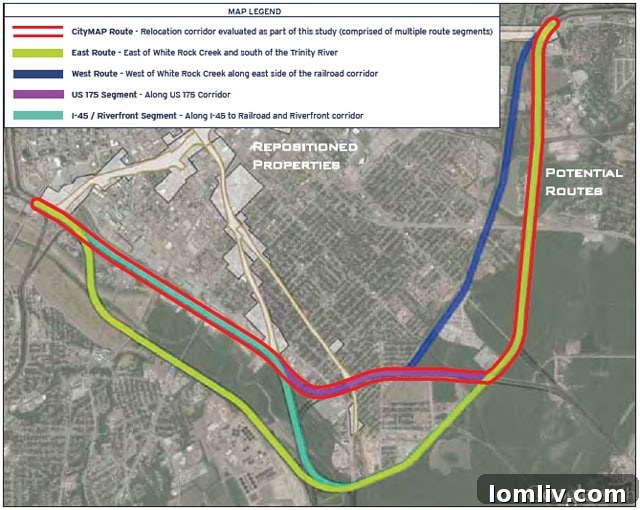
One of the most radical, and arguably perplexing, ideas put forth by CityMAP is the complete relocation of I-30 to a corridor far south of downtown Dallas. While the intent is clear – to free up valuable downtown real estate and potentially alleviate immediate pressure on the urban core – a fundamental and critical question looms: how long would such a solution truly last before I-30 inevitably reverts to being the same “finger through the cake icing” that it is today? Dallas’s historical growth trajectory has predominantly marched northward, driven by available land and suburban expansion. However, as urban planners increasingly recognize that “dirt is dirt” and the city’s geographical confines are finite, a significant southern expansion is not just plausible but highly probable as development pushes outward.
Such an expansion, fueled by population growth and economic activity, would quickly encroach upon a newly relocated I-30, recreating the very problem we sought to solve within a few decades. As the graphic above clearly depicts, existing neighborhoods already border or are in close proximity to the potential new routes for I-30, indicating that any new corridor would quickly be enveloped by development. This proximity is particularly concerning when juxtaposed with expected population growth projections for the Dallas-Fort Worth metropolitan area in the coming decades, which forecast millions of new residents. Relocating I-30 without comprehensively addressing the underlying patterns of urban sprawl and development pressure simply defers the problem, rather than providing a sustainable, long-term solution. My primary concern for this option is straightforward: are we merely reinventing the current I-30 congestion problem in a different geographical location? If so, this isn’t a sustainable solution; it’s merely passing the buck to a future generation, burdening them with the same infrastructure challenges we face today.
The CityMAP Meeting: Insights Beyond the Plans
The recent CityMAP meeting also brought to light some important public sentiments and dynamics inherent in large-scale urban planning. Several attendees expressed indignation at feeling excluded or unaware of previous neighborhood planning sessions. To them, I offer a perspective tempered with experience: “Get a grip.” Urban planning initiatives of this magnitude involve countless hours, numerous public forums, and extensive discussions across various stakeholder groups over many years. This wasn’t a clandestine operation; undoubtedly, many meetings occurred that even I, a keen observer of Dallas development, was unaware of. It’s crucial not to immediately resort to “high-dungeon” or indignation but rather to approach such situations with a constructive mindset, asking, “Let’s see what’s been done, understand the work to date, and explore how I can now contribute meaningfully to the ongoing dialogue.”
Another prominent point of contention revolved around the Trinity Tollway, with one attendee particularly miffed by its limited prominence in the CityMAP plan (and by extension, in this column). Before hearing the consultants’ explanation, I had initially interpreted this omission as a brilliant strategic move. The CityMAP report dedicates only a couple of pages to the Trinity Tollway, pointedly excluding its impacts from their core traffic calculations. I saw this as the urban planning equivalent of leaving a disfavored relative a symbolic dollar in one’s will – acknowledging their existence but ultimately dismissing their influence on the larger inheritance. The Trinity Tollway, in my view, has long been associated with Mayor Rawlings and the NTTA’s pursuit of a “piggy bank-raiding, trophy project” that offers negligible benefit to actual congestion reduction in the core of Dallas. Even the Army Corps of Engineers, a highly respected authority, has reportedly deemed it “stupid and useless” in its proposed form. Thus, I concluded that CityMAP had strategically given the Trinity Tollway its symbolic dollar, sidestepping a political quagmire.
The consultant’s actual explanation reinforced this strategic detachment: they deliberately minimized the Trinity Tollway’s inclusion because it has become a deeply divisive “political football,” and they wished to keep CityMAP’s rigorous, objective efforts unstained by its controversial legacy and the often unproductive debates surrounding it. This decision, to strategically keep CityMAP out of the “swirling cesspool” that is the Trinity Tollway debate, is commendable and wise. It allows CityMAP to maintain its focus on actionable, impactful infrastructure solutions rather than getting entangled in prolonged political battles over a project widely considered problematic.
Next Steps: From Discussion to Action in Dallas
The path forward for CityMAP is clear: it’s time to begin. Begin talking, begin adjusting, begin planning – everything. This document, while comprehensive and meticulously researched, is not designed to be the “be-all, end-all” definitive answer (though it was, admittedly, initially advertised as such). It is, fundamentally, a meticulously crafted starting point. It represents the collective intellect of experts who have gathered extensive information and performed rigorous preliminary work, providing a solid, data-driven foundation for public discourse and informed reaction. The true value lies not just in the proposals themselves, but in their capacity to catalyze constructive engagement and spark innovative thinking.
Let’s be pragmatic: having highly skilled professionals compile vast amounts of data, analyze complex traffic patterns, and conduct intensive groundwork offers an infinitely superior starting place than a committee lacking such expertise attempting to navigate complex urban challenges blindly. When faced with a serious medical condition, one consults a neurosurgeon, not a committee armed with a rudimentary instruction manual. CityMAP embodies this principle, offering Dallas a well-researched, expert-driven platform to forge its future urban landscape, mitigate congestion, and enhance community connectivity. Your engagement and informed feedback are crucial to shaping these critical decisions, ensuring that Dallas’s future infrastructure serves all its residents and supports sustainable growth.
About the Author
My passion lies in Dallas’s dynamic real estate landscape, particularly high-rises, HOAs, and renovation projects. I also possess a keen appreciation for both modern and historical architecture, always balancing these with the vital principles of the YIMBY (Yes In My Backyard) movement, advocating for sustainable urban growth and housing availability. If you’re interested in hosting a Candysdirt.com Staff Meeting event, I’m your dedicated contact. In 2016, my contributions to real estate journalism were honored with Bronze and Silver awards from the National Association of Real Estate Editors. Do you have a compelling story about Dallas’s development, a local issue that needs attention, or perhaps even a marriage proposal to make? Don’t hesitate to reach out! Shoot me an email at [email protected].