Understanding Dallas Zoning: A Comprehensive Guide for Residents and Investors
As the vibrant City of Dallas continues its dynamic growth trajectory, it is inevitably transforming into a denser, more vertically developed urban landscape. Neighborhoods once considered fully established are experiencing renewed development. Streetscapes and iconic views, which have remained unchanged for decades, are now evolving. This evolution, while sometimes met with apprehension, represents a vital and largely positive step for the city’s future.
The only alternative to this inward growth and increased density would be to endlessly expand into the financially unsustainable sprawl of the suburbs. These areas are characterized by miles of roadways, extensive sewer systems, vast water pipe networks, and numerous bridges – an infrastructure burden that low-density spaces often struggle to maintain with their limited tax bases. If you’ve ever been frustrated by potholes in Dallas, imagine the infrastructure challenges faced by a middle-income suburb celebrating its 50th anniversary.
Furthermore, the allure of living within the urban core, often defined by the LBJ Freeway loop, is undeniable for many. Whether you aspire to live centrally or prefer a quieter periphery, a fundamental understanding of Dallas zoning regulations is absolutely essential for every homeowner, prospective buyer, and developer.
The Foundations of Dallas Zoning: Categories and Subtypes
At the heart of urban planning, Dallas, like many major cities, designates land for specific purposes through zoning. These broad categories typically include residential, office, retail, industrial, and various governmental uses such as schools and libraries. However, within these overarching classifications, lies a complex system of multiple sub-types of zoning, each with its own set of detailed rules and regulations.
The Zoning Districts of Dallas document offers a comprehensive breakdown. For residential properties alone, it outlines seven distinct categories for single-family homes, three for townhouses, four for multi-family dwellings, and individual designations for duplexes and mobile homes. A particularly interesting classification is “clustered housing,” which can encompass both single-family and multi-family residences. This extensive list doesn’t even account for the three Mixed-Use and three Urban Corridor designations that explicitly permit residential components, highlighting the city’s nuanced approach to housing development.
Note: Clustered Housing is a planning strategy designed to group homes closer together, thereby creating larger, contiguous open spaces. This concept is not new; medieval villages utilized similar layouts to free up land for communal farming, a method large, divided lots would not allow. In modern urban planning, it was reinvented to curb large-lot sprawl, often to preserve natural landscapes or agricultural land. The first modern cluster development in the U.S. dates back to 1928 in Radburn, New Jersey. While the resulting “Radburn design” gained widespread adoption, the passage of time brought to light certain design flaws and operational challenges. Despite this, the underlying principle of efficient land use remains relevant in contemporary development.

Navigating Dallas Zoning Information: Where to Find Your Zoning
For current property owners, the most straightforward method to ascertain your property’s zoning classification is to consult your Dallas Central Appraisal District (DCAD) listing and cross-reference it with the concise Zoning District Designations document from Dallas City Hall. For instance, if your property is a condo within an MF-3 (Multi-Family District 3) area, you’ll discover that this zoning often permits significant building heights, potentially reaching “airplane-scraping” levels.
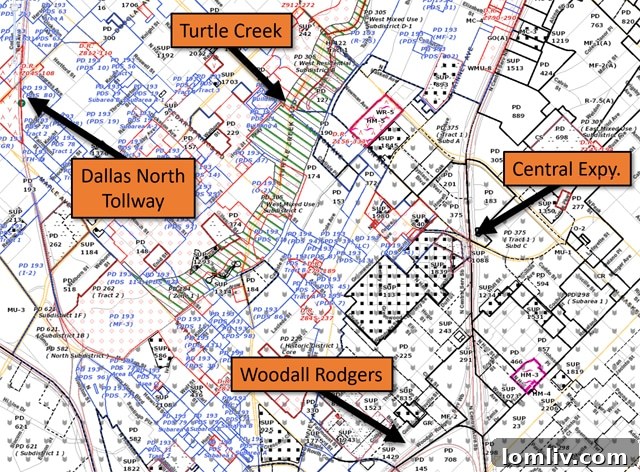
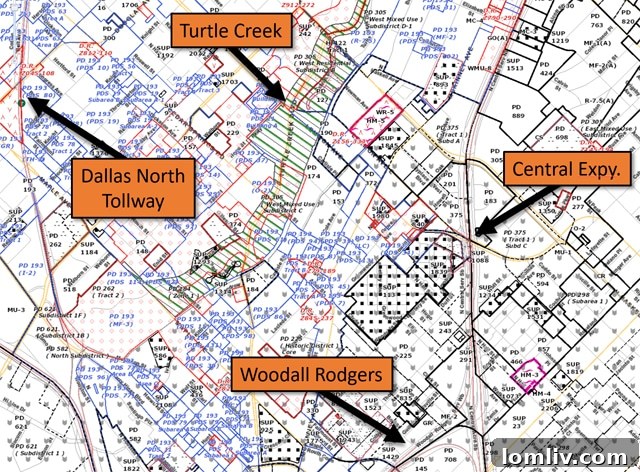
However, for prospective buyers evaluating properties, or for anyone interested in the broader development potential of an area surrounding a particular purchase, delving deeper is crucial. Instead of sifting through individual addresses, the city offers interactive online zoning maps. While the initial wide-angle view might appear overwhelming due to its complexity, using your mouse to zoom into specific areas will reveal clearer, more digestible results, allowing you to easily identify the zoning of neighboring parcels and larger districts.
Beyond the Basics: Special Zoning Designations in Dallas
Understanding the standard zoning classifications is foundational, but Dallas also employs several special designations that can significantly impact property use, development, and value. These require particular attention:
PD = Planned Development District
A Planned Development District (PD), followed by a number, denotes areas operating under their own bespoke sets of rules. These rules can vary subtly or dramatically from the city’s standard zoning ordinances. A PD can encompass a single parcel or a vast expanse of land. Within a PD, all rules and entitlements are considered shared resources, accessible to any parcel located within its boundaries. Property owners typically petition the city for a PD designation, often to allow for more flexible or innovative development not permitted under conventional zoning. The numerical suffix simply indicates the chronological order of its approval. For example, PD-15, approved in 1947, signifies the 15th such district, while PD-946, established in 2015, governs properties like the Laurel apartments at Northwest Highway and Preston Road. If you reside within or near a PD, thoroughly reviewing its specific regulations is paramount.
PDS = Planned Development District Sub-District
Within larger, more complex PDs, sub-districts (PDS + number) are sometimes created. These PDSs feature rules that diverge from the main PD’s regulations. This mechanism is primarily utilized to avoid the extensive time and bureaucratic hurdles involved in amending the governing documents of an entire PD. Essentially, PDSs are designed to apply distinct rules to a specific parcel or a small cluster of parcels within a broader PD, often to accommodate unique development needs or address particular site constraints without disrupting the master plan of the larger district.
NSO = Neighborhood Stabilization Overlay
Unlike the long-standing PDs, Neighborhood Stabilization Overlays (NSOs) are a more recent addition, introduced in Dallas around 2005. Their inception stemmed from neighborhoods’ desire for a regulatory tool that was less time-consuming and complex than a PD or PDS, which can often take years to establish. In essence, NSOs emerged as a streamlined solution to address specific neighborhood concerns. Despite their name, which might suggest broader socio-economic goals, NSOs are predominantly employed by wealthier areas to combat the proliferation of “McMansions.” They typically impose regulations on front and side yard setbacks, dictate garage placement, and, critically, establish height restrictions. This height control is particularly important in areas dominated by single-story homes, where standard zoning might allow 36-foot heights, enabling three-story McMansions to overlook private backyards, impacting privacy and neighborhood character.
SUP = Specific Use Permit
A Specific Use Permit (SUP) is a vital tool when a developer or property owner wishes to construct or operate something not explicitly allowed by the existing zoning classification. A common example is a church in a residential area, or a small commercial venture in a district primarily zoned for mixed-use. The city meticulously evaluates the potential impact of such a specific use on the surrounding community before granting approval. However, an over-reliance on SUPs can lead to the contentious practice of “spot zoning,” where a single parcel is zoned inconsistently with its neighbors, potentially leading to legal challenges from affected residents.
ZILS = Zoning Information Links Suck (A Frustrating Reality)
While the city’s online zoning map offers immense value, users may encounter a common frustration, humorously termed “Zoning Information Links Suck” (ZILS). When clicking on specific parcels for more detailed information, particularly for older zoning designations, users often find that the associated documents have not been digitized (especially those pre-2012) or that the case links provided are broken. This can be a significant barrier to accessing crucial information. While frustrating, it highlights the ongoing challenge of maintaining comprehensive digital records for historical planning decisions. In such cases, direct outreach to the city’s planning department might be necessary.
Putting It All Together: A Closer Look at Dallas Zoning in Practice
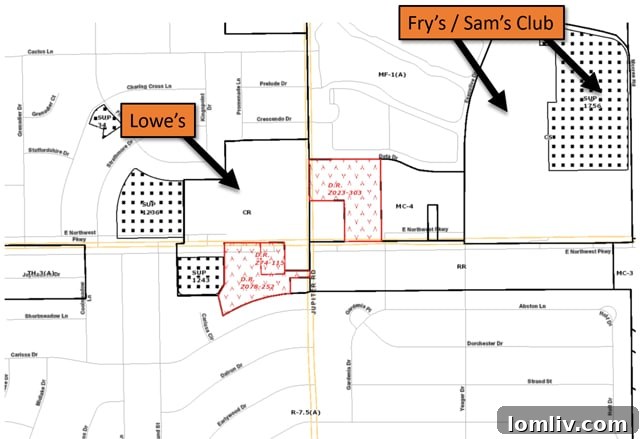
To illustrate the interplay of these various zoning elements, let’s zoom into a specific area, such as the intersection of Northwest Highway and Jupiter Road, as depicted on a detailed zoning map. Here, you’ll observe black squares in the background, which typically denote areas granted Specific Use Permits (SUPs). One such SUP might have been approved for a Sam’s Club, likely for its gas station facility, while another could designate the Bethel Lutheran Church, allowing it to operate within an otherwise residential or commercial zone. Lowes, for instance, is typically zoned CR (Community Retail), indicating its purpose as a retail hub serving local communities. Southeast of the Jupiter and Northwest Highway intersection, you might find areas designated RR (Regional Retail), signifying larger retail establishments designed to attract shoppers from a wider geographical area. The red DR designations on the map are particularly important, as they indicate Deed Restrictions, which are covenants that can significantly limit property use or development and warrant thorough investigation.
Note: Deed restrictions in Dallas fall into two primary categories: municipal and civil. Municipal deed restrictions are imposed by the city itself, often as conditions for certain permits or zoning changes. Civil deed restrictions, also known as restrictive covenants, are privately created and enforced agreements, often established by developers or homeowners’ associations, that govern property use within a specific development or community. Both types can dictate everything from building materials and architectural styles to allowable businesses or even the color of your home, and are legally binding.
Additional Considerations: Historic and Conservation Districts
Beyond traditional zoning and special designations, it’s crucial to determine if your property falls within a historic or conservation district. Properties in historic districts are subject to stringent regulations. Even minor exterior alterations, such as moving a stone on your own property, can require extensive review and approval from the city, demanding considerable time and effort. While this can be administratively challenging, these districts offer the highest level of protection against zoning changes, ensuring the preservation of architectural heritage and neighborhood character. Conservation districts, while still focused on maintaining aesthetic integrity (caring about pebbles and paint colors), offer a somewhat more streamlined process. Here, property owners often only need to consult with city staff for approval, rather than enduring the lengthy City Plan Commission hearings and documentation required for historic districts, significantly reducing the approval timeline from weeks to hours.
For specific questions about zoning or if you encounter a sign announcing a proposed zoning change in your area (which is legally required), you can contact the City of Dallas Planning Department at (214) 948-4480. In most instances, hold times are reasonable, and staff members are typically helpful in guiding residents through the complexities of zoning regulations.

Now You Know: What Are the Implications for Dallas Real Estate?
Equipped with this knowledge, what are your next steps, particularly if you’re a homeowner, buyer, or investor in Dallas? If you are situated in or considering a purchase within a Planned Development (PD) or Planned Development Sub-District (PDS), it is imperative to obtain and meticulously review a copy of the governing paperwork. This documentation will illuminate the specific allowances and restrictions, such as significantly higher density, that could impact the area. Understanding these details will enable you to monitor any proposed zoning cases and participate effectively in the decision-making process. A crucial way to stay informed and exert influence is to join, support, or at the very least, subscribe to the mailing list of your local neighborhood association. For residents in areas like Uptown, Knox, or Oak Lawn, the Oak Lawn Committee serves as a significant oversight body for the expansive PD-193 area.
Developers often seek the path of least resistance, initially targeting parcels that already possess favorable zoning for their projects. However, as available land with high-density zoning dwindles within desirable areas, developers inevitably begin to “nibble around the edges” – a strategy akin to a child pointing out that “Molly’s parents let her stay out until 10 p.m.” If an adjacent parcel has significantly more permissive zoning, developers will actively lobby the city to extend that zoning to their own land. Similarly, in highly sought-after areas where appropriately zoned land is scarce, developers will aggressively pursue increased density approvals to meet market demand.
For those looking to sell or purchase property in an area identified as ripe for increased density, there can be substantial financial gains. Properties that transition from lower to higher density zoning often see a significant increase in market value, presenting lucrative opportunities for investors and homeowners alike. Conversely, for residents who desire to maintain the status quo or exert considerable control over the pace and nature of change, the task becomes more challenging in rapidly developing areas. It necessitates proactive engagement, careful planning, and often, collective action to influence city planning decisions.
The recent development of the Toll Brothers’ high-rise in Oak Lawn stands as a vivid and, for some, painful illustration of these dynamics. Many residents, some living in adjacent high-rises, faced unexpected changes due to a lack of attention to their area’s existing zoning. This incident underscored the critical importance of understanding and actively monitoring the zoning landscape, even in areas already designated for high-rise development.
While Yazz and the Plastic Population may not have had urban growth in mind when they sang The Only Way is Up in 1988, their sentiment rings true for Dallas’s trajectory. The city’s growth is inherently upward and inward, making an informed understanding of its zoning policies more critical than ever.
Remember: My focus areas include high-rises, Homeowners Associations (HOAs), and property renovation. I also hold a deep appreciation for modern and historical architecture, always balancing these aesthetics against the principles of the YIMBY (Yes In My Backyard) movement, which advocates for more housing development. If you’re interested in hosting a daltxrealestate.com Staff Meeting event, please reach out. My writing has been recognized by the National Association of Real Estate Editors, earning two Bronze awards (2016, 2017) and two Silver awards (2016, 2017) in 2016 and 2017. Should you have a story to share, a real estate query, or even a marriage proposal, feel free to email me at [email protected].