Navigating Dallas’s PD-15 Zoning Overhaul: A Critical Look at Preston Tower Development
The urban landscape of Dallas is constantly evolving, and at its heart lies the intricate dance of zoning regulations. A prime example is the ongoing effort to revise PD-15, the Planned Development District governing a crucial area around Preston Tower. For decades, the original PD-15 documentation has been a source of frustration, widely criticized for its ambiguity and lack of precise guidelines. This longstanding issue created a challenging environment for both developers and residents, often leading to stalemates in crucial planning decisions.
However, the recent recommendations put forth by city staff, intended to rectify these historical shortcomings, unfortunately, introduce their own set of clarity issues. The Draft PD and Presentation materials, while aiming to streamline development, still leave many questions unanswered, demanding extensive explanations from city personnel. This perpetuates a cycle of uncertainty, hindering efficient urban planning and community engagement.
Recall the events of last November, when Council Member Jennifer Gates took decisive action, dismissing the second neighborhood committee after it became deadlocked by the rigid positions of high-rise representatives. This move was meant to unblock the planning process. Over the subsequent two months, city staff were tasked with crafting their own recommendations, drawing upon their research and professional experience. Yet, the resultant documentation suggests a hasty preparation, perhaps only truly commencing after the holiday season concluded, underscoring a potential lack of dedicated focus on such a critical urban planning initiative.
The primary concern with the new draft is its inability to function as a standalone, easily comprehensible document. It necessitates significant verbal clarification from city staff during public meetings, which suggests the text itself is not sufficiently self-explanatory. This deficiency creates barriers for stakeholders—from residents to potential developers—who seek to understand the proposed changes without requiring an official interpreter. As the draft undergoes further revisions, it is imperative that these ambiguities are resolved, ensuring that future readers can immediately grasp its intent and implications, thereby fostering transparency and efficiency in the Dallas zoning process.
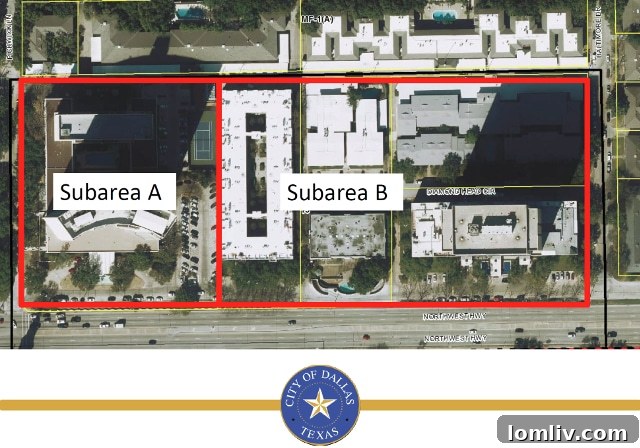
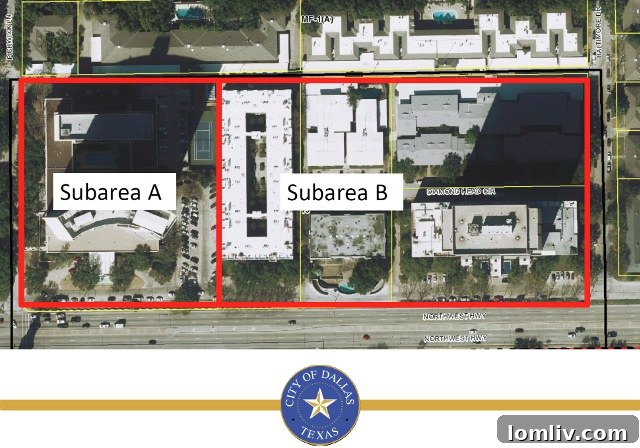
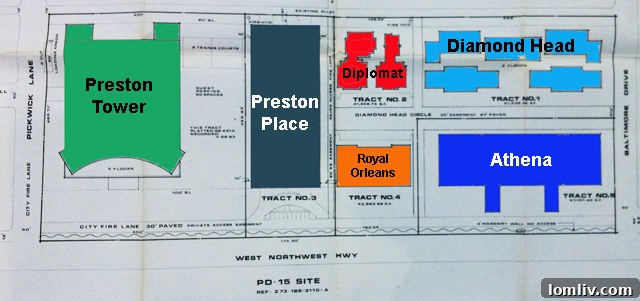
For those eager for an early glimpse into the city’s recommendations for this vital Dallas corridor, the plan outlines specific height allowances. The area situated between Northwest Highway and Diamond Head Circle is proposed to accommodate structures reaching up to 240 feet in height. Moving northward from Diamond Head Circle to the alley, buildings would be limited to 96 feet. Overall, the updated PD-15 aims to standardize density across the district at 90 units per acre. This would translate to a rough total of 540 to 750 residential units, with approximately 405 to 615 being new constructions. The range in total units underscores an underlying complexity that requires further examination, which we will delve into.
Navigating the Nuances: Deeded vs. Buildable Lot Lines in PD-15
A fundamental issue that emerged during the recent discussions centered on the distinction between “deeded lot lines” and “buildable lot lines.” The inconsistency in the document’s application of these measurement points breeds considerable confusion, impacting how developers and residents perceive land use and open space. For instance, deeded lot lines are utilized when calculating lot coverage. However, a peculiar aspect of PD-15 is that interior roadways are often owned to their midpoint by adjacent buildings. This means that deeded lot lines effectively include portions of these roadways.
Consequently, when the document cites a 65 percent lot coverage, one might envision a substantial, park-like green space. In reality, a much smaller percentage—perhaps only 5 to 10 percent—of the actual lot might be uncovered, as the roadways themselves are not counted as “covered land” despite being part of the deeded lot. This discrepancy creates a misleading impression of the area’s actual open space, potentially leading to a more concrete-heavy environment than originally envisioned by residents and planners seeking greener urban spaces.
Further exacerbating this confusion is the section regarding setbacks and encroachments. The draft suggests that amenities like “benches, street lamps, landscape planters, sculptures, and other decorative landscape items” could be placed on private roadways. This allowance creates a logical inconsistency: if setbacks are defined by deeded lot measurements, yet pedestrian access and sidewalks typically begin at the curb (or the buildable line), where exactly do these decorative elements fit? The lack of clarity around these intersecting definitions makes it challenging to visualize and implement cohesive urban design.
For a document meant to guide significant urban development in Dallas, clarity and consistency in terminology are paramount. Improving the immediate comprehensibility of these definitions would not only streamline the planning process but also ensure that all stakeholders share a common understanding of the proposed land use, fostering more effective and harmonious development within the PD-15 district.
Addressing Development Constraints: Setbacks and Heights Around Preston Tower
Shrinking the Northwest Highway Setback: Traffic Implications
One of the more contentious recommendations from city staff involves reducing the Northwest Highway setback from its current 100 feet to 70 feet. This proposed change has significant implications for both urban aesthetics and traffic flow. The existing 70-foot area is already largely occupied by the “Pink Wall” barrier, which varies in width and composition—ranging from a stark wall to a green strip or parallel parking areas—alongside a two-lane frontage road. This frontage road itself may incorporate additional setbacks, creating a complex layering of public and semi-public spaces.
Adding another layer of complexity, while a building could theoretically be constructed 70 feet back from Northwest Highway, a proposed 15-foot portico would effectively reduce the building’s setback to just 55 feet, further encroaching upon the critical frontage road. This reduction in usable frontage road space, coupled with the projected addition of hundreds of new residential units in the PD-15 area, presents a significant challenge. Deliberately reducing the free flow of traffic on a major frontage road, precisely when a substantial increase in residential density is anticipated, seems problematic from a traffic management perspective. It raises concerns about congestion, accessibility, and the overall efficiency of the area’s transportation network, necessitating a thorough reevaluation of this specific setback proposal.
Multiple Ceilings For Height: Conflicting Regulations
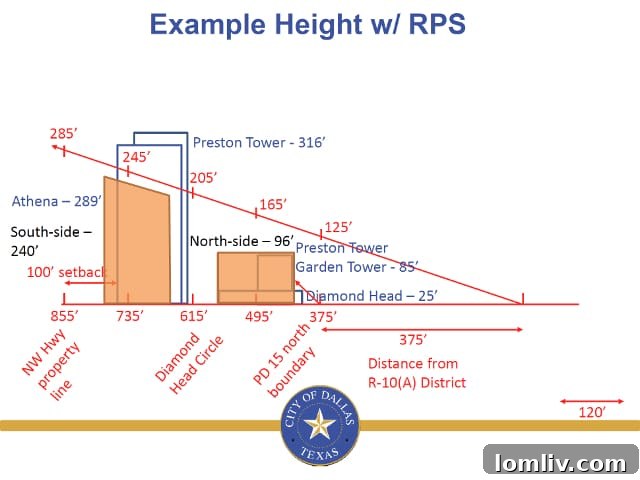
The proposed PD-15 document introduces a puzzling array of height controls, creating potential conflicts and ambiguity for developers and planners. As visually depicted in the accompanying graphics, the plan includes at least two distinct Residential Proximity Slopes (RPS). One of these RPS definitions appears to allow for significantly greater building heights than the flat 96-foot height limit proposed for parcels located north of Diamond Head Circle.
This raises a crucial question: why implement both a Residential Proximity Slope, which is typically designed to protect adjacent lower-density residential areas from excessive shadowing and visual impact, and a fixed height restriction simultaneously? The coexistence of these two types of controls, particularly when they offer conflicting height allowances, can lead to confusion, complex calculations, and potentially inconsistent development outcomes. A clear, singular framework for height regulations would streamline the planning process, provide predictability for developers, and ensure the desired urban form is consistently achieved throughout the PD-15 district.
Setbacks Squeeze The Toothpaste: Unintended Consequences
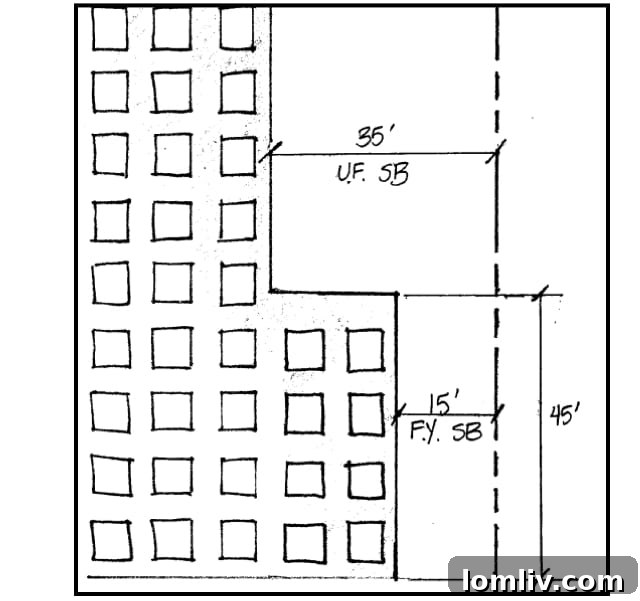
Beyond the height complexities, the draft also mandates both urban form and tower spacing setbacks, specifically 20 feet on Diamond Head Circle and Northwest Highway, and 30 feet along north-south property lines. These requirements, however, only apply to structures exceeding 45 feet in height. While the intent behind such pullbacks—to create more open space and improve urban aesthetics—is commendable, their application across all four sides of a building, particularly those above a certain height, can lead to unintended consequences.
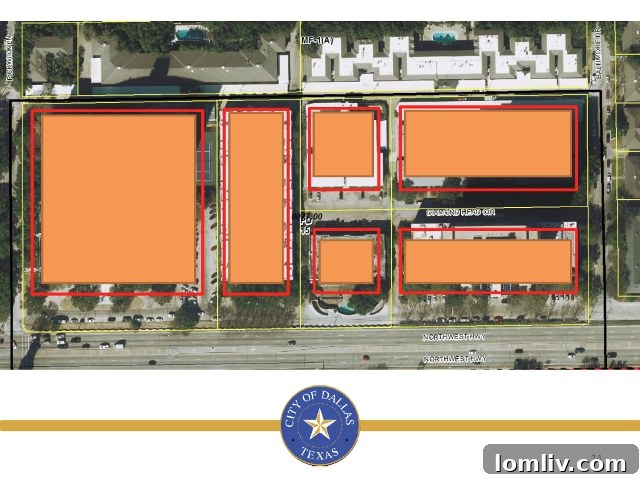
Consider the analogy of a tube of toothpaste: if you squeeze it significantly from four sides, the toothpaste has only one direction to go—up. Similarly, with stringent and extensive setbacks on all sides, the bulk of a building is effectively forced upward. This outcome directly contradicts the concerns of the neighborhood, which has consistently expressed resistance to taller structures, especially further north within the district. The question then arises: do residents truly benefit from extensive setbacks on Northwest Highway or along side boundaries if the direct consequence is buildings that are ultimately taller? This design paradox highlights the need for a more nuanced approach to setbacks that balances urban form with community preferences and efficient land use.
Parcel Combination Oddity: City’s Role and Unaddressed Hurdles
During recent meetings, city staff repeatedly emphasized the benefits of combining smaller lots into larger parcels, citing increased design flexibility and potentially more coherent development options. This concept of parcel combination, or replatting, has been a recurring theme throughout the planning discussions for the PD-15 district. What makes this persistent advocacy particularly peculiar is that while the draft PD itself seems to subtly encourage such combinations, the process of combining or replatting lots falls squarely within the purview of individual lot owners. It is generally not considered an appropriate role for the city to actively encourage or discourage such private property decisions, making the city staff’s repeated comments somewhat unusual.
More critically, despite 18 months of ongoing discussions and the city’s implicit encouragement, there remains a glaring omission: the city has yet to definitively state whether the necessary roadway closures—often a prerequisite for enabling such large-scale parcel combinations—would actually be permitted. Without this crucial clarification, any talk of combining lots, regardless of its potential benefits, remains purely theoretical. Developers and property owners are left without a clear pathway forward, rendering the city’s suggestions for parcel combination as merely “pie in the sky” until the fundamental question of roadway closures is unequivocally addressed.
Incentives and Oversight: A Critical Look at City Provisions
Unrewarding Rewards: Open Space and Affordable Housing Incentives
The proposed PD-15 documentation includes provisions for density bonuses, ostensibly to incentivize developers who incorporate green space or affordable housing into their projects. These “sweeteners” could theoretically allow for an increase of up to 35 more units per acre, pushing the maximum density from the proposed 90 units per acre to 125 units per acre. However, a significant flaw undercuts the effectiveness of these incentives: there is no corresponding increase in the buildable envelope or Floor Area Ratio (FAR). This critical omission means that developers would be required to generate additional units within the same physical building footprint, effectively “cannibalizing” their potential income without receiving any tangible added benefit.
From an economic standpoint, this presents a clear disincentive. If a developer maximizes the proposed 90 units per acre, they could then potentially increase this to 125 units per acre by offering green space or affordable housing. Yet, if the building’s physical size cannot expand, the result is the same total rentable square footage, merely divided into a greater number of smaller units. Furthermore, up to 15 percent of these additional units would be designated as affordable housing, meaning they would rent for less than market rate. For a developer, this scenario is, at best, an economic wash; at worst, it represents a direct reduction in potential revenue without any compensating increase in overall rentable space. While the intent to foster affordable housing is laudable and essential for urban equity, the current incentive structure is fundamentally flawed, failing to offer a compelling economic rationale for developers to participate. A truly effective incentive program would need to align the public good with private financial viability.
Missing Mandates: The Absence of Energy Efficiency Requirements
In addition to the issues surrounding the incentives, a notable oversight in the PD-15 document is its complete silence on any form of energy efficiency requirements. There are no mentions of LEED guidelines, sustainability certifications, or any other environmental performance standards. In an era where climate change and sustainable development are paramount concerns for modern cities, this absence is particularly glaring.
While implementing energy efficiency measures undoubtedly adds to initial construction costs, these investments yield significant long-term benefits. They contribute to a higher quality of life for residents through reduced utility bills, enhance building longevity, decrease operational costs, and, crucially, mitigate the environmental impact of urban development. Omitting such forward-thinking requirements represents a missed opportunity for the City of Dallas to champion sustainable practices and ensure that new developments in the PD-15 district contribute positively to both environmental health and the future resilience of the community. Incorporating robust energy efficiency mandates would align the development with contemporary urban planning best practices and public expectations for responsible growth.
Community Voices and Future Outlook for PD-15
The Committee Speaks: A Call for Clarity and Time
Following the city staff’s presentation of their recommendations and rationale for PD-15, which largely consisted of boilerplate language from existing zoning documents, the floor opened for questions and comments from committee members. A common sentiment expressed was gratitude towards the city for finally committing what had previously been abstract concepts to paper. This acknowledgment highlights the protracted nature of the planning process and the sheer relief that some concrete proposals were now on the table. Indeed, had this level of detail been provided a year earlier, the entire process might have concluded months ago, underscoring the value of tangible documentation in urban planning. While appreciating the city’s initial desire for the neighborhood to self-organize, the committee’s comments suggested that a structured official proposal was long overdue.
Beyond the initial thanks, the most prevalent request from committee members was for more time to properly digest the extensive recommendations. The draft documents had only been made available approximately four days prior to the meeting, and crucially, without the comprehensive verbal explanations provided by city staff during the session. This short turnaround time is insufficient for a thorough review of complex zoning changes. Committee members rightly argued that the materials should have been distributed at least a week in advance, ideally accompanied by illustrative visuals and clear, asterisked explanatory notes to aid comprehension, thus facilitating more informed and constructive feedback.
A specific and pertinent comment also addressed the critical issues of sidewalks and overall aesthetic coherence. The city’s recommendations did include proposed improvements to sidewalk conditions within the area. However, several committee members astutely pointed out a fundamental challenge: since not all buildings in the district will undergo redevelopment simultaneously—with many decades likely passing before existing structures like Athena or Preston Tower might be replaced—achieving a cohesive and uniform aesthetic across the entire area will be virtually unattainable in the short to medium term. This raises an important point about the long-term vision of urban planning and the incremental nature of change in established districts.
This reality underscores the limitations of zoning changes, which are typically not retroactive. For example, older buildings were not mandated to install fire sprinklers until such requirements became standard in the late 1970s. However, an intriguing proactive suggestion emerged: could the committee engage with the owners of the existing high-rises to explore their willingness to voluntarily update their landscaping and sidewalks to align more closely with the new recommendations? Such a collaborative approach might encourage these established towers to avoid becoming “ugly ducklings” amidst future redevelopment, potentially fostering a more harmonious transition for the entire neighborhood.
Another strong critique from a committee member targeted the pervasive lack of visual representation in the city’s presentations. “A picture is worth 1,000 words,” they stated, “and the city continues to give 1,000 words.” Having witnessed advanced 3-D visuals in other urban planning contexts, it’s evident that such immersive representations are invaluable, conveying far more than any textual description ever could. Council Member Gates and staff acknowledged this deficiency, assuring the committee that detailed 3-D exhibits would be ready for the upcoming public meeting, slated for late February, where a more formal presentation to the wider community will be given. This delay in providing crucial visual aids, combined with the tight timeline for document review, further supports the impression that the draft document was indeed crafted much closer to the meeting date than would be ideal for thorough public engagement.
Finally, several committee members highlighted the extensive work they had undertaken independently between official meetings, crafting their own alternative plans and visions for the district. They expressed a desire for these community-driven proposals to be heard and considered by the public. City staff confirmed that these contributions had been taken into account during the formulation of their official recommendations, but clarified that the community plans did not form the primary basis of their work. While there was some discussion about the possibility of finding a compromise, the general sentiment from city staff indicated that, from their perspective, the formal recommendation process had largely run its course, implying that any significant adjustments would now need to be initiated and championed by the committee itself.
Political Dynamics and the Path Forward
The intensity of community sentiment around the PD-15 zoning changes was strikingly highlighted by an email circulated this morning by Barbara Dewberry, a representative for Athena and now an HOA board member. The subject line, “Who can run against Jennifer?”, immediately conveys a deep level of frustration and a perceived political slight. The email asserts that the community’s concerns have been “ignored” and that Council Member Jennifer Gates, along with Margo, is perceived as pushing “the developer’s wishes to reality.” This reflects a belief that the council member has utilized community committees merely as a formality, ultimately pursuing an agenda she intended from the outset.
The content of the email then transitions into an urgent call for political action, desperately seeking a viable candidate to challenge Council Member Gates. Names like Laura, John Pritchett, and even inquiries about the potential return of former Council Member Ann Margolin are floated, underscoring the community’s readiness to engage in electoral politics to protect their neighborhood’s character. The message also rallies neighbors to attend the upcoming Community Meeting, framing it as a crucial opportunity to “preserve the neighborhood.” This robust political response demonstrates the profound impact that zoning decisions can have on local communities, transforming urban planning debates into significant political contests.
As previously mentioned, a larger public presentation detailing the PD-15 recommendations is scheduled for late February. Further specific details regarding this crucial meeting are expected to be announced soon. This gathering will serve as a pivotal moment for wider community input and will undoubtedly be a heated forum where these complex planning issues and political tensions will once again take center stage, shaping the future development of the Preston Tower area in Dallas.

Remember: My focus is on high-rises, HOAs, and renovation trends in Dallas real estate. I also delve into the interplay between modern and historical architecture, balancing it against the principles of the YIMBY (Yes In My Backyard) movement, which advocates for more housing development. My writing has been consistently recognized by the National Association of Real Estate Editors, earning me three Bronze awards in 2016, 2017, and 2018, as well as two Silver awards in 2016 and 2017. If you have a compelling story to share, or perhaps even a marriage proposal, feel free to reach out via email at [email protected]. You’re also welcome to search for me on Facebook and Twitter, though you likely won’t find me there.