Unlocking Cedar Springs: Debunking the ‘By-Right’ Development Myth for Dallas’ Iconic LGBTQ+ District
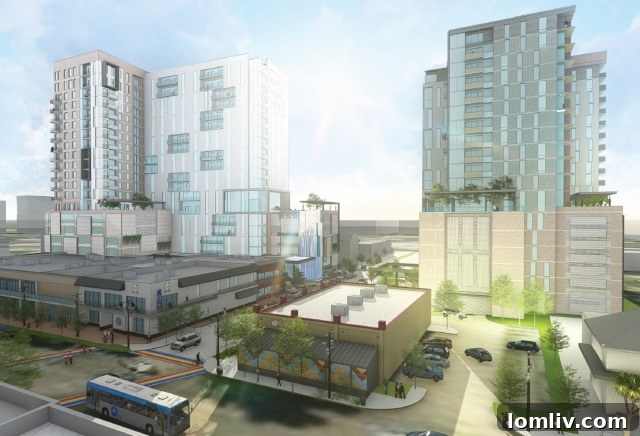
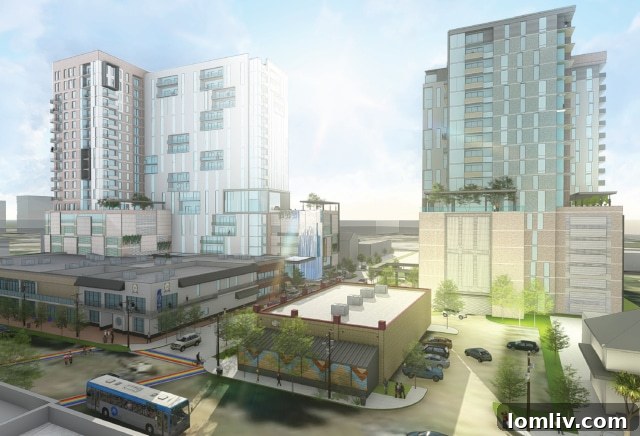
The future of Dallas’ vibrant Cedar Springs district, a cornerstone of the LGBTQ+ community and home to legendary bars, hangs in the balance. Recent discussions have centered around a proposed real estate development deal involving Caven Enterprises, the current landowners, and prominent developer Mike Ablon. Ablon’s vision entails constructing two high-rise buildings while strategically preserving the existing bars, a proposal that has generated considerable debate and scrutiny within the community. For a deeper understanding of the initial discussions, you can read the first story here, and a follow-up here.
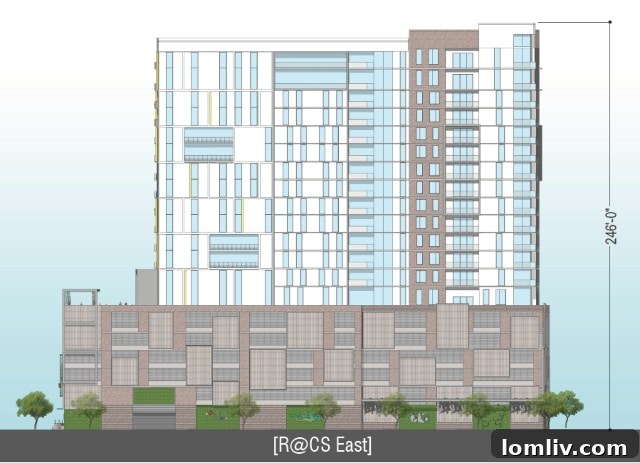
At the heart of this complex dialogue is Caven Enterprises’ persistent claim: without securing this specific deal, in its current configuration, they would be compelled to sell to an alternative developer. This developer, Caven asserts, would then proceed with an “by-right” development – erecting a substantial 10-12 story building, reminiscent of the nearby Illume residential project, and entirely demolishing the beloved LGBTQ+ establishments. Crucially, Caven implies such a scenario would not even necessitate a zoning change. This narrative has significantly shaped public perception and community anxiety, painting the Ablon deal as the sole protector of the district’s cultural heritage. However, a closer examination of the existing zoning regulations reveals a different, far more intricate reality for any large-scale property development in this sensitive and historic Dallas neighborhood.
Decoding the Cedar Springs Zoning: PD-193, Sub-District (19)
To truly understand the feasibility of “by-right” development in Cedar Springs, one must delve into the specific zoning ordinance governing these properties. On February 12, 1997, the Dallas City Council approved PD-193, sub-district (19). This zoning classification, seemingly instigated and tailored by Caven Enterprises themselves, applies directly to their Cedar Springs landholdings. While the underlying zoning for the area is GR (General Retail), which typically permits building heights up to 120 feet – a significant allowance – the sub-district Caven previously agreed to, and now seeks to overturn, introduces substantial limitations that fundamentally alter these potential building parameters. These existing restrictions make the prospect of a high-rise “by-right” project on these specific parcels highly improbable, if not impossible, without the very zoning changes Caven claims to be avoiding.
The Ordinance and Development Plan: Strictures on Height and Coverage
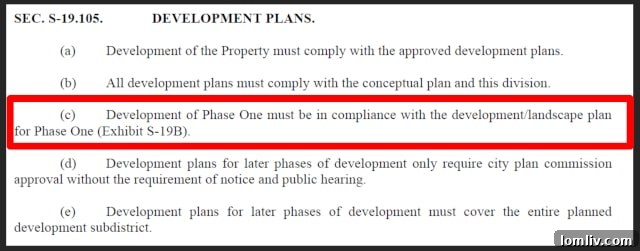
The sub-district ordinance explicitly states that “Development of Phase One [the block bounded by Cedar Springs, Reagan, Throckmorton, and Dickason] must be in compliance with the development/landscape plan for Phase One (Exhibit S-19B).” This clause is critical. What precisely does Exhibit S-19B stipulate for this prime Dallas real estate?
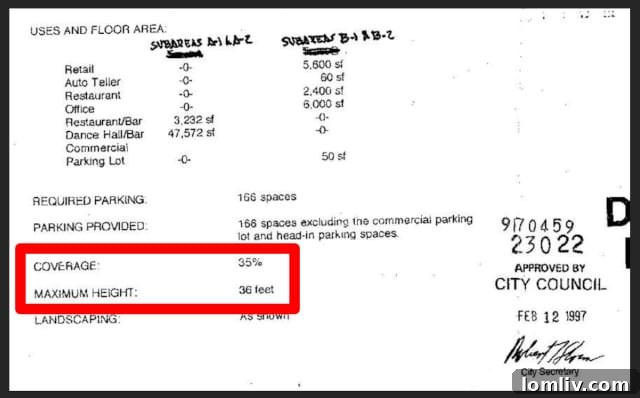
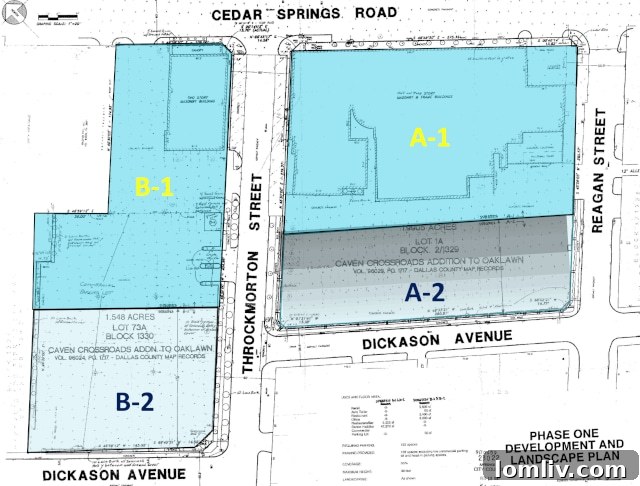
An excerpt from Exhibit S-19B (shown above) reveals startling limitations for anyone considering large-scale commercial or residential development: it lists lot coverage at a mere 35 percent and a maximum height at an astonishingly low 36 feet. This means that for the specific portion of Caven’s holdings that houses iconic venues like Sue Ellen’s, JR’s Bar & Grill, S4, and The Mining Company (TMC), any new construction appears to be restricted well below both the 120-foot height and 80 percent lot coverage permitted by the underlying GR zoning. The clear implication is that a multi-story, Illume-style apartment building cannot be built “by-right” on subareas A-1 and A-2 (as depicted on the map below) without undergoing the very same, extensive zoning change process that Ablon and Caven are navigating today. This directly contradicts Caven’s narrative of a readily available “by-right” alternative. The ordinance essentially locks in a specific, low-density, low-height development pattern for these crucial parcels, reflecting a past vision that prioritizes the existing character over potential high-rise development.
However, even if we were to momentarily disregard these stringent initial limitations, the remainder of the sub-district 19 ordinance still presents significant hurdles. While it suggests that 120-foot heights are technically “possible” under certain interpretations, the practical application of other clauses makes such a scenario highly improbable and economically unviable for developers seeking substantial returns.
Residential Proximity Slope (RPS): A Critical Height Limitation for Dallas Developers
Similar to today’s proposed Dallas urban planning, the sub-district meticulously divides the parcels into four distinct areas: A-1, A-2 (encompassing the front and back parking lots of the JR’s and S4 block), and B-1, B-2 (related to the Skivvies building and its rear parking lot, important assets in the Cedar Springs real estate landscape). What makes sub-district 19 particularly unique, especially given its age, is the inclusion of a Residential Proximity Slope (RPS). This often-overlooked but powerful zoning tool dictates precisely where and to what extent it’s permissible to construct buildings reaching the 120-foot height limit on these specific lots. The RPS is designed to protect adjacent residential areas from overly tall structures, significantly impacting the developable envelope.
The ordinance clearly outlines the RPS restrictions:
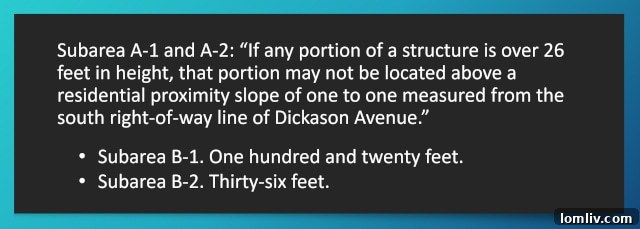
For the B-2 “Skivvies” lot at the rear, the limitations are straightforward yet impactful. For a depth of 150 feet measured from the Dickason property line, no building is allowed to exceed 36 feet in height (the lightest blue area on the map). The remaining 275-foot deep B-1 subarea, which directly fronts Cedar Springs Road, theoretically could build up to 120 feet (the darker blue area). This critical distinction means that the construction of a high-rise residential tower or even a 75-foot multi-level parking garage would be expressly forbidden on the rear of the “B” parcels. Only the narrower, Cedar Springs-facing portion holds the potential for taller structures, and even then, under significant constraints. This poses a major challenge for developers envisioning comprehensive mixed-use development.
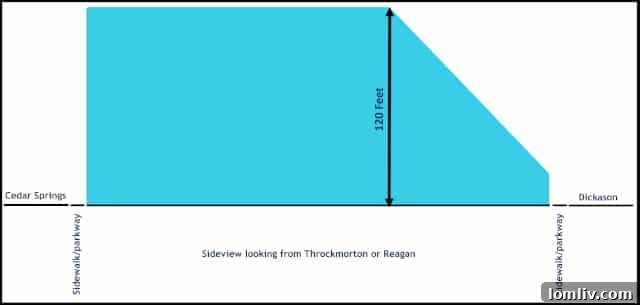
On the “A” side, the rear A-2 subarea terminates 100 feet from the Dickason property line. The RPS for this section employs a graduated scale: for every foot away from the far edge of the Dickason right-of-way, a building’s allowable height increases by one foot (e.g., one foot away allows a one-foot tall structure, two feet away allows two feet, and so on). This calculation begins at 26 feet, presumably due to the property line’s distance from the Dickason starting point. The practical outcome is a wedge-shaped building envelope for the back 100 feet of A-2, gradually ascending from 26 feet along Dickason to a maximum of 120 feet approximately 94 feet further in. This geometric restriction severely complicates the design and efficiency of any potential high-rise structure, significantly reducing the usable footprint at higher elevations. Consequently, while 120 feet might theoretically be permitted by right on over half of the total acreage (regardless of whether the bars are preserved or not), this fragmented and constrained development potential is vastly less appealing and financially viable to a real estate developer than either a monolithic 12-story building or the pair of 260-foot high-rises proposed by Mike Ablon’s ambitious Cedar Springs development plan.
It’s reasonable to infer that Caven Enterprises, in placing these restrictive RPS clauses on their own lots years ago, did so precisely to prevent the kind of large-scale, high-density development they are now actively pursuing. The irony of their current position, seeking to undo the very protections they once implemented, is not lost on close observers of Dallas real estate and zoning law. This historical context underscores the complexities of land development in established urban areas like the Oak Lawn committee’s purview.
Setbacks: Further Constraining Cedar Springs Development
Beyond the Residential Proximity Slope, a multitude of setback requirements further diminish the attractiveness and practicality of any “by-right” development plan for the Cedar Springs properties. These regulations, designed to ensure light, air, and pedestrian space, significantly reduce the buildable area and complicate architectural design, particularly for high-rise buildings in urban environments like Dallas.
Along Cedar Springs Road, between Throckmorton and Reagan, an eight-foot setback is mandated at ground level. More significantly, on both Cedar Springs and Throckmorton, a substantial 25-foot setback is required for any structure rising above 36 feet in height. In a hypothetical “by-right” Illume-style scenario – a multi-story residential building – this would effectively remove a 25-foot strip from two crucial borders of the building, likely impacting multiple residential floors. This substantial loss of floor plate would severely hamper design efficiency, especially for the already narrow B-1 parcel, and when combined with other existing infringements, renders a large-scale project commercially dubious. Imagine trying to create a functional and appealing apartment layout with such significant reductions in width and depth; it becomes an exercise in compromise and inefficiency for any prospective Dallas real estate developer.
Additional 10-foot setbacks are required along Reagan and Dickason, extending from the ground up. Furthermore, a 10-foot setback above 36 feet is mandated on the border with Woody’s Bar, complemented by another 10-foot setback from the ground up on the back section of the property (subareas B-1 and B-2). The Cedar Springs-facing portion of the B-1 subarea, at its narrowest, measures only 109 feet wide by 175 feet deep. When any structure exceeds 36 feet in height, the effective buildable width shrinks by 37.5 feet, leaving a meager 71.5 feet of width. This constrained dimension makes developing an efficient, double-stack apartment layout with a central corridor exceptionally challenging and often economically unfeasible. Such limitations would lead to less desirable units and lower profitability, making it a far less appealing investment for a high-rise developer.
For context, the Ablon development team’s proposal explicitly seeks to lift these prohibitive 25-foot setbacks (for structures above 36 feet) to 75 feet. This significant modification is essential solely to accommodate their proposed multi-story parking garage, demonstrating just how impactful the current zoning restrictions are and the extent of the variances required for their project to proceed. This highlights the crucial role of zoning variances in urban planning projects across Dallas.
Floor Area, Height, and Lot Coverage: The Math of Development in Oak Lawn
The existing sub-district ordinance also places strict limitations on the total floor area, a critical factor for any large-scale development in a high-demand area like Cedar Springs. The ordinance states:
“If no residential component, maximum permitted floor area for all uses combined is 200,000 square feet. An additional one square foot of floor area for each two square feet of residential floor area is permitted up to a maximum permitted floor area of 250,000 square feet for all uses combined on the Property.” [Emphasis added]
These figures are profoundly restrictive. The total land area of the lots amounts to 3.5385 acres, which translates to approximately 154,137 square feet. Considering the 80 percent lot coverage typically allowed by the underlying GR zoning, the 250,000-square-foot maximum permitted floor area for a mixed-use development with residential components effectively restricts any building on this property to roughly two stories. This limitation dramatically impacts the density and profitability potential for developers seeking to maximize their investment in this prime Dallas location.
While it is possible to concentrate height on a smaller portion of the lot to achieve a taller building, the calculations remain stark. Even under a scenario where one could achieve a not-quite-by-right 12-story, 120-foot building (assuming other restrictions were somehow circumvented), such a structure would yield only about 21,000 square feet per floor. This equates to a mere 14 percent lot coverage, a drastic reduction from the 80 percent coverage usually allowed under GR zoning. Such low coverage drastically diminishes the overall square footage and, consequently, the number of residential or commercial units, making the project financially unsustainable for most large-scale developers.
In stark contrast, the Ablon team’s proposal seeks a fundamental change to this floor area calculation, requesting a shift from a raw numerical limit to a Floor Area Ratio (FAR) of 5:1. This proposed change would dramatically increase the allowable combined square footage to an astounding 770,685 square feet – more than triple the 250,000 square feet permitted under the current ordinance. This immense disparity underscores the profound gap between what is currently permissible “by-right” and what is necessary for a high-density, high-rise development in Cedar Springs. It firmly demonstrates that Ablon’s plan, like any significant development, is entirely reliant on substantial zoning variances and not on existing “by-right” privileges. The request highlights the developer’s understanding that existing zoning for this Oak Lawn property is simply inadequate for modern high-rise development.
The Undeniable Truth: No ‘By-Right’ High-Rise for Cedar Springs
Based on the comprehensive analysis of the existing zoning ordinance, PD-193, sub-district (19), it becomes unequivocally clear that Caven Enterprises’ assertions regarding the feasibility of an “by-right” Illume-type project on their Cedar Springs land are without merit. The intricate web of existing restrictions makes such a development impossible under current regulations. Furthermore, selling the land under these restrictive conditions would undeniably result in a significantly lower financial return for Caven from the land sale itself, further undermining the incentive for a “by-right” approach.
My interpretation of the sub-district 19 ordinance and its associated development plan dictates that any construction on these parcels is strictly limited to a maximum height of 36 feet and a lot coverage of only 35 percent. These are not minor recommendations but binding regulations. This means that without significant changes to the zoning, the concept of a multi-story residential or commercial building is simply not permitted.
Even if one were to find a loophole or alternative interpretation for the initial height and lot coverage, the project would still face insurmountable obstacles from the severe limitations imposed by the residential proximity slope, the numerous setback requirements, and especially the restrictive floor area maximums. These combined factors collectively render any substantial high-rise development project impossible “by-right.” The efficiency and profitability of an “Illume-style” apartment building depend on maximizing density and design flexibility, both of which are severely curtailed by current zoning. Coupling these architectural and planning challenges with typical construction types, where a theoretical 120-foot structure might translate into five stories of less expensive wood construction atop three levels of concrete parking, further diminishes economic viability. Such a project, even if technically feasible in parts, would be nowhere near the scale or financial return that Caven Enterprises reportedly desires or that a major developer would pursue.
Therefore, it is evident that whatever Caven Enterprises ultimately intends to do with their Cedar Springs land – whether it involves the Ablon proposal or an alternative – they will invariably require a substantial zoning variance from the City of Dallas. The community dialogue should thus focus not on the false premise of a “by-right” alternative, but on the true impact and long-term implications of any proposed zoning changes for this vital part of Dallas’ cultural fabric and its cherished LGBTQ+ institutions. The future of Cedar Springs development hinges on transparent urban planning and community engagement.