

The highly anticipated surge of Californians relocating en masse to Texas, driven by the allure of abundant job opportunities and lower taxes, didn’t materialize quite as drastically in 2020 as initial projections suggested. While the narrative of a significant “California exodus” has long captured public attention, new data from the U.S. Census Bureau provides a nuanced perspective on actual household movement during a pivotal year shaped by a global pandemic. This fresh insight challenges some deeply entrenched beliefs about interstate migration patterns.
Prior to 2020, reports like the one from the Texas Realtors Association in 2018 painted a clear picture: Californians were flocking to Texas at a rate exceeding 2-to-1 compared to Texans moving to California, with no signs of deceleration. Regional forecasts, particularly for North Texas, even predicted areas like Plano, Frisco, and Little Elm would soon mirror the rapid growth and economic dynamism of California’s Silicon Valley hub, San Jose. The expectation was that this relentless influx would continue, dramatically reshaping Texas’s demographic and economic landscape.
However, the COVID-19 pandemic introduced an unprecedented variable into human mobility patterns. According to new U.S. Census Bureau national data, the very nature of household movement underwent significant changes throughout 2020. This shift caught many experts by surprise, highlighting the complex interplay of economic factors, health concerns, and remote work trends.
Joshua Roberson, a senior data analyst at the Texas Real Estate Research Center, commented on these unexpected findings: “Many analysts expected a large interstate migration last year, such as from California to Texas or from New York to Florida, but that doesn’t appear to be the case.” His statement underscores a key takeaway: while the underlying appeal of states like Texas remained strong, the actual mechanics and volume of long-distance moves were more constrained than initially forecast, leading to a recalibration of migration narratives.
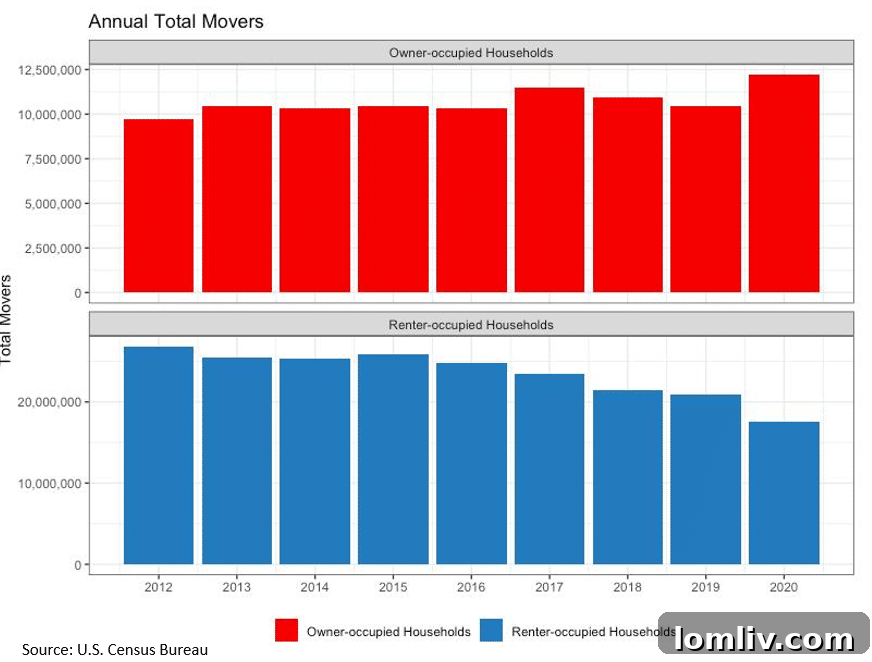
Paradoxically, despite the tempered interstate migration, the number of owner-occupied households moving actually saw an increase, a trend reflected in the record-breaking home sales observed across various markets. This suggests a different kind of mobility was at play, possibly driven by a desire for more space, a shift to remote work allowing relocation within a state or region, or simply capitalizing on favorable interest rates. Conversely, renter-occupied household moves experienced a precipitous and significant decline. This steep drop among renters likely reflects a combination of factors, including economic uncertainty, job instability, and perhaps even eviction moratoriums or a general reluctance to move during a period of global health crisis.
Robertson further emphasized the disparity, stating, “The biggest influence in this decline was the large drop off in movement from renter-occupied households.” This distinction is crucial for understanding the true dynamics of migration in 2020, revealing that the impact of the pandemic was not uniform across all housing tenure types. While homeowners might have had the financial flexibility and motivation to relocate, renters faced different challenges that curtailed their mobility.
It’s imperative to clarify that Californians are undeniably still heading to Texas. The allure of the Lone Star State remains potent for many seeking a different lifestyle or economic advantage. However, the Census data for 2020 reveals a more nuanced picture than a simple mass exodus from California directly into Texas. Instead of a direct interstate swap dominating the statistics, a more pronounced trend emerged: more people moved from one county to another within Texas. This intrastate migration highlights a shift in where growth is occurring, often driven by residents seeking more affordable housing, less dense environments, or shorter commutes as remote work became more prevalent.
The decline in net migration into principal cities, a trend already underway before the pandemic, saw an even steeper dip in 2020. This suggests a broader societal shift away from urban cores, at least temporarily. In stark contrast, the surrounding, less-dense cities within the same metropolitan areas experienced significant net growth. This decentralization trend reflects a desire for more suburban or exurban living, often characterized by larger homes, bigger yards, and a perceived increase in quality of life, especially for families during lockdowns. This movement away from dense urban centers further complicates the traditional narrative of interstate migration, emphasizing internal population shifts.
In another illuminating segment of the same Census data, the analysts’ Texas/California comparison became even more telling regarding overall population shifts. Texas proudly added the most residents of any state in the U.S. during 2020, solidifying its status as a premier growth engine. Conversely, California experienced the largest population drop, signaling a significant reversal of its historical growth trends. This stark contrast underscores the divergent demographic trajectories of these two economic powerhouses.
From July 1, 2019, to July 1, 2020, Texas gained an estimated 373,965 residents. This impressive figure, roughly equivalent to the entire population of a major city like Arlington, encompasses both natural increases (births minus deaths) and net migration. During the same period, California saw a loss of 69,532 residents, a number comparable to the population of Rowlett. While the reasons for California’s decline are multifaceted—including higher cost of living, housing affordability issues, and potentially a changing business climate—Texas’s consistent growth highlights its enduring appeal as a destination for individuals and businesses alike.
Further solidifying the narrative of Texas’s magnetic pull and California’s challenging environment is a particularly revealing study from an authority on migration: U-Haul. The moving truck rental giant, which tracks migration patterns based on one-way truck rentals, ranked Texas as No. 2 on its annual list of hottest states for where people are moving in 2020. This metric, often seen as a practical indicator of relocation intent, consistently places Texas at the top. In stark contrast, California ranked 50th—dead last—on the list, continuing a trend of poor performance, having been ranked 48th or lower since 2016. Texas, on the other hand, has consistently been a top-two growth state for the past five years, a testament to its sustained attractiveness. This data from U-Haul provides a real-world validation of the Census figures, illustrating the tangible movement of households across state lines.
Understanding Texas’s Enduring Appeal and Market Dynamics
Texas’s consistent population growth and strong economic performance are not accidental. Several key factors contribute to its enduring appeal, making it a prime destination for both individuals and businesses. The state boasts a diverse and growing economy, anchored by major industries such as technology, energy, healthcare, and manufacturing. This robust economic landscape translates into ample job opportunities across various sectors, attracting talent from across the nation and globally. Moreover, Texas’s favorable business climate, characterized by lower regulatory burdens and no state corporate income tax, makes it an attractive location for companies looking to expand or relocate, creating a virtuous cycle of job creation and population growth.
Perhaps one of the most significant draws for new residents, especially those from high-cost states like California, is Texas’s comparatively lower cost of living. Housing affordability, in particular, stands out as a major advantage. While home prices have been rising in Texas’s major metropolitan areas, they generally remain more accessible than in California’s most desirable regions. The absence of a state income tax further enhances the financial attractiveness of living in Texas, allowing residents to retain more of their earnings. Beyond economic considerations, many migrants are drawn to Texas for its quality of life, offering more space, diverse cultural experiences, and a generally more relaxed pace of life compared to congested urban centers in other states.
Other Notable Reports Influencing the Texas Housing and Rental Markets
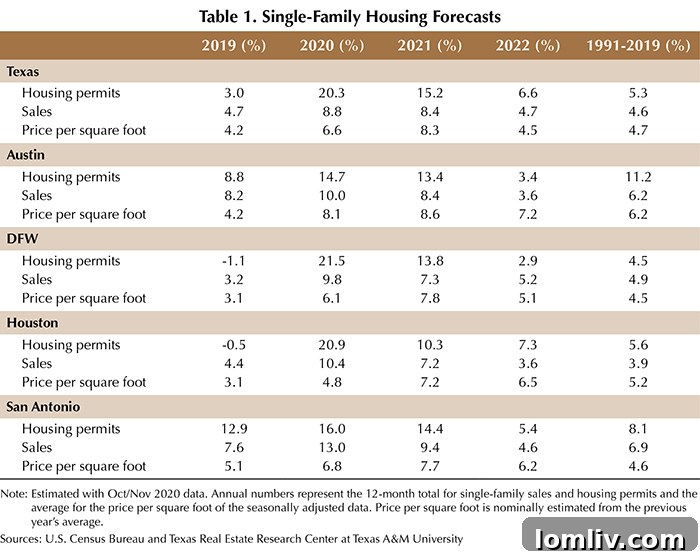
- 2021 Texas Housing & Economic Outlook: Looking ahead, the Texas Real Estate Research Center economists’ 2021 housing market outlook forecasted a landscape dominated by robust demand and critically low inventories, inevitably leading to solid price growth. This imbalance between supply and demand has been a defining characteristic of the Texas real estate market in recent years. The report specifically highlighted that inventories of homes priced below $300,000 would remain particularly scarce, significantly impacting sales volume at the entry-level and mid-range price points. Despite these inventory challenges, the unwavering and stable demand from both new residents and existing Texans would ensure positive price appreciation across the state. This outlook underscores the resilience and competitiveness of the Texas housing market, driven by its underlying economic strength and desirability. The dynamics described here illustrate the pressure points within a rapidly growing market, where affordability can become a concern despite a lower overall cost of living compared to other states. Learn more about the detailed forecast here.
- Zumper National Rent Index: Turning to the rental market, the Zumper National Rent Index offered valuable insights into urban rental dynamics. Dallas, a major economic hub in Texas, ranked 35th on the nation’s most expensive cities for renters. Interestingly, the report indicated a slight softening in rental prices for Dallas during the preceding month, with the price of one-bedroom units falling 3.2 percent to an average of $1,210, and two-bedroom units dropping 2.4 percent to $1,640. This localized dip in Dallas’s rental market might reflect a temporary oversupply in certain segments, a response to the pandemic-induced shift away from urban cores, or increased availability as new apartment complexes came online. Nationally, the overall trend was more stable, with the median rent for 1BR units remaining flat at $1,224, while 2BR units saw a modest increase of 0.3 percent to $1,491. The Zumper report comprehensively covers 100 cities nationwide, aggregating data from over 1 million active listings, providing a broad snapshot of the rental landscape. These figures are crucial for understanding the living costs associated with moving to Texas’s major cities and how they compare to national averages. Explore the complete rental price data here.
In conclusion, while the initial narrative of a massive Californian exodus to Texas in 2020 proved to be overly simplistic, the underlying trend of Texas’s robust growth and California’s population challenges remains undeniable. The pandemic introduced complexities, shifting some interstate movements to intrastate migrations and altering the dynamics between owner-occupied and renter-occupied households. Nevertheless, Texas continues to attract residents with its strong economy, diverse job market, and more accessible cost of living, particularly when it comes to housing. These factors, combined with a favorable business environment, position Texas for continued prominence as a leading destination for growth and opportunity in the United States, influencing both its real estate and rental markets for the foreseeable future. Understanding these nuanced migration patterns is key for policymakers, real estate professionals, and individuals considering a move to or within the Lone Star State.