By Jon Anderson
Columnist
The pursuit of safe, affordable housing for low-income citizens is not merely a social welfare issue; it is a fundamental driver of economic upward mobility and a cornerstone for a thriving society. My colleague, Candy, and I have often discussed the profound impact that stable living conditions have on individuals and communities. When those struggling financially gain access to secure housing and the basic necessities of life, their ability to participate meaningfully in the economy and improve their circumstances dramatically increases. This isn’t just about charity; it’s about fostering a more dynamic and equitable economic landscape for everyone, particularly in a rapidly growing metropolitan area like Dallas.
Consider the stark contrast in spending patterns between different economic strata. Affluent individuals often channel their wealth into intangible investments, complex savings schemes, or luxury goods that, while stimulating niche markets, do not always generate broad economic ripples. In contrast, when low-income individuals have more disposable income, they spend it on immediate, essential needs: food, clothing, transportation, and crucial services. This spending is not discretionary; it is a necessity that directly infuses capital into local economies. This creates a powerful, positive cycle: increased consumer demand leads manufacturers and service providers to produce more, which necessitates hiring additional staff. More people employed means more consumers with money to spend, perpetuating a robust economic flow. This phenomenon was starkly evident during past recessions when governments lamented dwindling tax revenues. As employment rates recovered, tax coffers replenished, demonstrating the direct link between widespread economic participation and fiscal health. States like Texas, in particular, have seen tax revenues not just recover, but overflow during periods of strong employment.
Indeed, the severity and frequency of economic recessions could be significantly mitigated if companies were incentivized to maintain their workforces or if unemployment benefits adequately mirrored former salary levels. Recessions often trigger a devastating domino effect: one major company lays off workers, reducing consumer spending and subsequently decreasing orders for its suppliers. These suppliers, in turn, are forced to lay off their own employees, creating a cascading spiral of job losses and economic contraction. This destructive pattern, which I term “trickle-back economics,” highlights how economic downturns disproportionately affect the most vulnerable and underscore the urgency of policies that protect worker stability and income security.
I personally experienced the harsh realities of economic instability during the telecom meltdown early in the millennium. This period saw half a million skilled workers, including myself, cast out onto the streets, facing unprecedented unemployment. For nearly three harrowing years, I navigated this landscape of uncertainty. Desperate for any opportunity, I was prepared to uproot my life, even leaving my partner, for a job. Ultimately, securing employment required relocating to another state, a move that irrevocably ended my relationship. Yet, in the grand scheme, I was fortunate compared to many others who faced even greater hardships and prolonged joblessness.
During part of that time, I relied on unemployment benefits, which amounted to a maximum of $1,600 per month – a mere fraction of my previous salary. I must confess, the act of claiming unemployment, despite having contributed to the system for years, was deeply challenging. It carried a heavy stigma, feeling like an admission of personal failure. This monthly check, however, did little more than slow the eventual depletion of my carefully accumulated three-year emergency fund. I share this personal detail not to elicit sympathy, but to underscore a critical point: $1,600 per month, which exceeds the current minimum wage in America, proved barely sufficient for survival even with extensive savings and a rent-free living situation. This column is not an argument solely for higher minimum wages, though that is a related issue. Instead, its primary objective is to meticulously document and clarify the actual financial requirements for living a dignified, human existence in a vibrant city like Dallas. (Spoiler alert: it’s considerably more than the current minimum wage allows.)
- How many times have we observed a dilapidated, sputtering car on the road, clearly in dire need of significant repairs, and thought, “Why don’t they just fix that or buy a newer vehicle?” The answer is far from simple: for many, the choice isn’t between car repairs and a new car, but between maintaining basic transportation to get to work and affording food or rent for their family. These are choices born of extreme financial constraint, not poor judgment.
- Similarly, driving past run-down homes with locked car doors, we might wonder, “Why would anyone choose to live there?” The stark reality is that for a substantial portion of our population, such residences represent the only housing they can realistically afford. They are not chosen out of preference, but out of absolute necessity, often in neighborhoods lacking adequate public services or amenities.
- My travels to Marrakech brought a similar, albeit culturally different, moment of “tone-deafness.” Tourists frequently asked locals, “How does everyone stay so thin?” or “How do you live without air conditioning in this 100+-degree heat?” The simple, often uncomfortable truth is that in many parts of the developing world, choices are severely limited; people live with what they have, not necessarily by choice, but by enduring circumstance. These observations highlight a common societal blind spot: a failure to grasp the profound constraints faced by those living on the economic margins, both locally and globally.
Understanding the true scope of poverty and economic hardship requires moving beyond simplistic, outdated metrics. Various measurements exist, but many fall short of reflecting the real cost of living in contemporary society. The federal “poverty line,” frequently cited across the nation, provides a rudimentary and often misleading picture of economic reality. Created in 1963 and only updated annually for inflation, its core calculation remains archaic. This metric is particularly flawed because it applies a blanket standard across vastly different regions, treating expensive metropolitan areas like New York City identically to more affordable locales like Dallas. This oversimplification stems from its categorization into just three broad buckets: the 48 contiguous states (plus DC), Hawaii, and Alaska.
To address some of these glaring disparities, the Supplemental Poverty Measure (SPM) was introduced in 2011. While an improvement, as it factors in regional differences for housing and other costs, it still primarily measures abject poverty rather than the requirements for a secure, modest standard of living. For instance, in 2013, the most recent year for which Texas data was available relative to federal numbers, Dallas wasn’t drastically different from the federal poverty line under the SPM. However, the additional $1,250 annually ($100/month) that the SPM allotted for a nuclear family of two adults and two children, above the roughly $2,000/month federal poverty level, would undoubtedly be welcomed, though still far from sufficient for genuine financial stability. Consider these benchmarks for a family of four:
- Federal poverty level (2 adults / 2 children): $24,250 per year
- Supplemental Poverty Measure for Dallas: $25,500 per year
These figures, while providing a baseline for understanding the lowest income thresholds, do not paint a realistic picture of what it truly costs for a family to thrive, or even to live without constant financial anxiety. They fundamentally underestimate the expenses associated with modern life, especially in dynamic urban environments like Dallas.
This month, in August 2015, the Economic Policy Institute (EPI) unveiled its updated Family Budget Calculator. This robust tool represents a significant leap forward in accurately assessing living costs across the United States. Unlike traditional poverty calculators that aim to determine the bare minimum for survival, the EPI’s model estimates the costs required to achieve “a secure yet modest living standard.” This crucial distinction means factoring in expenses for living in “structurally safe and sanitary rental housing” located within communities that offer essential amenities like local big-chain grocery stores, and ensuring bedrooms are places of rest, free from the fear of stray gunfire or rodent infestations. By incorporating granular local data and considering a broader spectrum of needs, the EPI’s calculator provides a far more truthful and relatable understanding of what a modest, dignified life truly entails. Its comprehensive approach covers 618 communities across the United States and accounts for 10 different family structures, ranging from single adults to two adults with up to three children. Furthermore, it meticulously integrates local metrics for critical expenses such as child care, healthcare, and “other necessities,” which encompass a wide array of everyday items like school supplies, telephone services, clothing, and even basic furniture.
Let’s examine the EPI’s startling findings for a family of two adults and two children residing in Dallas. The calculated annual income required to meet a secure yet modest living standard is a staggering $61,150 – or approximately $5,096 per month – all *after taxes*. This figure is nearly two and a half times higher than the amounts determined by the federal poverty line or the Supplemental Poverty Measure, revealing a profound disconnect between official poverty definitions and actual cost of living in Dallas. To achieve this modest standard, both adults in this family would need to work full-time, each earning an hourly wage of approximately $14.50 – more than double the current federal minimum wage. Many might initially find this number unbelievable, but a closer look at the detailed breakdown illuminates the harsh reality:
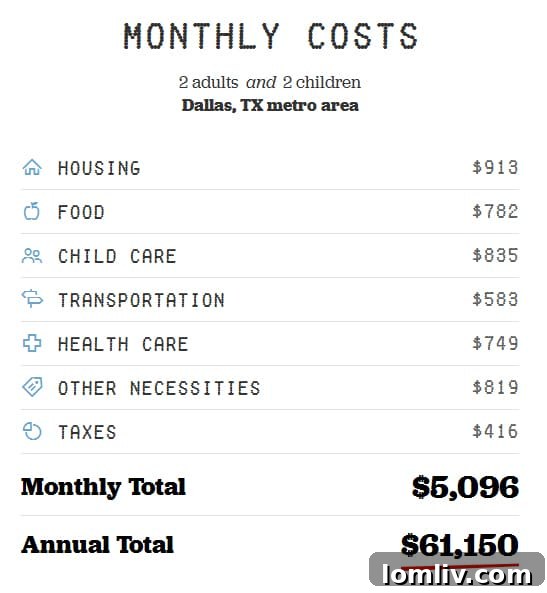
As the detailed budget illustrates, this is far from a luxurious lifestyle. The allocation of just $913 per month for rent suggests a modest two-bedroom, two-bathroom apartment – a challenging find in many Dallas neighborhoods even at that price point, often necessitating compromises on safety or quality. Childcare expenses are estimated to be almost as high as rent, a significant burden for most families, often dictating employment choices and limiting career advancement for parents. This cost may fluctuate depending on the children’s ages, but it remains a substantial and unavoidable expense for working parents. The “Food” category is based on the Department of Agriculture’s stringent “low-cost plan,” which assumes nearly all meals are prepared at home with a focus on achieving “nutritionally adequate diets” rather than convenience or dining out – a stark contrast to typical American dietary habits. Healthcare costs may appear substantial, but it’s important to recognize that a large percentage of workers within this income bracket lack the comprehensive employer-provided health benefits that many daltxrealestate.com readers might take for granted, leaving them with higher out-of-pocket expenses for insurance premiums, co-pays, and prescriptions. The “Other Necessities” category, initially appearing oversized, becomes perfectly reasonable when considering the cumulative cost of a four-person cell phone contract, school supplies, essential clothing for growing children, cleaning products, personal care items, and other miscellaneous household needs like transportation costs and occasional household repairs. “Taxes” encompass not only federal income taxes but also sales taxes and various other often-invisible levies that chip away at household income. This budget, therefore, highlights the sheer effort required simply to maintain a basic, secure existence in Dallas, without any frills or significant financial leeway for unexpected expenses.
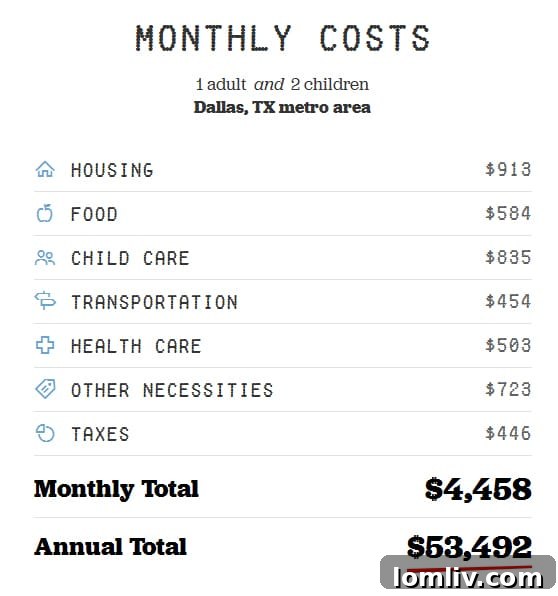
The financial picture becomes even more challenging and, frankly, grim when we consider a single-parent household. For a single adult with two children in Dallas, the total income required is reduced by $7,658 annually compared to a two-parent household, primarily due to slightly lower food and healthcare costs, and a reduction in “other necessities.” However, crucial fixed costs such as housing and childcare remain largely unchanged, as these expenses do not scale down proportionally with the loss of an adult. Compounding this, the household has lost an entire adult salary. Consequently, the remaining single parent must earn a staggering $25.72 per hour – nearly three and a half times the current federal minimum wage – to meet this “secure yet modest” living standard. This stark illustration unequivocally demonstrates why single-parent households frequently face immense economic hardship and are disproportionately susceptible to financial instability. The burden of providing for a family on a single income, especially when fixed costs are so high and support systems are often insufficient, creates an almost insurmountable obstacle for many, impacting their ability to provide for their children and plan for the future.
What all these calculated figures, even the comprehensive EPI budgets, crucially omit are provisions for future financial security: emergency funds, college savings for children, and retirement accounts for parents. The absence of these vital savings components means that families, at best, are living paycheck-to-paycheck, often finding themselves a paycheck or two behind. This precarious financial state makes them prime targets for predatory lending practices such as payday and title loans, which trap individuals in cycles of debt with usurious interest rates that can skyrocket up to 730 percent annually, essentially sucking the life out of already struggling households. The long-term consequences are devastating: children grow up believing college is an impossible dream without a full scholarship, often deterring them from even attempting to pursue higher education. Parents, perpetually struggling, are ill-equipped to teach their children effective strategies for breaking the cycle of poverty, because they are constantly in survival mode. For these parents, retirement becomes a distant, unattainable fantasy, forcing them to work until their last breath, if their health allows. This is not a rosy outlook for anyone; rather, it’s a recipe for the persistent, multi-generational poverty that continues to plague communities today, including our own in Dallas.
And should circumstances take a turn for the worse, falling off the economic tightrope into homelessness exacerbates every existing challenge to an almost unimaginable degree. Without access to basic dignities like bathing facilities, clean clothes, and a stable address – all essential components of maintaining employment – finding or even successfully interviewing for a job becomes an unimaginably arduous task. The journey back into stable housing is equally formidable, requiring significant savings for security deposits, initial rent, and utility connections, which are nearly impossible to accumulate while unsheltered. The emotional, psychological, and developmental toll this instability takes on children is simply unimaginable, perpetuating a cycle of disadvantage that is incredibly difficult to break and often leaves lasting scars. Homelessness is not merely a lack of shelter; it is a profound barrier to human dignity and economic participation.
The current federal minimum wage stands at a meager $7.25 per hour. For a full-time worker, this translates to roughly $290 per week, or a paltry $15,080 annually – assuming no vacation or holiday time off (a luxury few earning this wage could ever afford). This isn’t just low pay; it represents hourly, grinding work that is simultaneously critical to the functioning of our society and paradoxically deemed “valueless” by its compensation. These essential workers, who often form the backbone of our service industries, public services, and care sectors, find themselves trapped in a cycle of poverty, highlighting the urgent need for a living wage that truly reflects the cost of human existence and allows for more than just bare survival.
Stiffing the Poor Because We Can: A Question of Dignity
The unfortunate reality is that too often, the poor are “stiffed” – undervalued, disrespected, and exploited – simply because their vulnerable economic position allows it. This morning, my housecleaner shared a telling anecdote about why she missed our last appointment. She works for a service, and their communication can, at times, be less than ideal. She arrived at her previous appointment, an apartment complex, only to find no key waiting for her at the front desk, as was customary. After waiting patiently for 90 minutes, the client finally instructed her to drive to their office, retrieve the key, complete the cleaning, and then return the key. What should have been a 90 to 120-minute job stretched to double that time, including unpaid travel. Did the housecleaner receive additional compensation for this wasted time or the extra travel? No. Did she lose income by not being able to clean my home as scheduled? Absolutely. This incident perfectly illustrates an employer and a client who failed to respect and value the housecleaner’s time, despite her crucial role in their operations.
I candidly admit I would make a terrible housecleaner (aside from the fact that I’m inept enough to hire one myself!). My personal rule would dictate that if a client or employer was 15 minutes late, I would leave. I certainly wouldn’t sit around for 90 minutes unpaid, waiting for someone to sort out a key. Of course, it’s easy for me to say I wouldn’t wait. But the difficult truth is that if I *really* needed that job, just like my housecleaner likely did, I would endure the indignity and loss of time to keep it. This desperate dependency is precisely what some employers unfortunately count on, exploiting the economic vulnerability of their staff. The service agency, in this scenario, should have compensated the cleaner for her waiting time and billed the client for the inconvenience caused. After all, if you make a no-show at a hotel, you are charged for the room. Why should a human being providing essential labor expect any less respect or compensation than an unoccupied hotel room? This isn’t just about financial fairness; it’s about acknowledging the inherent dignity of every worker and recognizing the systemic issues that allow such exploitation to persist.
The Hard Truth for Dallas Citizens
As we reflect on these figures and personal stories, it is critical to remember a sobering statistic: 40 percent of American households earn less than $35,700 per year. For a significant portion of these families, particularly those earning at the lower end of this spectrum, navigating the economic landscape is a constant struggle for survival. Furthermore, the support systems intended to assist them are woefully inadequate; only 23.4% of low-income families in the United States receive any form of housing assistance from the federal government, leaving the vast majority to fend for themselves in an increasingly expensive market. When we apply the Economic Policy Institute’s comprehensive calculations to these realities, combined with what our instincts and observations tell us about economic hardship, a stark conclusion emerges: a staggering 40 percent of Dallas citizens are currently unable to afford what the EPI defines as a “secure yet modest living standard.” This means nearly half of our community is struggling to live with basic dignity, facing constant financial precarity despite often working tirelessly in essential roles. This is not just a statistic; it represents countless individuals and families striving for a better life in one of America’s rapidly growing cities, a struggle that impacts our collective well-being.
It is imperative that we, as a community, acknowledge and address this pervasive challenge. Understanding the true cost of living is the first step toward advocating for policies and initiatives that foster genuine economic mobility, ensure fair compensation for all labor, and ultimately guarantee that every Dallas resident has the opportunity to live a truly human existence with dignity and security.
Remember: Do you have an HOA story to tell? A little high-rise history? Realtors, want to feature a listing in need of renovation or one that’s complete with flying colors? How about hosting a Candy’s Dirt Staff Meeting? Shoot Jon an email. Marriage proposals accepted (they’re legal)! [email protected]