Saving History: The Monumental Journey and Meticulous Restoration of Dallas’s Blue House
The sight of an entire house slowly trundling down a city street is truly a marvel, a testament to human ingenuity and a profound commitment to preserving the past. In Dallas, such a spectacle unfolded with the legendary Blue House in the Cedars neighborhood. This cherished Victorian Queen Anne mansion, built in 1885 by Max Rosenfield, stood on the brink of demolition before a community rallied to save it. Now, under the expert guidance of Dallas developer and preservationist Mark Martinek, this long-neglected beauty is being painstakingly brought back to life, embarking on a new chapter seven blocks from its original Griffin Street location.
The journey of the Blue House is more than just a physical relocation; it’s a powerful narrative of architectural heritage, urban development challenges, and the intricate art of historical restoration. Martinek, known for his award-winning preservation work, faces a unique set of opportunities and challenges with this project, making it a cornerstone event in Dallas’s ongoing efforts to protect its irreplaceable historic structures.
A City’s Resolve: The Blue House’s Peril and Preservation Triumph
The saga of the Blue House began in 2016 when Time Warner (now Spectrum) acquired the land it sat upon, signaling a grim future for the 130-year-old structure. The threat of demolition loomed large, jeopardizing a significant piece of Dallas’s architectural and social history. For a time, it seemed as though the grand old dame would not see another century of Dallas life.
However, the spirit of preservation in Dallas is strong. A determined campaign to save the house quickly gained momentum, drawing in preservationists, history enthusiasts, and concerned citizens. The city responded with a crucial 10-day demolition delay, providing a vital window for advocacy. Through concerted lobbying efforts, the company eventually relented, agreeing to spare the building and even fund its relocation, provided a suitable new site could be secured.
This commitment from Time Warner was a pivotal moment, transforming what seemed like an impossible dream into a tangible possibility. The high cost associated with moving a structure of this size and age typically poses an insurmountable barrier. However, the collaborative spirit that emerged truly defined this project. Katherine Seale, the dedicated chairwoman of the Dallas Landmark Commission, stepped forward with a remarkable gesture of support, purchasing a new lot on Browder and Beaumont, just a short seven blocks from the original site. With the land secured and the relocation costs covered, the stage was set for Mark Martinek to lend his expertise and embark on the challenging yet rewarding task of restoration.
The Unprecedented Undertaking: Moving a Victorian Gem
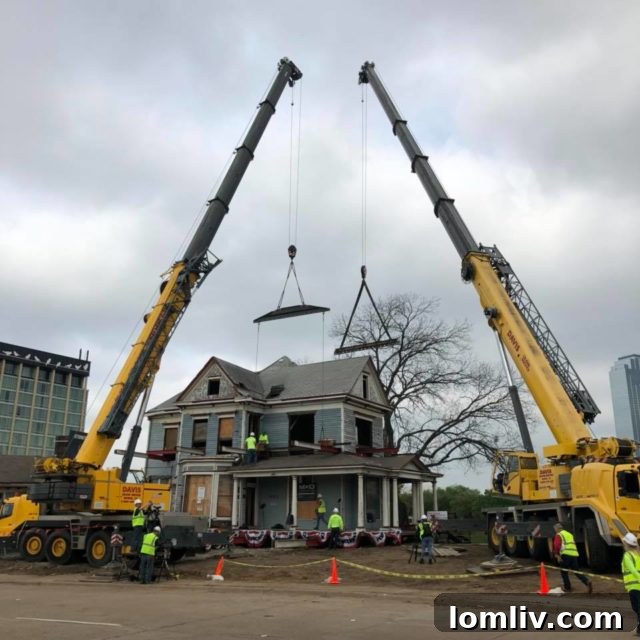
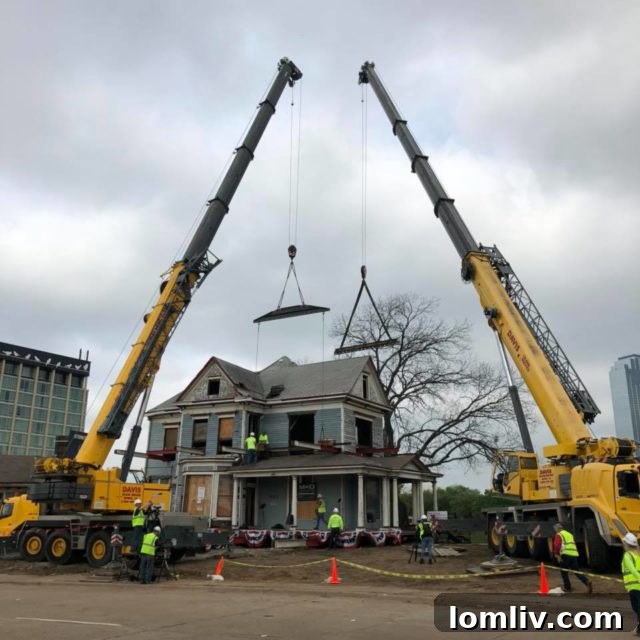
Relocating an entire historic mansion built in 1885 is a feat of engineering and meticulous planning. Martinek describes it as an undertaking that never ceases to fascinate. The process involves delicately segmenting the house, lifting it, and transporting it in pieces, often requiring specialized equipment like massive cranes. “We’re still moving it,” Martinek noted, referring to the house being temporarily split between its original Griffin lot and the new location on Beaumont and Browder.
The complexities of such a move are manifold. Weather, for instance, proved to be an unexpected adversary. Strong winds have repeatedly halted the delicate process, rendering the use of towering cranes unsafe. “Wind is always a major problem,” Martinek explained. Each delay underscores the precision and safety protocols required, with operations resuming only when weather conditions are absolutely optimal for the crane operators. This cautious approach means that what might seem like a straightforward move can extend over several weeks, with Martinek estimating it could take “more like two weeks before it’s all moved” once favorable conditions permit.
Once the components of the house arrive at the new lot, the next critical phase begins: “restacking.” This involves reassembling the various sections of the mansion from the bottom up, a process that demands incredible accuracy to ensure structural integrity and historical alignment. Martinek personally oversees this phase, meticulously checking the work of the house moving company to ensure everything is perfectly aligned before the extensive restoration work can commence.
Mark Martinek: A Visionary in Historic Restoration
Beyond Relocation: The Art of Bringing History Back to Life
Mark Martinek is no stranger to the intricate world of historic preservation in Dallas. As a Cedars resident, he has garnered significant recognition for his previous projects, including awards for the stunning restoration of two shotgun homes on Gould Street. These earlier successes honed his craft and deepened his understanding of Dallas’s unique architectural heritage.
However, the Blue House project presented a novel challenge: his first experience moving an entire historic structure. Approaching this new dimension of preservation, Martinek partnered with what he considers “the best house mover in North Texas,” a collaboration designed to minimize complications in such a complex operation. His philosophy extends beyond mere structural repair; it’s about a profound respect for the building’s original intent and character. He emphasizes that this is “not just a production job. It requires a great deal of thought, and care.”
Martinek’s dedication is evident in his approach to sourcing materials. He maintains a valuable “stash of old materials from other houses,” which often includes prized old-growth southern yellow pine and cypress – woods prized for their durability and historical authenticity. Furthermore, every brick unearthed from beneath the Blue House’s original foundation was carefully salvaged and will be meticulously reused, ensuring that as much of the original fabric of the house as possible is preserved. When custom components are needed, such as specific moldings that can’t be sourced, Martinek is prepared to commission them, patiently waiting for their arrival. This unwavering commitment reflects his core principle: “Most of the time, you only get to choose two of those [speed, economy, and quality]. And we’re going to choose quality, and we’re going to choose economy, over speed.” This patient, quality-driven methodology defines the entire restoration effort.
Balancing Past and Present: Restoration Goals and Challenges
Authenticity Meets Modern Comfort
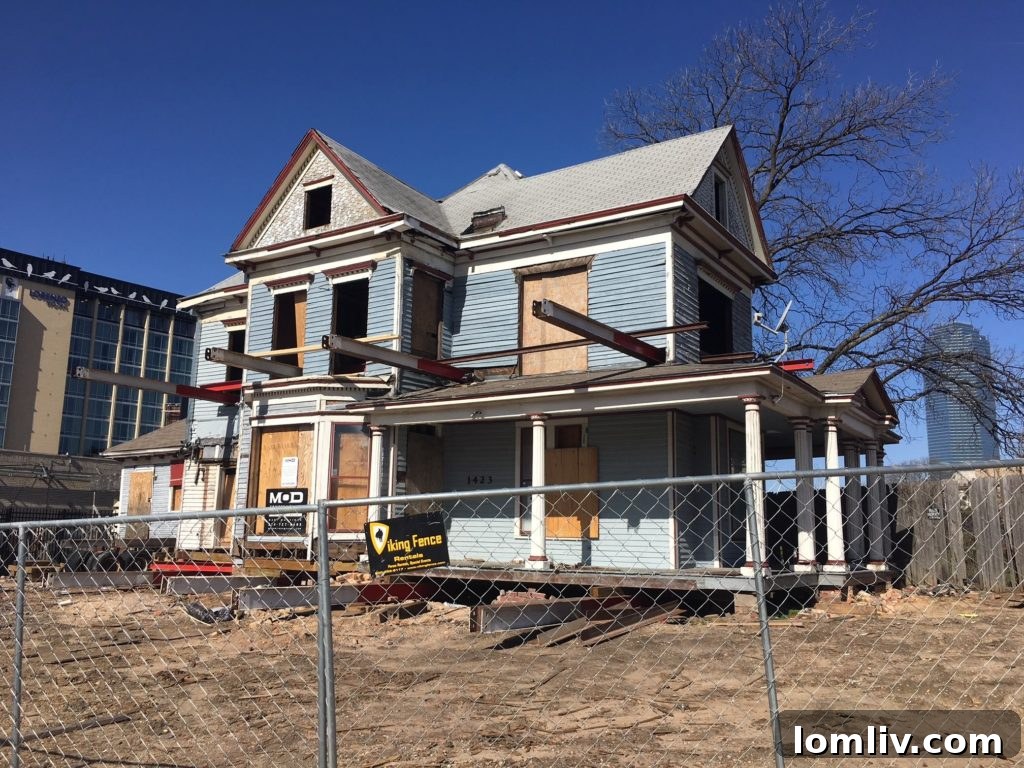
The restoration of the Blue House is a delicate dance between honoring its 1885 origins and integrating the necessities of 21st-century living. Martinek’s vision is clear: “We’re gonna more or less restore it to the exact same condition it was built in,” he explains, referring to its exterior aesthetics and historical detailing. This commitment means that any newer, anachronistic materials that may have been introduced over its 130-year lifespan will be replaced. For example, modern Hardy board siding will be removed and replaced with solid pine, aligning with the original construction materials.
Internally, however, the house will embrace modernity for comfort and efficiency. While the charming old sash windows will be retained, they will be meticulously rebuilt to eliminate drafts, enhancing energy efficiency without sacrificing their historical character. Crucially, the home will receive modern plumbing, efficient insulation, and air conditioning – amenities essential for contemporary living that will ensure the house’s long-term viability and appeal.
Navigating Urban Development: Cedars Neighborhood Specifics
Restoration in Dallas’s Cedars neighborhood comes with its own unique set of challenges, extending beyond the mere physical act of moving an old structure. Martinek highlights a significant hurdle: “The other real challenge in Cedars is that the way that the new PD [Planned Development] is written, the setbacks that are required don’t accommodate these old houses anymore.” This means that fitting a historic mansion onto a new lot, even one purchased specifically for its relocation, is not as simple as dropping it into place. Modern zoning and development regulations often clash with the footprints and traditional placement of older homes, requiring careful negotiation and creative solutions to ensure compliance while preserving the historical integrity of the building. It underscores that historic preservation is often a multi-faceted battle involving not just construction, but also policy and urban planning.
Unearthing the Past: The Legacy of Max Rosenfield
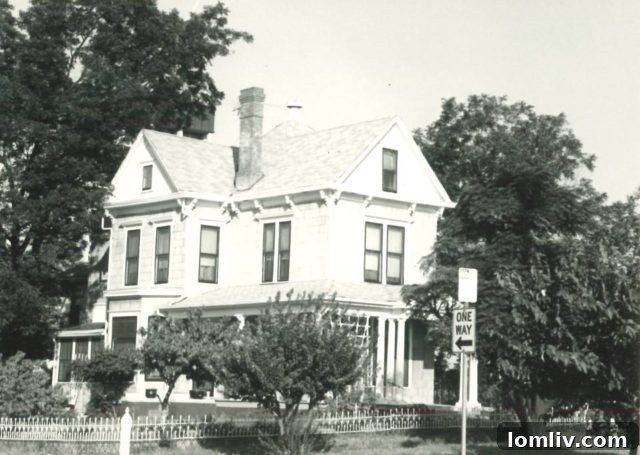
To truly understand the Blue House, one must delve into the story of its original builder, Max Rosenfield. Constructed in 1885, the house was a product of a dynamic period in Dallas’s history. Intriguingly, Rosenfield, alongside Gersen Meyer, a coworker at the prominent Sanger Brothers department store, engaged in a lucrative side business: real estate. As historian Paula Bosse meticulously detailed in her deep dive into the Blue House’s history for Flashback Dallas, their real estate ventures were extensive.
Bosse recounts, “They bought and sold real estate (often to fellow Sanger’s employees), apparently as a lucrative side-business (Rosenfield even conducted his real estate transactions from his Sanger Bros. office).” Their entrepreneurial spirit was so successful that by 1886, they had acquired enough land to establish their own ‘addition’ in East Dallas, aptly named ‘Rosenfield and Meyer’s Addition.’ This historical context reveals that the Blue House was not just a residence but potentially an investment property from its inception. Martinek notes that it appears the home was originally built with the capacity for three units, a common practice for its era, designed for the possibility of housing multiple families – an insight that informs its planned adaptive reuse today.
A Future Reimagined: The Blue House’s Next Chapter
After decades of patient dormancy and years of neglect, the Blue House’s rehabilitation is not a quick fix. Martinek estimates the entire restoration process will span approximately two years. This extended timeline underscores the complexity of working with a 130-year-old structure and the commitment to unparalleled quality. It’s a project that demands patience, meticulous research, and a deep appreciation for craftsmanship that honors the original builders.
When completed, the Blue House will begin its new life as a three-unit dwelling. This adaptive reuse strategy is not only practical but also historically resonant, given the understanding that the house may have been built with the flexibility for multiple occupants. Transforming it into multi-unit housing ensures its economic viability and sustainable future, preventing it from becoming a financial burden that could again threaten its existence. This approach allows more people to experience and appreciate the beauty and history of this significant Dallas landmark.
The restoration of the Blue House is more than just a construction project; it is a powerful demonstration of how communities, businesses, and dedicated individuals can collaborate to save and repurpose vital pieces of urban heritage. It stands as an inspiring example for other cities facing similar challenges, proving that with “a great deal of thought, and care,” even the most daunting preservation tasks can lead to brilliant outcomes, enriching the urban fabric and preserving stories for generations to come.
Bethany Erickson is an expert columnist covering education, consumer affairs, and public policy. Contact her at [email protected].