The Great Texas Influx: Unpacking Migration Trends and Why Californians Are Moving South
From Staff Reports
Texas has long been a beacon for opportunity, growth, and a distinctive way of life. In recent years, its magnetic pull has become stronger than ever, drawing a significant number of new residents from across the United States. Data from the Texas Real Estate Research Center at Texas A&M University reveals a compelling story of demographic transformation, highlighting interstate migration as a key driver of the state’s burgeoning population. Among all states, California consistently stands out as the primary source of this influx, shaping the cultural and economic landscape of the Lone Star State.
California’s Enduring Influence: A Decade of Dominance
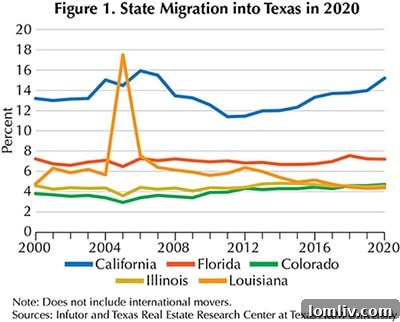
The movement of Californians to Texas is not a recent phenomenon, but rather a sustained trend that has intensified over the past decade. According to a comprehensive report by Dr. Luis Torres and research associate Wesley Miller, more than one in every ten people who relocated to Texas in 2020 hailed from California. This statistic underscores California’s unparalleled contribution to Texas’s population surge.
Historical data further solidifies California’s position as the leading origin state for new Texans. In an astonishing 19 out of the last 20 years, California has held the top spot. The only exception occurred in 2005, when Louisiana briefly surpassed it due to the mass displacement caused by Hurricane Katrina. Since 2011, the share of Californians choosing Texas as their new home has steadily increased year after year, indicating a persistent and growing attraction to the Lone Star State’s offerings. This continuous trend speaks volumes about the differing economic landscapes, quality of life, and cost of living between the two states, making Texas an increasingly appealing destination.
Beyond the Golden State: Other Key Contributors to Texas’ Growth
While California leads by a substantial margin, other states also contribute significantly to Texas’s vibrant growth. Florida emerged as the second-largest provider of new Texans in 2020, accounting for a 7.2 percent share. This figure, though substantial, is less than half the influx observed from California, emphasizing the unique scale of the California-to-Texas migration. Rounding out the top five states sending residents to Texas were Colorado, Illinois, and Louisiana, each contributing to the diverse tapestry of newcomers.
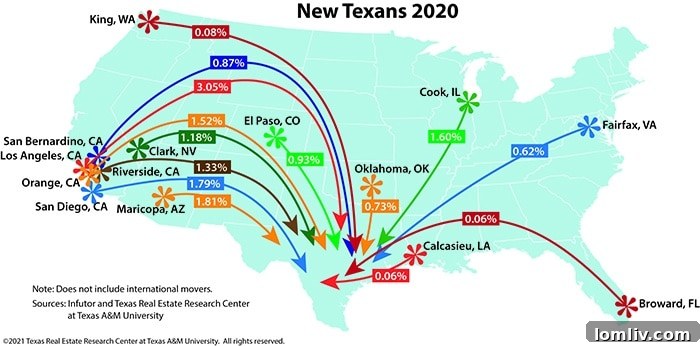
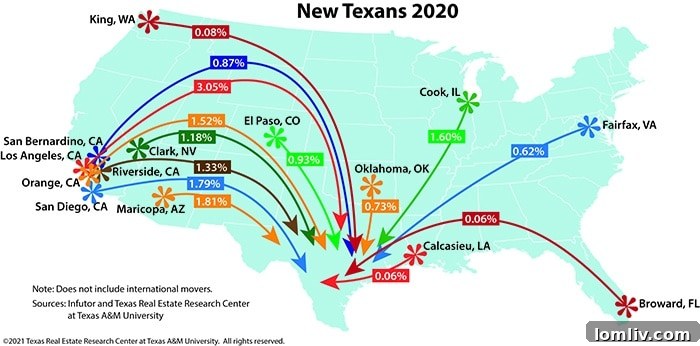
Delving deeper into the county level, the majority of newcomers relocating from California originated from Los Angeles County. This single county alone represented 3.1 percent of the total migration to Texas, a figure that is unsurprising given its status as California’s most populous county. The migration patterns reveal a strong preference among Southern Californian residents for a move to Texas. Four other major Southern Californian counties — San Diego, Orange, Riverside, and San Bernardino — also featured prominently in the top ten counties sending the most residents to Texas, underscoring the regional nature of this migratory flow.
Interestingly, the data challenges a common misconception. Contrary to popular belief, the primary drivers of migration from California are predominantly from the southern part of the state, rather than the technologically rich Silicon Valley in the north. This distinction is crucial for understanding the specific demographics and motivations of those making the move.
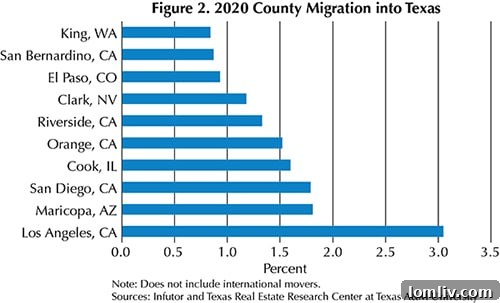
Beyond California, other notable U.S. counties contributed to the top ten sources of new Texans. These included Maricopa County in Arizona, Cook County in Illinois, Clark County in Nevada, El Paso County in Colorado, and King County in Washington. These diverse origins indicate a broader national trend of population redistribution, with Texas emerging as a central beneficiary.
Where New Texans Settle: Top Destination Counties and MSAs
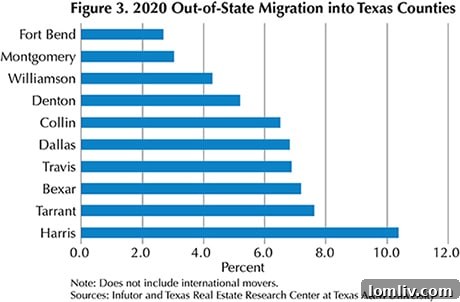
Once in Texas, new residents overwhelmingly gravitate towards the state’s highly populated urban and suburban areas, drawn by job opportunities, amenities, and established infrastructure. Of all the newcomers from other states, a significant 10.4 percent chose Harris County as their destination, making it the most popular landing spot. Harris County, home to Houston, offers a robust job market, diverse economy, and relatively affordable living compared to major coastal cities.
Other top destination counties for interstate relocations included Tarrant County (7.6 percent), Bexar County (7.2 percent), Travis County (6.9 percent), Dallas County (6.8 percent), and Collin County (6.5 percent). These top ten Texas destination counties collectively attracted a substantial 60.7 percent of all interstate relocations, funnelling new residents into Texas’s four major Metropolitan Statistical Areas (MSAs): Houston, Dallas-Fort Worth, Austin, and San Antonio. This concentration highlights the economic and social pull of these major metropolitan hubs, which offer a blend of career prospects, educational institutions, and a vibrant lifestyle.
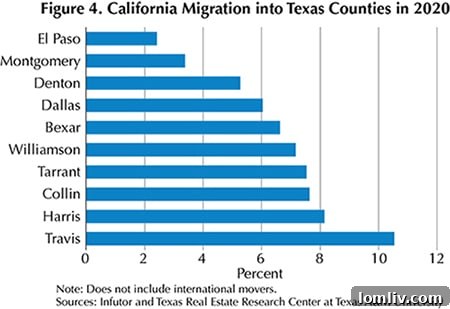
Californians, in particular, showed a strong preference for specific Texas counties. Travis County, home to the state capital Austin, was the top choice for former residents of the Golden State, attracting 10.5 percent of Californian movers. Austin’s booming tech industry, vibrant cultural scene, and progressive environment likely appeal to many coming from California. Other Texas counties popular with Californians included El Paso, Williamson, Collin, Tarrant, Dallas, Denton, Harris, Montgomery, and Bexar, demonstrating a spread across major urban centers and their rapidly growing suburban peripheries.
Even among those migrating from specific high-profile areas, the destination preferences are clear. San Francisco County, despite representing a smaller fraction (0.3 percent) of total migration flows to Texas in 2020, saw a significant portion of its out-migrants choose Travis County (Austin), with 38.4 percent relocating there. Dallas County attracted 11.7 percent, Harris County 9.0 percent, Tarrant County 5.6 percent, and Bexar County 4.8 percent of these San Francisco expatriates. This specific data further solidifies Austin’s reputation as a particularly attractive destination for those seeking an alternative to the traditional West Coast tech hubs.
Intra-State Migration: The Unsung Majority
While much media attention focuses on the dramatic influx of people from other states, it is crucial to remember that the vast majority of moves within Texas are by Texans themselves. In 2020, most relocations were by residents moving within the same county or to neighboring counties. This internal mobility is a continuous process that shapes local communities and drives localized growth, often overshadowed by the larger narrative of interstate migration.
Williamson County, situated north of Austin and part of the vibrant Austin MSA, serves as an excellent illustration of this trend. In Williamson County, a significant 44.6 percent of all moves were made by residents relocating within the county itself. Furthermore, Texans moving from neighboring Travis County accounted for another 19.4 percent of the total moves into Williamson County. Combined, these two Central Texas counties represented a substantial 64.0 percent of all in-state moves affecting Williamson County, highlighting strong regional ties and localized growth corridors.
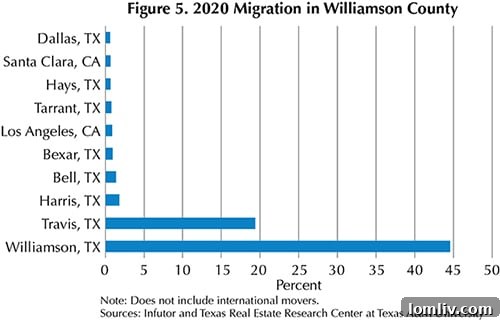
Comparatively, approximately 21.5 percent of moves into Williamson County could be attributed to movers from other states. This demonstrates that while interstate migration is a powerful force, internal relocation forms the bedrock of demographic change in many Texas counties. The share of interstate migration varies significantly for each Texas county, influenced by factors such as population size, economic opportunities, and industry mix. In fast-growing areas like Williamson County, which benefits from the Austin MSA’s thriving economy, businesses and people are attracted in greater proportion than to many other counties across the state, creating a dynamic blend of internal and external growth.
Why Texas? Factors Driving the Migration Boom
The persistent appeal of Texas, especially to Californians, can be attributed to a confluence of compelling factors. Understanding these pull factors is essential for grasping the motivations behind such significant demographic shifts:
- Economic Opportunity: Texas boasts a robust and diversified economy, with thriving sectors in technology, energy, healthcare, manufacturing, and finance. The state’s business-friendly policies, including no state income tax and less stringent regulations, attract companies and foster job creation, drawing professionals and entrepreneurs alike.
- Affordable Cost of Living: Compared to California’s notoriously high housing costs and general expenses, Texas offers a significantly more affordable cost of living. This allows residents to achieve a higher quality of life, purchase larger homes, and stretch their income further, which is a powerful incentive for families and individuals.
- Housing Market: While Texas’s housing market has seen appreciation, it remains far more accessible than California’s. The availability of land, coupled with ongoing construction, means that homeownership is a more realistic goal for many who might be priced out of the Californian market.
- Quality of Life: Texas offers a diverse range of lifestyles, from bustling urban centers with world-class amenities to charming small towns and vast open spaces. The state’s cultural richness, strong community focus, and variety of recreational activities appeal to a broad spectrum of people.
- Lower Tax Burden: The absence of a state income tax in Texas is a major financial draw for residents and businesses relocating from states with high tax rates like California.
Implications for Texas: Growth, Infrastructure, and Future Outlook
This continuous influx of new residents presents both opportunities and challenges for Texas. The population growth fuels economic expansion, increases the tax base, and brings diverse talents and perspectives to the state. However, it also places immense pressure on existing infrastructure, including roads, utilities, schools, and healthcare services. Housing affordability, while still better than in California, is becoming a growing concern in popular metropolitan areas.
Texas state and local governments are continually grappling with how to manage this rapid growth sustainably. Strategic urban planning, investment in public transportation, expansion of educational facilities, and careful resource management are all critical to ensuring that Texas can accommodate its burgeoning population while maintaining its high quality of life. The demographic shifts also have political and cultural implications, as the state becomes increasingly diverse and dynamic.