
In the dynamic world of real estate, strategic pricing is not just a numbers game; it’s an art and a science that significantly impacts a property’s appeal and saleability. Real estate professionals continuously refine their pricing approaches to captivate serious buyers, understanding that a transaction encompasses far more than the simple interplay of supply and demand. Motivated buyers are driven by the perceived value embedded in the entire deal – a complex mosaic of pricing, advantageous terms, prevailing interest rates, required down payments, associated fees, realtor commissions, various closing costs, and, critically, the long-term value proposition of the property. Different market segments require tailored pricing strategies that resonate specifically with their unique motivations and financial capabilities. This comprehensive guide delves into various buyer groups and explores how finely-tuned pricing strategies can effectively cater to their needs, ensuring a smoother, more successful transaction for all parties involved.
Among the most significant demographics entering the property market are first-time homebuyers. This group, often transitioning from the rental market, clearly recognizes the inherent long-term benefits of homeownership over renting. Realtors often engage with first-time buyers by emphasizing the substantial equity they can build by owning a home. For a homeowner, each mortgage payment contributes to building tangible ownership in a real asset. While a larger portion of early payments typically goes towards interest rather than the principal, this balance gradually shifts over time, progressively increasing the homeowner’s equity. This equity is not merely a number on a balance sheet; it represents a powerful financial tool for future investments, renovations, or even securing lines of credit. Educating first-time buyers about this wealth-building aspect is crucial for demonstrating the profound financial advantages of entering the housing market.
Beyond the immediate financial outlay, homeownership instills a sense of stability and permanence. It provides a sanctuary that can be customized to personal tastes and needs, fostering community ties and offering a secure environment for families. For first-time buyers, the journey can seem daunting, but strategic guidance from real estate experts can demystify the process, highlight available grants or loan programs (like FHA loans with lower down payment requirements), and underscore the enduring financial and personal rewards that come with owning a piece of the American dream. Understanding their unique anxieties and aspirations allows real estate agents to craft compelling narratives and pricing strategies that make the prospect of homeownership attainable and exciting.
The Psychology of Pricing: Numbers That Speak to Buyers
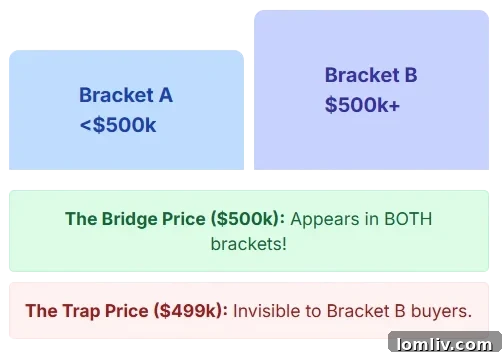
The numbers used in a listing price carry a subconscious weight that influences buyer perception and search behavior. Savvy real estate professionals leverage this psychological impact to maximize visibility and appeal. A fundamental understanding of how buyers search for homes online is paramount. Over 80% of potential buyers utilize price filters, often in convenient increments such as $25,000 or $50,000 (e.g., “Max $500k” or “Min $500k”). This common search habit gives rise to a critical strategic approach:
The “Search Bridge” Strategy for Optimal Visibility
Consider the profound difference a mere dollar can make in online visibility. If a property is priced at $499,900, it will appear in search results for buyers whose maximum filter is $500,000. However, it will remain entirely invisible to the larger pool of buyers actively searching within the “$500k to $600k” range. This effectively cuts off a significant segment of the market. Conversely, by strategically pricing a property at a round number like $500,000, it ingeniously appears in search results for buyers looking up to $500k AND for buyers looking from $500k. This “Search Bridge” strategy significantly broadens the property’s exposure, dramatically increasing the likelihood of attracting more potential buyers and, consequently, generating more interest and offers.
When to use this:
This powerful strategy is best employed when your home hovers “on the fence” of a major price point (e.g., $400,000, $500,000, $750,000, or $1,000,000) and is in excellent condition, warranting a competitive price. It ensures that the property captures the widest possible audience searching within and across these critical price thresholds.
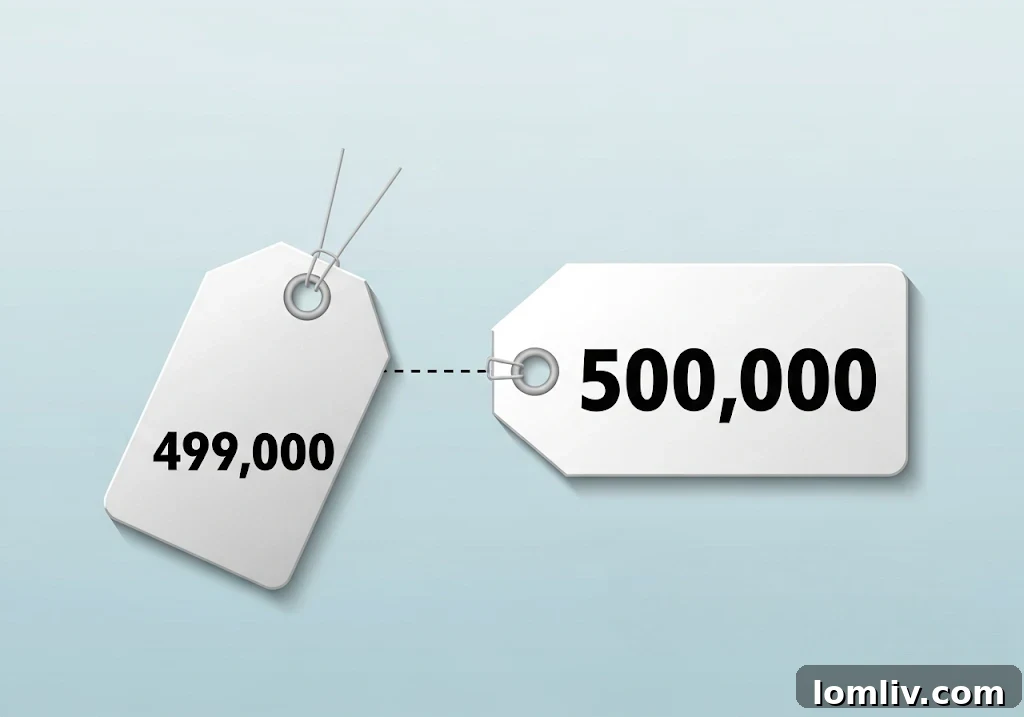
Odd Numbers ($X99k) vs. Round Numbers ($X00k): Subconscious Signals
The format of your pricing communicates a powerful, subconscious signal to buyers even before they delve into the listing details. Understanding these psychological cues allows for strategic positioning:
- $499,000 (The “Bargain” Signal): This type of “charm pricing” leverages the “left-digit effect,” where consumers focus on the leftmost digit and perceive the price as significantly lower. It inherently implies value, urgency, and the potential for a great deal. This strategy is most effective for: Standard suburban homes, properties positioned as fixer-uppers (where value add is key), or in high-inventory markets where standing out as a good value is crucial. It can stimulate faster interest and encourage offers from buyers seeking perceived savings.
- $500,000 (The “Prestige” Signal): Round numbers, in contrast, convey a sense of quality, luxury, and a firm, confident pricing stance. They suggest that the property’s value is undeniable and doesn’t require “trick pricing.” This approach is ideal for: Luxury properties (e.g., in upscale neighborhoods like Park Cities), homes with unique architectural significance, or meticulously maintained, turnkey homes where the expectation is premium quality and a straightforward valuation. It targets buyers who prioritize prestige and are willing to pay for perceived excellence, often with less inclination to haggle.
Equity, the difference between a home’s market value and the outstanding mortgage balance, is a profoundly powerful financial tool that extends far beyond merely owning a property. Homeowners frequently leverage this accumulated wealth to fund significant life events or investments. This can include undertaking home renovations to enhance property value and personal enjoyment, financing higher education for their children, making strategic investments, acquiring other substantial assets, or even fulfilling long-held bucket-list experiences. Putting down roots with real estate represents a serious, long-term commitment to building personal wealth. For the vast majority of individuals, a home is the single largest investment they will ever make. It serves as a foundational asset, providing not only shelter but also a platform for financial stability, sustained growth, and enduring long-term prosperity, often becoming a cornerstone of generational wealth transfer.
Beyond the immediate financial gains, homeownership offers considerable tax benefits. Deductions for mortgage interest and property taxes, where applicable, can significantly reduce a homeowner’s taxable income. Furthermore, over time, a property’s value tends to appreciate, serving as a hedge against inflation and a reliable store of wealth. This appreciation, combined with the gradual payoff of the mortgage, compounds the equity, allowing homeowners to build substantial assets that can be accessed when needed or passed down to future generations. Understanding and articulating these multifaceted benefits allows real estate professionals to paint a holistic picture of homeownership, showcasing its value beyond just a purchase price.
Net Proceeds Estimator: Understanding Your Take-Home From a Sale
3%
1.5%
$ 500,000
-$ 15,000
-$ 7,500
-$ 250,000
Understanding the “Net Proceeds” from a home sale is paramount for sellers, as it represents the actual cash they will receive after all expenses are paid. This calculation goes beyond the initial sale price and provides a realistic figure for future financial planning. As illustrated by the estimator above, several key factors directly impact these net proceeds, and sellers should be acutely aware of each component to avoid surprises. The primary determinants include the agreed-upon Estimated Sale Price, which is the starting point. From this, several deductions are made. The most significant often being the Mortgage Payoff Amount, which covers the remaining balance on any existing loans tied to the property.
Another substantial deduction comes from Commissions, typically a percentage of the sale price paid to the real estate agents involved in the transaction. This percentage can vary and is often a point of negotiation. Finally, Estimated Closing Costs, which generally range from 1-3% of the sale price, encompass a variety of fees. These can include title insurance, escrow fees, legal fees, recording fees, transfer taxes, and other administrative charges necessary to finalize the sale. While the estimator provides a clear picture of these major outflows, it’s crucial for sellers to remember that other factors, such as property tax prorations, outstanding homeowners’ association (HOA) fees, and any agreed-upon repair credits, can further influence the final net proceeds. A clear breakdown, proactively provided by a knowledgeable real estate agent, empowers sellers to make informed decisions and accurately forecast their financial outcome from the sale.
Another incredibly important and often underserved group in the homebuying market consists of veterans, active service members, and their eligible family members. The United States is home to tens of millions of veterans, representing conflicts spanning generations, from World War II to recent engagements in Afghanistan. These individuals have made profound sacrifices, consistently putting country and duty above personal interest. As a testament to society’s gratitude for their invaluable service, a unique and highly beneficial program exists to facilitate their homeownership journey: the VA home loan. These loans are partially guaranteed by the U.S. Department of Veterans Affairs, which significantly reduces the risk for lenders. This government backing makes lenders far more willing to extend credit to eligible veterans, often under more favorable terms than conventional loans.
The advantages of VA loan requirements are substantial and specifically designed to ease the financial burden of homeownership for those who have served. Realtors specializing in military relocation and veteran services often highlight these VA-backed programs as a cornerstone of their offerings. One of the most significant benefits is that eligible veterans are not required to make a down payment when applying for a VA mortgage. This is a crucial distinction, as many other buyers using conventional loans often need to provide as much as a 20% down payment to avoid the additional cost of private mortgage insurance (PMI). The exemption from both down payment and PMI requirements makes the prospect of homeownership dramatically more accessible and affordable for veterans, removing major financial hurdles that often deter other buyers.

Equally important are the competitive interest rates and terms associated with VA loans. VA home loans frequently carry interest rates that are either slightly lower than, or at least on par with, many non-VA conventional loan products. Even a small reduction in the interest rate can translate into colossal long-term savings over the life of a 15-year or 30-year mortgage, significantly reducing the total cost of ownership. Furthermore, VA loans often come with more lenient credit requirements, making homeownership a reality for veterans who might not qualify for conventional financing due to past credit challenges. The absence of a monthly mortgage insurance premium, which is standard for most conventional loans with less than 20% down, represents another significant ongoing saving. These combined benefits underscore the immense value of VA loans and the commitment to supporting those who have protected our nation.
Beyond the mortgage itself, a multitude of additional expenses can quickly accumulate, adding a substantial layer of cost on top of the principal and interest payments. These include home warranties, homeowners’ association (HOA) dues, various realtor fees, and commissions, all of which can collectively impact a buyer’s affordability. With the median home price in the United States currently standing around $430,000, monthly mortgage payments are already a significant financial commitment for most households. When additional expenses such as property insurance, optional warranty coverage, HOA dues, and realtor fees or commissions are factored in, they can considerably eat into a buyer’s available disposable income and impact their long-term financial planning. This is where the expertise of savvy realtors truly shines, as they can proactively address these concerns and appeal to motivated buyers through a variety of transparent and supportive strategies.
For instance, some forward-thinking agents may choose to include a one-year home warranty with the purchase of a home as a valuable gesture of appreciation and a safeguard against unexpected repair costs. This not only adds tangible value but also provides peace of mind to buyers, especially those new to homeownership. While HOA dues are not the direct responsibility of the realtor, buyers deeply appreciate agents who provide thorough information regarding the historical stability of these dues, their typical rate of increase, and the value they provide in terms of community amenities and services. Transparency in this area helps buyers understand their ongoing financial commitments. Crucially, realtor fees and commissions are also negotiable in many situations, offering another avenue for potential savings for buyers and sellers alike. An agent who is upfront about these costs and willing to discuss flexibility can build immense trust. Proactively addressing all these potential additional expenses and offering thoughtful concessions or clear information can significantly tip the scales in favor of buyers, helping to alleviate concerns and smoothly move the deal toward a successful close.
The Curtain Call: A Holistic Approach to Real Estate Value
In conclusion, truly savvy real estate professionals grasp that the perceived “all-in” cost of a home is what ultimately matters most to buyers. Often, it’s not merely the list price but the aggregation of seemingly minor, yet significant, extra expenses that can complicate a deal or even cause it to falter. By adopting a proactive and transparent approach to these various costs – particularly concerning realtor fees and commissions, offering a complimentary one-year home warranty as a value-add, or providing clear, comprehensive information about homeowners’ association dues and other recurring charges – agents can effectively put potential buyers at ease and strategically influence their decision in favor of the property. This comprehensive strategy builds trust and confidence.
Ultimately, a successful real estate transaction is less about fixating on one specific number and more about whether buyers genuinely feel that the home represents exceptional overall value. It’s a delicate and sophisticated balance of fair, market-appropriate pricing combined with smart, well-timed concessions and transparent communication. This nuanced approach is precisely how experienced realtors consistently navigate the complexities of the market, build strong client relationships, and successfully close deals, ensuring satisfaction for both buyers and sellers alike.