

A Decade of Unprecedented Growth: Unpacking the Texas Real Estate Boom (2011-2020)
Cast your mind back ten years. What significant milestones were you celebrating? While many were navigating personal journeys, real estate professionals across the Lone Star State, particularly in the sprawling Dallas/Fort Worth-Arlington metropolitan area, were orchestrating a period of truly remarkable growth and transformation within the Texas housing market. The decade spanning from 2011 to 2020 proved to be a golden era for Texas real estate, cementing its status as a national powerhouse.
According to the meticulously compiled A Decade in Texas Real Estate report by Texas Realtors, the Dallas/Fort Worth-Arlington metroplex emerged as the state’s undisputed leader in home sales. This comprehensive report sheds light on the incredible momentum that defined the market, painting a vivid picture of sustained demand, soaring property values, and an influx of new residents and businesses.
Dallas/Fort Worth-Arlington: The Epicenter of Texas Housing Success
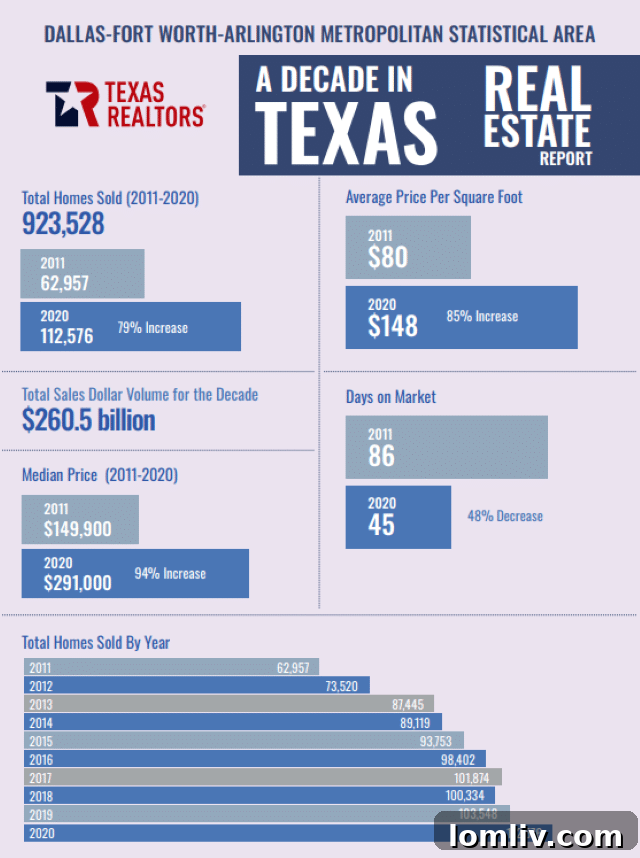
The D/FW-Arlington market didn’t just participate in the growth; it led the charge with astonishing figures. Over the ten-year period, a staggering 923,528 homes changed hands, reflecting an unparalleled level of market activity. This immense volume of sales translated into an astronomical total sales volume of $260.5 billion. To put this in perspective, this figure dwarfs the net worth of many prominent billionaires, underscoring the sheer economic impact generated by the region’s robust housing sector.
Statewide, the performance was equally impressive, with nearly 3.12 million homes sold during the same decade. This collective achievement highlights Texas’s magnetic appeal and its ability to attract and accommodate a burgeoning population.
Dr. Luis Torres, a distinguished research economist with the Texas Real Estate Research Center at Texas A&M University, eloquently summarized the period: “The Texas housing market thrived during the last decade. It expanded at a record pace, achieving consistent home sales growth each year and strong home price growth during the decade.” This statement encapsulates the twin engines of growth—volume and value—that propelled Texas real estate forward.
The credibility and depth of this analysis are rooted in robust data. The report’s insights are derived from the Data Relevance Project, a collaborative initiative involving local Realtor associations, their Multiple Listing Services (MLS), and Texas Realtors, with expert analysis provided by the Texas Real Estate Research Center. This collaborative approach ensures that the data is comprehensive, accurate, and truly representative of the market’s dynamics.
A Closer Look at DFW’s Remarkable Trajectory (2011 vs. 2020)
Delving deeper into the D/FW-Arlington market reveals some truly astounding year-over-year comparisons between 2011 and 2020. The numbers paint a clear picture of an accelerated, high-demand environment:
- Homes Sold: The number of homes sold surged from 62,957 in 2011 to 112,576 in 2020, representing an extraordinary 79 percent increase. This almost doubling of sales volume speaks volumes about the region’s increasing desirability and capacity for growth.
- Median Price: Property values experienced a dramatic ascent. The median price climbed from $149,900 in 2011 to $291,000 in 2020, marking an incredible 94 percent increase. This nearly doubled the value of an average home, contributing significantly to homeowner equity and regional wealth.
- Average Price Per Square Foot: The cost per square foot, a key indicator of property value density, similarly rose from $80 in 2011 to $148 in 2020. This consistent appreciation across various metrics underscores the strength of demand outstripping supply.
- Days on Market: Perhaps one of the most compelling indicators of a red-hot market is the speed at which homes sell. In 2011, homes typically spent 86 days on the market. By 2020, this figure had plummeted to just 45 days, illustrating intense buyer competition and a highly efficient transaction process.
While the D/FW-Arlington market experienced an exceptional decade, it wasn’t without minor fluctuations. The year 2018 saw a slight dip in total homes sold, with 100,334 transactions. However, the market quickly rebounded in 2019, recording 103,548 sales, demonstrating its underlying resilience and consistent buyer demand. Crucially, even during this minor slowdown in volume, median prices continued their upward trajectory every single year, highlighting the sustained appreciation of real estate assets in the region.
This phenomenal growth in D/FW-Arlington can be attributed to several factors. The metroplex has long been a magnet for corporate relocations and expansions, fostering robust job growth across diverse sectors like technology, finance, logistics, and healthcare. This economic vitality, coupled with a relatively lower cost of living compared to coastal megacities, has drawn in millions of new residents seeking opportunity and a high quality of life. The resulting population boom naturally fueled an insatiable demand for housing, pushing prices and sales volumes to new heights.
The Broader Texas Canvas: A Market Thriving Against All Odds
Beyond Dallas/Fort Worth, the entire state of Texas showcased remarkable real estate dynamism. The sheer volume of nearly 3.12 million homes sold statewide underscores Texas’s sustained appeal. The factors driving this statewide success are multifaceted, including:
- Pro-Business Environment: Texas’s business-friendly policies and lack of state income tax continue to attract companies and individuals alike, creating a vibrant economic landscape.
- Diverse Economy: While historically known for energy, Texas has successfully diversified its economy, with thriving tech hubs, growing healthcare sectors, and significant manufacturing capabilities, providing stability and varied job opportunities.
- Strategic Location and Infrastructure: Its central location within the U.S. and extensive transportation networks facilitate trade and logistics, making it an attractive hub for businesses.
Houston Metro Area: A Strong Contender in the Texas Housing Saga
While D/FW led the state, the Houston metropolitan area solidified its position as Texas’s second-busiest home market. With 811,105 home sales valued at an impressive $224.2 billion over the decade, Houston demonstrated its own significant economic might and housing demand. Houston’s growth is often propelled by its unique economic drivers, including its status as the energy capital of the world, home to the largest medical center globally, and a major international port. These industries generate substantial employment and attract a diverse, growing population, all contributing to its robust real estate market.
Texas’s Dominance in U.S. Homebuilding
The strength of the Texas market is further emphasized by its national standing. All of the state’s major metropolitan areas consistently rank among the top-10 U.S. homebuilding markets. This indicates not only strong consumer demand but also the capacity and willingness of developers and builders to invest heavily in creating new housing inventory to meet the needs of the state’s exploding population.
Key Factors Shaping a Dynamic Decade in Texas Real Estate
Marvin Jolly, the esteemed Texas Realtors chairman during this period, provided valuable perspective on the confluence of factors that shaped the market. “We’ve had a dynamic real estate market in Texas over the past decade,” Jolly noted. He highlighted several key influences:
- Significant Population Growth: Texas has experienced one of the fastest population growth rates in the nation. People are migrating to Texas from various states, particularly California and the Northeast, drawn by job prospects, lower cost of living, and a favorable economic climate. This continuous influx of new residents directly translates into sustained demand for housing, both rental and ownership.
- Natural Disasters Big and Small: While the decade saw its share of natural challenges, from hurricanes to severe weather events, the Texas housing market consistently demonstrated resilience. Recovery and rebuilding efforts, often supported by insurance and federal aid, sometimes even spurred new construction and modernization, contributing to market activity in the wake of adversity.
- New Home Technologies: Advancements in construction techniques, energy efficiency, and smart home technologies played a role in shaping buyer preferences. Modern homes offering enhanced comfort, lower utility bills, and integrated tech features became increasingly desirable, influencing design trends and boosting demand for new constructions.
- The Pandemic (COVID-19): The latter part of the decade, specifically 2020, saw the profound impact of the global pandemic. While initial forecasts were grim, the housing market, particularly in Texas, defied expectations. Low interest rates, a shift towards remote work prompting a desire for more space, and the perception of homes as safe havens fueled an unprecedented surge in buyer activity and competition, pushing prices even higher and significantly reducing days on market. The pandemic, unexpectedly, served as a powerful accelerant for an already booming market.
The Foundation of Insight: Data and Analytics
The insightful analysis provided by the “A Decade in Texas Real Estate report” would not be possible without the diligent efforts of the Texas Real Estate Research Center and the collaborative spirit of local Realtor associations and their Multiple Listing Services (MLS) through the Data Relevance Project. This commitment to accurate and comprehensive data collection is crucial for understanding market trends, informing policymakers, and empowering both buyers and sellers to make educated decisions in an increasingly complex real estate landscape.
Looking Ahead: Sustaining the Texas Real Estate Momentum
The extraordinary growth observed in Texas real estate from 2011 to 2020 lays a strong foundation for the future. While new challenges, such as affordability concerns, inventory shortages, and evolving interest rate environments, will undoubtedly shape the coming years, the fundamental drivers of Texas’s appeal—economic opportunity, quality of life, and a favorable business climate—remain firmly in place. The state’s ability to adapt, innovate, and continue attracting a diverse population will be key to sustaining this remarkable momentum.
Conclusion: A Blueprint for Prosperity
The past decade unequivocally established Texas as a leading force in the national real estate arena. The Dallas/Fort Worth-Arlington metroplex, in particular, stood out as a beacon of growth, symbolizing the state’s economic vitality and magnetic draw. From skyrocketing home sales and unprecedented price appreciation to rapid days on market, the data speaks volumes about a market that has not only thrived but has also set new benchmarks for success. This “Decade in Texas Real Estate” report serves not just as a historical record, but as a compelling testament to the resilience, dynamism, and enduring prosperity of the Lone Star State’s housing market, offering invaluable insights for anyone interested in real estate trends and economic development.