Amazon’s HQ2 Drama: Could Dallas Get a Second Shot After New York’s Exit?
The corporate world watched with bated breath as Amazon embarked on its highly publicized search for a second headquarters, dubbed “HQ2.” After nearly a year of intense competition and cities across the nation vying for the prestigious project, Amazon initially surprised many by announcing its decision to split HQ2 between two locations: Long Island City, New York, and Crystal City, Virginia. However, this groundbreaking plan quickly hit an unforeseen snag in the Big Apple, igniting a fierce debate that ultimately led to Amazon reconsidering its New York commitment. As the e-commerce giant potentially re-evaluates its strategy, the question on many minds, particularly in the Lone Star State, is whether a jilted contender like Dallas could re-emerge as a prime candidate for this monumental investment.
The initial HQ2 competition was a spectacle, with hundreds of cities submitting elaborate proposals, promising billions in incentives and touting their unique advantages. Dallas, with its robust economy, central location, and business-friendly environment, was considered a strong contender, investing significant resources into its bid. Amazon’s eventual decision to select two locations—a departure from its original single-site promise—was met with mixed reactions, but the real drama unfolded swiftly in New York City.
The New York Backlash: A Cautionary Tale of Urban Development
Almost immediately following the announcement, a powerful wave of resistance began to swell in New York. Local residents, community organizers, and some elected officials voiced profound concerns about the potential impact of Amazon’s arrival. The primary anxieties revolved around an anticipated surge in housing prices and rents, threatening to displace existing residents and exacerbate the city’s already challenging affordability crisis. Critics also lambasted the substantial public incentives offered to Amazon, arguing that billions in tax breaks and subsidies could be better spent on improving public infrastructure, education, and social services for current New Yorkers.
The opposition wasn’t limited to economic concerns. Labor unions raised issues about Amazon’s employment practices, citing past controversies regarding worker treatment and unionization efforts. Others expressed fears about increased traffic congestion and strain on public transportation systems. This growing chorus of dissent created an increasingly challenging environment for Amazon, culminating in a report by The Washington Post indicating that the company was indeed re-evaluating its Long Island City plans. The intense pushback highlighted a critical tension in urban development: the balance between attracting major corporations for economic growth and preserving the fabric and affordability of existing communities.
“If the Amazon deal falls apart, they will have nobody to blame but themselves. A major problem is the way the deal was put together shrouded in secrecy and ignoring what New Yorkers want and need. They arrogantly continue to refuse to meet with key stakeholders to address their concerns, despite requests from New York’s top elected officials to do so. With their long history of abusing workers, partnering with ICE to aid their persecution of immigrant communities, and contributing to gentrification and a major housing crisis in their hometown of Seattle, New Yorkers are right to raise their concerns and opposition to this plan. New Yorkers won’t be bullied by Jeff Bezos, and if Amazon is unwilling to respect workers and communities they will never be welcome in New York City.”
— Stuart Appelbaum, President, Retail, Wholesale and Department Store Union
Dallas’s Renewed Hope: “New York Doesn’t Want You; Dallas Does”
As the news of Amazon’s potential withdrawal from New York spread, cities that had previously made bids began to buzz with renewed speculation. Dallas, a city often lauded for its pro-business stance and robust economy, quickly emerged as a prominent candidate for a second look. The Dallas Morning News editorial board seized the moment, publishing an impassioned op-ed titled, “Dear Amazon, New York doesn’t want you; Dallas does.” The piece underscored Texas’s reputation as a state that actively courts and supports corporate investment, contrasting it sharply with the adversarial climate Amazon faced in New York.
The editorial highlighted Texas’s favorable tax policies, streamlined regulatory environment, and a general political landscape seen as more welcoming to large businesses. It suggested that Governor Andrew Cuomo’s efforts to secure Amazon for New York were undermined by a layer of lawmakers and public sentiment less aligned with grand corporate incentives. The subtext was clear: Dallas, and Texas as a whole, would provide a more stable and appreciative home for a company of Amazon’s scale and ambition.
“New York will never be the happy home for Amazon that Texas could be. The Empire State’s governor, Andrew Cuomo, might be able to cough up billions in incentives to land a high-flyer like Amazon, but there is a layer of lawmakers who will work to undermine the very company investing in the state. Cuomo might have realized this recently when he lamented the fact that his state is losing tax revenue because the well-heeled are lighting out for the territories—otherwise known as Florida and other lower-tax states.”
Despite the media speculation, getting official confirmation from Dallas city officials on a potential renewed bid proved challenging, mirroring similar experiences reported by other local outlets like D Magazine. This silence, however, only fueled public curiosity and debate.
The Great Dallas Debate: Residents Weigh In on Amazon’s Potential Arrival
With official channels quiet, the conversation naturally shifted to the community. When asked whether Dallas should try again for Amazon if the opportunity arose, local residents offered a diverse range of opinions, reflecting a nuanced understanding of the potential benefits and drawbacks. These discussions highlighted the complex trade-offs involved in attracting a major corporation and the balancing act cities must perform to foster economic growth while safeguarding community well-being.
The question posed to Dallas residents: “If Amazon ditches New York, and starts looking for a second choice, would anything make you want Dallas to try again, and why/why not?” generated significant engagement. The responses, divided into “Nay,” “Yay,” or “Eh,” paint a vivid picture of the local sentiment.
The “Nay” Camp: Concerns Over Unfettered Growth and Public Costs
Many Dallas residents expressed strong reservations, primarily citing concerns about the strain on existing infrastructure, the impact on housing affordability, and the perceived inequity of corporate tax incentives.
- Michelle Christy Michell, a former Amazon employee, stated: “Let me get this out of the way: I have worked for Amazon for two years. It is a great job for someone in school. I don’t want them here.” Her firsthand experience provided a unique perspective, suggesting that even with personal knowledge of the company, the larger community impact outweighed individual employment benefits.
- Timothy Ward Dickey voiced profound frustration over the initial $600 million incentive package: “I still can’t get over the fact that Our Downtown Betters secretly committed us to offering $600 million in incentives. This, in a city with $11 Billion in unmet infrastructure needs, an abysmal bus system, potholes galore, a police department just barely hanging on for dear life, park maintenance Budget cut by half a million dollars, homeless encampments proliferating under freeway overpasses, and on and on. But the Amazon deal is B_G, so we HAVE to go for it, no matter the cost, right?” This sentiment encapsulated the feeling that public funds should address pressing local issues before being offered to a wealthy corporation.
- Rebecca Bell Wilson echoed tax concerns: “Not if Dallas is going to give a massive tax break that Dallas homeowners have to subsidize with property taxes.” This highlights the fear that the financial burden of corporate incentives would fall disproportionately on existing residents.
- Kris Moore focused on social equity: “Dallas is already in a housing and inequality crisis. The very last thing we need is more rich people being catered to by our city government.” This perspective emphasizes the potential for gentrification and widening wealth gaps.
- Karen Newton pointed to practical infrastructure deficiencies: “We don’t have the transportation infrastructure. What if these people are used to commuting by train? They would be limited on where they could live.” This highlights the challenge of integrating a large workforce accustomed to different urban amenities.
- Kimberly Boyce articulated a broader skepticism of corporate incentives: “Cities typically offer huge give-always to companies moving in. I don’t think those giveaways are ever matched by the returns. In addition I wouldn’t want Amazon anywhere near our central neighborhoods. It would lead to completely pricing out current residents.”
The “Yay” Camp: Vision of Prosperity and Progress
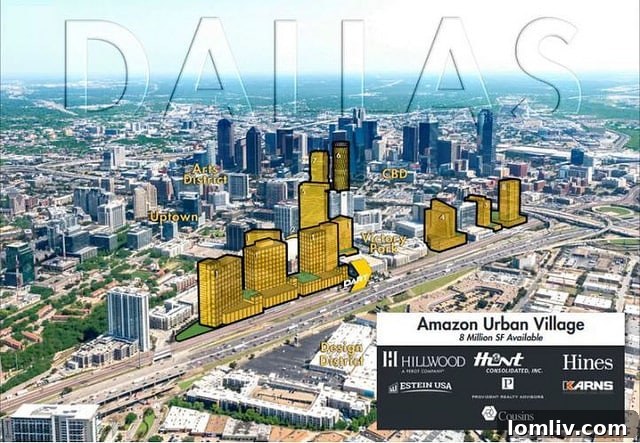
On the other side of the spectrum, many residents enthusiastically supported the idea of Amazon coming to Dallas, envisioning significant economic benefits and a boost to the city’s global profile.
- JP Piccinini saw immense potential for downtown revitalization: “The downtown Dallas scene would greatly benefit from this. No doubt in revenue to the state and counties levels with personal sales and property taxes. I was in LI city here recently and I shook my head as to why that site was selected…other than just a straight political snob it didn’t make financial sense. Now it’s backfiring because of the same policies and gubernatorial mentality they were so proponent of. Dallas just has to go in with a close.”
- Kyle Rains likened the impact to a historic event: “If Amazon were to relocate in or near Downtown Dallas it would be a game changer on the scale of the Texas Centennial at Fair Park in 1936. It put us on the map. Otherwise we might be Tyler, Texas.” This highlights the desire for a transformative economic catalyst.
- Eric Dettmers offered a conditional “yay”: “I’d say bring it on … if Amazon stipulated that Dallas upgrade their surface streets from third-world to developed-country.” This points to a desire for Amazon’s presence to drive improvements in public services.
- Ryan Jacobson expressed a general pro-business sentiment: “Any corporation moving here is a good thing.”
- Suzanne Frossard emphasized Texas hospitality: “I think it is all about the people. We would welcome them with Texas hospitality and succeed no doubt. Nothing like it above the Mason Dixon line.”
- H.L. Rowry viewed it as a future-defining opportunity: “It would be totally worth it. This isn’t some sports franchise. This is the foreseeable future of America, HQ’d in Dallas.”
- Vaun Lineberg succinctly stated: “DFW is a perfect place for Amazon.”
The “Eh” Camp: Cautious Optimism and Conditional Acceptance
Some residents fell into a more nuanced category, expressing conditional support or a more skeptical, yet open-minded, approach.
- William Reynolds proposed a reversal of the incentive model: “Only if they pay us to be here not the other way around. There are a lot of companies coming here now BECAUSE Amazon isn’t.” This suggests a desire for corporate investment without significant public concessions.
- David Burrows set clear conditions for acceptance: “Tax breaks for billionaires isn’t a popular theme. If Bezos can help pony up money for our infrastructure, fire and police and give everyone in Dallas free Prime, we can talk.” This highlights a demand for Amazon to contribute directly to public services.
- David Morrison raised practical doubts about Amazon’s preferences: “Some of you are forgetting we already have Amazon warehouses and order fulfillment centers here. Whether they would build a headquarters here however, I doubt it. They wanted a location that has anti-discrimination laws, good transportation, walkability for their employees.” This points to a realistic assessment of Dallas’s current offerings versus Amazon’s stated needs.
- Randy Smith viewed the entire HQ2 process with a cynical eye: “Two company hq’s is very odd. They’ve made this a political football for a few years now to successfully pit city against city and drive up their value. The estimated $5B the investment will bring in the Amazon groupies, but probably won’t be supported by most cities’ infrastructure. It’s funny really, you know, whether Bezos’ or some other folks are the bigger egos. That’s a big part of all this. It’s fun to watch though.”
Bridging the Divide: Conversations on Growth and Responsibility
The online discussion also featured lively back-and-forth exchanges, illustrating the complexity of balancing economic aspirations with social responsibility. Mark Melton argued for the economic benefits of incentives:
“Massive tax break? You mean a break from taxes we otherwise would never have, and great jobs for our residents that continue the growth of our urban core. It grows the economy at little to no actual cost to the city. I’m not sure why we wouldn’t.”
Deb Young countered, raising concerns about infrastructure costs:
“Ongoing increases to our infrastructure costs including roads & schools that would normally be paid from taxes are paid for how? Raising taxes on residents?”
Melton responded by emphasizing the broader tax contributions of new workers and the temporary nature of abatements:
“All those workers are taxpayers paying sales tax in the city every day they’re working here. And if we actually develop affordable housing for them it’s even more in taxes. Finally, those tax abatement are temporary. Eventually, Amazon pays taxes, too.”
Young, however, remained skeptical of the impact of sales tax revenue:
“Sales tax is the most regressive tax option available, putting the most burden in the least fortunate. Also, in this state the local take is 2% at most…that is a tiny trickle of money to address large infrastructure projects.”
Meanwhile, Lynn Davenport highlighted Dallas’s inherent advantages:
“We have the potential for the infrastructure and resources which makes us a ‘prime’ target.”
She referenced a recent article by Soap Hope founder Salah Boukadoum, who envisioned Dallas as the “Impact City,” a global hub for developing sustainable solutions to humanity’s challenges. Boukadoum argued that Dallas’s lack of a specific “21st-century global identity” makes it a perfect blank slate, ready to define itself, supported by its ideal airport and central location.
“We can become the Impact City. Around the world, we find global centers for finance, technology, culture, religion, manufacturing, and medicine, yet no center has emerged for sustainable solutions to humanity’s greatest challenges — until now. It is time for a global impact center, and that center will be Dallas.”
Such aspirations suggest that Dallas offers not just a logistical hub but a potential partner in shaping a forward-thinking global identity—an appealing prospect for a company like Amazon. Annette Krausse, however, pondered the city’s readiness for such a transformative role: “Are we really, as a city, that forward thinking at this stage?”
Dallas’s Enduring Appeal: A Corporate Relocation Magnet
Whether Amazon ultimately gives Dallas another look or not, one thing remains clear: the city and the broader North Texas region continue to be a powerhouse for corporate relocations and expansions. An analysis by CityLab revealed Dallas and Houston ranked third and fourth, respectively, in terms of growth in headquarters locales, with 22 and 20 new headquarters, a testament to their sustained economic vibrancy and strategic advantages. This robust performance predates and exists independently of the Amazon HQ2 saga.
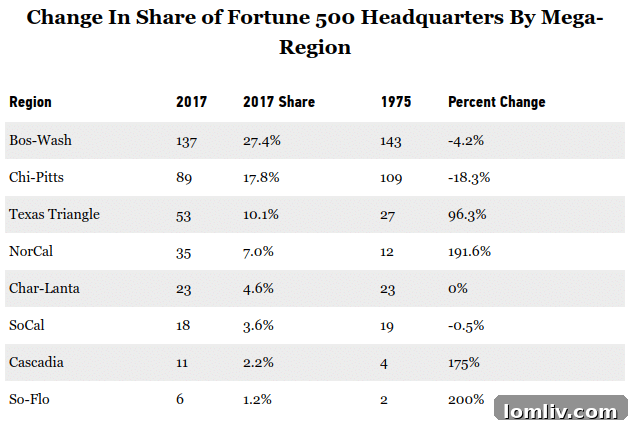
The broader Texas Triangle region—encompassing Dallas, Houston, and Austin—collectively secured third place nationally for corporate headquarters, attracting 53 new headquarters across the three metropolitan areas. This speaks volumes about the region’s combined appeal: a diverse talent pool, strategic geographical location with excellent connectivity (including DFW International Airport as a major global hub), a lower cost of doing business compared to coastal behemoths, and a generally favorable regulatory and tax environment. These intrinsic strengths mean that North Texas will continue to be a magnet for corporate investment, irrespective of Amazon’s final decision.
Conclusion: A Future Defined by Strategic Growth and Community Dialogue
The Amazon HQ2 saga has been a compelling case study in modern urban development, highlighting the complex interplay between corporate ambition, economic incentives, and community concerns. New York’s experience serves as a stark reminder that even the most lucrative corporate deals can face insurmountable public opposition if not handled with transparency and a clear understanding of local impacts. For Dallas, the situation presents a unique opportunity to re-evaluate its approach, learning from New York’s missteps while reinforcing its undeniable advantages as a corporate hub.
While the prospect of Amazon establishing a major presence in Dallas excites many with promises of jobs and economic prestige, it also rightfully ignites critical discussions about infrastructure, housing, and social equity. Any future engagement with a company of Amazon’s scale would necessitate a balanced approach: leveraging the city’s business-friendly climate and robust growth, while simultaneously addressing resident concerns through strategic urban planning, investment in public services, and transparent dialogue. Regardless of whether Amazon finds its way to Dallas, the city’s trajectory as a leading center for corporate America remains strong, driven by its inherent strengths and a vibrant, if sometimes divided, community vision for its future.