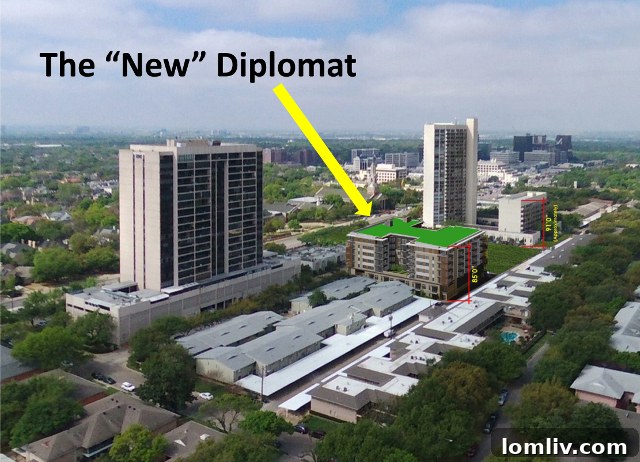
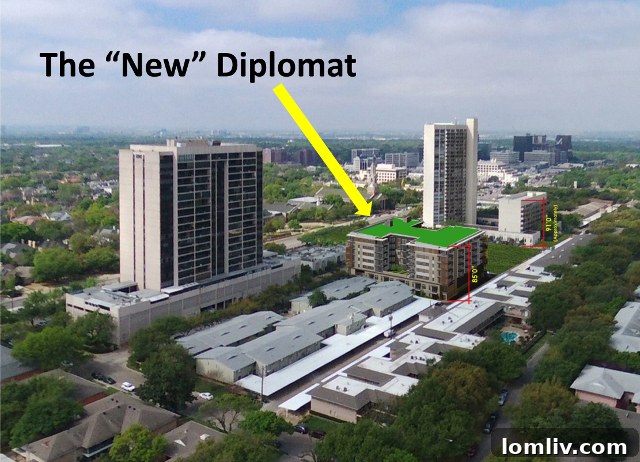
The recent PD-15 meeting provided a crucial glimpse into the future of two significant Dallas properties: The Diplomat and Preston Place. Developers A.G. Spanos and Provident Realty, respectively, unveiled their initial proposals, offering a compelling contrast in design philosophy and presentation. While city planners often focus on the intricate details of platting, drainage, and residential proximity slopes – essential yet perhaps less visually exciting aspects – the developer proposals delivered the tangible “ooo-ah” factor through their architectural drawings and massing studies.
Early observations from the presentations suggest A.G. Spanos arrived with a more developed vision for The Diplomat. Their plans were notably more refined, showcasing detailed architectural “skin” and design elements that offered a clear picture of the proposed building. In stark contrast, Provident Realty’s presentation for Preston Place was a more abstract “stack of grey boxes,” reminiscent of the Centrum on Oak Lawn Avenue and Cedar Springs Road. This lack of detail – no discernible windows, no vibrant facade – left a distinct impression of incompleteness, akin to a first date presenting a vague, uninspired self.
Understanding Dallas Development: Key City Planning Insights
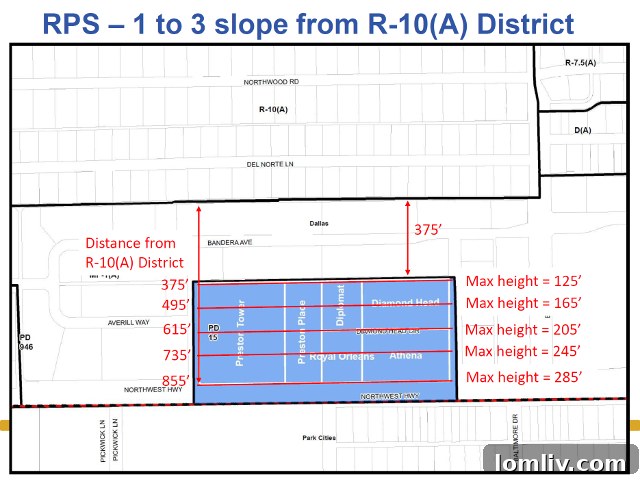
Before delving deeper into the individual development plans for the Diplomat and Preston Place, it’s essential to highlight some critical insights shared by city staff, underscoring the value of collaborative urban planning efforts with neighborhood representatives. A prime example is the concept of Residential Proximity Slope (RPS). The calculations for RPS, a crucial metric determining building height limitations near single-family homes, presented at last night’s meeting differed significantly from those used by a task force in the previous fall. This demonstrates the dynamic nature of urban planning data and the importance of updated, accurate information.
Under the revised understanding, the northern boundary of PD-15 could potentially accommodate buildings up to 125 feet, or roughly 11 stories. Conversely, the buildable southern edge of the district might allow structures reaching approximately 20 stories. While PD-15 itself isn’t directly subject to these specific RPS guidelines – a situation with both advantages and disadvantages – the metric serves as an invaluable instructional tool for understanding potential development envelopes, especially when precisely calculated and applied.
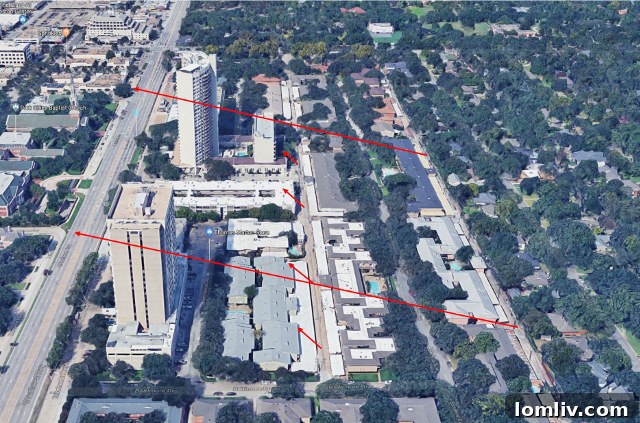
It’s worth noting that the current towers within the PD-15 area already exceed modern RPS guidelines. City officials clarified that should either of these existing structures be destroyed by natural events, they would be permitted to rebuild to their original specifications, benefiting from a “grandfathered” status. However, if a developer were to intentionally demolish one of these towers with the intent of constructing a taller building, they would face denial if the site were subject to contemporary RPS restrictions – which, fortunately for the existing structures, they are not currently.
The Peculiar Case of Platting in PD-15
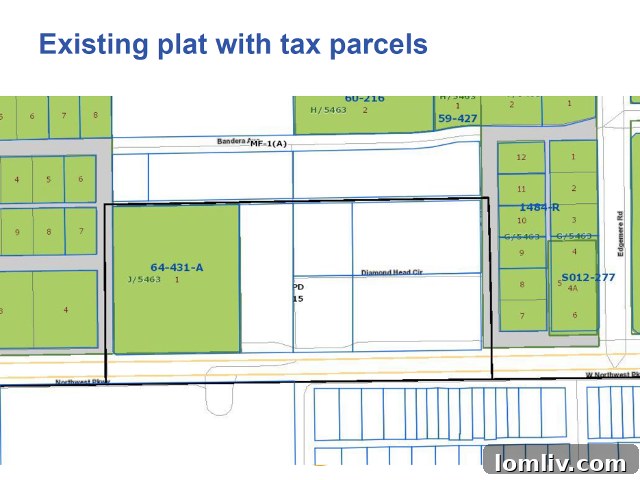
Another fascinating and somewhat unusual revelation from the meeting concerned the platting status of parcels within PD-15. We learned that only Preston Tower, surprisingly, is officially platted with the city and has an established development plan. The remaining PD-15 parcels, along with several adjacent properties to the north, are not currently platted. While the city and DCAD (Dallas Central Appraisal District) acknowledge their existence, any future redevelopment efforts on these unplatted parcels would necessitate formal platting. It’s crucial to understand that platting is distinct from setbacks, which are legally recorded in deeds. For instance, all Northwest Highway-facing lots within PD-15 are subject to a fixed 100-foot setback, a requirement that lies outside the platting process and is unlikely to be altered, given the importance of maintaining the frontage road integrity.
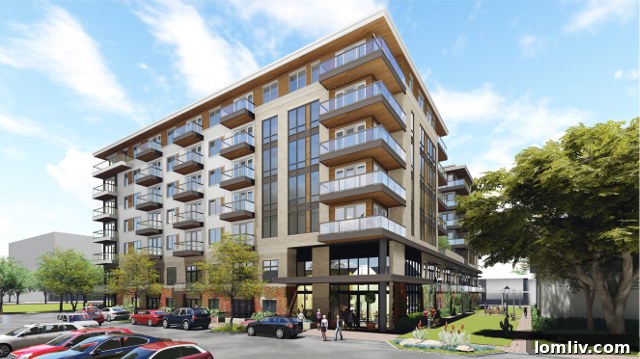
A.G. Spanos’ Vision for The New Diplomat in Dallas
A.G. Spanos’ redesigned Diplomat represents a significant evolution from its earlier iterations. Gone are the anachronistic 1960s throwback elements, replaced by a sophisticated, upmarket exterior blending cast stone with expansive glass panels. This refined aesthetic promises to elevate the architectural landscape of the area. The detailed plan outlines a seven-story structure accommodating between 110 and 125 residential units, each averaging a spacious 950 square feet. This unit mix is carefully considered to appeal to a discerning market seeking modern, amenity-rich living spaces in a prime Dallas location.
A closer look at the ground-floor plans reveals thoughtful integration with the surrounding environment. The alley separating The Diplomat from the Diamond Head Condos has been thoughtfully considered for a potential pocket park, creating a green oasis and pedestrian connection between the two buildings. Furthermore, a prominent green wall is proposed to the left of the main corner entry, enhancing the visual appeal and adding crucial greenery for pedestrians utilizing the new sidewalk that will span the length of the building. These elements collectively reflect a commitment to creating not just a building, but a vibrant, livable urban space.
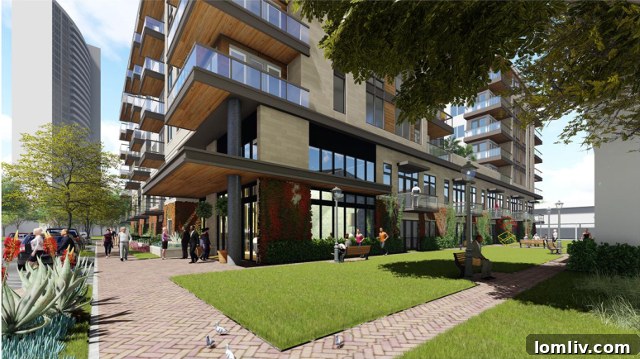
While the proposed pocket park is not yet an official, binding part of the plans, its inclusion signifies A.G. Spanos’ responsiveness to neighborhood desires and a willingness to explore community-centric features. The developers indicated that if fire department access were a concern, they could utilize a permeable concrete product known as Grasscrete. This innovative material not only supports vegetation growth, allowing for a truly green space, but also facilitates stormwater permeation, thereby slightly reducing urban runoff and contributing to environmental sustainability. The renderings also reveal several ground-floor units designed to open directly onto this potential park space, a refreshing departure from some developments where units face less desirable, traffic-heavy thoroughfares.
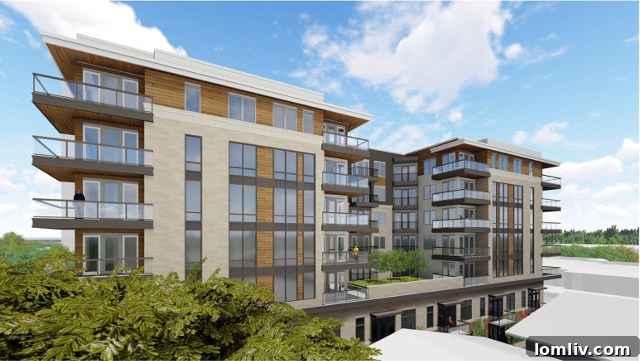
Viewing the project from the perspective of the Diamond Head Condos, the side elevation showcases a harmonious blend of glass, stone, and elegantly integrated balconies. A noticeable architectural recess on this facade is designed to accommodate an above-ground amenity deck, offering residents a private outdoor retreat (the main pool deck is situated on the opposite side of the building). This careful consideration of building massing and amenity placement demonstrates a commitment to both aesthetic appeal and resident comfort.
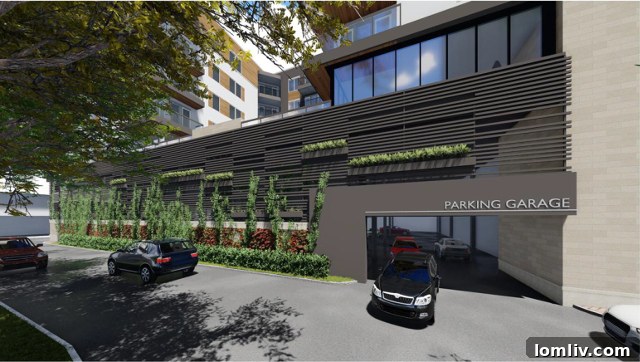
Positioned strategically between The Diplomat and Preston Place, the main parking entrance and exit have been carefully designed. The partially above-ground garage is discreetly screened behind a contemporary metal facade, punctuated by what are essentially window boxes filled with lush greenery. This thoughtful design integrates the necessary utilitarian elements of parking with an attractive, verdant aesthetic, minimizing visual impact and enhancing the pedestrian experience. One might even suggest enhancing these green features with flowering vines to introduce splashes of color and further enliven the streetscape.
Community Dialogue: Unit Sizes and Economic Viability
While The Diplomat’s proposal garnered significant positive attention, it wasn’t without its points of discussion. Several committee members raised questions regarding the average unit size of 950 square feet. Some expressed concerns that this might be too small for the neighborhood’s established character, particularly representatives from Preston Tower. Ironically, while Preston Tower’s largest original units measured 1,673 square feet, it also contains a substantial number of much smaller units, many under 600 square feet – a classic case of the pot calling the kettle black. This highlights the complex dynamics of density and market demand in established communities.
A notable omission from the discussion was the lack of questions directed at Joseph Cahoon from HR&A, the author of Spanos’ latest economic viability study, which critically evaluates the existing Preston Center area plan. Mr. Cahoon was present and prepared to answer, yet no questions arose. This could be attributed to the limited time allocated for each developer presentation or perhaps the poor acoustics in the meeting room, which might have hindered his introduction from being clearly heard. Nonetheless, the insights from such a study are crucial for comprehensive planning and understanding the financial feasibility and market demand driving these significant projects.
Provident Realty’s Preliminary Plan for Preston Place
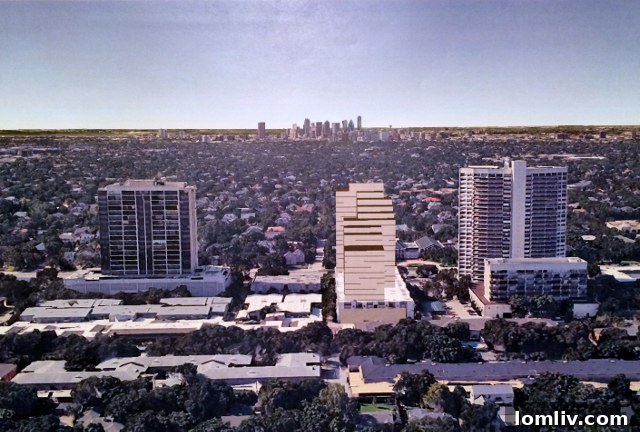
Provident Realty’s presentation for Preston Place was, by comparison, less a fully fleshed-out plan and more a preliminary massing study, akin to a student admitting, “the dog ate my homework.” This initial graphic provided a high-level overview of how a building might occupy the property. What we could glean from this singular visual was the proposal for a 20-story structure comprising 275 units, each averaging a substantial 1,300 square feet. While large units can be desirable, this scale, without detailed architectural articulation, translates into what appeared to be an overly bulky and imposing building.
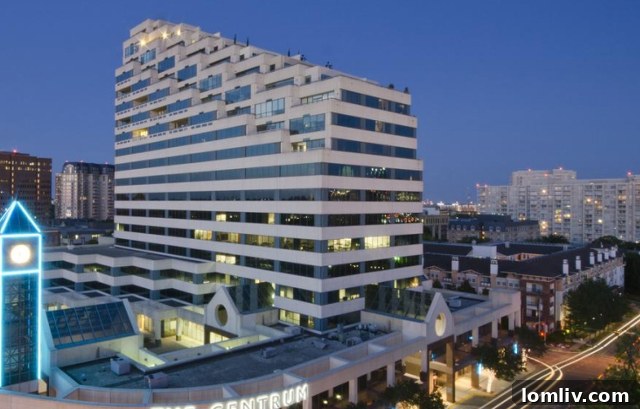
The proposed design features a stair-stepped building, with its tallest section oriented along Northwest Highway and gradually tapering down towards the rear. This architectural approach, reminiscent of structures like the Centrum, often aims to create valuable outdoor amenity spaces on its various terraces. To Provident’s credit, their wire-frame renderings suggested a more articulated building form than the solid slabs seen in some massing studies, implying a potential for more dynamic facades. However, a significant concern emerged regarding the initial “stair step,” which appears to be 12 stories off the ground at the northern edge of the lot – a height five stories taller than Spanos’ neighboring Diplomat proposal. Furthermore, the building rests on a tall plinth that consumes a considerable portion of the lot. Removing or reducing this “skirt” could lead to a more slender building profile and significantly increased opportunities for valuable green spaces, which currently seem minimal.
Another critical concern is the proposed main entrance and exit location on the Northwest Highway frontage road. This presents a potentially dangerous traffic scenario. Drivers attempting to enter Northwest Highway from this location would need to execute an almost U-turn maneuver to head west, and visibility for eastbound traffic at Edgemere Road is severely limited, posing significant safety risks for both residents and other motorists.
Following the meeting, I conveyed my concerns to Provident’s representatives regarding the building’s bulk and its height, particularly on the northern side of the lot. I also pressed them on the comparative incompleteness of their plans, especially juxtaposed against the detailed renderings provided by Spanos. Given the ample time allotted for preparation, the expectation was for a more “baked” and comprehensive proposal. As the saying goes, first impressions are lasting, and in urban development, clarity and detail are paramount.
On a positive note, Provident’s chosen architects, GDA (Gromatzky Dupree Associates), have an impressive portfolio of impactful projects across Dallas, unlike some other projects. They are credited with designing prominent structures such as the Museum Tower, an iteration of The Limited Edition at 2505 Turtle Creek, and the Windrose at Legacy West. Their work, despite a somewhat questionable name for this particular project (depending on one’s politics and affinity for large, flashy signage), generally demonstrates a high level of design capability.
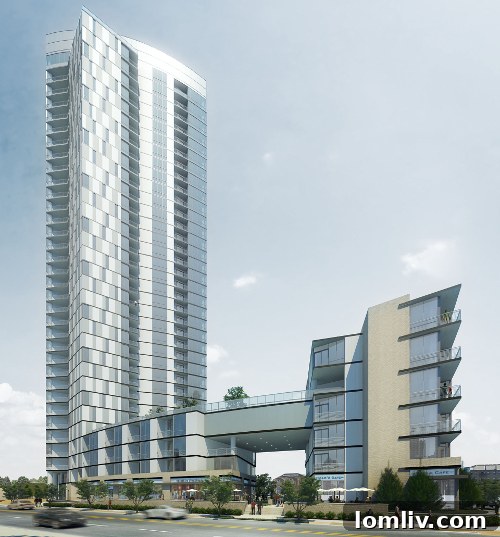
Indeed, a review of GDA’s broader portfolio, including projects like Confluence Park in Denver, reveals a capacity for innovative, context-sensitive design that could offer valuable inspiration for de-bulking and enhancing the Preston Place project. Leveraging such expertise could transform the current massing study into a more refined, community-integrated architectural statement.
Addressing the Dallas Traffic Conundrum
One of the most intensely debated topics at the PD-15 meeting, and a perennial concern in any urban development discussion, was the ramifications of increased traffic. This issue quickly devolved into a classic Catch-22 scenario. City officials expressed their commitment to preventing overdevelopment that would unduly strain the internal road networks or the external Northwest Highway. However, they stipulated that a comprehensive traffic study, essential for understanding current capacities and future impacts, could not be conducted until a definitive development plan was in place. Conversely, the committee members, rightly concerned about potential overbuilding, emphasized their need for a robust traffic study *before* authorizing any significant zoning or development changes, thus initiating a frustrating cycle of inaction.
City staff attempted to alleviate concerns by referencing traffic studies previously conducted for the broader Preston Center area plan. These studies reportedly indicated a long-term trend of decreasing traffic volumes at the critical intersection of Preston Road and Northwest Highway. This assertion was met with skepticism and audible scoffing from the audience, whose intuitive “knee-jerk” reaction is that traffic is perpetually worsening. However, the city’s explanation points to a demographic shift: communities like Park Cities and Preston Hollow are experiencing an aging population, leading to more retirees and fewer children. This demographic trend results in smaller household sizes, fewer registered vehicles per household, and consequently, a reduction in overall daily trips.
Coincidentally, A.G. Spanos arrived prepared with their own traffic study for The Diplomat. While a commendable first step, the committee underscored the need for a more holistic approach. What is truly required is a comprehensive study capable of extrapolating the cumulative impacts of *all* proposed and anticipated projects in the area, not just individual developments. Compartmentalizing or minimizing the impact of a single building, while ignoring the synergistic effect of multiple future constructions, significantly diminishes the usefulness of any traffic analysis. There is a strong hope that both Provident Realty and A.G. Spanos will collaborate to provide traffic data in a common, integrated format, facilitating a more holistic understanding of the area’s transportation needs.
In a positive development, A.G. Spanos also committed to contributing to a fund specifically earmarked for the repair and enhancement of existing infrastructure that would be impacted by their development. It is a reasonable expectation that Provident Realty would also “chip in,” as the resolution of surrounding area issues directly benefits their future tenants. Furthermore, Provident agreed to formally enshrine any specific project requirements – which are yet to be fully defined – within their development plans or through deed restrictions. This ensures that unique agreements, which might not naturally or appropriately fit within an updated PD-15 document, are legally binding and enforceable.
Mark my words, this recent gathering will not be the final meeting between the committee and these developers. And that, fundamentally, is a positive sign. Continued dialogue, iterative feedback, and a commitment to collaborative planning are precisely how successful, well-integrated urban developments are achieved, ensuring projects truly serve the community’s best interests.

About the Author: My focus consistently revolves around high-rises, homeowners’ associations (HOAs), and property renovations. Beyond these core areas, I maintain a keen appreciation for modern and historical architecture, always considering its balance within the context of the YIMBY movement. My dedication to insightful real estate commentary has been recognized by the National Association of Real Estate Editors. In 2016, 2017, and 2018, my writing earned three Bronze awards (2016, 2017, 2018) and two Silver awards (2016, 2017). If you have a compelling story to share, a development insight, or even an unconventional marriage proposal, please don’t hesitate to reach out via email at [email protected]. You’re also welcome to look for me on Facebook and Twitter, though finding me there might prove to be an engaging challenge!