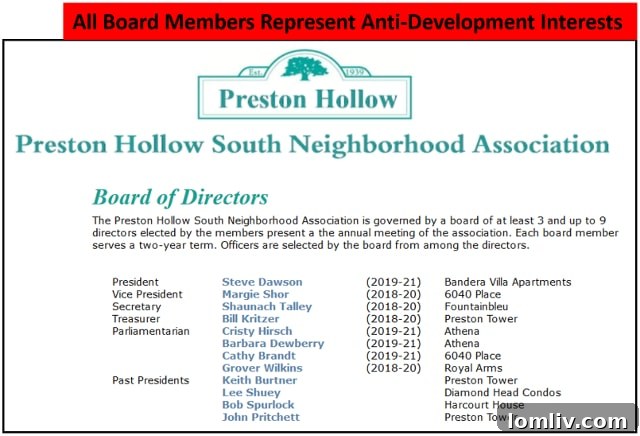
A dramatic power shift has recently rocked the Preston Hollow South Neighborhood Association (PHSNA), with members of CARD (Citizens Advocating Responsible Development) now at the helm. This group, known for its staunch opposition to the controversial changes proposed for PD-15 zoning, appears to have strategically positioned itself to gain leverage. However, this move comes at a time when city government has largely moved past the contentious zoning debate, raising questions about the new board’s effectiveness and direction.
The saga of PD-15 redevelopment, particularly concerning the future of the area often referred to as the “Pink Wall,” reached a critical juncture with the Dallas City Council’s vote. Following the unanimous passage of the zoning changes, University Park resident and owner of an eight-plex apartment within the Pink Wall, Steve Dawson, issued a stark warning to the council: they had not seen the last of the protesters. Speaking to the Dallas Morning News, Dawson indicated that his group would “take the next week or two to consider their legal options” and might “request a legal injunction to stop development from proceeding while the lawsuit was pending.” This statement underscored a deep-seated resistance that foreshadowed future political maneuvers within the neighborhood.
Further details emerged from an incredibly thorough email circulated throughout the neighborhood by Claire Stanard, a former PHSNA board member. Stanard’s communication painted a concerning picture of Dawson’s tactics, alleging that he threatened Council Member Jennifer Gates personally. According to the email, Dawson “intended to sue her personally for ethics violations using the power of the three attorneys in his family and planned to get Northwest Parkway blockaded in order to prevent construction equipment from entering, and intended to sue the City over abandoning the Area Plan.” Such aggressive postures signal a leader whose primary mode of engagement has been confrontation rather than collaboration.
Stanard’s email also revealed a complex dynamic regarding Gates’s efforts. “I was also sent a text by Steve Dawson saying that he was upset by the fact that Jennifer Gates had finally done something positive for the neighborhood in agreeing to the opening of Tulane Road to Northwest Highway on Sept. 5 and honoring her commitment to the RPS.” For context, RPS, or Residential Proximity Slope, is a crucial city ordinance designed to control building height near certain residential neighborhoods, aiming to protect their character and sunlight access. This incident highlights a deep ideological divide, where even seemingly positive actions by city officials are viewed through a lens of suspicion by some factions.
Sources within City Hall suggest that Dawson’s prolonged and uncompromising opposition to almost any form of urban development has significantly eroded his political capital. Yet, in what many observers describe as a critical period for the Pink Wall—a time demanding smooth, functional communication channels with City Hall to ensure effective progress—the PHSNA has surprisingly appointed Dawson as its president. This decision has raised eyebrows, not least because of the contentious manner in which this leadership change allegedly occurred.
Typically, one would assume such an appointment follows an election, but insider accounts suggest a different process unfolded.
The Unsettling Annual Meeting and Stanard’s Removal
On October 17, the PHSNA held its annual meeting. Our own publisher, Candy Evans, was a speaker at the event. However, during the business portion of the meeting, which Evans did not attend, the opaque nature of the leadership transition became evident. It was during this segment that Dawson’s candidacy for the board was announced. Simultaneously, Claire Stanard, the very board member who had previously alerted then-president John Pritchett to Dawson’s problematic history with City Hall, discovered she had been removed from the ballot at the last minute, and without her prior knowledge. Stanard was allegedly branded a “loose cannon,” and the board meeting proceeded without her participation. This incident, shrouded in controversy, suggests a calculated effort to consolidate power and silence dissenting voices.
The irony here is palpable: the individual who courageously flagged concerns about a potential leader known for “dropping lawsuit bombs” around Dallas City Hall (1500 Marilla being its address) was, in turn, unceremoniously dismissed. This situation begs comparison to political intrigues typically associated with higher levels of government or even elementary school dramas, highlighting a troubling lack of transparency and fairness within the neighborhood association.
Such actions should be a serious concern for every resident of the Preston Hollow South neighborhood. The so-called “loose cannon,” Claire Stanard, was, in fact, the driving force—a veritable one-woman band—responsible for bringing together diverse agencies. Her efforts successfully convened the Texas Department of Transportation (TXDoT), the North Central Texas Council of Governments (NTCoG), the Dallas streets department, and Council Member Jennifer Gates. Their collaborative objective? To implement the critical plan to open Tulane Blvd at Northwest Highway, a vital project aimed at mitigating construction traffic and the influx of new resident vehicles from overwhelming the neighborhood. This project addresses what is widely recognized as the area’s number one problem: traffic congestion. And now, the person most capable of advancing this crucial initiative is gone from the board, leaving a void that is difficult to fill.
Who’s Guiding the Pink Wall’s Future?
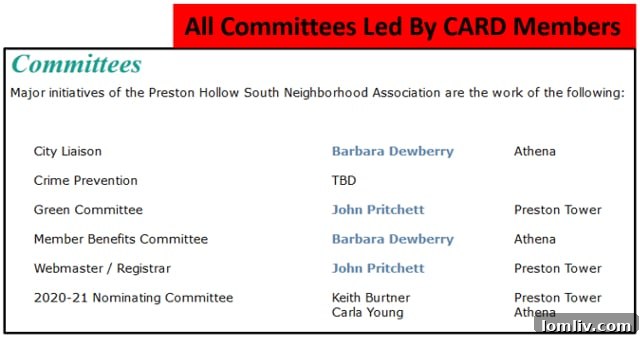
With Claire Stanard effectively pushed out of her leadership role, a critical question looms large for the residents of Preston Hollow South: who will now champion these essential community projects? Who possesses the intricate understanding and diplomatic skills necessary to manage the delicate relations between the Pink Wall community and key governmental bodies like the City of Dallas, TXDoT, and NTCoG? Barbara Dewberry, a CARD member and Athena resident, has replaced Stanard as City Liaison. While her appointment marks another victory for CARD, her capacity to navigate these complex inter-agency relationships, especially after Stanard’s proven track record, remains to be seen.
The irregularities surrounding these leadership changes extend further. Steve Dawson, a prominent CARD member, was placed on the ballot by the nominating committee. This committee comprised Carla Young from Athena and Keith Burtner from Preston Tower – both also CARD members. Crucially, this nominating committee was reportedly appointed unilaterally by former PHSNA president and CARD member, John Pritchett, allegedly without any input or approval from the wider board. This perceived bypassing of standard governance procedures raises significant questions about the legitimacy and fairness of the entire process.
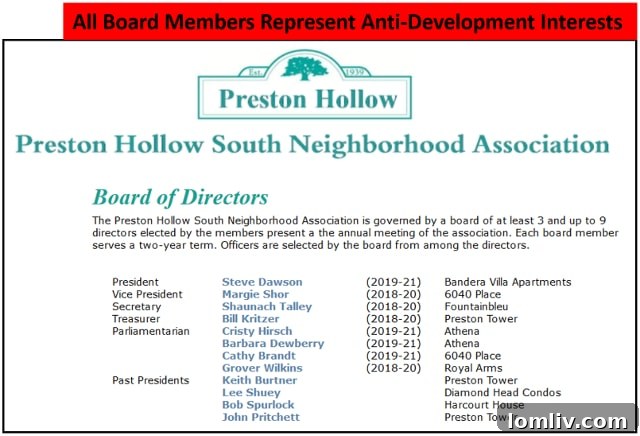
The repercussions of these actions are clear: the PHSNA board, now consisting of eight members, is entirely composed of individuals representing anti-development interests. Furthermore, all key committees are now led by representatives from Athena and Preston Tower, the two most vocal constituencies opposing any form of new development. This homogeneity on the board and within committees effectively silences any dissenting or alternative viewpoints.
As a result, Pink Wall residents who supported the PD-15 development, or those who, while initially opposed, have accepted the outcome and wish to move forward, find themselves without a voice within their own neighborhood association. What was intended to be a non-political, representative community organization has been, according to many, hollowed out. It now functions, in essence, as a new clubhouse and a superficial veneer for CARD, enabling it to present itself as the legitimate voice of the neighborhood while pursuing a specific, singular agenda.
Running Afoul of Nonprofit Rules and Public Trust
It’s vital to revisit the assertion that Dawson wasn’t truly elected. Since PHSNA has been officially registered as a nonprofit organization with the state of Texas since 2008, it is legally bound to adhere to specific rules and procedures. A fundamental requirement for such organizations is that the board itself must officially appoint the president during a publicly announced meeting. There is no public record of a meeting being called since Dawson became a board member where he could have been properly elected (by the board) to the presidency. While, given the current composition of the new board, his election might appear to be a foregone conclusion, the strict adherence to transparent, public procedures is paramount for any genuine nonprofit organization. Bypassing these rules not only undermines the organization’s legitimacy but also erodes public trust and accountability.

The Future of Preston Hollow South: Navigating a Fractured Landscape
Despite the internal political turmoil, there is still hope for vital community projects. I maintain the optimistic view that the opening of Tulane Road will indeed proceed. Council Member Gates, who has consistently stated her commitment to what is best for the community—often enduring significant animosity in the process—is likely to pick up the mantle and ensure its completion. Her dedication to the neighborhood’s welfare, despite the political attacks, suggests she will continue to push for progress.
However, the new leadership’s capacity to facilitate this progress remains a significant concern. Barbara Dewberry, the new City Liaison, is perceived by many to carry her own “City Hall baggage” and may lack the specific skills and diplomatic acumen required to provide truly meaningful input and foster collaborative relationships with city agencies. It would not be surprising to see a series of panicked calls eventually directed to Claire Stanard, who would be entirely justified in simply sending them to voicemail, given how she was treated.
A predictable outcome of this current dynamic is a recurring cycle: once vital projects like Tulane Road are completed, largely through the efforts of city officials and other stakeholders, the same anti-development forces now dominating PHSNA will likely (and once again) complain that they were not adequately consulted or given sufficient input into the process. This pattern of opposition followed by complaint, even after successful outcomes, risks alienating key partners and hindering future cooperation.
Indeed, a pervasive theme I anticipate is widespread complaining about not being heard or included. This is particularly problematic because at this juncture, those who have been most vocal in their opposition (the “haters”) critically need the cooperation of those they previously opposed (the “hated”) to achieve progress for the neighborhood. Yet, the current “stacked deck” within the PHSNA leadership provides a convenient, albeit counterproductive, excuse for city officials and other groups to disengage or “cut the CARDs,” potentially leaving the neighborhood in a state of stalled progress.
If these complex, often petty, power struggles sound remarkably similar to the machinations of Washington D.C., or even the dramas of grade school playgrounds, rest assured, you are not alone in that observation. The stakes, however, for the future development and well-being of Preston Hollow South are considerably higher.

About the Author: My primary focus in real estate journalism encompasses high-rises, homeowners’ associations, and property renovation trends. Beyond these beats, I hold a deep appreciation for the delicate balance between modern and historical architecture, particularly in the context of the growing YIMBY (Yes In My Backyard) movement, which advocates for more housing development. My commitment to insightful real estate coverage has been recognized by the National Association of Real Estate Editors, which awarded my writing with three Bronze awards in 2016, 2017, and 2018. Additionally, I received two Silver awards in 2016 and 2017 for my contributions to the field. If you have a compelling story to share, a perspective on urban development, or even a marriage proposal (yes, really!), feel free to reach out via email at [email protected]. You’re welcome to search for me on Facebook and Twitter, though finding me there might prove to be an interesting challenge.