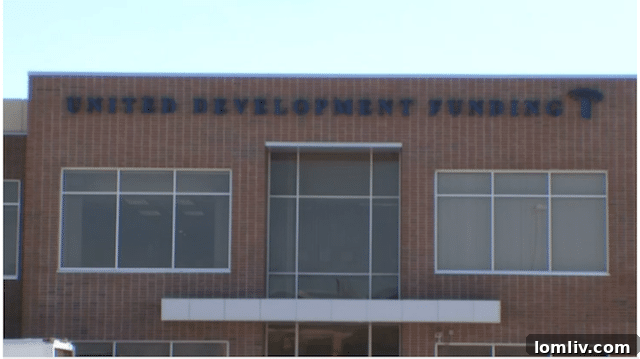
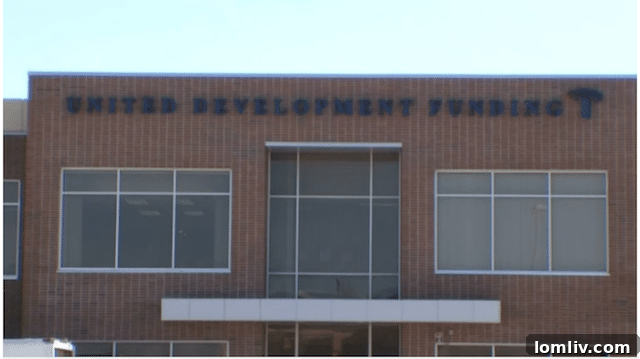
A recent development in the Dallas-Fort Worth financial landscape has sent shockwaves through the investment community, culminating in a dramatic FBI raid on the offices of United Development Funding (UDF) in Grapevine, Texas. This federal intervention follows persistent and escalating allegations from prominent hedge fund manager Kyle Bass, founder of Hayman Capital Management, who has publicly accused UDF of operating a sophisticated Ponzi scheme. The situation underscores the complex and often contentious world of real estate finance, drawing intense scrutiny to a company that has financed over a billion dollars in residential development across Texas.
The controversy began to unfold publicly when Bass, a figure known for his high-stakes bets and vocal criticisms of perceived financial malfeasance, started sounding the alarm about UDF. His claims, initially disseminated through reports and letters to the media, depicted a “billion-dollar house of cards” and a “Ponzi-like real estate scheme.” Bass alleged that UDF was not only mishandling investor funds but also systematically overstating the value of its assets and engaging in improper lending practices to developers. These serious accusations quickly caught the attention of investors, regulators, and the public, culminating in the highly visible FBI raid reported by KXAS-TV.
On the morning of the raid, federal agents were observed meticulously carrying boxes of documents and equipment from UDF’s offices on Municipal Way, loading them into large trucks. While spokespeople for the U.S. Attorney’s office in Dallas and the FBI declined to offer specific comments or characterize the operation as a search warrant, the presence of federal law enforcement at a financial institution of UDF’s stature signaled the gravity of the ongoing investigation. Such actions are rarely taken lightly and typically indicate significant probable cause that a serious financial crime may have occurred.
Kyle Bass’s involvement, however, has not been without its own layer of controversy. It was widely known that Hayman Capital Management had taken a substantial short position on United Development Funding’s stock. Shorting a company’s stock means betting that its value will decline, allowing the investor to profit from the fall. Indeed, UDF’s stock had already plummeted by more than half its value in the months leading up to the raid. Critics have accused Bass of being self-serving, suggesting his public outcry was primarily intended to benefit his short positions. While profiting from a declining stock is a legitimate strategy for hedge funds, the act of “blowing the whistle” on a company one is actively shorting is unusual and raises questions about motivation. Bass, for his part, has maintained that his actions are aimed at protecting smaller, less sophisticated investors who might otherwise fall victim to the alleged scheme.
The operational model of financial firms and hedge funds like United Development Funding often differs significantly from that of traditional banks. They typically face less stringent regulatory oversight, a characteristic they share with vehicles like 1031 Exchanges. This reduced regulatory burden is often justified by the assumption that their investors are primarily high-net-worth individuals or institutions deemed capable of absorbing greater risk. However, this environment also means that when allegations of misconduct arise, they can be particularly complex to unravel and have far-reaching implications.
Bass stated that his firm initiated its deep dive into UDF’s operations back in 2014, long before the public allegations. “We have done an enormous amount of work on this, and we believe it is not as it seems,” Bass asserted. “Every time we have peeled back a layer of the onion, it’s only gotten worse.” To substantiate his claims and provide transparency, Hayman Capital launched a dedicated website, udfexposed.com, daring the company to refute the detailed reports posted there.
In response to Bass’s accusations, Hollis M. Greenlaw, CEO of United Development Funding, has vehemently denied any wrongdoing. Greenlaw, an attorney with a distinguished background including a degree from Columbia University and an undergraduate education at Bowdoin University, and previous experience as a partner at The Hartnett Group, Ltd., has countered Bass’s claims with equal force. In an online message to shareholders, Greenlaw accused Hayman Capital of making “false and misleading statements about our company” and affirmed UDF’s commitment to “protecting investor value through the preservation of our portfolios” and defending their funds “aggressively against these unfounded accusations.”
The core of Bass’s allegations revolves around several critical points:
- **Improper Fund Transfers:** Bass claims UDF has improperly moved money from one fund to others, blurring the lines between distinct investment vehicles.
- **Reckless Lending:** He alleges that UDF has extended millions of dollars in loans recklessly, potentially jeopardizing investor capital.
- **Developer Concentration:** A significant concern raised by Bass is UDF’s alleged over-concentration of funds with a limited number of developers, particularly Centurion American Development Group.
Centurion American Development Group, based in Farmers Branch, Texas, is indeed one of the largest residential land developers in North Texas, headed by Mehrdad Moayedi. Since 1990, Moayedi’s company has developed more than 15,000 lots and is renowned for its innovative projects, including the luxurious Stoneleigh Residences and the historic Statler Hilton in downtown Dallas. Centurion has also been involved in new high-end developments in areas like Prosper. The company boasts numerous awards, including the “Best Real Estate Deal 2015” from the Dallas Business Journal. When questioned, Centurion American Development Group informed Steve Brown of the Dallas News that all its debt with United Development Funding is current and that UDF is just one of over two dozen lenders with whom the company conducts business, implying a diversified financial strategy.
Despite UDF’s strong denials, the company has, in fact, been under regulatory scrutiny for some time. Filings with the Securities and Exchange Commission (SEC) in December revealed that the SEC had been examining UDF’s operations since April 2014, a detail that adds another layer of complexity and concern to the unfolding saga. In response to Bass’s claims, UDF stated that his allegations “clearly demonstrate a lack of understanding of the residential development project life cycle, which typically involves multi-phase master planned communities and the related financing structures.” The company emphasized its strategic approach: “By design, we concentrate our lending to seasoned and accomplished builders and developers,” suggesting a deliberate and calculated risk assessment rather than recklessness.
An image circulating online, possibly related to the investigation, shows a screenshot titled “Screen-Shot-2016-02-18-at-2.15.08-PM,” which, while not directly tied to specific evidence in the text, symbolizes the digital trail and evidence often involved in such financial investigations.
The seriousness of Kyle Bass’s accusations is underscored by his comparison of the alleged UDF scheme to that of Bernie Madoff, whose infamous Ponzi scheme defrauded investors of billions. Such a comparison immediately evokes images of systemic fraud and raises the stakes considerably. Bass challenged UDF by stating, “Show us where we are wrong. If you were calling Bernie Madoff at the beginning of his scheme unwinding what would he say to you?” This rhetorical question highlights the difficulty of uncovering such schemes and the typical denials from those accused.
Adding to the public interest, a video embed presumably from YouTube provides additional context or coverage related to the ongoing developments, although its specific content isn’t detailed here.
The intertwining narratives of a prominent hedge fund manager, a multi-billion dollar real estate financing firm, an FBI raid, and an ongoing SEC investigation paint a complex picture of financial intrigue in North Texas. The outcome of these investigations will have profound implications not only for United Development Funding and its investors but also for the broader real estate development sector and the regulatory oversight of non-bank financial institutions. It serves as a stark reminder of the importance of due diligence, transparency, and robust corporate governance in safeguarding investor interests against potential financial fraud. As the layers of this “onion” continue to be peeled back, the financial community awaits clarity on what truly transpired at United Development Funding.