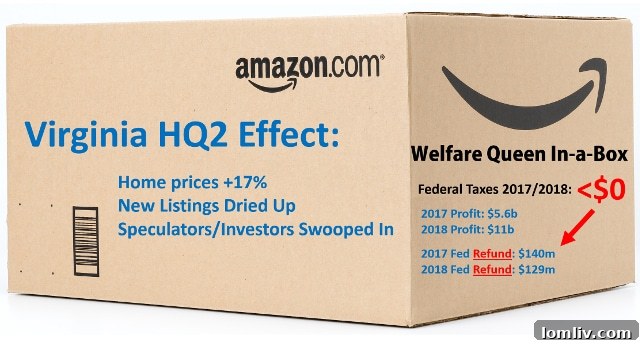
There’s a unique satisfaction in uttering “I told you so,” especially after enduring periods of skepticism and disbelief. Recently, I found myself in a position to say it quite often, particularly when reflecting on the much-hyped Amazon HQ2 saga.
Do you recall the dramatic corporate welfare pageant? Cities across North America vied intensely, brandishing taxpayer checkbooks, desperate to lure Amazon to locations that, in many cases, its corporate relocation team had already pre-selected. It was a spectacle of municipal desperation, driven by the siren song of promised jobs and economic growth.
The Dallas-Fort Worth Metroplex was among the eager contenders. We even advanced beyond the initial selection phase before being ultimately sent home without the Amazon “rose,” our municipal checkbook still firmly in our grasp. While New York City famously rejected Amazon’s full HQ2 proposal amidst local opposition, Amazon has continued to expand its presence there, albeit with fewer jobs than the initially projected 25,000. This outcome underscored a crucial point: Amazon desired a New York presence regardless of the hefty incentives offered, suggesting that many of these “freebies” are often superfluous to a corporation’s strategic location choices.
Contrast this with Virginia, which enthusiastically embraced the Amazon bouquet. The consequences for its local housing market have been stark and immediate. Home prices in the HQ2 vicinity have surged by an alarming 17 percent. Property owners, anticipating even greater windfalls, have drastically reduced new listings—one zip code near HQ2 witnessed an astonishing 85.3 percent decrease. This has effectively frozen the market, causing property tax bills to swell as valuations climb. The expectation is that once Amazon’s hiring ramps up further, property valuations will explode. This same dynamic is actively playing out in the rental market, especially in historically affordable areas, as Real Estate Investment Trusts (REITs) and other investors strategically acquire properties.
The Unintended Consequences: A Deep Dive into Housing Affordability
It’s important to remember that suburban Washington, D.C., was never an inexpensive place to live. Much like Dallas, the existing housing stock in these areas tends to be more luxury-oriented than true workforce housing. A universal truth holds: wherever housing costs are exorbitant, a severe housing shortage typically exists. Amazon’s arrival, with its promise of tens of thousands of jobs paying over $100,000 annually, merely exacerbated an already precarious situation. The influx of high-income earners created immense pressure on limited housing supply, driving up prices far beyond the reach of average residents. Housing designed to serve this demographic is distinctly different from the affordable workforce housing essential for a diverse, functioning urban economy.
In a gesture that many found to be symbolic rather than substantive, Amazon offered a modest $3 million donation to a local community foundation. This “parsimonious drop in the ocean” offers little genuine relief against the tidal wave of affordability challenges sweeping through the region. It highlights a common criticism of corporate relocations: the significant public subsidies are rarely matched by equally significant, direct investments in addressing the negative externalities they create, particularly housing crises.
Beyond the Headlines: Unmasking the Flaws of Corporate Welfare
The issues stemming from Amazon HQ2 are emblematic of a broader, more systemic problem: the pervasive reliance on corporate welfare. Recall the promises made during the Trump administration’s corporate tax cuts, which heralded a new era of prosperity. Instead, the reality diverged sharply from the rhetoric. Corporate tax revenues plummeted by a third, and the gap between taxes collected and government spending widened by 17 percent, significantly driving up the national deficit. While corporate spending saw an initial bump in the first two quarters of 2018, it quickly flattened in the third quarter.
This all occurred against a backdrop of corporations repatriating vast sums of foreign money, much of which they had previously refused to pay taxes on. A staggering half of this repatriated capital—approximately $124 billion—was not reinvested into job creation or innovation, but rather spent on buying back their own stock. When combined with shareholder dividends, this figure ballooned to an astounding $1.3 trillion in 2018, representing a 17 percent increase from the previous year. This practice primarily enriches shareholders and executives, doing little for the broader economy or the average worker.
What about the much-touted job creation? An analysis of the 1,000 largest publicly-traded companies revealed a net loss of jobs, with 140,000 positions shed against only 73,000 created. Even the promised wage increases largely failed to materialize. Wages grew by a mere 0.6 percent in 2017 and then slowed to 0.5 percent in 2018 after the tax cuts were enacted. So much for the theory that tax cuts would “pay for themselves” through economic expansion and job growth; the evidence suggests a transfer of wealth upwards, not a broad-based economic uplift.
Unfortunately, the phenomenon of corporate welfare is far from an isolated incident. It’s a widespread practice with demonstrable negative impacts on public resources and equitable development.

The Absurdity of Inter-State Corporate Poaching: The Kansas Cities Saga
Consider the infamous “border war” between Kansas City, Kansas, and Kansas City, Missouri. Over the past decade, Kansas disbursed $184 million in tax incentives to corporations that relocated jobs from Kansas City, Missouri, across the state line. Concurrently, Missouri countered by offering $151 million in incentives to lure jobs away from Kansas City, Kansas. This amounted to a staggering $335 million spent solely on poaching jobs between two adjacent cities within the same metropolitan area.
The net outcome of this fiscally irresponsible competition? Kansas City, Kansas, gained approximately 1,200 jobs, while Missouri ended up with 1,200 fewer. This translates to an astonishing cost of $279,166 per job created or retained through these incentives. Even more concerning, incentives were frequently awarded after companies had already made their relocation decisions, revealing a profound inefficiency and a lack of due diligence in public spending. This “race to the bottom” pits communities against each other, depleting public coffers without generating genuine net economic growth.
Texas, unfortunately, is no exception to this trend. A 2017 report by UT Austin professor Nathan Jensen, highly relevant for any HQ2 enthusiasts, examined 80 incentivized deals in the state. His findings were unequivocal: only 15 percent of these companies would not have invested in Texas without the financial incentives. Jensen’s research further indicated that the majority of projects and associated capital had already been committed to Texas before any incentives were even formally offered. These studies consistently demonstrate that corporate incentives often serve as a bonus for companies rather than a deciding factor, representing a significant drain on taxpayer money that could otherwise fund essential public services like schools, infrastructure, or affordable housing initiatives.
Real Estate’s Core Challenge: The Housing Supply Crisis
As this is a real estate focused platform, let’s circle back to the core issue: housing. Amazon’s impact, as seen in Virginia, directly exacerbates housing affordability in already expensive areas. While Dallas remains relatively affordable in comparison, our home values are steadily rising. The fundamental question is, why?
As previously mentioned, all high-priced urban locations share a common denominator: they simply are not building enough housing to adequately serve the majority of their citizens. In some instances, natural geographical barriers like mountains or oceans impose limitations. More frequently, however, the culprit is restrictive municipal regulations on construction, most notably archaic zoning laws. By limiting the availability of developable land and mandating low-density housing types, these regulations artificially drive up prices and perpetuate housing shortages.
A growing number of cities are beginning to recognize that sprawling, single-family homes are a luxury that many cannot afford and that their cities can no longer sustain. Minneapolis, for example, made a landmark decision in 2019 to largely eliminate single-family zoning across most of the city, with exceptions for historic districts. This bold move was a concerted effort to encourage new, denser residential development. While single-family homes can still be built, the effective “down-zoning” of lots now allows for up to three units (a triplex, for instance), fostering a greater diversity of housing options and increasing overall supply.
In the Dallas Metroplex, builders have observed a shift towards smaller homes on smaller lots in response to the market’s retreat from the red-hot years and the intensifying affordability squeeze. However, these efforts are often met with resistance. Builders report that many of the Metroplex’s “212 municipalities actively oppose any form of increased density, driven by fears that it will devalue existing homes and strain their infrastructure.” This perspective, as highlighted by Metrostudy, often overlooks a critical truth: “well-designed, affordable housing strengthens communities by diversifying its demographic composition and fostering economic vibrancy.” And, of course, sometimes the most vocal opposition comes from neighbors with unrealistic expectations or a desire to preserve the status quo.
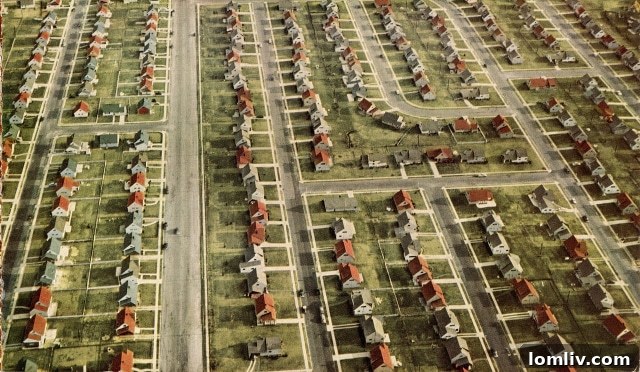
Single-family zoning is increasingly becoming a focal point of urban planning discussions in many municipalities because it locks vast swathes of potentially buildable land into its lowest and most inefficient use. Urban planners often speak of land “attaining its highest and best use.” In Minneapolis, for example, single-family zoning historically comprised a staggering 70 percent of all residential land, severely restricting housing options and contributing to sprawl.
Looking at historical urban maps reveals a fascinating insight: multi-family zoning often aligned with old streetcar routes. This historical pattern underscores a fundamental understanding that cities once embraced: high concentrations of people, coupled with efficient public transportation, directly equated to urban vibrancy and economic efficiency. Before the advent of car-driven sprawl fundamentally reshaped our cities, we possessed an intuitive grasp of how to build dense, livable, and connected urban environments. If the wheels are turning in your head, consider this: Where in Dallas do we see a high concentration of multi-family housing today? Often, it’s along the remnants of those very trolley lines.
Dallas’s Zoning Reality: An Imbalance of Land Use
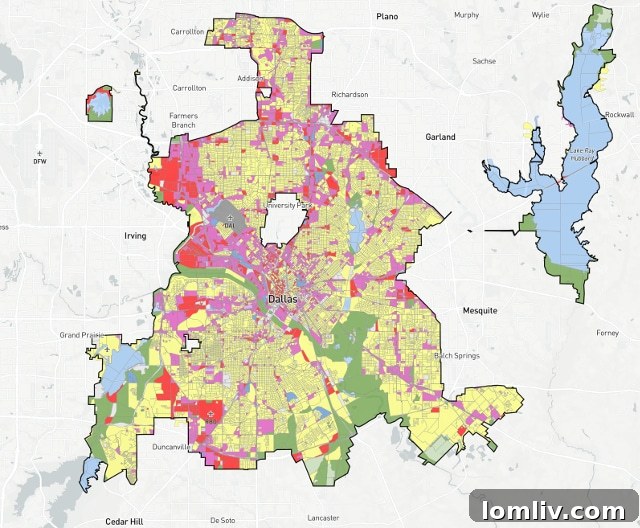
Let’s examine the raw numbers for Dallas, courtesy of UrbanFootprint. Dallas currently boasts 517,636 dwelling units. Of these, 236,670 are single-family homes, 21,418 are townhomes, and 259,538 are multi-family units. This means approximately 46 percent of Dallas’s dwelling units are dedicated to single-family homes. While not quite a 50-50 split, it’s remarkably close.
However, when we delve into land use—the actual “dirt”—the imbalance becomes stark. Single-family zoning encompasses a vast 14,483 acres, whereas multi-family zoning accounts for just 7,941 acres. This translates to an astounding 64.6 percent of residentially-zoned land in Dallas being restricted to a single-dwelling unit. In essence, 46 percent of Dallas’s dwelling units occupy nearly 65 percent of its residential land—a nearly 20-point spread that unequivocally demonstrates inefficient land use and a profound mismatch between housing supply and demand.
While accessory dwelling units (ADUs), often referred to as “granny flats,” can offer some incremental relief, they alone will never be enough to address a systemic housing shortage. If Dallas genuinely aims to circumvent the trap of a severe housing crisis, driven by high housing prices and a scarcity of affordable land, a comprehensive re-examination of single-family zoning is imperative, particularly within the bustling LBJ Loop. If Dallas wants to stop losing residents and economic vitality to its surrounding suburbs, it must become more affordable and offer a wider range of housing choices.
Putting aside the substantial corporate welfare that was likely unnecessary to secure Amazon HQ2, Dallas should be immensely grateful for the reprieve. This temporary absence of such a large corporate anchor provides a crucial window of opportunity to proactively develop and implement more equitable and sustainable land management policies. Make no mistake: Dallas will continue to grow rapidly. If it genuinely intends to prevent pricing out significant and valuable segments of its existing residents, and attract new ones, it must get ahead of its looming housing shortage. This means taking decisive action to enable the creation of diverse, affordable workforce housing accessible to both new arrivals and long-time citizens. Without the immediate pressure of an Amazon HQ2, Dallas has a little more time—time it must use wisely—to build a more inclusive and resilient urban future.
See? I told you Amazon would likely prove to be more of a curse than a boon for the winning city, especially in the long run.

Remember: High-rises, HOAs, and property renovations are my primary focus. However, I also deeply appreciate how modern and historical architecture intersect with the principles of the YIMBY (Yes In My Backyard) movement. From 2016 to 2018, the National Association of Real Estate Editors recognized my writing with three Bronze (2016, 2017, 2018) and two Silver (2016, 2017) awards for journalistic excellence. Do you have an intriguing story to share or perhaps a unique real estate proposal? Feel free to email me at [email protected]. You’re also welcome to search for me on Facebook and Twitter, though finding me might prove to be a delightful challenge.