The Pandemic’s Profound Reshaping of the Real Estate Landscape: A Deep Dive into New Realities
The COVID-19 pandemic fundamentally altered global industries, and few sectors felt its seismic shift more acutely than real estate. What began as a temporary disruption quickly evolved into a catalyst for lasting change, creating an entirely new paradigm for how we live, work, and interact with our built environments. From urgent health and safety protocols to a dramatic re-evaluation of residential and commercial spaces, the real estate industry has been navigating uncharted territory, adapting to unprecedented demands.
At the forefront of these transformations is the undeniable surge in suburban growth, a phenomenon directly linked to the widespread adoption of remote work. This shift has not only spurred remarkable growth for homebuilders but has also irrevocably transformed the location and feature requirements for both homebuyers and renters across the nation. The traditional blueprints of urban living and daily commutes have been redrawn, giving rise to new preferences for space, functionality, and proximity.
These critical trends, alongside their far-reaching implications, were meticulously explored by leading experts at the 54th annual journalism conference of the National Association of Real Estate Editors (NAREE). Presented as a comprehensive webinar to its members, the conference served as a vital platform for industry leaders to dissect the demographic shifts, economic data, and evolving consumer behaviors that are now defining the modern real estate market.
Suburban Migration and Remote Work: The Game-Changer for Housing
A key session titled “Suburban Migration and Coronavirus Changes” brought together a panel of distinguished speakers: Rebecca Rockey, David Mele, and Rob Dietz. These experts meticulously broke down the profound demographic changes precipitated by the global pandemic. Rockey, an economist for Cushman & Wakefield, and Dietz, an economist for the National Association of Home Builders, presented crucial data points that vividly illustrated the pandemic’s impact on migration patterns within their respective industries, painting a clear picture of an accelerated suburban shift.

Homes.com Unveils Startling Consumer Shifts
David Mele, President of Homes.com, presented compelling data underscoring how the widespread shift to remote work is fundamentally reshaping the home-buying and renting landscape. His insights, drawn from a December survey of 1,000 consumers, revealed the unexpected dynamism of the housing market.
A striking 36 percent of respondents who had moved in the preceding 12 months admitted they had no plans to relocate before the onset of COVID-19. This statistic highlights the sudden and reactive nature of many moves, driven by evolving personal and professional circumstances. Even more tellingly, 45 percent of all respondents indicated they would be willing to move if they were granted the option to work remotely, with a significant 20 percent confirming that remote work was precisely the reason behind their recent relocation. Mele succinctly captured the essence of this transformation, stating, “The coronavirus pandemic is not just impacting moves and residential real estate, but driving moves. Remote work/work from home is the game-changer.” This sentiment emphasizes the profound and enduring influence of flexible work arrangements on residential patterns.
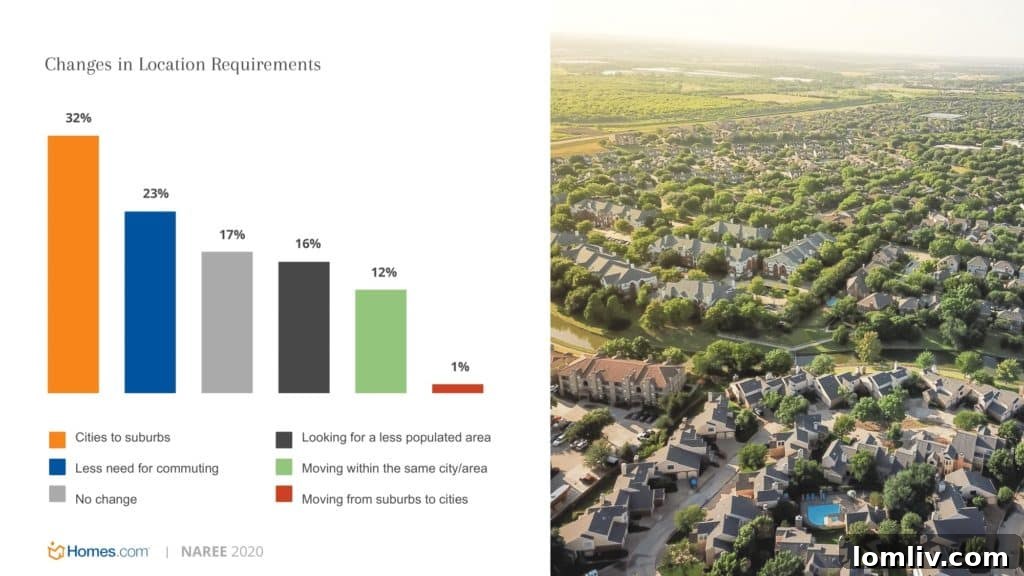
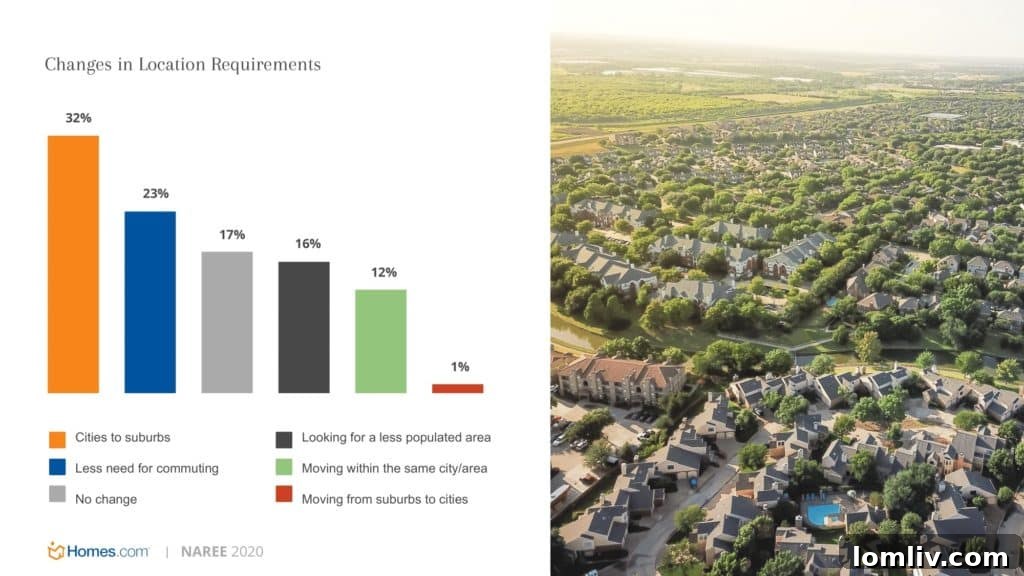
The ability to eliminate, or significantly reduce, the daily commute has emerged as a primary driver in consumers’ location decisions, leading to a substantial revision of traditional requirements. Real estate agents and brokers have observed this firsthand: 32 percent reported city-to-suburb moves as the number one change requested by clients. Furthermore, 23 percent noted a decrease in requests for properties in close proximity to public transportation or major highways, indicating a reduced dependency on traditional commuting infrastructure. This fundamental shift allows individuals to prioritize factors beyond mere commute times, such as larger living spaces, better school districts, or access to nature, without compromising their professional lives.
Contrary to initial speculation that these moves might be temporary, Homes.com data suggests a more permanent transition. Mele elaborated that nearly three out of four consumers who have already moved, or are actively planning to move, to leverage remote work opportunities, reported no intention of returning to their pre-pandemic residences. This permanence signals a lasting alteration in residential geography, suggesting that the migration out of urban centers into more spacious suburban areas is not merely a transient trend but a deeply embedded behavioral change shaping future communities.
“Working from home has really shaken things up. It’s not just a tweak; it’s a profound reset for the real estate market.”
Rebecca Rockey, Global Head of Forecasting, Cushman & Wakefield
The directional flow of this migration is strikingly clear. Homes.com data reveals a stark one-way street: 32 percent of respondents are actively moving from bustling cities to quieter suburbs, while a mere 1 percent are making the reverse journey from suburb to city. This imbalance underscores a decisive preference for suburban living, driven by factors such as increased living space, affordability, and a perceived improvement in quality of life when freed from the daily urban grind.
Evolving Home Features: Space and Functionality Take Center Stage
The Homes.com survey also gathered insights from 600 real estate professionals, providing a ground-level view of changing client demands. Nearly 80 percent of these professionals cited client requests for dedicated home offices as the single most significant change in buyer preferences. This was closely followed by a demand for larger square footage, noted by 57 percent of agents. The urgency of these needs is further highlighted by comparing these figures to a July Homes.com survey, where 40 percent of consumers wanted a home office (up to 30 percent in December) and 27 percent desired larger square footage (up to 57 percent in December). This rapid acceleration in demand for specific features within a span of months illustrates the immediate and profound impact of prolonged remote work and stay-at-home orders.
Looking ahead, the market appears poised for sustained activity. With the virus’s lingering presence and interest rates remaining historically low, a substantial 57 percent of agents and brokers anticipate home-buying activity to persist at its current robust levels for at least the next 12 months. An additional 28 percent are even more optimistic, predicting an increase in transactions in the coming year. This collective confidence suggests that the current momentum in the housing market, fueled by evolving preferences and favorable economic conditions, is expected to continue shaping the real estate landscape.
Commercial Real Estate Adapts: Suburban Benefits and Hybrid Models
Rebecca Rockey, Cushman & Wakefield’s global head of forecasting, offered crucial data on leasing trends and the commercial real estate sector’s response to the pandemic and economic recession. Her analysis highlighted a significant reallocation of demand, particularly emphasizing how suburban areas are poised to benefit at the expense of traditional central business districts (CBDs).
Rockey articulated that while CBDs have historically been the gravitational centers for businesses, the remote work revolution has initiated a pull of demand towards suburban markets. This doesn’t necessarily mean a complete abandonment of city centers, but rather a decentralization of commercial activity, potentially leading to new satellite offices or smaller, more distributed footprints for companies. Furthermore, her data indicated that companies are showing no immediate urgency to bring large numbers of workers back to traditional office settings. This cautious approach reflects ongoing health concerns, the proven efficacy of remote work, and a strategic re-evaluation of office space requirements. Companies are actively exploring hybrid models that blend remote work with occasional in-office collaboration, signaling a fundamental shift in corporate real estate strategies.
Reiterating her earlier point, Rockey emphasized, “Working from home has really shaken things up.” This sentiment extends beyond residential preferences, deeply impacting the commercial sector as well. The implications are profound, suggesting a future where office spaces are less about daily attendance and more about flexible, collaborative hubs. This evolution challenges traditional leasing models and compels commercial property owners to innovate, offering adaptive spaces that cater to a dynamic workforce and evolving business needs.
The Resilient Homebuilding Sector: Navigating Unprecedented Demand and Future Outlook
Providing an essential perspective on the construction side of the housing boom, Rob Dietz, chief economist and senior vice president for economics and housing policy for the National Association of Home Builders (NAHB), shared compelling data on the suburban shift’s impact on homebuilding. Dietz aptly summarized the past year, stating, “2020 has just been a remarkable year” for homebuilders, highlighting a period of unexpected and sustained strength amidst global uncertainty.
This remarkable performance is clearly reflected in the NAHB/Wells Fargo Housing Market Data. According to their comprehensive reports, builder confidence levels soared, hitting successive all-time highs over the three months leading up to the conference. This unprecedented confidence index indicates a strong positive sentiment among homebuilders regarding current sales conditions, buyer traffic, and future sales expectations. It underscores the robust demand for new construction, particularly in suburban and exurban areas, as consumers seek more space and amenities tailored to a remote work lifestyle.
Dietz pointed to the vigorous homebuilding activity across the nation, driven by a confluence of low interest rates, limited existing home inventory, and the persistent demand for new, larger homes. However, he also offered a nuanced prediction, suggesting potential slowdowns in the coming year. This cautious outlook is born from the observation that “Builders are selling more homes that haven’t even started construction yet.” While this backlog signifies strong demand, it also points to supply-side constraints, including labor shortages, rising material costs, and challenges in securing land and permits. Dietz’s analogy, “(But) we’re likely to see some slowing of sales. Builders don’t want to get ahead of their skis,” emphasizes the industry’s need for prudence and sustainable growth, avoiding overextension in a rapidly shifting market. This suggests a period of adjustment where builders will focus on catching up with existing demand while carefully monitoring market conditions for future projects.
The Enduring Legacy: Long-Term Real Estate Implications
The insights shared at the NAREE conference collectively paint a picture of an industry undergoing profound and likely permanent transformation. The acceleration of suburban migration, driven by the ubiquity of remote work, is not merely a temporary blip but a foundational shift in how people choose to live and what they value in a home. The demand for dedicated home offices and increased living space reflects a permanent integration of work life into domestic environments. For commercial real estate, this means a necessary evolution towards flexibility, hybrid models, and potentially a more distributed footprint outside of dense urban cores.
These changes carry significant long-term implications for urban planning, infrastructure development, and local economies. Suburban areas may experience increased pressure on schools, transportation, and public services, while urban centers will need to creatively reimagine their spaces to remain attractive and viable. The market dynamics, while currently robust due to low interest rates and high demand, will require careful monitoring by builders, investors, and policymakers to ensure sustainable growth and equitable access to housing.
Connect with Industry Leaders: The NAREE Conference
The annual NAREE conference, held virtually on December 9-10, exemplified its role as a premier forum for real estate journalism. The event curated engaging, real-estate-focused panels that delved into crucial industry trends and future forecasts, offering unparalleled insights to its members. Beyond the insightful discussions, the conference fostered professional development through peer-to-peer journalism workshops, celebrated excellence by honoring award winners, and provided invaluable networking opportunities for its diverse membership.
To learn more about the National Association of Real Estate Editors and its commitment to excellence in real estate journalism, please visit naree.org.