The Eternal Dilemma: Renting vs. Buying Your Home in Today’s Market
The question of whether to rent or buy a home is a pervasive and often perplexing one, touching upon deeply personal financial goals, lifestyle aspirations, and market realities. For many, it’s not just about finding a place to live, but about making a sound long-term financial decision that aligns with their income and geographic location. While some urban centers, like the bustling metropolis of New York City, might make renting seem like the only sensible choice due to exorbitant property values, other cities present a much more nuanced picture. This article delves into the complexities of this decision, particularly examining insights from Zillow’s comprehensive research and applying them to various U.S. markets, including Dallas, Houston, New York City, and Washington D.C.
Understanding the financial implications requires looking beyond simple monthly payments. Factors such as upfront costs, property appreciation, and the opportunity cost of capital all play a significant role. Making an informed choice demands a thorough analysis of market dynamics, personal financial health, and future plans. Let’s explore how a data-driven approach can shed light on this critical housing decision, helping individuals navigate the often-turbulent waters of the real estate market.
Unraveling Zillow’s Breakeven Horizon: A Comprehensive Financial Tool
To help individuals make sense of this complex equation, Zillow, a leading online real estate marketplace, developed a powerful metric known as the “Breakeven Horizon.” This innovative calculation provides a precise, data-backed answer to the rent-or-buy question by pinpointing the exact moment when purchasing a home becomes more financially advantageous than continuing to rent a comparable property. It’s a sophisticated model that moves beyond superficial comparisons, offering a holistic view of housing costs over time.
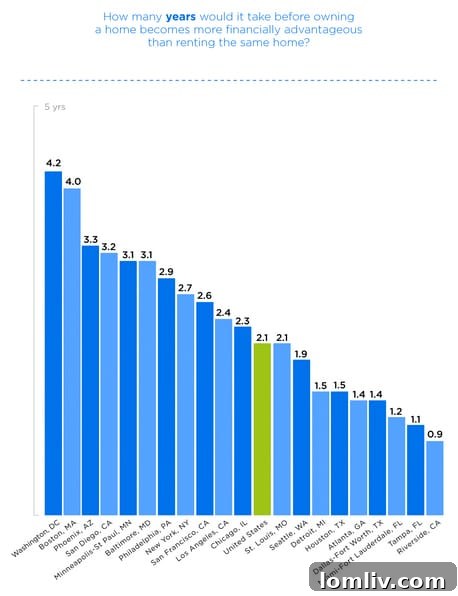
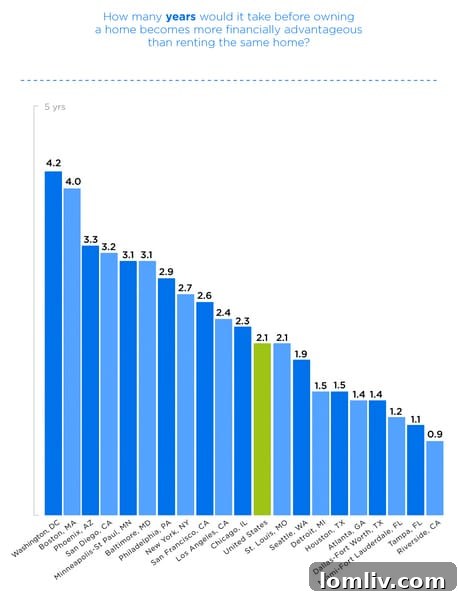
Zillow’s breakeven horizon calculates the point, in years, at which buying a home becomes less expensive than renting the same home. It incorporates all costs associated with buying and renting, including upfront payments, closing costs, anticipated monthly rent and mortgage payments, insurance, taxes, utilities, maintenance and renovation costs. We also consider the different asset streams available to buyers and renters. For buyers, the home equity grows. Alternatively, renters can invest some of the money they would have spent on a home purchase and earn interest. It then factors in historic and anticipated home value appreciation rates, rental prices and rental appreciation rates.
The genius of Zillow’s Breakeven Horizon lies in its comprehensive scope. It meticulously accounts for every financial component, from the initial outlay of cash for a down payment and closing costs to the ongoing expenses of property ownership like mortgage interest, property taxes, homeowner’s insurance, and even the often-overlooked costs of maintenance and potential renovations. Critically, it also considers the financial opportunities available to both buyers and renters. Homeowners build equity, which is a significant wealth-building asset, while renters have the flexibility to invest their savings (the money they would have spent on a down payment or higher mortgage costs) into other assets, potentially earning returns. By integrating historical and projected home value appreciation rates, alongside rental price trends, the Breakeven Horizon offers an invaluable framework for understanding the true cost-benefit analysis of buying versus renting.
City-Specific Insights: Where Does Buying Make Sense Sooner?
The Breakeven Horizon reveals stark differences across various U.S. metropolitan areas, underscoring the localized nature of real estate markets. What might be a sound decision in one city could be financially dubious in another, highlighting the importance of region-specific data.
Dallas and Houston: Short Paths to Breakeven
In the vibrant Texas markets, the data suggests a relatively short commitment period for buyers to achieve financial parity with renters. For instance, in Dallas, homeowners typically reach their breakeven point after just 1.4 years of ownership. Houston presents a similar scenario, with buyers breaking even after 1.5 years. These notably short horizons indicate a potentially favorable environment for prospective buyers. This could be attributed to several factors: robust job growth driving demand, a relatively affordable cost of living compared to coastal cities, or strong home value appreciation rates that quickly offset initial buying costs. Such statistics make a compelling case for homeownership in these burgeoning Southern cities, suggesting that the long-term financial benefits of buying can accrue much faster than in other parts of the country. This rapid breakeven can significantly enhance a buyer’s return on investment and build equity more swiftly, offering a quicker path to financial stability and wealth accumulation.
New York City: A Longer-Term Commitment
Conversely, the path to breaking even stretches considerably in more expensive and densely populated markets. In New York City, for example, it takes 2.7 years for homeowners to financially outpace renting. This extended timeline is hardly surprising given the astronomical property values and high cost of living that characterize the Big Apple. The substantial upfront costs, including hefty down payments and closing fees, combined with elevated property taxes and a competitive rental market, mean that buyers need a longer period for their investment to truly pay off against the alternative of renting. While homeownership in New York City can certainly lead to significant wealth in the long run, the initial financial hurdle and the time it takes to break even necessitate a more extended financial commitment and a willingness to ride out market fluctuations over a greater period.
Washington D.C.: The Longest Horizon Among Major Metros
Among the 20 major metropolitan areas analyzed by Zillow, Washington D.C. stands out with the longest breakeven horizon, a substantial 4.2 years. This extended period suggests that the nation’s capital presents unique challenges for prospective buyers seeking immediate financial benefits from homeownership. Several factors likely contribute to this prolonged breakeven point. D.C. boasts a highly competitive and often inflated housing market, driven by a stable government workforce and a booming private sector. High property values, coupled with potentially slower appreciation relative to the initial purchase costs and a strong, consistent rental demand, can make renting a more financially appealing short-to-medium-term option. For those considering buying in Washington D.C., the decision often requires a very long-term perspective, emphasizing stability, potential for future appreciation, and the desire for homeownership over immediate financial gains compared to renting.
Beyond the Numbers: Personal and Market Factors
While the Breakeven Horizon offers a powerful numerical framework, the decision to rent or buy is rarely purely mathematical. A myriad of personal preferences, lifestyle considerations, and broader market conditions also play crucial roles in shaping this significant life choice.
Flexibility vs. Stability: The Lifestyle Choice
One of the most significant non-financial factors is the desire for mobility and flexibility. Renting typically offers a lower level of commitment, allowing individuals to relocate more easily for job opportunities, personal reasons, or simply to explore new neighborhoods or cities without the burdens of selling a property. This freedom from long-term responsibility can be incredibly appealing, especially for younger professionals, those in transient careers, or individuals who value the ability to adapt quickly to changing circumstances. Homeownership, on the other hand, often implies a desire for stability, roots in a community, and the ability to personalize one’s living space without landlord restrictions. The choice here often boils down to whether one prioritizes the ease of movement or the security and personalization that comes with owning property.
Financial Realities and Opportunity Costs
Even when buying seems financially advantageous on paper, real-world financial constraints can dictate the decision. The necessity of a substantial down payment, closing costs, and maintaining a good credit score can be prohibitive for many. Moreover, the ongoing costs of homeownership, beyond the mortgage, require a robust emergency fund and consistent financial planning. For renters, the money saved on these upfront costs and potential maintenance can be invested elsewhere, generating returns. While Zillow’s model factors this ‘opportunity cost’ for renters, individuals must also consider their personal comfort level with debt and illiquid assets. A significant portion of wealth tied up in a home means less liquid capital for other investments or unforeseen expenses.
Building Long-Term Wealth Through Homeownership
For many, homeownership is synonymous with building long-term wealth. Beyond the potential for property appreciation, which can be substantial over decades, paying down a mortgage steadily builds equity – a form of forced savings. This equity can later be leveraged for other investments, renovations, or as a financial safety net. Furthermore, in many jurisdictions, homeowners can benefit from tax deductions on mortgage interest and property taxes, which can further enhance the financial appeal of buying. While renting offers immediate flexibility, it typically does not contribute to personal asset accumulation in the same direct way. The long-term perspective, therefore, often favors buying for those looking to establish a solid financial foundation and secure their future.
The Importance of Localized Data: Drilling Down to Neighborhoods
The original article astutely questions the granularity of city-wide averages, posing whether a breakdown by Zip Code or even population density would offer a more accurate picture. This point is incredibly salient. Real estate markets are hyper-local, and a city’s average can often mask significant variations within its different neighborhoods. For example, in a sprawling metropolis like Dallas, the financial wisdom of renting versus buying can swing dramatically depending on whether one is looking at an upscale, historically established area or a rapidly developing, more suburban locale.
Consider Dallas’s affluent Park Cities versus its bustling high-density urban core like Uptown. In the Park Cities, where property values are among the highest, a substantial down payment and a long-term financial commitment are almost prerequisites for buying. Here, renting might indeed make more financial sense for a larger segment of the population, especially those prioritizing flexibility or facing significant budget constraints. Similarly, in high-density, amenity-rich areas like Uptown, renting is often the predominant option due to the sheer cost and limited availability of ownership opportunities, alongside a vibrant, transient population that prefers the convenience of rental living. Conversely, in more family-oriented suburban pockets of Dallas or Houston, where land is more plentiful and housing costs are relatively lower, buying a home might become financially advantageous much faster, aligning with the shorter breakeven horizons observed for these cities overall. This highlights that while city-level data provides a useful baseline, individual decisions must be informed by highly localized market analysis, understanding the specific dynamics of a chosen neighborhood.
Making Your Informed Decision
The decision to rent or buy is undeniably one of life’s most significant financial and lifestyle choices. While comprehensive tools like Zillow’s Breakeven Horizon provide invaluable data-driven insights into the financial landscape, they represent just one piece of the puzzle. The optimal path for an individual depends on a careful calibration of these financial metrics against personal circumstances, including career stability, family plans, desired lifestyle, and risk tolerance.
Whether you’re drawn to the rapid breakeven potential in Dallas, contemplating the long-term commitment in Washington D.C., or navigating the unique challenges of New York City, it’s crucial to perform due diligence. Research specific neighborhoods, consult with financial advisors and real estate professionals, and critically evaluate your own readiness for the responsibilities and rewards of homeownership. Ultimately, the “best” choice is the one that most effectively aligns with your financial well-being and life goals, ensuring peace of mind and a secure future in the home that’s right for you.