Transforming Oak Lawn: A Deep Dive into Key Development Proposals
At a recent pivotal Oak Lawn Committee meeting, Streetlights Residential faced a thorough interrogation regarding the proposed design for their ambitious new tower at the high-profile intersection of Lemmon and Oak Lawn avenues. This significant development promises to reshape a cornerstone of the vibrant Oak Lawn neighborhood, necessitating careful consideration and community input.
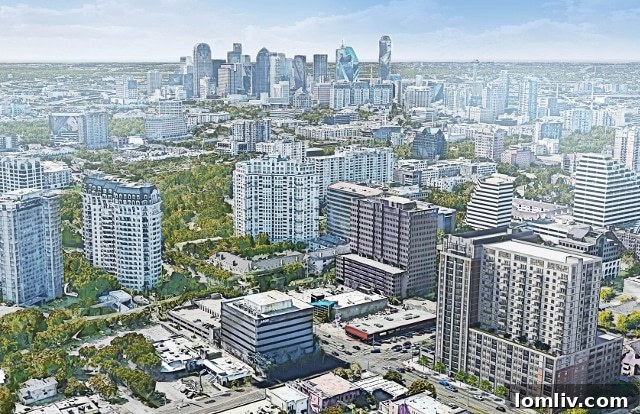
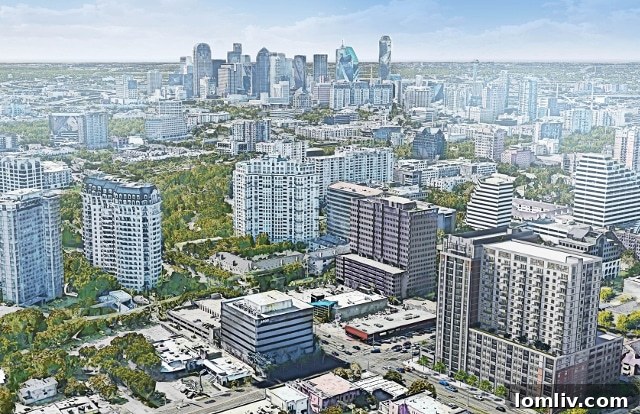
This eagerly anticipated 21-story luxury apartment building is slated to replace the existing Shell station and Pizza Hut, strategically positioned adjacent to the beloved Eatzi’s (which is also intricately woven into the broader development plan). For those familiar with the area, the proposed structure on the lower right in satellite imagery provides a glimpse into the future landscape of this bustling Dallas intersection.
The Enduring Legacy of Esquire Theater: A Community’s Hallowed Ground
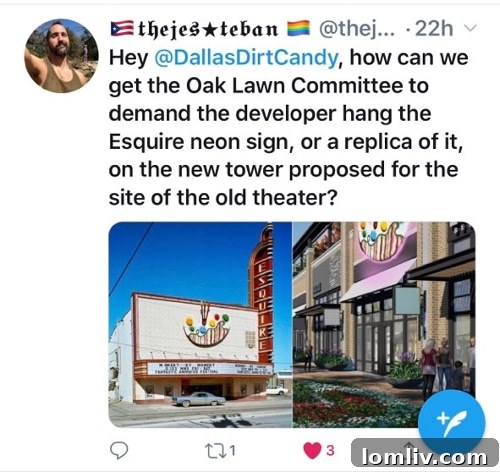
The parcel of land designated for this new development carries profound historical significance for the Oak Lawn community. It was the catalyst for the creation of the rigorous Oak Lawn Plan and PD-193, meticulously overseen by the Oak Lawn Committee. This very site once housed the iconic Esquire Theater, originally known as the Melrose Theater when it opened its doors in 1931. Local lore suggests the name “Esquire” was chosen for its perfect fit on the marquee, having the same number of letters as its predecessor.
Tragically, the theater, which would have celebrated its 88th anniversary this year, was controversially demolished in the dead of night in February 1985 by Lincoln Property. This act of demolition, steeped in neighborhood legend, galvanized the community, solidifying this location as somewhat of a hallowed ground in Oak Lawn. Consequently, any new proposal for this long-neglected corner naturally draws immense scrutiny and a deep-seated expectation for excellence.
Streetlights Residential’s Vision: Initial Design Critiques and Aspirations
When Streetlights Residential, a developer known for numerous high-quality projects across the region, unveiled their initial proposal, questions swiftly emerged concerning the building’s exterior design. Multiple Oak Lawn Committee members voiced their disappointment, querying why the developer wasn’t committing to an unequivocally “signature” building for such a highly trafficked and historically resonant corner. The prevailing sentiment was a desire for architectural distinction that would truly elevate the Oak Lawn streetscape.
The good news, according to the developer, is that the exterior design remains a work in progress. This assurance is crucial, as early renderings appeared to fall short when compared to other prominent high-rises in their portfolio and the numerous well-executed projects that define Streetlights Residential’s reputation. The community eagerly awaits a design that reflects the importance of this unique Dallas location.
Enhancing the Pedestrian Experience: Commendable Design Elements
Amidst the design discussions, several positive highlights emerged, particularly concerning the pedestrian realm. A standout feature is the generously wide, 25-foot setback planned for Oak Lawn Avenue. This thoughtful design choice is intended to foster a more inviting and communal public space, allowing future restaurants and retail establishments to expand their presence onto a wider, more extensively landscaped frontage. This approach promises greater engagement with the street scene, creating a vibrant urban environment.
This vision stands in stark contrast to the existing concrete and neglected stumps, offering a refreshing departure from conventional urban development. It’s commendable to see a developer prioritize public space over maximizing concrete coverage. Further demonstrating their commitment to an enhanced pedestrian experience, Streetlights Residential plans to bury the utilities, resulting in a pole-less block. This forward-thinking initiative could set a precedent, inspiring similar improvements across Oak Lawn and fostering a more aesthetically pleasing and functional urban corridor.
Architectural Details Under Scrutiny: Facade, Podium, and Proportion
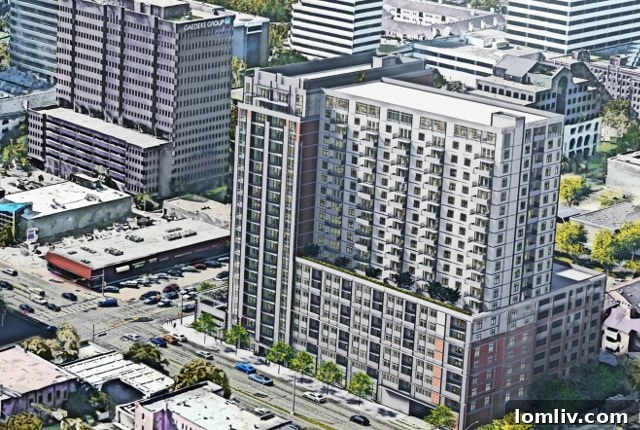
As a rule of thumb, if a design appears unappealing in white, its underlying flaws are often amplified, whereas darker hues can mask imperfections. The close-up renderings reveal a significant expanse of white stucco, underscoring the importance of the ongoing exterior design refinement. Encouragingly, other parts of the presentation indicated a greater incorporation of brick, a material that could provide a richer, more enduring aesthetic than a dominant sea of white stucco. Regardless of the final color palette, the fundamental design must possess an inherent elegance that transcends mere superficial treatment.
Beyond the surface, two specific design aspects raise concerns. Firstly, while Oak Lawn Avenue benefits from an exceptionally wide sidewalk, Lemmon Avenue appears to receive less attention. For a prominent corner, both major thoroughfares should boast equally inviting pedestrian infrastructure. Secondly, a preference was expressed for the main tower to descend directly to the ground, rather than incorporating a pronounced podium “bump out,” which can sometimes detract from the building’s verticality and street-level integration.
The Unseen Challenge: Rethinking Parking Solutions for a Prime Urban Location
Another critical design issue revolves around the parking garage. The renderings reveal the backside of a predominantly above-ground parking structure, offering an unattractive view to both Oak Lawn and Lemmon Avenue traffic. The lack of adequate screening for such a significant visual element is perplexing. In a location of this prominence and for a development aiming for luxury, a more sophisticated approach is warranted.
Ideally, like the proposed buried power lines, the parking garage should be entirely underground. A single ground-level parking area could then serve Eatzi’s spillover and the development’s own retail needs. Residents of these undoubtedly expensive apartments deserve the convenience and cleanliness of subterranean parking, shielded from the dust and dirt inherent in an open garage, especially one situated at such a busy intersection. While an underground garage represents a higher investment, a corner of this stature demands a more artful and thoughtful solution than a large, boxy garage podium reminiscent of a suburban hotel rather than a sophisticated urban dwelling. Prioritizing aesthetics and functionality in parking design is crucial for a truly elevated Oak Lawn development.
Height, Zoning, and the Contentious “Double-Dipping” Debate
Perhaps the most contentious aspect of the proposal is the building’s projected height. Streetlights Residential proposes a 21-story structure, soaring to 240 feet and encompassing 297 apartments. This significantly exceeds the current zoning limit of 120 feet for the parcel. The developer’s strategy involves “taking” the 120 feet allowed on the adjacent Eatzi’s site and combining it with the corner’s existing height allowance. However, this calculation appears flawed unless the Eatzi’s site is granted zero height allowance independently.
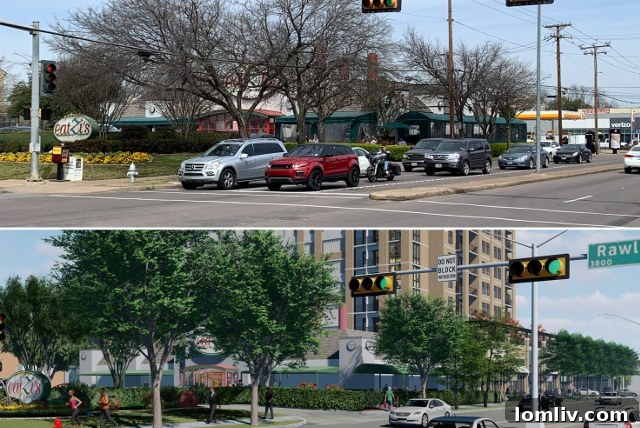
The issue of height is a significant concern for the community, a fact evident by the audible gasps of surprise when the proposed height was initially discussed. Consequently, all developer-provided images tend to downplay the building’s true scale. Whether viewed from above or presented in heavily cropped before/after image pairs, the actual magnitude of the building is often obscured when presented out of full context. While the concept of shifting height allowances between adjacent sites is an idea worth exploring, it must come with stringent caveats.
For instance, if the Eatzi’s site’s surplus height were to be utilized for the corner development, that height should be permanently extinguished from the Eatzi’s parcel. This was not the developer’s stated intention. Attendees were informed that while such a swap might be recorded in the site plan, the height could potentially be “resurrected” on the Eatzi’s site through a future zoning case. The community’s clear stance is against such “double-dipping,” advocating for clear, long-term zoning commitments.
Navigating Congestion: Addressing Traffic Flow in a Busy Urban Corridor
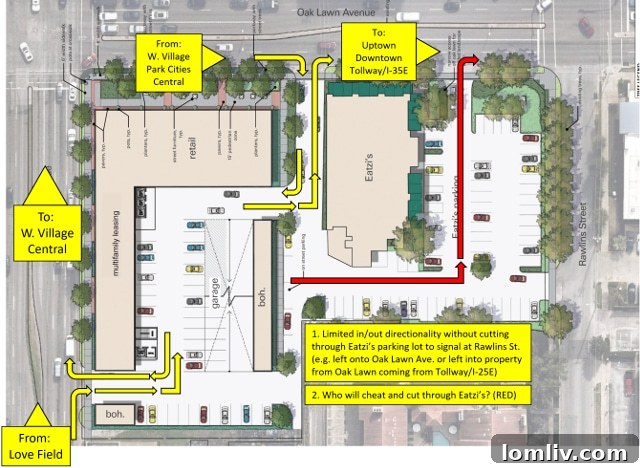
Finally, the proposed traffic flow plan requires substantial refinement. Given the high volume of traffic on Oak Lawn and Lemmon avenues, the presence of un-crossable medians near the intersection severely restricts the directions vehicles can enter and exit the new building. As illustrated by the yellow indicators in the diagram, vehicles approaching from the Love Field direction can turn into the property, and those departing can proceed towards West Village and Central. However, a significant limitation prevents traffic from traveling towards Love Field on Lemmon Avenue from either of the main entrance/exit points.
On Oak Lawn Avenue, entry is permitted when traveling from Park Cities, West Village, or Central (via a left turn from Lemmon onto Oak Lawn). Exiting the building onto Oak Lawn Avenue towards the Tollway and I-35E is also feasible. Conversely, residents cannot cross the median to enter the building when returning from that direction, nor can they make a left turn onto Oak Lawn Avenue.
The red arrow in the diagram ominously highlights a probable outcome: residents exiting the parking garage, faced with long backups, will likely opt to cut directly through the Eatzi’s parking lot. This unofficial shortcut, further detailed by the red arrows in the subsequent diagram, is not merely a hypothetical “cheat” but is projected to become a proposed route of travel for many.
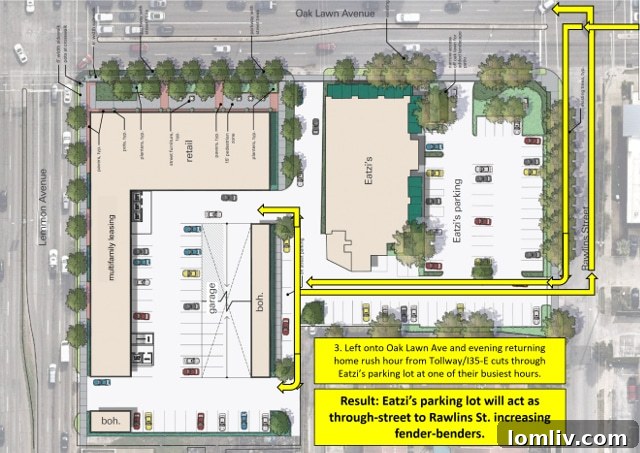
Consider the implications: peak hour traffic, with residents returning home, will inevitably funnel through Eatzi’s parking lot precisely when the store is at its busiest. This predicted scenario raises serious concerns about increased congestion, potential fender-benders, and a degraded experience for both shoppers and residents. For those wishing to turn left onto Oak Lawn (perhaps to then turn left onto Lemmon) or to access the complex from the Tollway/I-35E direction, the most probable route involves Rawlins Street and, once again, cutting through the Eatzi’s parking lot. This traffic pattern is inefficient and compromises both safety and convenience.
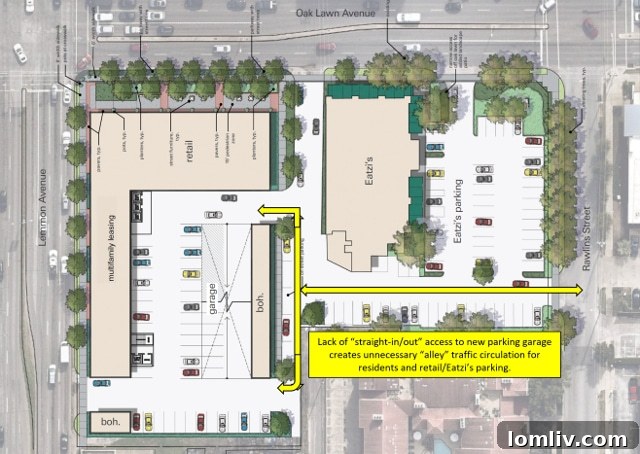
Compounding these issues is the misalignment of the parking garage entrance with the Eatzi’s cut-through. This spatial discord will force drivers into awkward dog-leg turns, creating additional points of friction and congestion. This inefficiency appears to be a direct consequence of the garage ramp orientation, rather than an optimized traffic management plan. Furthermore, this area, already plagued by complex vehicle movements, also serves as the critical zone for Eatzi’s delivery trucks and their steady stream of grocery-laden two-wheelers, further exacerbating potential bottlenecks and safety concerns. A thorough and integrated traffic study is imperative to mitigate these foreseeable challenges.
There is no question that this prominent corner of Oak Lawn is ripe for revitalization, and Streetlights Residential boasts an impressive portfolio of “trophy buildings” in the Dallas area. However, this particular project still requires significant refinement of its exterior design, parking solutions, and crucial traffic flow before it can be deemed truly ready. The Oak Lawn Committee is expected to review this project again, and perhaps multiple times, emphasizing the community’s commitment to ensuring a superior outcome for such a vital urban intersection. Given Streetlights’ track record, there is optimism for an improved proposal. While the interiors are undoubtedly destined to be stunning, the exterior and functional aspects must equally reflect the high standards expected for this landmark development.
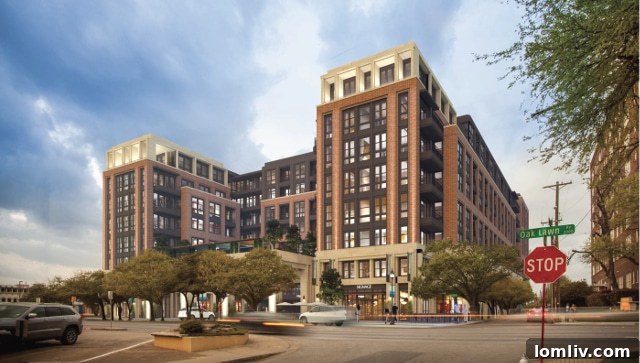
The 2929 Oak Lawn Avenue Project: Thoughtful Revisions and Community Improvements
Moving just one intersection down from the Streetlights project, we find 2929 Oak Lawn Avenue, currently home to an Office Depot situated beside The Melrose Hotel. This project garnered the support of the OLC approximately a year ago and successfully navigated City Hall for approval. For those familiar with the timeless elegance of The Melrose Hotel, this new neighbor is envisioned as a complementary update, harmonizing with the 1924 building’s distinctive vibe.
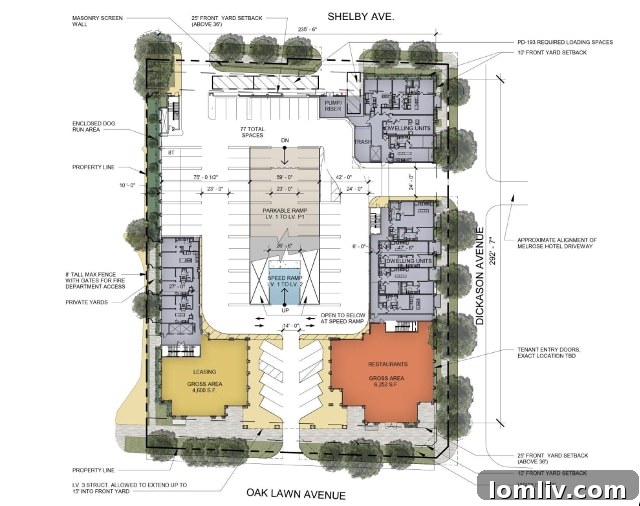
Given its prior approval, the question arises: why the return to the committee? The developers have actually proposed a reduction in scope, opting for seven stories instead of the originally approved eight. Furthermore, they have significantly enhanced the “Unnamed Street” situated between the development and the Post Office – an area that previously drew criticism. As visible in the mid-lower left of the rendering, new residential units now elegantly wrap a portion of this side, effectively obscuring the parking garage. The rear section has been thoughtfully transformed into a landscaped dog park/run, representing two commendable improvements.
Should the adjacent Post Office parcel ever undergo redevelopment, the investment in this opposing side’s aesthetic appeal should serve as a powerful incentive for that future development to match its attractiveness. These revisions represent a clear win for both pedestrians and future residents, demonstrating a commitment to thoughtful urban design. While technically these minor adjustments did not necessitate a return to the OLC, their proactive approach is appreciated, underscoring a commitment to continuous project improvement.
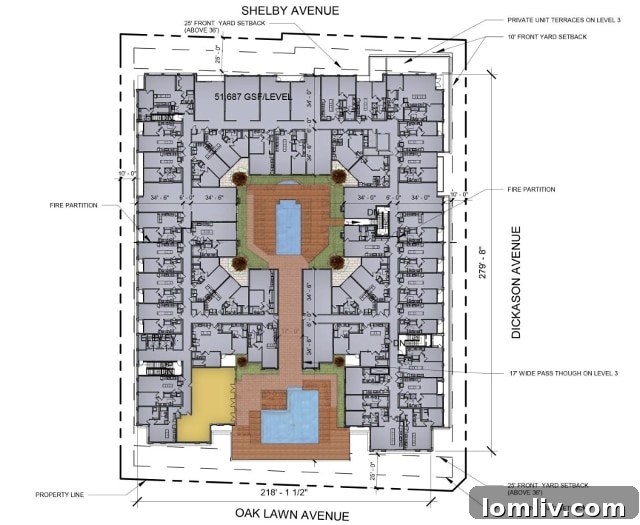
An Innovative Touch: The Vision for a Cantilevered Pool
Despite these positive changes, one intriguing design suggestion remains for the 2929 Oak Lawn project. Observing the pool positioned at the bottom-center of the rendering, which prominently projects beyond the building’s footprint and directly overlooks Oak Lawn Avenue, a compelling opportunity arises: cantilever it. Imagine the architectural drama and visual impact of pedestrians walking beneath this suspended amenity on Oak Lawn Avenue, or envision it gracefully floating above the main driveway. Such a bold design choice would undoubtedly elevate the building’s aesthetic appeal and unique identity.
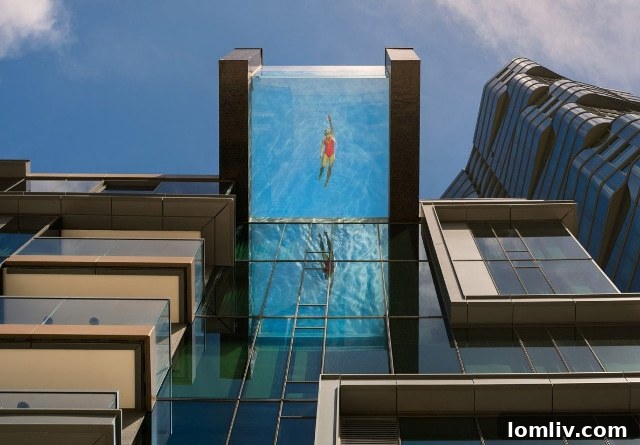
This innovative feature would not only enhance the building’s coolness factor but also potentially command higher rental rates, appealing to those seeking truly distinctive urban living. With groundbreaking not slated until the first quarter of 2020, there remains ample time to incorporate this visionary element. It’s a design flourish that could transform a functional amenity into a signature architectural statement for Oak Lawn. The meeting, which addressed these two significant projects, concluded after a concise yet impactful discussion.

About the Author: My focus areas include high-rises, homeowners associations (HOAs), and renovation projects. I also hold a deep appreciation for the delicate balance between modern and historical architecture, especially within the context of the YIMBY (Yes In My Backyard) movement. My writing has been recognized by the National Association of Real Estate Editors, earning me three Bronze awards in 2016, 2017, and 2018 for my work (2016, 2017, 2018), as well as two Silver awards in 2016 and 2017 for contributions to Second Shelters (2016, 2017). If you have a compelling story to share or a proposal to discuss, please feel free to reach out via email at [email protected]. While I encourage you to look for me on Facebook and Twitter, please be advised that my online presence is intentionally minimal.