Have you ever heard the classic joke about what happens when you play a country song backward? You get your girlfriend back, your house back, your truck back, your dog back… a delightful reversal of fortune, isn’t it?
This humorous analogy offers a surprisingly insightful perspective on how we consume news, especially when it concerns vital economic sectors like real estate. Over a recent rainy weekend, I undertook a detailed review of every Dallas Morning News article pertaining to the residential real estate market in the Dallas-Fort Worth Metroplex, dating back to March 1st. My findings revealed a consistent pattern: negative or alarming headlines frequently lead the story, often giving way to more balanced, or even positive, conclusions deeper within the article. The unfortunate reality is that many readers—though certainly not discerning individuals like yourself—stop at the headline or the opening paragraphs. This means that a significant portion of the audience is left with a predominantly negative perception, missing the crucial context and often more optimistic outcomes presented further down. This phenomenon underscores the critical importance of looking beyond initial impressions and delving into the full narrative to truly understand the dynamics of the Dallas housing market.
Dallas Real Estate Market: Strong Fundamentals Amidst Shifting Narratives
The onset of COVID-19 sent shockwaves across global economies, and while the Dallas real estate market certainly felt the ripple effects, it’s essential to distinguish between immediate reactions and underlying resilience. Despite sensational headlines and anxious speculation, the Dallas housing market is underpinned by robust fundamental drivers that position it for sustained stability and growth. Understanding these core strengths is paramount to forming an accurate assessment, rather than being swayed by the often-transient and emotionally charged nature of news cycles.
Unpacking Dallas Market Fundamentals: A Decade of Growth and Persistent Shortage
The Dallas real estate market entered the pandemic in a fundamentally strong and unique position, primarily characterized by a significant and expanding housing shortage. This deficit is not a recent development but rather a lingering consequence of slow recovery post-2008 recession, coupled with consistent, vigorous population growth over the past twelve years. For more than a decade, residential construction in the Dallas-Fort Worth (DFW) Metroplex has consistently lagged behind the escalating demand fueled by corporate relocations, a diversified economy, and a steady influx of new residents. This potent combination of burgeoning demand and constrained supply serves as the primary engine driving housing prices upward in Dallas since the market’s recovery began around 2012.
Even before the full economic impact of COVID-19 became apparent, official reports highlighted this critical imbalance. On March 4th, the Dallas Morning News reported alarming statistics from Freddie Mac, stating “Texas is missing more than half-million houses.” The article further emphasized that Texas bore the brunt of the nationwide housing shortage, accounting for 7.5 out of every 100 houses lacking across the entire country. This severe discrepancy between available housing units and the sheer number of households needing them created a significant buffer, ensuring price resilience even in the face of broader economic uncertainties.
This positive outlook was further reinforced by subsequent reports from the Dallas Morning News. A March 9th article celebrated, “February was another big month for North Texas home sales,” indicating robust market activity and strong buyer confidence. The following day, March 10th, brought equally encouraging news with a headline declaring, “D-FW home foreclosures and late payments continue to fall.” These indicators collectively painted a picture of a healthy and stable market, characterized by vigorous sales, historically low foreclosure rates, and financially sound homeowners—a stark contrast to the speculative bubble and lax lending practices that preceded the 2008 housing crisis.
Crucially, unlike the conditions leading up to the 2008 Recession, which saw an oversupply of housing inventory coupled with risky lending to unqualified buyers, that volatile and explosive combination simply does not exist in today’s Dallas real estate market. The underlying structural integrity of the market is significantly more robust.
In summary, as of early March, the DFW Metroplex faced an acute need for tens of thousands of housing units that the market simply could not provide. This wasn’t a nascent problem but a deeply entrenched imbalance preceding the pandemic. Any significant slowdown in residential construction, therefore, would inevitably accelerate this existing shortfall, leading to even greater demand-side pressure. This fundamental reality is precisely why residential construction was swiftly designated an “essential” service during initial lockdown measures. A potential reduction in new builds would stem from challenges such as developer financing, supply chain disruptions, or labor availability, rather than a decline in the inherent, urgent need for housing.
March’s Volatile Narrative: From Lion’s Roar to Lamb’s Whimper?
The month of March vividly showcased the dramatic shift in media sentiment regarding Dallas real estate. Early in the month, reports maintained a cautious yet balanced tone. However, as the pandemic’s severity became clearer, headlines rapidly veered towards increasingly dire forecasts. On March 12th, for instance, a headline declared, “Home market could take a hit from economic headwinds.” The accompanying article acknowledged a “tug of war” between favorable conditions, such as cheap home financing, and rising economic apprehension spurred by the coronavirus outbreak. Crucially, the piece quoted Jim Gaines, chief economist at the Real Estate Center at Texas A&M University, who offered a more optimistic local perspective: “The D-FW area really shouldn’t feel much of that [oil price impacts]. The housing sector will probably win out in your market. Dallas’ main concern is what the national economy does. It’s going to slow down — no doubt about that — but nobody knows how long or how deep it will be.” This expert opinion, highlighting Dallas’s unique economic resilience, was notably framed within a cautionary leading headline.
Remarkably, on the very same day, March 12th, another DMN story painted a starkly different, and decidedly positive, picture. Titled “Dallas on list of cities with most home value hikes,” it reported that Dallas had achieved the third-best recovery from the 2008 Recession, with home prices soaring an impressive 75 percent above their pre-crash peak. While the article itself didn’t explicitly detail the reasons, this exceptional recovery is directly attributable to the persistent underbuilding of residential units combined with the region’s robust job growth and burgeoning population – the very strong fundamentals discussed earlier. The simultaneous publication of these two contrasting narratives on the same day underscores the often-conflicting signals readers were receiving.
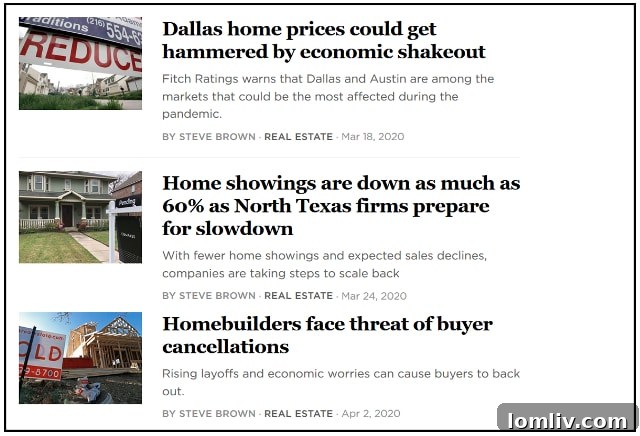
However, this momentary glimmer of market strength seemed to dissipate by March 18th, when the headline shifted dramatically to “Dallas home prices could get hammered by economic shakeout.” This alarming declaration largely drew upon a warning from Fitch Ratings, an agency that has, for an extended period, consistently categorized Dallas as an overvalued market. It is important to note that credit rating agencies often employ a different analytical framework than local market economists, typically focusing on broader, long-term risk factors and historical valuations. Deeper within this article, more measured and nuanced responses were offered by economists like A&M’s Gaines and Lawrence Yun from the National Association of Realtors. Both acknowledged the likelihood of market disruption but emphasized the significant unknowns: the precise duration of lockdowns, the trajectory of unemployment, the scope of government assistance, and the timeline for vaccine development. The deliberate choice of the word “hammered” in the headline clearly prioritized sensationalism and alarm over a balanced presentation of expert opinions, a pattern that unfortunately would recur.
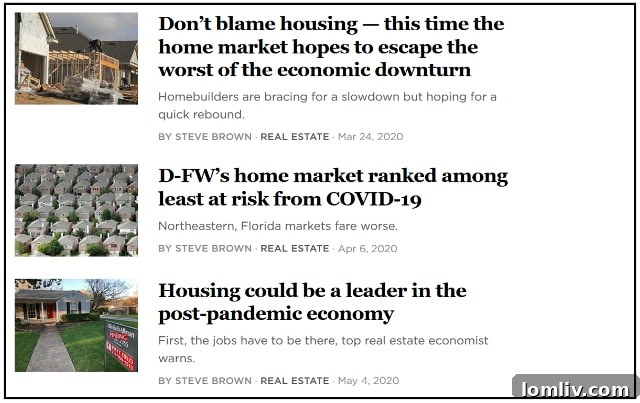
The remainder of March saw COVID-19 continuing to dominate real estate narratives. One particular DMNstory opened with a stark pronouncement: “With the economy slamming on the brakes, homebuilders are potentially facing the greatest falloff in business in a decade.” Yet, remarkably, it concluded on a far more optimistic note: “Last time housing led the recession. This time it’s poised to bring us out.” This stark juxtaposition within a single article perfectly illustrates the narrative tension prevalent at the time. Another headline blared, “Home showings are down as much as 60% as North Texas firms prepare for slowdown,” a dramatic figure that, while accurate, was hardly surprising given the widespread implementation of shelter-in-place orders effectively halting in-person activities. Bookending these cautious reports was a March 31st piece suggesting, “This Spring’s home market could see fewer houses up for grabs,” which, in the context of persistent undersupply, could arguably be interpreted as a positive for sellers, signaling continued tight inventory. These mixed and often conflicting signals created a confusing and anxiety-inducing landscape for anyone attempting to gauge the true health of the North Texas real estate market.
April’s Outlook: A Deluge of Doom with Glimmers of Hope
April intensified the trend of anxiety-driven real estate reporting, with the DMN publishing 22 stories related to residential real estate. The first week of coverage, in particular, was heavily weighted towards impending doom, cultivating a narrative suggesting a market on the brink of collapse. These headlines, while undeniably attention-grabbing, often failed to capture the full complexity and nuanced reality of the situation:
- Doom-Focused Headlines:
- Newest home foreclosure numbers belie coming wave (implying a larger, hidden problem)
- Latest D-FW apartment stats don’t hint at the coming storm (suggesting a deceptive calm before a catastrophe)
- Builders face threat of buyer cancellations (highlighting a specific vulnerability within the construction sector)
- Asking prices of D-FW homes for sale are already headed down (a direct indicator of perceived market weakness, albeit one that requires deeper analysis)
- Missing: 20,000 D-FW apartment renters to fill new units (a seemingly dire forecast for the rental market, which ironically, by April 29th, had “bounced back”—a crucial piece of context often overshadowed by initial alarm)
- Dallas-area home prices were still ahead in February — but not by much (a subtle yet effective way to frame even positive data with a negative connotation)
- A Warning in Disguise:
- Dallas-based home investor says it plans to keep buying – While seemingly a neutral business report, this headline subtly functions as a “warning.” The profiled investor, HomeVestors, specializes in acquiring houses below local median prices, often converting them into rental properties. This practice, while legitimate and profitable for investors, can inadvertently reduce the already limited inventory of affordable homes available for owner-occupancy, exacerbating the housing accessibility challenge for many prospective homebuyers in a market already struggling with undersupply. It highlights a market dynamic that, while not “doom” in itself, contributes to broader affordability concerns.
- A Glimmer of Hope:
- D-FW’s home market ranked among least at risk from COVID-19 (a headline that, despite its inherently positive and reassuring nature, often got buried amidst the more alarming reports, if read at all). This crucial piece of information underscored the inherent strengths of the DFW market, including its diversified economic base, robust job creation, and strong ongoing population influx, which collectively provided a significant buffer against economic shocks compared to many other regions.
May’s Measured Approach: Market Stabilization and Decoding Price Trends
As May progressed, a discernible, albeit gradual, shift in the Dallas Morning News‘s real estate coverage began to emerge. The frenetic pace of alarming headlines seen throughout April started to subside, with postings in the first two weeks of May nearly halving April’s rate. This suggested a move towards a more measured journalistic approach, perhaps reflecting a growing recognition of the market’s underlying resilience or a natural easing of the initial panic. The month commenced with headlines that, while still cautious, offered a more pragmatic and reasonable perspective:
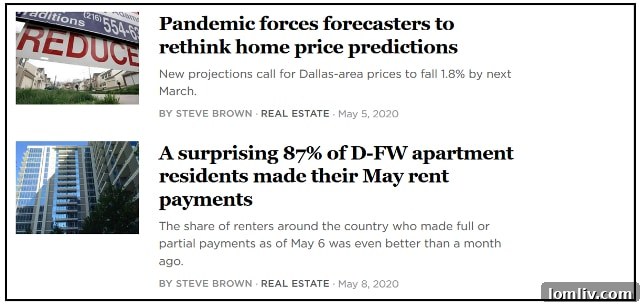
- Forecasters are taking a wait-and-see approach to home prices (a pragmatic and necessary stance that, arguably, should have been adopted much earlier instead of engaging in speculative doom-mongering).
- Housing could be a leader in the post-pandemic economy (a hopeful and, considering the deeply rooted housing shortfall in the DFW Metroplex, an arguably obvious conclusion from the very outset).
Despite these more balanced beginnings, the narrative pendulum still occasionally swung back towards negative territory with subsequent headlines throughout May. These included:
- D-FW median home list prices are down
- North Texas home sales hammered by pandemic
- Home list prices since the pandemic have trended lower
However, a closer and more analytical examination of the data supporting this trio of headlines reveals a crucial nuance often overlooked by headline-readers: one primary reason for the observed “down” or “lower” median home prices was a significant shift in the *composition* of properties available on the market. Specifically, there was a noticeable decrease in the number of high-priced home listings compared to previous periods. When fewer luxury properties are listed, the overall median asking price for the entire market naturally skews downwards. This doesn’t necessarily indicate a widespread devaluation of properties across all segments, but rather a greater propensity for wealthier individuals to temporarily withhold their high-end homes from the market during times of economic uncertainty, more so than owners of lower or mid-priced homes. It reflects a change in market inventory mix, not a fundamental collapse in property values.
Furthermore, critical data points emerged that actively defied the negative framing. While homes were indeed being priced more aggressively from the outset, aiming to capture buyer interest in a cautious environment, a significant trend was that fewer sellers were actually cutting their prices after an initial listing compared to the previous year. This suggests that sellers, or their real estate agents, were more effectively “pricing-in” the COVID-19 related market conditions from the very beginning. This resulted in more realistic initial pricing, leading to more stable negotiations and fewer dramatic price reductions post-listing. This astute initial pricing strategy was instrumental in keeping overall market prices within a relatively stable band. Indeed, CoreLogic, a highly respected property data and analytics provider, forecasted a remarkably modest 1.8 percent decline in median DFW prices over the next year. This figure, while a slight decline, is hardly “Earth-shattering” and certainly does not support the imagery conjured by terms like “hammered” or “plunging.”

The persistent use of emotionally charged words like “hammered” warrants further critical scrutiny. The underlying reality in April was that the *number* of property sales (sales volume, not prices) was down 17 percent. While this is a notable decline, it was hardly a surprise given the stringent shelter-in-place orders that effectively halted in-person showings, restricted open houses, and severely constrained the entire transaction process. Instead of a more factual and contextually accurate headline such as “DFW Home Sales Drop 17% Reacting to Stay-at-Home Orders,” the choice to declare home sales as “hammered” again served to sensationalize a situation that was largely a direct, temporary consequence of governmental mandates, rather than a deep, structural failure of the market itself. This deliberate choice of language can significantly skew public perception.
Parsing Words and Sentiment: The Profound Impact of Media on Public Perception and Decision-Making
Beyond the specific fluctuations and data points of the Dallas real estate market, it is vital to consider the broader implications of media framing on public perception, consumer confidence, and even individual well-being. Just last week, the BBC reported on compelling research from the University of California Irvine, which vividly demonstrates how media coverage of disasters can profoundly impact our mental outlook and even our long-term physical health. A research team, led by Dr. Alison Holman, was conducting an extensive study into mental health across the country, involving 5,000 volunteers, when the tragic Boston Marathon bombing occurred. This unforeseen event provided the researchers with a unique and invaluable mental health baseline against which to compare post-bombing reactions, allowing for a robust and ethically sound analysis of media exposure’s effects.
Conventional wisdom might suggest that the actual victims of the bombing and their immediate social circles would experience the most significant mental health degradation. However, the study’s findings dramatically challenged this intuition. The mental health impact on actual victims was “bested” – meaning it was less severe – than for those individuals who consumed repetitive and graphic news coverage of the event for more than six hours a day over the subsequent week. This groundbreaking revelation underscores the insidious power of media over-saturation and its potential to inflict psychological trauma even on those physically removed from an event, merely through relentless exposure to negative narratives.
Armed with this striking data, Holman’s team extended their inquiry to examine the long-term health implications on those most stressed by the events of 9/11. The results were even more startling: in the three years following 9/11, that specific group – primarily individuals who had only watched the endlessly replayed events on television – experienced a staggering 53 percent increase in cardiovascular problems. This compelling evidence illustrates that chronic exposure to negative and sensationalized news can translate into tangible, severe physiological health consequences, extending far beyond transient anxiety or fear. It highlights how the psychological burden of media consumption can manifest physically.
The relevance of this research to the current climate, particularly concerning the Dallas real estate market, is undeniable. For months, COVID-19 coverage has been non-stop, often dominated by grim statistics, alarming forecasts, and an overall sense of uncertainty. In our focused sphere of residential real estate, a pervasive atmosphere of negativity has frequently overshadowed strong underlying fundamentals, creating an environment of apprehension. While this analysis has focused somewhat on the Dallas Morning News, the patterns and angles discussed are by no means unique; similar journalistic approaches were broadcast across various media platforms, creating a collective echo chamber of concern and, at times, panic. This constant barrage of negativity, even when detailed reports suggest a more resilient and stable picture, can significantly erode consumer confidence, influence critical buying and selling decisions, and potentially even create self-fulfilling prophecies within the market.
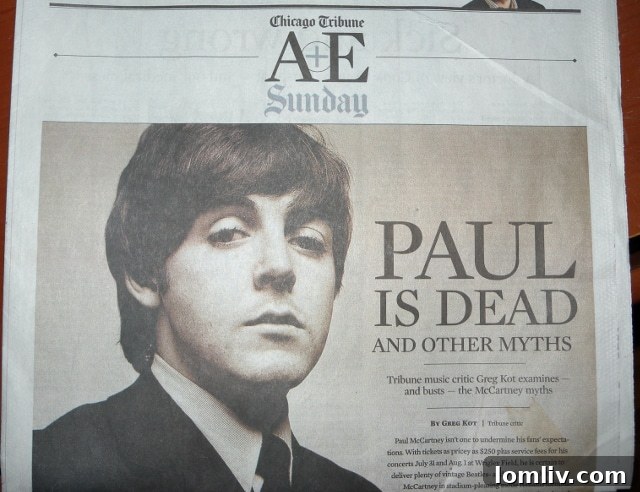
So, if you find yourself hesitant to make a move in the Dallas real estate market – whether buying, selling, or even signing a lease – take a moment to ask yourself why. Is your hesitation based on a thorough understanding of the local market fundamentals, expert analysis, and a balanced perspective on data? Or is it subtly influenced by the pervasive, and often sensationalized, narratives dominating the news cycle? Perhaps, like our opening country song analogy, there’s profound value in trying to “read the news backward” – or at least in deconstructing it to find the deeper, more balanced truths. I promise you, in the grand scheme of things, and certainly for the robust, fundamentally strong Dallas real estate market, Paul still isn’t dead. The market’s resilience remains, waiting for those who look beyond the headlines.