U.S. Secretary of Education Betsy DeVos’s Controversial Dallas Visit Highlights Public Education Success and Reform Debates
In an unannounced and highly contentious move, then-U.S. Secretary of Education Betsy DeVos made a surprise visit to the Dallas-Fort Worth area on a Thursday, igniting a firestorm of controversy among local education leaders and advocates. The visit, notably absent from her public schedule, underscored the deep divisions surrounding her tenure and the future of public education in America. Her itinerary included stops at Urban Specialists, the celebrated Billy Earl Dade Middle School, and the 16 Streets Center, beginning her day in North Richland Hills’ Birdville ISD.
The Unannounced Arrival and Local Backlash
The clandestine nature of Secretary DeVos’s visit quickly became a focal point of contention. Dallas ISD board president Dan Micciche revealed that the visit was orchestrated by Urban Specialists, a privately funded organization partly supported by Stand Together (itself funded by the Charles Koch-led Seminar Network), and Dallas ISD trustee Bernadette Nutall. Nutall, who previously headed the Dallas non-profit Circle of Support Dallas, had recently integrated her efforts under the Urban Specialists umbrella, where she now serves as an executive director.
A Visit Shrouded in Secrecy
The lack of transparency surrounding the Secretary’s tour was a major source of frustration for many, including the majority of the Dallas ISD board. Micciche expressed his dismay, stating that the board remained unaware of the impending high-profile visit until receiving an email notification late Wednesday afternoon. “The school board was not even notified about the visit until I received an email from the U.S. Department of Education, which I immediately forwarded to all board members,” he recounted, highlighting a significant communication breakdown that further fueled the political tension.
Protests and Political Tensions Outside Dade
As news of DeVos’s visit spread, approximately 100 protesters gathered outside Billy Earl Dade Middle School, voicing their strong disapproval of the Secretary’s policies and presence. Despite their numbers, DeVos’s arrival at the school’s back door, greeted by a vibrant drum line and cheerleaders, meant she was largely shielded from the dissenting voices. Among the protesters were prominent local figures, including Dallas ISD trustee Joyce Foreman and Nutall’s electoral opponents in the upcoming May 22 school board election, Justin Henry and Ed Turner, signaling the intense local political stakes intertwined with the visit.

Trustee Nutall Under Fire
The backlash against Trustee Nutall for facilitating the visit was immediate and severe, especially from her political rivals. Justin Henry and Ed Turner, both vying for Nutall’s District 9 seat, wasted no time in condemning her decision on social media. Turner articulated the sentiment of many, asserting, “Trustee Bernadette Nutall’s invite of Betsy DeVos to Billy E. Dade is a slap in the face to the students, parents, and teachers in District 9.” He further emphasized the insult inherent in Nutall’s failure to inform her fellow trustees or the community in a timely manner.
Henry echoed these concerns, posing a rhetorical question that resonated with public education advocates: “Why did our current District 9 Trustee Bernadette Nutall invite an enemy of public education (Secretary Betsy DeVos) to Billy Earl Dade Middle School in DISD?” He labeled Secretary DeVos as “a clear and present danger to public education,” pointing to her active promotion of privatization and her track record as evidence.
An Ally’s Disappointment
Even Joyce Foreman, a frequent ally of Nutall on the Dallas ISD board, expressed her bewilderment and disapproval. Her Facebook post captured the surprise felt by many: “I just found out today that Education Secretary Betsy DeVos will be at Billy Earl Dade Middle School at 2:00 p.m. tomorrow. I have also been told that there will be a protest. I do not support the direction of the Department of Education under Betsy DeVos.” Foreman’s public stance highlighted the breadth of opposition to DeVos’s educational philosophy, even among those who typically align with Nutall on other issues.
Trustee Nutall’s Defense: Showcasing Public Education Success
In response to the mounting criticism, Trustee Nutall took to Facebook to defend her decision, asserting her unwavering commitment to public education. “There is no doubt about my commitment to Public Education, our students and the residents of Dallas ISD District 9,” she wrote. Acknowledging the predictable disagreement, she continued, “We have different ideas, viewpoints and politics about public education in America. Yes, I know that this won’t sit well with some, and I get that.”
Nutall’s rationale for extending the invitation to Secretary DeVos was rooted in a desire to showcase the remarkable achievements of Billy Earl Dade Middle School. She expressed her belief that Dade’s successes could serve as a national model for public education, hoping the visit would demonstrate to DeVos—often perceived as an adversary of traditional public schooling—the effectiveness of innovative approaches within public institutions. “I am not supporting her stances……instead; I am utilizing this as an opportunity to highlight how DISD is responding to challenges with viable solutions,” Nutall clarified. She emphasized the importance of engaging in dialogue, stating, “I believe we shouldn’t turn our back on the chance to discuss our position and commitment to public education, and subsequently our children, educators and communities.”
Billy Earl Dade Middle School: A Beacon of Turnaround Success
At the heart of the controversial visit was Billy Earl Dade Middle School, a institution that has garnered national attention for its extraordinary transformation. Just a few short years prior, Dade was struggling, widely considered the worst-performing middle school in Dallas. Yet, through dedicated leadership and innovative programs, it had risen to become one of the district’s best, a testament to what is possible within public education.
Principal Tracie Washington is widely credited for helming the team that masterminded this remarkable turnaround. Her exceptional leadership earned her the title of the district’s principal of the year in 2016. Dade was also part of the inaugural cohort of ACE (Accelerating Campus Excellence) campuses, a Dallas ISD initiative designed to provide additional funding and resources to historically underperforming schools. This program allowed Dade to implement targeted strategies to address deeply rooted academic and social challenges, demonstrating how strategic investment and empowered leadership can yield significant results.
DeVos Inside Dade: Praises and Policy Discussions
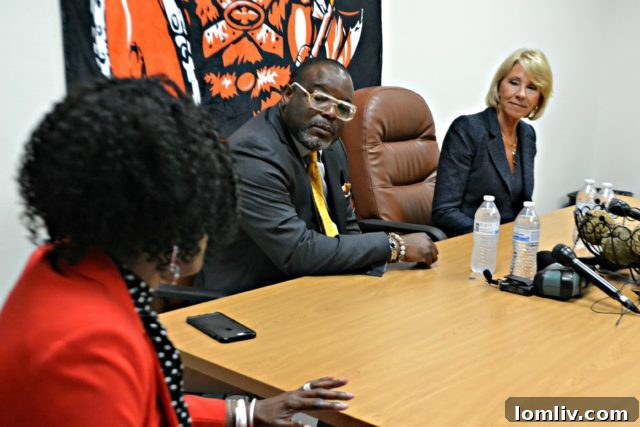
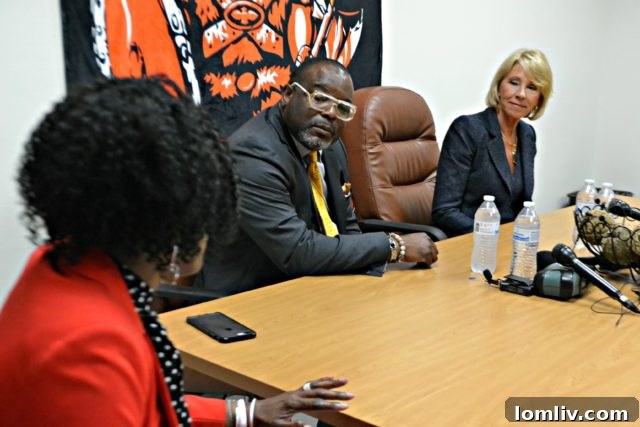
During her tour of Dade, Secretary DeVos was accompanied by Principal Tracie Washington, witnessing firsthand the vibrant learning environment and the innovative programs in place. Following the tour, DeVos participated in a brief roundtable discussion with Omar Jahwar of Urban Specialists, Trustee Nutall, and Principal Washington, all in front of assembled press. DeVos praised Washington and her team for their exceptional work, describing it as “very inspirational.”
“Every time I’m able to visit and see firsthand a school like this, it’s great,” she remarked, acknowledging the tangible successes at Dade.
The Local vs. Federal Divide
A key question from reporters revolved around whether the programs and strategies that made Dade’s success possible would be adopted as national policy. DeVos, however, quickly tempered expectations regarding federal intervention. “We should not expect Washington to hand down what is going to happen,” she stated, reiterating her long-standing belief that states and local school districts are best equipped to determine what works for their communities. This stance, while emphasizing local control, often leaves critics questioning the federal government’s role in disseminating proven educational models or ensuring equitable opportunities across the nation.
Defending School Choice and Refuting Privatization Claims
When pressed on her controversial advocacy for school choice, which critics argue could divert funds from public schools through vouchers, DeVos defended her position. “I’m a champion for all schools,” she asserted. “I’m a champion for kids and for kids having a great opportunity to learn.” She emphatically denied any desire to privatize public education, reframing her philosophy: “I view education as an investment in individual students and individual children.” Her goal, she maintained, was simply to empower every parent with the ability to choose the best educational path for their child. “So, if we keep oriented around making sure that every student has the opportunity to pursue a great education, I think we’ll all be able to arrive at good solutions,” she concluded, attempting to bridge the ideological chasm.
Funding Innovation: Merit Pay and Federal Flexibility
Reporters also questioned DeVos about the potential for federal funding to support innovative programs like Dallas ISD’s merit pay system, which rewards teachers who meet specific performance benchmarks and is often cited as a contributor to the success of schools like Dade. While avoiding a direct commitment to a new federal program, DeVos highlighted the existing flexibility within federal funding streams. She noted that several federal programs already allow districts to allocate funds as they deem fit, suggesting that Dallas ISD could potentially “reallocate some of its federal funds to offset its funding needs for teacher pay increases” rather than relying on new federal initiatives.
Re-evaluating Disciplinary Policies
Another critical policy area discussed was a proposed reversal of Obama-era guidelines aimed at addressing racial bias in school disciplinary policies. DeVos indicated that the department was still in the “information gathering stage.” While acknowledging positive feedback about practices such as restorative justice, she remained cautious, declining to endorse these practices as universally applicable, reflecting her administration’s approach to reviewing federal mandates.
Beyond the Visit: Lasting Questions and Implications
Throughout her visit, Secretary DeVos reserved her most effusive praise for Dade Middle School and its principal, Tracie Washington. However, she stopped short of suggesting that Dade’s specific model could be replicated universally. “The really important factor here is the leadership and staff of this school,” she emphasized, adding, “Leadership matters. Teachers are incredibly important.” She mentioned that part of the Every Student Succeeds Act included an overview of available school resources and their utilization, and that her department was awaiting the completion of that comprehensive review.
After her impactful visit to Dade, Secretary DeVos concluded her Dallas itinerary with a driving tour through the neighborhoods surrounding the school, followed by another meeting at the 16 Streets Center. She finished her engagements about an hour ahead of schedule.
Ultimately, DeVos’s surprise visit to Dallas illuminated the ongoing national debate surrounding public education. It showcased the remarkable success of a public school like Billy Earl Dade, even as it highlighted the deep ideological divides on how best to support and reform educational systems. The visit served as a potent reminder that while local triumphs inspire, the national conversation on school choice, funding, and federal oversight remains as complex and contentious as ever.