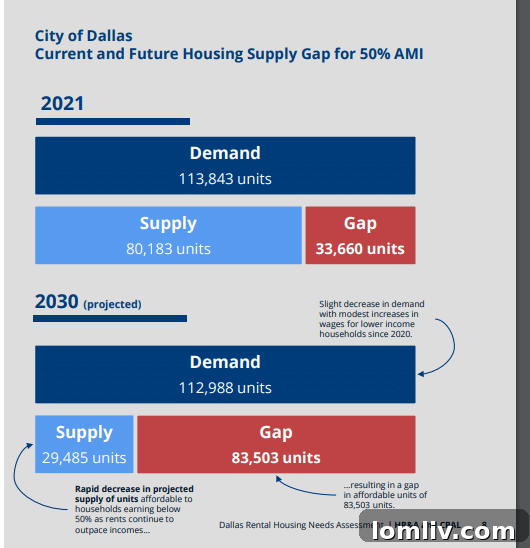
Dallas is grappling with a severe deficit of approximately 33,660 affordable homes, a concerning figure highlighted in a recent comprehensive study published by the Child Poverty Action Lab (CPAL). This significant housing shortage underscores a deepening crisis within the Dallas rental market, impacting thousands of residents and hindering the city’s overall economic and social well-being.
The critical findings of the CPAL report were meticulously reviewed by Ashley Flores, the senior director of the non-profit organization CPAL, during a recent conference call with members of Dallas Neighbors for Housing, a prominent activist group dedicated to addressing the city’s housing challenges. Flores’ presentation illuminated the stark realities of the Dallas affordable housing problem, setting the stage for urgent discussions and potential solutions.
For roughly six months, Flores collaborated extensively with HR&A Advisors, an esteemed economic development firm. Their joint effort aimed to gain a profound understanding of the intricacies of the Dallas rental market, meticulously analyzing the substantial discrepancies between the supply of and demand for housing units across various income brackets. This rigorous analysis forms the bedrock of CPAL’s comprehensive report, offering invaluable insights into the scope and nature of the city’s housing crisis.
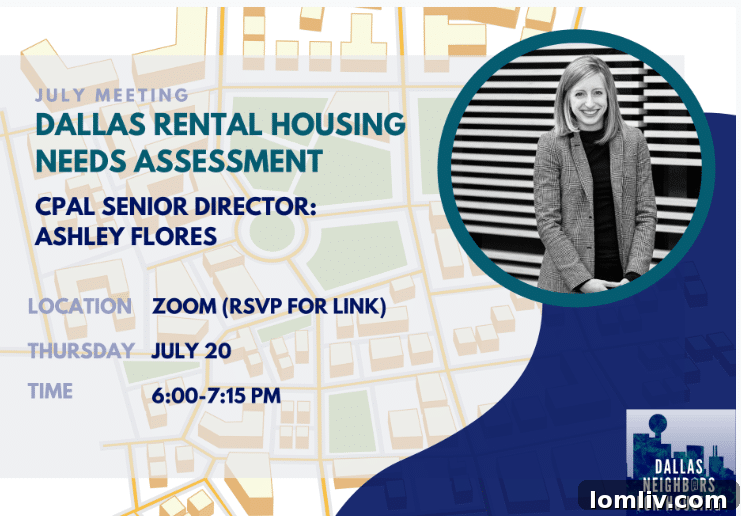
“The majority of residents in Dallas are renters,” Flores emphasized during her presentation, highlighting the critical importance of focusing on the rental sector. She further elaborated, “We also know that renters in Dallas are disproportionately low-income and disproportionately members of communities of color.” While acknowledging the vital roles of homeownership, rehabilitation, and preservation within the broader housing ecosystem, Flores clarified that the primary objective of this specific CPAL report was to conduct an exhaustive deep dive into the dynamics and challenges of the Dallas rental market, which directly affects a large and vulnerable segment of the population.
Unpacking the Dallas Rental Market Crisis: Challenges and Pathways to Solution
The pressing issue of the Dallas housing shortage took center stage during an online discussion held on July 20, bringing together community leaders and advocates to dissect the problem in detail. This crucial conversation served as a preliminary step towards identifying concrete strategies and actions to alleviate the crisis. Building upon this initial dialogue, the focus is now shifting towards actionable solutions.
A forthcoming panel discussion, scheduled for August 24, promises to explore tangible solutions to the Dallas affordable housing problem. This anticipated event will feature influential figures from the city’s planning and development sectors, including City Plan Commission Chair Tony Shidid, Assistant Director of Planning and Urban Design Andreea Udrea, and Assistant Vice President of Venture Commercial Paul Carden. These panelists are uniquely positioned to influence policy and implement changes that could significantly impact the availability and distribution of affordable rental units in Dallas.
Adam Lamont, the founder of Dallas Neighbors for Housing, articulated the strategic importance of the upcoming panel, stating, “It sort of segues from Ashley’s ‘where we are’ to what we can do now, action-wise.” This sentiment reflects a broader desire within the community for a proactive approach, moving beyond problem identification to concrete policy recommendations and implementation plans to address the Dallas housing shortage effectively.
In a parallel effort, housing advocates, spearheaded by the newly established Dallas Housing Coalition, have announced ambitious plans to advocate for a substantial $200 million allocation in the upcoming 2024 bond issue. This significant funding initiative aims to bolster efforts to create more affordable housing options across the city, providing critical resources for development, preservation, and support programs. The bond issue represents a vital opportunity for Dallas to make a substantial investment in its housing future.
Elected officials have not only acknowledged but have also responded to the sobering insights presented in the CPAL report, signaling a growing recognition of the urgency of the Dallas affordable housing crisis. District 1 Councilman Chad West, for instance, remarked, “There is a delicate balance between protecting our existing housing supply and the need to build more.” He added, with a clear call to action, “However, Dallas needs to build more and soon. We need to look at encouraging [accessory dwelling units], missing middle housing, and incentivizing building on empty lots.” Councilman West’s comments highlight the multi-faceted approach required, encompassing both the expansion of housing options and the strategic utilization of available urban spaces to combat the city’s rental housing gap.
Decoding the Child Poverty Action Lab Report: Key Insights into Dallas’s Housing Crisis
The Child Poverty Action Lab’s CPAL report paints a stark picture of the Dallas rental market, revealing that in 2021, there were only 70 affordable housing units available for every 100 households earning at or below 50 percent of the Area Median Income (AMI). This substantial imbalance signifies a critical shortage, forcing many low-income families to compete for a limited supply of housing, often leading to increased housing instability and financial strain.
Flores elaborated on the implications of this deficit, stating, “If supply were leading demand perfectly, there would be 100 affordable units for every 100 households — or even better, there would be more than 100 affordable units.” She further emphasized, “The idea is to have a lot of choices in the market.” A healthy housing market offers diverse options and affordability across income levels, preventing predatory pricing and ensuring that all residents can secure stable housing. The current Dallas rental market falls far short of this ideal, exacerbating the affordable housing crisis.
The report identifies four primary factors that have converged to create and significantly widen the rental housing gap in Dallas, each contributing to the pressing affordable housing challenge:
• Rapid Regional Growth: The Dallas-Fort Worth (DFW) metro area has experienced an astonishing growth rate exceeding 20 percent over the past decade. While economic growth is often welcomed, this rapid influx of new residents has dramatically outpaced the development of new housing units, particularly affordable ones. This intense population pressure places immense strain on the existing housing stock, driving up demand and consequently, rental prices.
• Prevalence of Low-Wage Jobs: Despite its robust economy, the DFW region is characterized by a significant number of low-wage occupations. The top four most common jobs in DFW all have median annual wages under $40,500. This disparity between stagnant wages and rising housing costs creates an untenable situation for many families, making it increasingly difficult for them to afford even the most basic rental units. This economic reality is a crucial driver of the Dallas housing shortage.
• Insufficient Production of New Affordable Units: A critical failing highlighted by the report is Dallas’s inadequate rate of affordable housing construction. Since 2010, the city has only delivered a meager 1.9 new, deed-restricted affordable units per 1,000 residents. This puts Dallas at a dismal 21st out of 32 major U.S. cities in terms of affordable unit production. Deed-restricted units are essential as they legally mandate affordability for a specified period, yet their scarcity in Dallas contributes directly to the widening rental housing gap.
• Accelerated Rent Increases: The COVID-19 pandemic triggered an unprecedented surge in rental prices. The report reveals that rent has increased more significantly in the 34 months since the pandemic began than in the entire 72 months preceding it. This rapid acceleration in rental costs has pushed countless families beyond their financial limits, turning an already challenging situation into a full-blown affordable housing crisis.
The rental housing gap is not merely a static problem; it is actively expanding, Flores explained. By 2030, projections indicate that the City of Dallas will face an alarming gap of 83,500 rental units for households at or below 50 percent Area Median Income (AMI). This nearly threefold increase from the current deficit underscores the urgent need for immediate and robust intervention.
Adding to this bleak outlook, the widening of the rental housing gap will be further exacerbated by the projected loss of nearly 54,000 units of Naturally Occurring Affordable Housing (NOAH). NOAH refers to older, unsubsidized rental properties that are affordable simply due to their age or location, without deed restrictions. As these properties are renovated, redeveloped, or face rising property taxes, they often transition out of the affordable market, displacing low-income residents and compounding the Dallas housing shortage.
Without significant and timely intervention, the current trends are poised to severely exacerbate existing inequalities across Dallas, ultimately hindering economic mobility for low-income children and perpetuating cycles of poverty, Flores warned. The impact extends beyond mere statistics, touching the very fabric of families’ lives and limiting future opportunities.
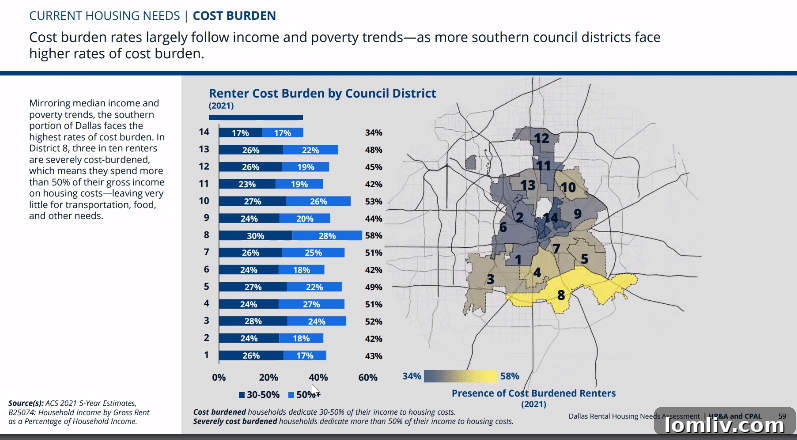
“Dallas ranks 10th out of the 12 largest cities for affordable housing units in ‘high opportunity’ census tracts and remains the most segregated big city in Texas — and among the most segregated big cities in the nation,” Flores stated, highlighting the deep-seated issues of inequity and spatial segregation that intersect with the housing crisis. She underscored the profound human cost: “Lack of housing affordability forces families to make tradeoffs with basic daily needs like food, clothing, and transportation. On average, families at or below 50 percent AMI are spending nearly half their income on housing each month.” This profound financial burden means less money for essentials, education, healthcare, and savings, trapping many in a precarious economic state.
Rental Units and Affordability: A Historical Perspective on Dallas’s Dilemma
A deeper look into Dallas’s housing production history reveals a critical misalignment between housing supply and population growth. Ashley Flores pointed out that Dallas builders constructed roughly the same number of rental units between 2000 and 2009 as they did in the subsequent decade, from 2010 to 2019. While seemingly consistent, this stability in construction rates masks a fundamental shift in demographic dynamics that profoundly impacted the Dallas rental market and its affordability.
“We were producing units at a comparable clip, but we added many more residents from 2010 forward, so that really drove down affordability,” Flores explained. “That helps explain why we’re in this pinch.” The influx of a significantly larger population during the latter decade meant that the same number of newly constructed units had to serve a much greater demand. This imbalance inevitably led to increased competition, inflated rental prices, and a shrinking pool of affordable housing options, contributing directly to the Dallas housing shortage and the widening rental housing gap.
Further delving into the data, the CPAL leader highlighted some “staggering” statistics included in the report, which underscore the severe human impact of the crisis. A particularly concerning finding reveals that approximately 74 percent of single-parent households with children are classified as “cost-burdened.” This means they are spending more than 30 percent of their total income on rent each month. For these families, a significant portion of their earnings is consumed by housing costs, leaving insufficient funds for other necessities and jeopardizing their financial stability and well-being.
“You see the difference in how populations are being affected by these steep housing costs,” Flores remarked, emphasizing the disproportionate impact on vulnerable groups. Single-parent households, often with limited income, are particularly susceptible to the soaring rental prices in Dallas, further entrenching them in economic hardship and making it exceedingly difficult to achieve economic mobility.
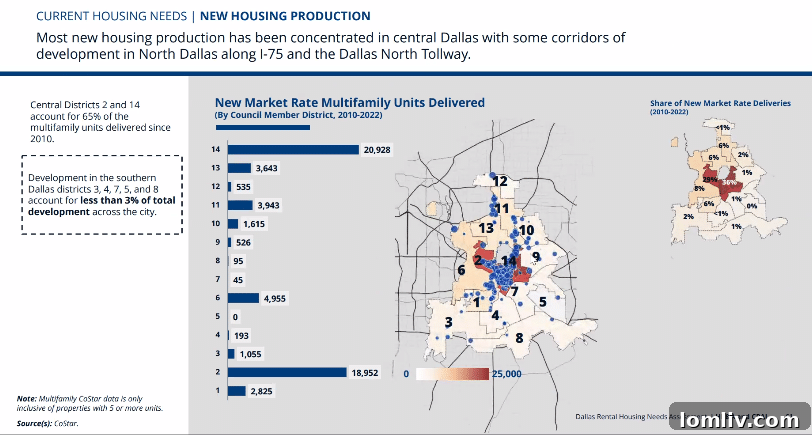
It is not merely about increasing the number of affordable units, Flores stressed, but also about strategically distributing them throughout Dallas. The report critically points out that deed-restricted affordable units, which are designed to remain affordable long-term, are overwhelmingly concentrated in the southern sector of the city. This geographic imbalance perpetuates existing patterns of segregation and limits access to opportunities for low-income residents.
“We haven’t done a great job of dispersing deed-restricted affordable housing so people can access neighborhoods across the city,” Flores acknowledged. This lack of equitable distribution means that many low-income families are confined to specific areas, often far from job centers, quality schools, and essential services. Achieving true housing equity in Dallas requires a concerted effort to build and preserve affordable units in all parts of the city, ensuring that every resident has the opportunity to thrive, regardless of their income or background. Addressing the Dallas affordable housing crisis necessitates both increasing supply and promoting equitable access to quality housing across all neighborhoods.