Understanding Dallas Housing Affordability: A Deep Dive into Income Disparities
For the past five years, the Dallas housing market has experienced unprecedented growth, with soaring prices impacting both prospective homeowners and renters alike. This escalating trend has pushed the boundaries of affordability, making it increasingly challenging for a significant portion of the city’s population to secure suitable housing. Amidst this backdrop, areas like Southern Dallas have emerged as crucial frontiers for affordable housing options, attracting a growing number of residents whose wages simply haven’t kept pace with the relentless rise in housing costs.
Recognizing the urgent need for a clearer understanding of these dynamics, the Dallas City Council recently reviewed compelling data presented by the Reinvestment Fund consultants. This comprehensive analysis meticulously inventoried and mapped the city’s housing stock, cross-referencing it with critical demographic information, including racial makeup and income levels. The objective of this vital study is to equip Dallas with more robust data, essential for formulating effective strategies to address its pervasive affordability crisis – a challenge that has historically plagued the city.
While many of us hold anecdotal knowledge about Dallas’s socio-economic landscape – generally perceiving North Dallas as affluent and Southern Dallas as economically disadvantaged – this study provides a granular, data-driven perspective that compels a deeper examination.
Deciphering the Housing Landscape: Understanding Property Designations
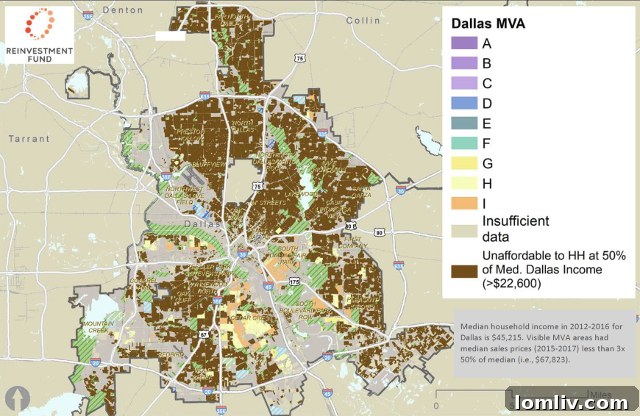
Note: Throughout the following graphics, the A-to-I designations classify different housing types based on a range of variables. To provide context for our discussion, “A” properties represent those with median sales prices exceeding $1 million, while properties categorized as “G, H, and I” denote declining median prices, ranging from approximately $91,300 down to $41,500. This categorization helps illustrate the vast disparity in housing values across Dallas neighborhoods.
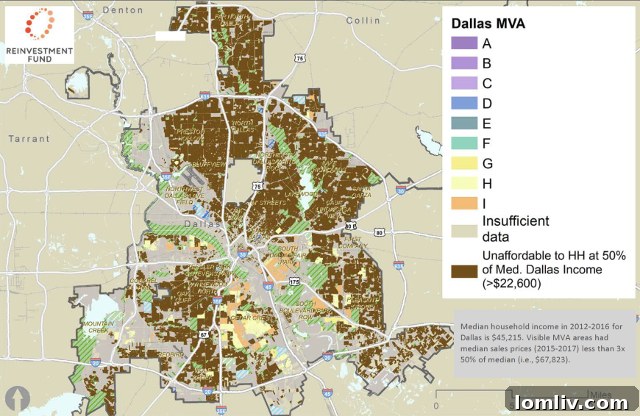
Let’s begin by scrutinizing the initial graphic, which illustrates the limited residential options available to a family of four earning 50 percent of the median Dallas income. This figure, specifically for Dallas proper, stands at $45,215 annually. It’s important to distinguish this from the broader Dallas area median income of $73,400, which encompasses wealthier enclaves like the Park Cities and surrounding suburbs, where poverty levels are considerably lower. The aspiration, undoubtedly, should be to elevate Dallas proper’s median income closer to that of the wider metropolitan area.
The Struggles of Earning 50% of Median Income: A Harsh Reality
Fifty percent of Dallas proper’s median income translates to a meager $22,600 per year, or approximately $11.30 per hour for a full-time job. To put this into perspective, consider that since 2008, the Texas (and Federal) minimum wage has remained stagnant at $7.25 per hour, amounting to just $15,080 annually. For tipped workers, such as those in restaurants or bars, the minimum wage plummets to $2.13 per hour, meaning they must generate an additional $5.12 per hour in tips just to meet the federal minimum wage. While tips might seem readily available in bustling or upscale establishments, this isn’t always the reality. Moreover, the vulnerability of these workers, often subjected to customer harassment and management pressure, leaves them with little recourse.
Insights from experts like Saru Jayaraman, co-founder of the Restaurant Opportunities Centers United, underscore these systemic issues. Jayaraman highlights how female wait staff are frequently encouraged to dress provocatively to boost tips, inadvertently increasing their exposure to harassment. Astonishingly, even well-known chains like Denny’s have been cited for such practices. Furthermore, studies consistently reveal that minority workers systematically earn less in these industries, exacerbating the income disparity.
The map vividly demonstrates that housing options are scarce even for those earning $11.30 per hour, which is 35 percent above minimum wage. This stark reality forces us to confront the living conditions of essential workers. When you support businesses that proudly announce $10 per hour wages, consider where their dedicated employees can afford to reside. Similarly, when visiting elderly relatives in affluent neighborhoods, remember the caregivers who provide vital services on similarly low wages, often safeguarding a loved one’s life. To secure even this limited, low-level housing, a household would typically require 1.5 full-time minimum wage jobs, equating to a demanding 60-hour work week, or two working adults, often settling for suboptimal living conditions.
Navigating Dallas with 80% of Median Income: Still Limited Choices
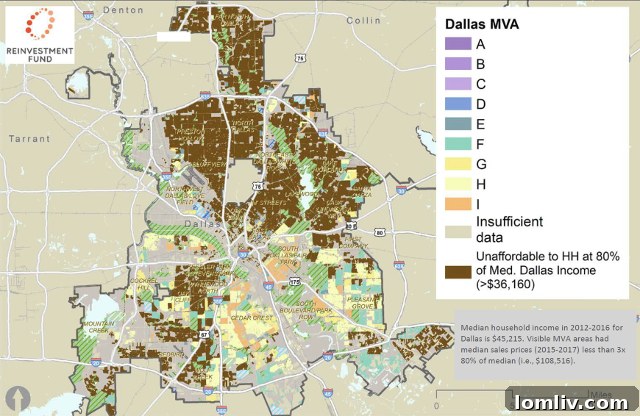
Progressing up the income ladder, the next graphic illustrates housing accessibility for a family earning 80 percent of the median Dallas income. This translates to $36,160 per year, or approximately $18.08 per hour for full-time employment. While this income level undeniably opens up more areas within the city, the majority of affordable options remain concentrated in Southern Dallas, with only sporadic, smaller pockets appearing further north. For those within the food service industry, Salary.com data indicates that 75 percent of full-time wait staff earn less than $29,968 annually, including tips, even with substantial experience spanning 20 years or more. This highlights a critical point: the bulk of food servers are engaged in roles that, while essential, do not command high wages. To ascend beyond this category and afford more desirable housing, families often face the necessity of having two full-time income earners contributing these salary levels.
The Paradox of Essential Workers: 120% of Median Income and Beyond
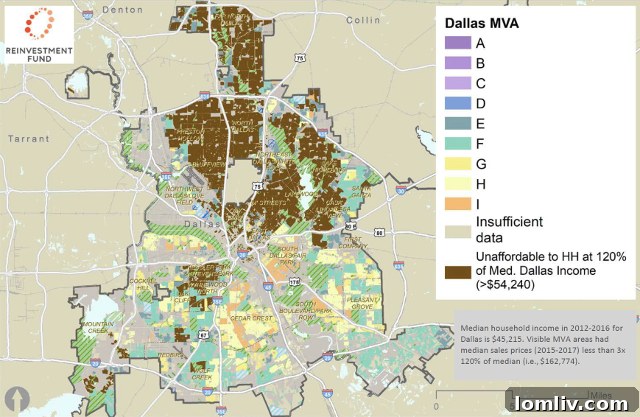
Even at 120 percent of the median income, or $65,068 per year ($32.53 per hour), a family of four will find many Dallas neighborhoods financially out of reach. This income bracket is particularly telling, as it often includes many of the city’s vital public servants – our local police officers, firefighters, and teachers. According to Salary.com, an average teacher or patrol officer in Dallas typically earns in the low-to-mid $50,000 range, while the median salary for a firefighter hovers around $45,000 annually. For housing costs not to become a financial burden, they ideally should not exceed one-third of one’s gross income. After accounting for estimated taxes, an annual income of $65,000 would ideally allow for a monthly housing expense (rent or mortgage/taxes) of approximately $1,300 for a family of four. The maps clearly demonstrate that even at this income level, suitable options remain limited.
A critical observation from these graphics is the persistent lack of affordability north of I-30 for residents earning less than 120 percent of the median income. This geographic divide underscores why lower-priced housing options in Northern Dallas are snatched up almost instantly these days. For those aspiring to live south of I-635, finding truly affordable and appropriate housing becomes nearly impossible without either crossing into the southern half of the city or relocating to the suburbs. This predicament forces many to endure longer commutes, increasing transportation costs and reducing quality of life, all while serving communities they cannot afford to call home.
Seeking Solutions and Forward Paths in Dallas Real Estate
Given these persistent challenges, proactive engagement with the market becomes crucial. For individuals seeking reasonably-priced properties with potential for appreciation that won’t strain their finances, exploring resources like the Southern Dallas Buyers’ Guide offers a practical starting point. The reliance on municipal authorities to unilaterally resolve these complex affordability issues, while necessary, is a long-term endeavor. A more immediate approach often involves informed decision-making and strategic property searches.
The stark reality presented by this data compels a critical reflection on Dallas’s future as an inclusive city. Addressing the housing crisis requires more than just acknowledging the problem; it demands sustained policy efforts, community investment, and innovative solutions to ensure that Dallas remains a city where individuals from all income brackets can thrive, work, and afford a dignified place to call home. Without concerted action, the growing chasm between housing costs and wages threatens to deepen socio-economic segregation and undermine the very fabric of our diverse communities.

About the Author: My professional focus spans high-rise developments, HOA complexities, and renovation projects. Beyond these specialties, I hold a deep appreciation for both modern and historical architecture, always viewed through the lens of the YIMBY movement. If your organization is interested in hosting a Candysdirt.com Staff Meeting event, I would be delighted to connect. My writing has been recognized by the National Association of Real Estate Editors, earning two Bronze awards (in 2016 and 2017) and two Silver awards (in 2016 and 2017). For story ideas, collaborations, or even a marriage proposal, please feel free to reach out via email: [email protected].