By James Barragán
The Texas Tribune
The End of an Era: George P. Bush’s Defeat and the Shifting Landscape of Texas Republican Politics
For decades, the Bush name has been synonymous with power, prestige, and a distinct brand of Republicanism, particularly within the political heartland of Texas. However, the recent and decisive defeat of George P. Bush in his primary runoff challenge for Texas Attorney General signifies more than just the loss of a single election; it marks a pivotal moment, potentially signaling the twilight of a four-generation political dynasty and a profound ideological realignment within the Texas Republican Party. This outcome highlights a dramatic shift away from the traditional pro-business, establishment conservatism embodied by the Bushes, towards a more aggressive, populist, and fiercely combative political style that has increasingly defined the modern GOP.
In 2000, a charismatic 24-year-old George P. Bush captivated audiences at the Republican National Convention. The nephew of then-presidential nominee George W. Bush, he possessed an undeniable political pedigree, a compelling bilingual ability, and a youthful appeal that seemed destined to broaden the Republican Party’s reach to a diverse, evolving electorate. Born into a lineage that boasted his father, former Florida Governor Jeb Bush, and his grandfather, former President George H.W. Bush, he represented a modern face for a party often perceived as homogenous. His rallying cry, “Que viva Bush! Y que vivan los Estados Unidos!” resonated with an audience eager for a new generation of leadership that embraced a more inclusive vision for America.
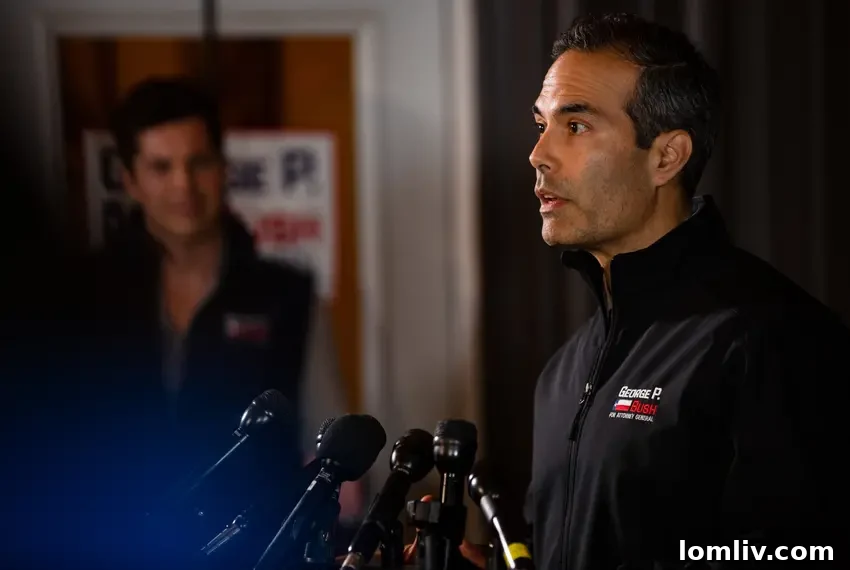
Fast forward to Tuesday, when the 46-year-old scion suffered a crushing loss in his runoff primary against two-term Attorney General Ken Paxton. Paxton, a staunch conservative, was widely considered the most vulnerable Republican incumbent due to a litany of scandals, including a felony indictment and an ongoing FBI investigation into allegations of malfeasance within his office. Yet, despite these significant liabilities, Bush could not prevail, underscoring the deep-seated ideological currents sweeping through the Texas GOP. This defeat will soon conclude Bush’s eight-year tenure as a statewide elected official, during which he served two terms as Texas Land Commissioner. While he remains in office until the end of the year, the political ramifications of his loss are far more substantial, heralding a future where the Bush brand of Republicanism may find itself increasingly marginalized.
The implications of Bush’s loss extend beyond individual political careers. It represents a significant victory for former President Donald Trump, who has long been at odds with the Bush family and whose repeated endorsements of Paxton played a crucial role in the outcome. This event crystallized a shift in Texas Republican politics towards a more populist, confrontational, and hardline conservative stance, moving away from the more traditional, business-friendly conservatism that the Bush family had championed. The defeat of George P. Bush could indeed mark the definitive end of a political dynasty that began when George H.W. Bush first arrived in Odessa in 1948, fundamentally altering the political landscape of Texas for generations to come.
Cal Jillson, a distinguished political scientist at Southern Methodist University, poignantly compared the Bush family name’s current standing to that of the Romanovs in Russia, suggesting, “There’s still somebody out there claiming to be czar but nobody’s listening.” This sentiment captures the stark reality that the very attributes that once made George P. Bush an attractive candidate—his moderate stance, his family legacy, and his bicultural background—have become liabilities in a Republican Party that has lurched aggressively to the hard right. Opposition to both legal and illegal immigration has become a cornerstone of the party’s platform, and the genteel, bipartisan consensus that the Bushes once epitomized has largely been abandoned. Bush’s inability to overcome a scandal-plagued opponent like Paxton illustrates just how profoundly the Texas and American electorates have transformed since his uncle, George W. Bush, was elected Texas governor in 1994 and president in 2000, highlighting a paradigm shift that has reshaped conservative politics across the nation.
Further evidence of this anti-establishment sentiment emerged from an April poll conducted by the Texas Hispanic Policy Foundation, revealing that a striking 40% of Republican primary voters unequivocally stated they would never vote for George P. Bush. A significant two-thirds of these voters attributed their aversion directly to his membership in the Bush family. Jon Taylor, a political scientist at the University of Texas at San Antonio, articulated this sentiment, noting, “Texas politics have shifted so much in the last 20 to 30 years that the family that was Republican royalty have gone from that to basically being vilified for essentially being mainline doctrinaire conservatives.” He underscored the irony that the very family instrumental in building the modern Republican Party of Texas now finds itself at odds with its current direction.
The Illustrious Bush Political History in Texas
The formidable Bush family’s political journey began not in Texas, but over a thousand miles away in Connecticut, with the family patriarch, Prescott Bush. An accomplished investment banker, Prescott Bush served as Connecticut’s U.S. Senator from 1952 to 1963, establishing the family’s foundational commitment to public service and laying the groundwork for future generations.
In 1948, his son, George Herbert Walker Bush, relocated to Odessa, Texas, to venture into the burgeoning oil business. It was here, in a state historically dominated by conservative white Democrats since the Reconstruction era, that George H.W. Bush began to forge inroads within Republican political circles. Despite multiple unsuccessful bids for a U.S. Senate seat, his perseverance paid off when he was elected to the U.S. House of Representatives in 1966. His career then rapidly ascended through various high-profile appointments, including U.S. Ambassador to the United Nations, Chairman of the Republican National Committee, and Director of the Central Intelligence Agency. This rich experience culminated in his election as Ronald Reagan’s Vice President in 1980, part of a landslide victory that unequivocally swept Texas into the Republican column. Indeed, Texas has not supported a Democratic presidential candidate since Jimmy Carter’s victory in 1976.
George H.W. Bush’s two terms as vice president coincided directly with the dramatic ascendance of the GOP in Texas. This era saw the election of Bill Clements in 1978, marking the state’s first Republican governor since the end of Reconstruction. In 1988, George H.W. Bush ascended to the presidency, where his extensive expertise in foreign relations became a defining characteristic of his leadership. He skillfully navigated the complex final years of the Cold War, commanded the nation through the first Persian Gulf War, and spearheaded the negotiations that would ultimately lead to the North American Free Trade Agreement. His vision of America as a global beacon of hope, his call for a “kinder, gentler” nation, and his steadfast distaste for budget deficits represented the culmination of a more consensus-driven political era, one that began to fray in the 1980s and all but vanished by the close of the 1990s. His aspirational view of the country’s role as a force for good was famously encapsulated in his “thousand points of light” metaphor, which encouraged broad civic engagement through community organizations.
However, George H.W. Bush’s presidency faced a critical turning point when he famously reneged on his promise not to raise taxes. This decision contributed significantly to his defeat in the 1992 presidential election by Bill Clinton, marking a temporary pause in the family’s direct hold on the White House.
The Bush dynasty’s mantle was then enthusiastically picked up by his son, George W. Bush, who in 1994, achieved a resounding victory over Democratic incumbent Ann Richards to become Governor of Texas. This election was not merely a personal triumph but a significant turning point for Texas politics, solidifying the state’s shift towards Republican dominance. Four years later, during his successful gubernatorial re-election campaign, Republicans achieved a clean sweep of all major statewide offices, a stronghold they have maintained for the subsequent 24 years. As governor, George W. Bush cultivated a reputation for popularity and effectiveness, focusing on key policy areas such as tax cuts, tort reform, and public education. His ability to work across the aisle with Democrats, combined with his advocacy for “compassionate conservatism,” became the cornerstone of his successful presidential campaigns in 2000 and 2004.
George W. Bush later reflected on his philosophy, stating, “I felt compelled to phrase it this way because people hear ‘conservative’ and they think heartless. And my belief then and now is that the right conservative philosophies are compassionate and help people.” This brand of conservatism emphasized improving education, reducing barriers for businesses, and fostering economic and social success for people of color. He actively courted Latino voters and, as president, appointed Alberto R. Gonzales, a former Texas Supreme Court justice, as the nation’s first (and to date, only) Hispanic Attorney General. The cultural significance of his outreach was underscored when Mexican ranchera legend Vicente Fernandez performed at the 2000 Republican National Convention, where Bush was nominated and his nephew, George P., was prominently featured.
In his 2004 presidential re-election campaign, George W. Bush secured over 40% of the Latino vote, bringing to the White House a strong desire for comprehensive immigration reform. His proposals included the establishment of a guest worker program, which faced opposition from many Democrats, and an eventual path to citizenship, which was met with resistance from numerous Republicans. He often reiterated his belief that “Family values don’t end at the Rio Grande Valley,” emphasizing a compassionate approach to immigration issues.
While these goals were popular during his initial years in office, they were increasingly stymied by a burgeoning anti-immigrant faction within the Republican Party. A bipartisan immigration bill, strongly backed by Bush, was ultimately defeated in the Senate in 2007. A similar legislative effort, supported by then-President Barack Obama, also failed in 2014 at the hands of House Republicans, illustrating the growing ideological chasm within the GOP. The latter years of George W. Bush’s presidency were further complicated by public opposition to the Iraq War, increased government surveillance measures during the War on Terror post-9/11, criticism over his administration’s handling of Hurricane Katrina in 2005, and the onset of the Great Recession.
These mounting dissatisfactions continued to fester within the GOP during Obama’s subsequent eight-year tenure, leading many Republicans to repudiate George W. Bush’s policies. He was blamed for not being more aggressive on socially conservative issues and for presiding over an economic downturn. Taylor, the UT-San Antonio political scientist, observed, “Once Bush is out of office, immediately the Republican party is in a position of the wilderness. The Republican party didn’t know where it was going. They knew where they were going only in opposition to Obama, and that morphed into the Tea Party movement.” This period marked a dramatic ideological realignment, laying the groundwork for the future political challenges faced by the Bush family.
George P. Bush’s Ascent Amidst the Tea Party Wave
George P. Bush’s own political rise coincided with this transformative period, particularly the emergence and powerful impact of the Tea Party movement. In Texas, the Tea Party reshaped the statehouse with unprecedented force in 2010, when Republicans captured an overwhelming 99 seats in the 150-member House, effectively ousting numerous moderate Republicans and Democrats. That same election cycle saw Republicans gain control of the U.S. House of Representatives, signaling a national trend towards a more conservative and activist base.
Two years later, a then-relatively unknown former Texas solicitor general, Ted Cruz, a staunch Tea Party favorite endorsed by George P. Bush himself, successfully unseated Lt. Gov. David Dewhurst, a moderate Republican, in the hotly contested 2012 U.S. Senate race. Dewhurst, a fixture of the GOP establishment, had first been elected statewide as land commissioner in the same year George W. Bush won his second term as governor. This shift in power continued in 2014 when Dewhurst lost his bid for another term as lieutenant governor to Dan Patrick, a conservative state senator who, during his initial years in office, had been a pariah to much of the Republican establishment.
It was in this evolving political climate that George P. Bush, whose middle name honors his family’s patriarch, successfully won election as land commissioner in 2014 with an impressive 61% of the vote. At that time, the younger Bush advocated for a “big tent” version of the Republican Party, actively appealing to disillusioned Democrats and independent voters. He notably expressed support for the Texas Dream Act, a state law that provides in-state tuition for undocumented immigrants who arrived in Texas as children, a position that reflected a more inclusive, compassionate conservatism. At his swearing-in ceremony, then-Texas Supreme Court Justice Don Willett hailed George P. Bush’s election as the dawn of a new era for “one of the most revered families in American history,” setting high expectations for his tenure.
Bush’s approach as land commissioner was often described as wonky and detail-oriented, reminiscent of his grandfather’s methodical style. His focus areas included the state’s complex water rights, pioneering the creation of the first online auction platform for oil leases, and meticulously ensuring that endangered species protection did not unduly impede business interests. In 2016, he publicly stated that his top legislative priority would be the vital protection of Texas’ extensive coastlines, showcasing a pragmatic, policy-driven focus. Yet, he also skillfully incorporated elements of his uncle’s “compassionate conservatism,” a philosophy that posited ample political space for both robust border security measures and empathetic assistance for undocumented immigrants seeking a better life in the country.
As a Latino, George P. Bush consistently worked to court candidates and voters of color for the GOP, a task that occasionally required him to directly denounce members of his own party who made overtly racist comments. For example, in 2019, he publicly condemned a Republican state legislator who suggested his opponents in a highly diverse Fort Bend County state house district were running solely due to their Asian heritage, stating that “my district might need an Asian to win.” George P. Bush also called for the resignation of a GOP county chairwoman who used a racial slur in a text message concerning a Black party organizer, demonstrating his commitment to inclusivity within a party increasingly grappling with its image on racial issues.
Even as the younger Bush embarked on his first term as land commissioner, an intense intra-party ideological war was already raging within the Texas GOP. Despite his personal leanings towards social conservatism, Bush often found himself aligned with the center-right, pro-business faction, which was increasingly at odds with the party’s surging populist and hard-right elements. This internal conflict would ultimately define the trajectory of his political career.
The Trump Effect: A Dynasty Under Siege
The 2016 presidential election became a watershed moment, decisively defining the Republican Party’s dramatic rightward shift and posing an existential challenge to the Bush dynasty. George P. Bush’s father, former Florida Governor Jeb Bush, announced his presidential candidacy in June 2015, entering the race with formidable financial backing from donors and strong endorsements from the party establishment. However, his campaign quickly collided with the unconventional and ultimately victorious candidacy of Donald Trump, who launched his campaign with inflammatory remarks, denigrating Mexican immigrants as “criminals, drug dealers, rapists.”
Initially, George P. Bush, like much of the party establishment at the time, dismissed Trump as a trivial candidate whose comments “have no place in our party.” This stance was particularly poignant given that George P. Bush’s mother is a naturalized U.S. citizen from Mexico, making Trump’s rhetoric a personal affront. Yet, Republican voters across the nation overwhelmingly gravitated towards Trump’s nationalist vision to “Make America Great Again” and his unapologetic penchant for making outlandish, often insulting, comments about women, people of color, and political opponents. Indeed, it was Jeb Bush whom voters rejected early in that primary race, largely influenced by Trump’s persistent and damaging characterization of him as “low energy.”
When Trump secured the party’s nomination, most members of the Bush family conspicuously declined to offer public support. George P. Bush, however, standing as the sole member of the family still holding elected office, became the only one to endorse Trump. He had initially campaigned for his father but ultimately threw his support behind Trump, describing it as a “bitter pill to swallow” for “Team Bush,” but asserting that Republican voters had a duty to prevent Democratic presidential nominee Hillary Clinton from winning. Later, George P. Bush characterized his relationship with Trump as “professional,” even while expressing concern that the Republican Party was perceived as unwelcoming to people of color. Despite these reservations, he maintained his support for Trump’s re-election effort in 2020, demonstrating a clear strategic choice to align with the party’s ascendant force.
When George P. Bush launched his campaign for attorney general in June of the prior year, he vigorously lobbied for Trump’s endorsement, even distributing campaign koozies emblazoned with a cartoon image of Trump and a quote attributed to the former president: “This is the only Bush that likes me. This is the Bush that got it right. I like him.” However, Bush faced a significant challenge: his opponent, Ken Paxton, had cultivated a far closer relationship with the former president. Paxton had notably filed a last-ditch lawsuit in federal court seeking to overturn the results of the 2020 presidential election in four states where Trump had lost. Although the U.S. Supreme Court ultimately dismissed the lawsuit, ruling that Texas lacked standing, the gesture proved sufficient to curry Trump’s favor, leading the former president to endorse Paxton early in the attorney general race.
In a desperate attempt to appeal to the increasingly conservative Republican primary voters, George P. Bush further shifted his political positions to the right. He pledged to vigorously support state efforts to secure the border and complete Trump’s unfinished wall. He also embraced state investigations into families of transgender children and vociferously denounced Democrats as a “woke” mob. Perhaps most notably, he reversed his previous support for the Texas Dream Act, now asserting that he supported the Republican Party of Texas’ platform to repeal the law, a stark departure from his earlier, more inclusive stance. Despite these concerted efforts to align himself with the party’s hard-right trajectory, he was ultimately overwhelmed by its powerful ideological momentum.
Renee Cross, a political scientist at the Hobby School of Public Affairs at the University of Houston, succinctly summarized the situation: “The party shifted, Republican voters shifted and the conservatism that may have been popular during George W. Bush’s tenure as governor just doesn’t fit Texas anymore.” This observation underscores the profound and irreversible changes that have swept through the Texas political landscape, leaving traditional conservatives, including the Bush family, struggling to find their footing.
Controversies and the ‘D Word’: George P. Bush’s Missteps and the Dynasty Question
Beyond the broader ideological shifts, George P. Bush’s tenure as land commissioner was marred by several controversies that ultimately came back to haunt his attorney general campaign. His handling of federal hurricane recovery relief funds became a significant point of contention. His agency’s distribution of funds was criticized for allocating disproportionately more money per person to inland areas compared to coastal regions that had been far more severely impacted by the devastating storms. The U.S. Department of Housing and Urban Development later found that his agency’s distribution of these critical funds discriminated against people of color, a serious indictment that damaged his reputation for fair administration.
Perhaps his most consequential misstep, however, involved his controversial involvement in a proposed redesign of the revered Alamo grounds. This plan controversially considered relocating a cenotaph, a monument dedicated to the revolutionaries who tragically died at the 1836 battle. Bush argued that moving the cenotaph approximately 500 feet to the south, near the historic Menger Hotel, was essential for its preservation. However, fierce opposition quickly mounted from those who vehemently argued that such a relocation would dishonor the profound sacrifice of the revolutionaries. Prominent Republican officials, including Lt. Gov. Dan Patrick, sided with those who insisted the cenotaph remain in its original location. During the attorney general race, Ken Paxton capitalized on this controversy, characterizing Bush as a “liberal” who had backed a “woke plan” to remove historic monuments, further cementing the perception of Bush as out of step with the party’s base.
Rick Range, a vocal member of a group formed specifically to oppose Bush’s Alamo redesign and who ran against him in the 2018 GOP primary for land commissioner, reflected on the incident, stating, “It was pretty much a debacle. His mishandling of the Alamo was what got me in opposition.” This sentiment highlights how local issues, particularly those touching on Texas heritage and conservative values, can become powerful motivators in statewide elections.
As a fourth-generation politician, having grown up attending political conventions and immersed in the world of his elders, George P. Bush has always been acutely aware of the formidable weight carried by his family name and the inherent assumptions that accompany it. In March, as he prepared for his runoff with Paxton, he offered a nuanced perspective: “What a lot of people get wrong about my family is that we covet title and it’s about continuing some sort of tradition, when it’s all about public service.” He elaborated further, adding, “This has never been about titles, let alone the ‘D word’ as we call it in our family,” nodding to the persistent use of the term “dynasty” to describe his influential lineage. “This is about serving,” he asserted, attempting to reframe the family’s political legacy as one rooted in selfless public commitment rather than inherited privilege.
Despite his recent loss, Bush’s past electoral performance offers a complex picture of his political strength. He is currently serving his second term as Texas land commissioner, and while his re-election race in 2018 became tighter due to a strong showing by Democrats, he still emerged as one of the top statewide vote-getters, securing 4.4 million votes. This impressive tally surpassed those received by senatorial candidates Ted Cruz and Beto O’Rourke, and indeed, any other statewide candidate except for Governor Greg Abbott. This past success, argues longtime lobbyist Bill Miller, still “counts for something” despite his more recent defeat.
Miller offered a broader historical perspective on political families, noting, “If you think about the arc of politics, the Kennedys have not always been successful. They’ve won and lost. Political dynasties have ups and downs. There’s unpredictability to it. There’s a season for it. Right now, he’s running against a guy who’s really popular with the Republican primary electorate. It’s not about George P. losing, it’s about Paxton winning.” This analysis suggests that Bush’s defeat may be more a reflection of the current political climate and his opponent’s specific appeal within the Republican base, rather than an absolute rejection of the Bush name itself.
Tuesday’s loss marks the second time in two years that a member of the prominent Bush family has failed to advance beyond the primaries in a Texas election. In 2020, George P. Bush’s cousin, Pierce Bush, finished a distant third in the GOP primary for Congressional District 22, located near their grandfather’s old Houston stomping ground, failing to even secure a spot in a runoff. These two consecutive losses, Taylor suggests, indicate a growing fatigue among voters with political dynasties. “We’ve seen and heard their names so many times, it’s like, ‘Oh gosh, another one?’ There comes a point where the electorate just gets tired of it.” This sentiment reflects a broader trend of anti-establishment feeling that has permeated American politics.
For now, Pierce and George P. Bush represent the last of the family expressing direct interest in electoral politics. Jenna Bush Hager, one of George W. Bush’s twin daughters, has carved out a successful career as a journalist on NBC’s Today Show, while her sister, Barbara Pierce Bush, is the co-founder of a public health nonprofit, demonstrating different avenues of public service outside traditional politics. Miller believes that while the family name is currently navigating a “rough patch” with the electorate, this period is likely temporary. He expresses confidence that George P. Bush possesses sufficient name recognition and political acumen to orchestrate a future comeback.
“Time heals all wounds,” Miller optimistically declared. “The political climates always change and everyone knows that. The political climate is not conducive to him or helpful to him at the moment. That may change or that may not, but [the Bush name] won’t be a negative going forward for much longer.” While acknowledging the recent defeats as a “halt” in the family’s remarkable run of political success, Miller remains unconvinced that this marks a permanent end. “Now is it permanent?” he asked. “I would argue it’s temporary.” The future of the Bush dynasty in Texas politics, while currently uncertain, remains a compelling narrative in the ever-evolving landscape of American conservatism.
“George P. Bush’s defeat could be the end of the line for a four-generation political dynasty” was first published by The Texas Tribune, a nonprofit, nonpartisan media organization that informs Texans — and engages with them — about public policy, politics, government, and statewide issues.