Sabo’s Provocative Sotheby’s Parodies: Satire, Celebrity, and the 2016 Election in Los Angeles
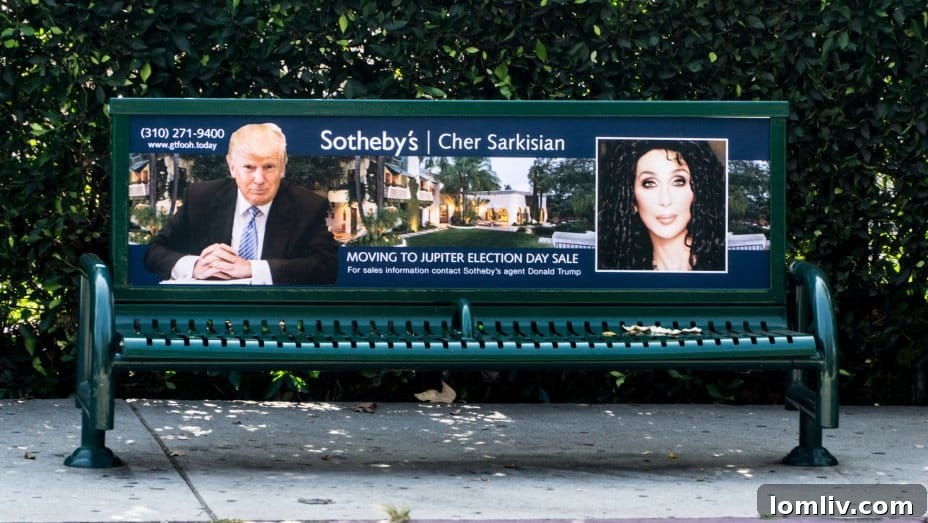
In the vibrant, often surreal landscape of Los Angeles, where celebrity culture intertwines seamlessly with political discourse and artistic expression, one artist carved a unique niche during the contentious 2016 presidential election. This was the moment when the lines between real estate, political campaigning, and satirical street art dramatically blurred. Amidst the city’s iconic palm trees and sprawling mansions, a series of visually striking, mock real estate advertisements began appearing on bus-stop benches, public spaces, and even in the meticulously manicured yards of homes listed for sale in affluent neighborhoods like Pacific Palisades, Brentwood, and Beverly Hills. These weren’t genuine luxury listings, but rather the latest provocative creations from an artist known as Sabo, an ultra-conservative street artist with a knack for stirring debate and lampooning liberal icons.
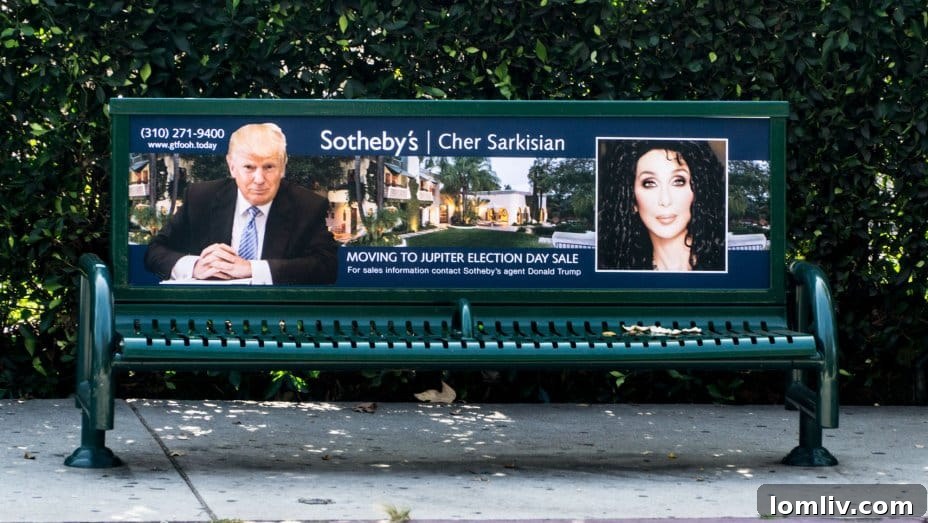
Sabo’s ingenious campaign specifically targeted a roster of Hollywood celebrities who had publicly declared their intention to leave the United States if Donald Trump won the presidency. Far from subtle, these artworks adopted the sophisticated, high-end aesthetic of Sotheby’s International Realty advertisements, lending an unexpected layer of credibility and irony to their politically charged message. Each ad prominently featured a celebrity’s image alongside a fake listing for their supposed property, implying a desperate, last-minute sale before their self-imposed exile. The underlying satirical content was designed to provoke a strong reaction, challenging the often-preached political stances of Tinseltown’s elite.
The Unmistakable Hand of Sabo: A Master of Conservative Satire
Sabo, a figure who deliberately cloaks much of his identity in anonymity, has established himself as a prominent voice in the realm of conservative street art. His works are often characterized by their sharp wit, direct political commentary, and a visually arresting style that mimics mainstream advertising or public service announcements. By co-opting familiar visual language, Sabo effectively delivers his message to a broad audience, forcing engagement with his controversial themes. His art transcends mere graffiti; it is a calculated form of public intervention designed to spark conversation, challenge narratives, and often, to mock what he perceives as hypocrisies within liberal Hollywood and mainstream media.
The choice to focus on celebrity pronouncements regarding emigration was a deliberate and potent one. For many conservatives, these threats symbolized an out-of-touch elite unwilling to accept democratic outcomes, viewing the United States as a place from which they could simply opt out if their preferred candidate didn’t win. Sabo’s art provided a visual, public, and undeniably humorous counter-narrative, turning the celebrities’ statements back on themselves in a highly public and humiliating fashion. It was a potent form of artistic retaliation, transforming political declarations into satirical real estate listings.
GTFOOH.today: The Digital Extension of Street Art
Beyond the physical installations, Sabo’s campaign leveraged digital platforms to amplify its reach and message. Each satirical ad was not just a standalone piece of street art; it was a carefully constructed call to action, driving curious onlookers to a specific website. As The Hollywood Reporter detailed, the advertisements included a phone number and a URL: GTFOOH.today.
There’s also a phone number and a website, GTFOOH.today, which prolific street artist Sabo told The Hollywood Reporter stands for: “Get the f–k out of here today.” (The plan is for satirical content at the website while the phone number is actually to a Beverly Hills art gallery that is temporarily closed).
This digital component was crucial. “GTFOOH.today” — an acronym for “Get The F*** Out Of Here Today” — served as a hub for further satirical content, extending the joke and deepening the commentary. The use of a seemingly legitimate, albeit temporarily closed, Beverly Hills art gallery’s phone number added another layer of mischievous realism to the whole operation. It blurred the lines between genuine artistic endeavor, political activism, and a clever prank, leaving observers questioning the authenticity of what they were seeing and experiencing. This multi-platform approach is characteristic of modern street art, which often extends beyond physical spaces into the digital realm to maximize impact and engagement.
The Art of Imitation: Sotheby’s and the Legal Gray Area
One of the most striking aspects of Sabo’s work was the uncanny resemblance of his ads to legitimate Sotheby’s International Realty branding. The logos, fonts, and overall aesthetic were replicated with such precision that, at first glance, they were indistinguishable from real luxury property advertisements. This meticulous imitation was a double-edged sword: it lent immense credibility and a high-brow veneer to the satirical content, but it also ventured into a precarious legal territory.
The unauthorized use of a renowned brand’s logo and intellectual property, even for satirical purposes, often invites legal scrutiny. Sotheby’s, a global powerhouse in luxury real estate and art auctions, is fiercely protective of its brand identity. One can only wonder how long it truly took for Sotheby’s legal team to become aware of these widespread parodies and contemplate issuing a cease and desist order. The tension between freedom of artistic expression and trademark infringement is a perennial debate, and Sabo’s work squarely positioned itself within this contested space. However, the ephemeral nature of street art often means that such legal actions are difficult to enforce before the art itself has vanished or been removed.
Celebrities in the Crosshairs: A Look at Sabo’s Targets
Sabo meticulously selected his targets, choosing high-profile celebrities who had made widely publicized statements regarding the 2016 election outcomes. These figures were not just famous; they were cultural influencers whose political opinions often garnered significant media attention. By featuring them in his “listings,” Sabo was not only mocking their political stances but also subtly critiquing the perceived elitism and disconnect of Hollywood from the concerns of everyday Americans.
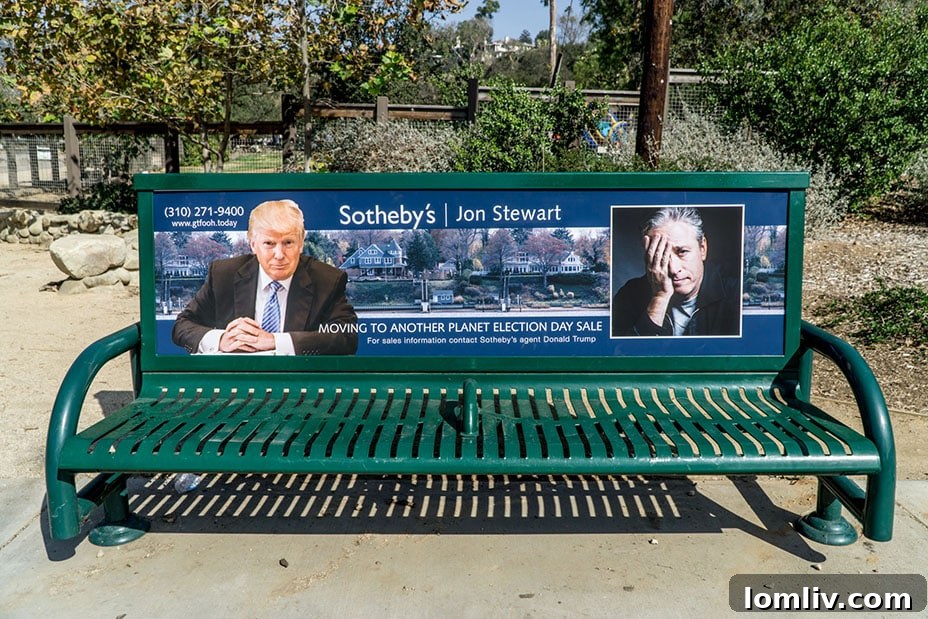
Among those featured were comedians and actors known for their liberal viewpoints. For instance, **Jon Stewart**, a celebrated satirist himself, had been a vocal critic of Trump. Sabo’s ad featuring Stewart served as a direct ironic counterpoint to the comedian’s own brand of political commentary.
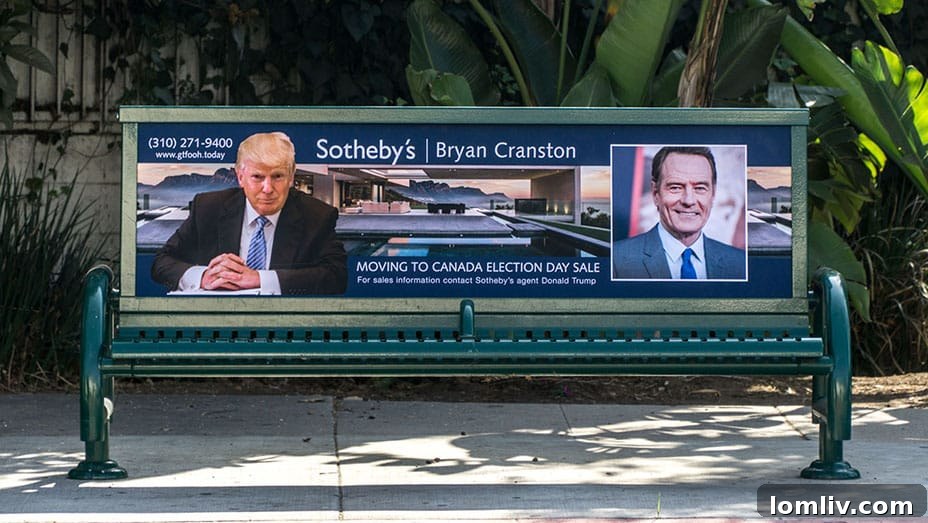
Actor **Bryan Cranston**, known for his roles in “Breaking Bad,” also found himself as a subject. Cranston had publicly stated he would “definitely move” if Trump became president, a sentiment widely reported and ripe for Sabo’s artistic interpretation.
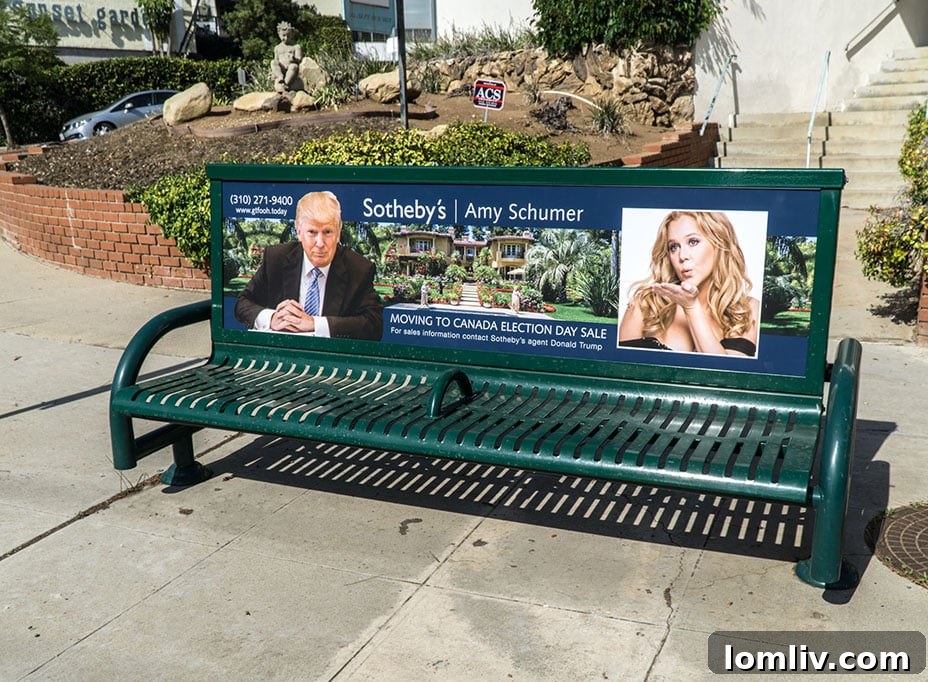
**Amy Schumer**, a comedian and actress renowned for her outspoken feminist and liberal views, was another prominent target. Her declaration that she’d move to Spain if Trump won resonated strongly in the media, making her an ideal candidate for Sabo’s artistic critique of celebrity political posturing.
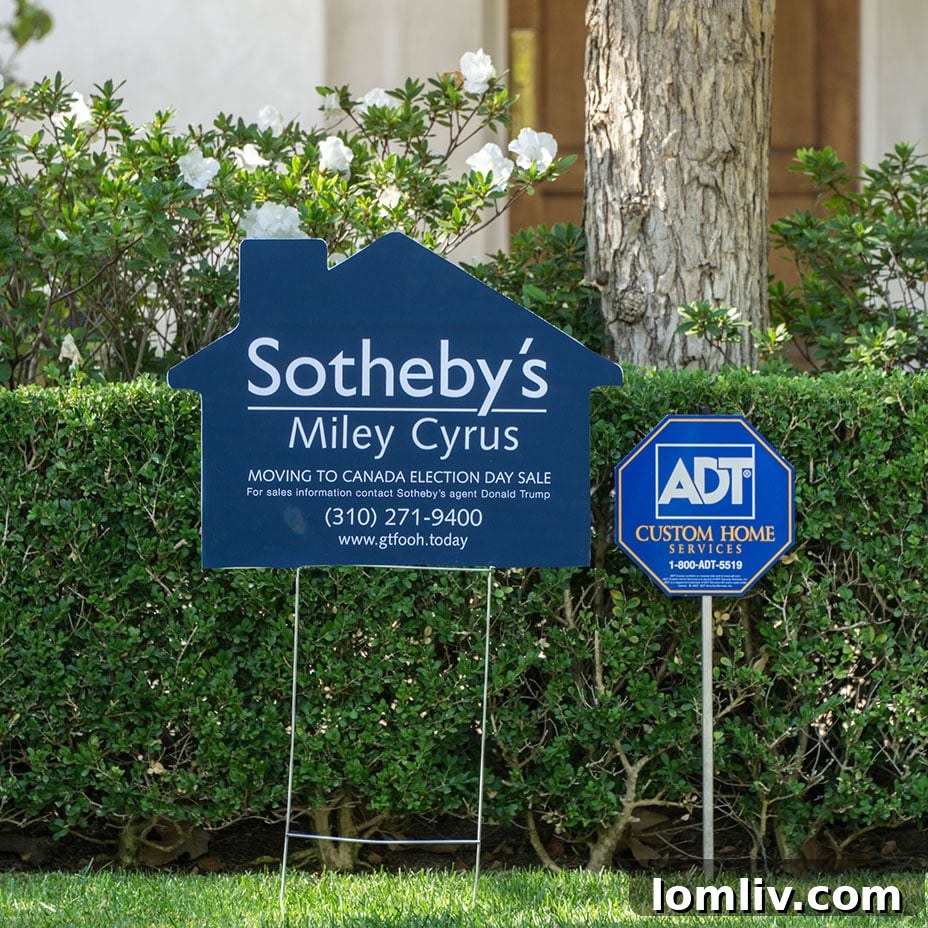
**Miley Cyrus**, the pop superstar, had also been unequivocal in her opposition to Trump, even posting on Instagram about her distress and threatening to leave the country. Sabo’s portrayal of her in a Sotheby’s ad highlighted the sensational nature of such celebrity pronouncements.
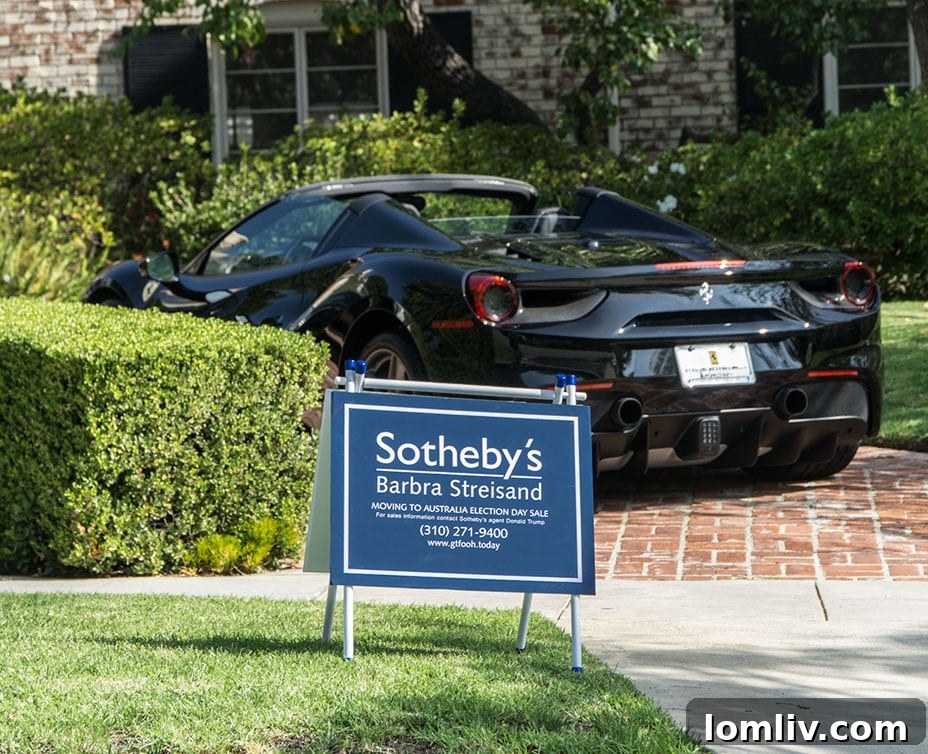
Legendary singer and actress **Barbra Streisand**, a long-time Democratic supporter, had also made public statements about moving to Australia or Canada. Her inclusion underscored the broad spectrum of influential figures Sabo chose to lampoon, ensuring his message reached various demographics.
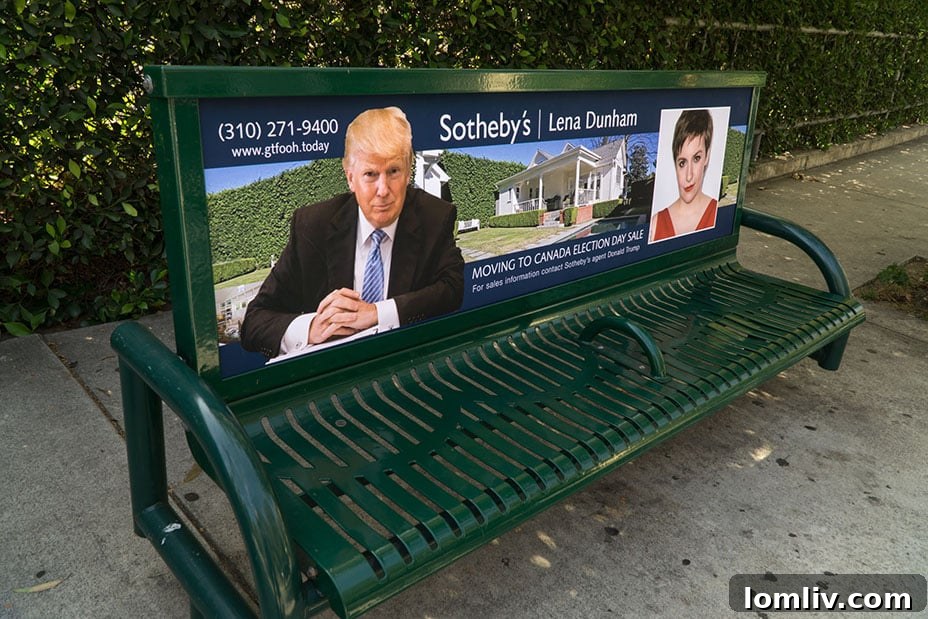
**Lena Dunham**, known for her role in “Girls” and her fervent activism, was another celebrity who publicly declared she would move to Canada if Trump won. Her outspoken nature made her a perfect fit for Sabo’s satirical gaze.
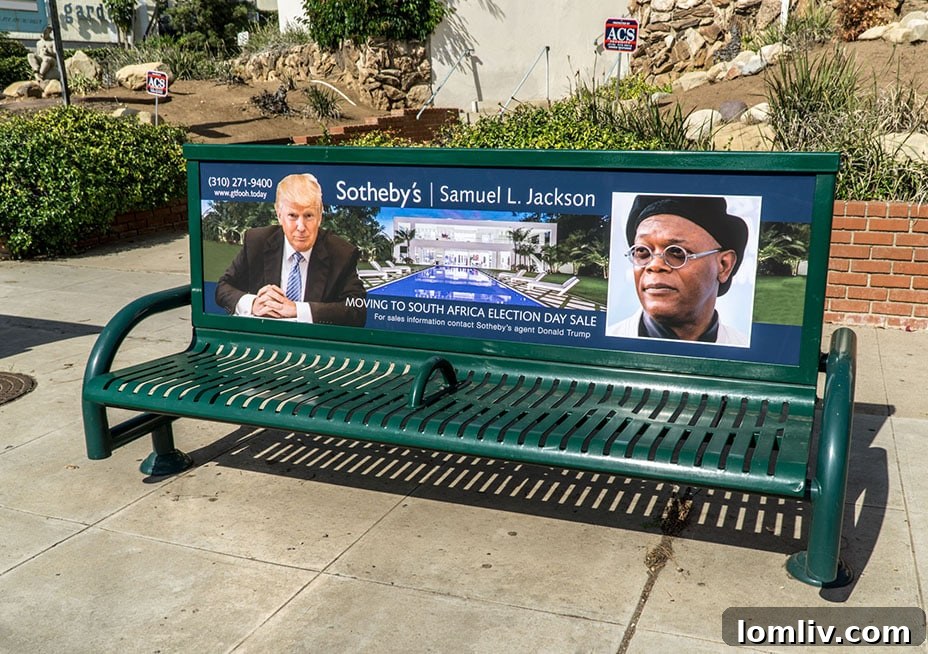
Even the iconic actor **Samuel L. Jackson**, who had joked about moving his “black ass” to South Africa if Trump were elected, was not spared. Sabo’s inclusion of Jackson demonstrated his commitment to portraying a wide array of celebrity figures who had made similar pledges, reinforcing the pervasive nature of this political sentiment among the Hollywood elite.
The Enduring Legacy of Political Art: More Than Just Street Posters
In the aftermath of the 2016 election, Sabo’s Sotheby’s parodies took on a new layer of meaning. What were initially controversial, potentially legally problematic pieces of street art, now held the potential to become valuable historical artifacts. Art, especially political art, often transcends its immediate context to become a commentary on a specific era, capturing the zeitgeist of a moment in time. These works encapsulate the intense political polarization, the role of celebrity influence, and the provocative nature of street art in challenging mainstream narratives.
Sabo’s work is a testament to the power of art as a form of social and political commentary. It highlights how visual culture can be manipulated and recontextualized to convey potent messages, sometimes more effectively than traditional media. His use of sophisticated mimicry, combined with sharp political insight, allowed these pieces to resonate deeply with audiences, eliciting both laughter and outrage, depending on one’s political leanings.
Ultimately, these satirical Sotheby’s ads are more than just clever images; they are a snapshot of a highly charged political moment, offering a unique perspective on the intersection of fame, real estate, and presidential politics in the singular environment of Los Angeles. They serve as a reminder that in a city defined by dreams and facades, art can often be the most honest, albeit provocative, reflection of reality.