Preston Center’s Future: Unpacking Development, Zoning, and the Perennial Parking Debate
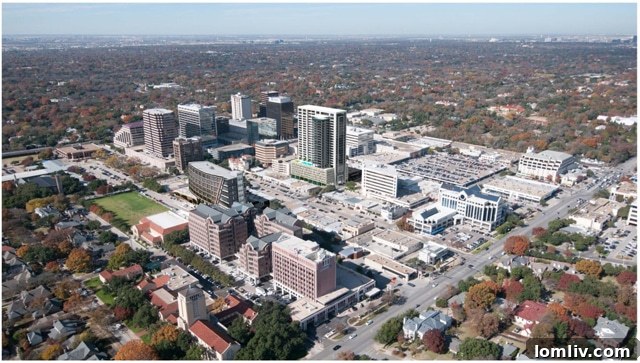
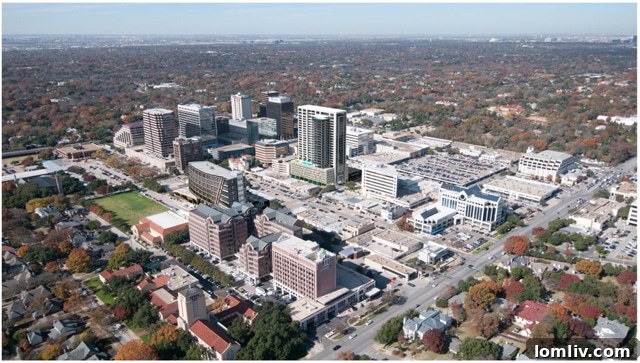
The urban landscape of Dallas is ever-evolving, and few areas encapsulate the complexities of growth, community aspiration, and developer interests quite like Preston Center. This vibrant district, a crucial hub in North Dallas, finds itself at a crossroads, with its future direction being actively shaped – and debated – by a dedicated task force, residents, and various stakeholders. While the discussions can be protracted and, at times, fiercely contentious, understanding the ongoing dialogues is paramount to grasping the vision for Preston Center’s next chapter. This article delves into the recent proceedings of the Preston Center Task Force, shedding light on critical zoning proposals, the persistent parking conundrum, and the broader implications for urban development in one of Dallas’s most sought-after locales.
Community Engagement and the Task Force’s Mandate
The Preston Center Task Force serves as a critical forum for navigating the intricate path of urban revitalization. Formed to address the multifaceted challenges and opportunities within the Preston Center area, the task force is charged with gathering community input, analyzing data, and formulating recommendations for future development. These recommendations often touch upon sensitive issues like zoning changes, density increases, traffic management, and the preservation of neighborhood character. A recent open house, held on November 3rd, offered a glimpse into the ongoing community dialogue, providing area residents with preliminary data and an opportunity to voice their perspectives.
Gauging Public Sentiment: The November 3rd Open House
The open house, designed to foster community engagement, featured “topic stations” equipped with flip-charts and markers, inviting attendees to share their thoughts and feedback. While 66 residents participated, representing a mere 1% of the 6,736 residents within the task force’s designated area, this turnout underscores a common challenge in urban planning: achieving broad and diverse community participation. Critics might suggest that such low engagement often leads to a vocal minority disproportionately influencing outcomes, leaving the broader “silent majority” to react only when decisions are solidified. This dynamic often pits proactive planners against apathetic residents who, as the saying goes, “are the first to complain and the last to volunteer.”
Despite the task force’s expansive mandate covering a significant geographical area, the feedback gathered during these sessions consistently reveals a laser-like focus on a very specific locale: the intersection of Preston Road and Northwest Highway. This intense concentration of interest raises pertinent questions about the true scope of community concern. Is the overwhelming focus on this single intersection a reflection of genuine widespread concern, or does it predominantly represent the self-interest of residents and businesses situated within a few blocks of this pivotal junction? The vast majority of attendees to these crucial meetings indeed reside or operate businesses in the immediate vicinity, suggesting a localized perspective often dominates the broader planning discussions.
Whose Voice Holds Weight? Redefining Stakeholder Engagement
This localized interest inevitably prompts a deeper examination of whose opinions should carry the most weight in urban planning initiatives. Should a resident living on the periphery of the task force area have more sway than a non-resident who navigates Preston Center daily for work or commerce? Considering that a mere 8 percent of survey respondents actually work within Preston Center, it highlights a potential disconnect. Effective urban planning, particularly for a commercial and residential hub like Preston Center, ideally requires input from a diverse array of stakeholders: not just local residents, but also daily commuters, business owners, employees, and even those from adjacent communities like University Park, which forms a significant quarter of the highly scrutinized intersection. A more inclusive approach could yield a more balanced and sustainable vision for the entire district.
Zoning Battles and the “No Cuban” Factor
One of the most charged aspects of urban planning in Preston Center revolves around zoning and its direct impact on development, particularly concerning the holdings of prominent figures. During the “dots” exercise at the open house, where attendees placed colored markers to indicate preferred land uses (residential, office, greenspace, or “other”), a clear pattern emerged: an undeniable focus on specific parcels, particularly those associated with developer Mark Cuban. The concentration of yellow (residential) and green (greenspace) dots strategically placed near Cuban’s holdings along Northwest Highway was widely interpreted as a targeted effort to influence the zoning of his properties, potentially down-zoning them for parkland or residential use, thereby limiting higher-density commercial development.
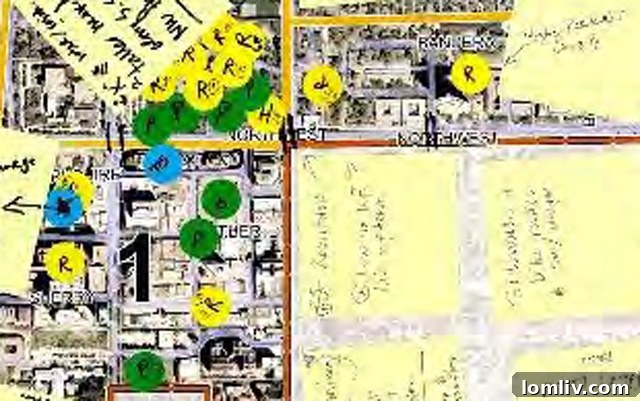
This focused “No Cuban” brigade demonstrated a meticulous approach, even extending to the allocation of a yellow Residential dot for Ebby Halliday’s former home, showcasing a deliberate intent to shape the future land use of key properties. Accompanying these visual cues were written comments on sticky notes, articulating clear preferences: “Do not increase density or increase zoning on north side of Northwest Highway from Preston to Tollway,” countered by a desire for “Taller mixed use along south side of NW Highway.” Further specificity was seen in requests for “Single-family residential on north side of NW Highway west of Preston and Low rise multi-family on north side of NW Highway east of Preston.” These directives collectively paint a picture of residents actively seeking to maintain or even reduce density in certain areas while potentially accepting it in others, reflecting complex, and often conflicting, visions for the district.
The “Millionaires’ Charity Appeal” and Transparency Concerns
Another compelling piece of feedback underscored the prevailing sentiment: a request for a “Sound barrier wall along NW Highway on north side between Preston and Douglas.” This appeal, often dubbed a “millionaires’ charity appeal,” highlights a common tension in urban development where the desire for quiet residential enclaves clashes with the realities of growing commercial activity and infrastructure needs. While ostensibly about noise mitigation, it also subtly points to a desire for the city (or other entities) to bear the cost of mitigating the perceived negative impacts of nearby development, rather than the residents themselves. This sentiment echoes a broader pattern where perceived loss of amenity due to development is expected to be offset by public funds or developer concessions.
Further fueling the debate over transparency and conflicting interests was the revelation concerning St. Michael’s high-rise ambitions. The knowledge that a task force member, Jay Grogan, who also served on St. Michael’s planning committee, allegedly withheld information about the church’s desire for a 250,000-square-foot office tower from the wider community until after the task force deliberations, ignited significant controversy. This incident underscores the delicate balance required in task force participation, where individual affiliations and institutional interests can potentially diverge from the broader community’s expectations for open dialogue and full disclosure. Such perceived lack of transparency can erode public trust and complicate the already challenging process of reaching consensus on critical urban development issues.
Preston Center West Parking: Perception vs. Reality
Among the most persistent and emotionally charged debates surrounding Preston Center is the perceived “parking problem.” An online survey, which garnered a comparatively robust 10 percent resident participation, indicated that 80 percent of respondents either “agreed” or “strongly agreed” that additional parking was needed. Interestingly, the only other question that achieved similar support was the desire for more outdoor dining, reinforcing the notion that residents frequently prioritize convenience and amenity. Retail changes, by contrast, elicited an overwhelmingly “neutral” response, suggesting that while the look and feel of the center matter, access remains a primary concern.
However, what do the measured facts reveal about parking availability at Preston Center West, contrasting sharply with popular perception?
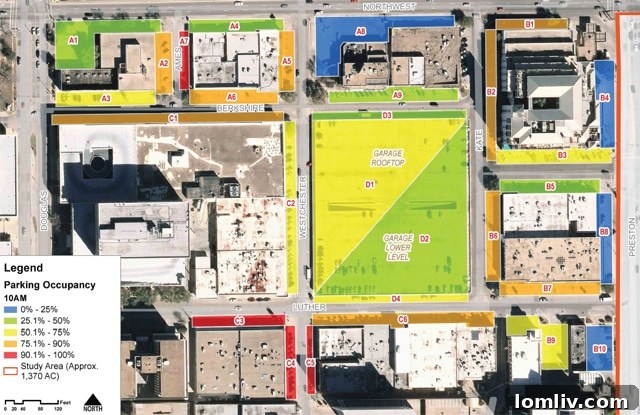
As demonstrated by photographic evidence, a typical Thursday at 10:00 AM shows that the only significant parking challenges are confined to a few surface spaces directly in front of popular restaurants with limited dedicated spots. The central parking garage, the area’s primary parking infrastructure, is typically just over half full on its upper level, predominantly occupied by area workers, and less than half full on the lower level, which serves customers. This data unequivocally indicates that for visitors and employees willing to utilize the central garage, there is a significant surplus of available parking space.
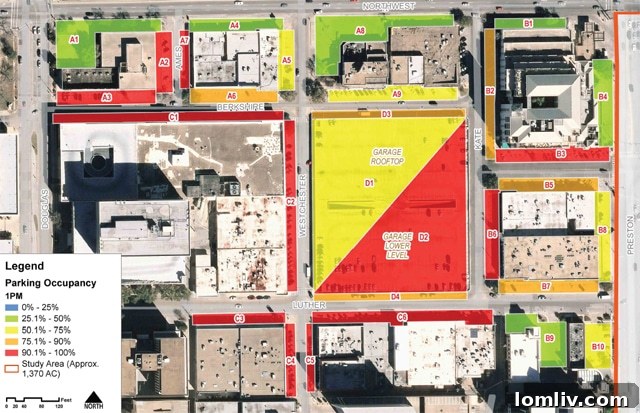
Even at 1:00 PM, during peak lunch hours on that same Thursday, while parking certainly becomes scarcer, the central parking garage remains far from full. This observation directly challenges the widely propagated notion that parking is impossible to find during midday. While the lower level might present more of a challenge due to higher demand from customers seeking closer proximity, the upper level consistently registers below 75 percent occupancy. The persistent issue, it seems, is not a lack of spaces, but rather a reluctance to navigate the upper levels and, crucially, the flight of stairs, particularly given the ongoing delays in implementing a skybridge and its associated elevators and accessibility improvements. This highlights a common urban dilemma: the desire for convenience often outweighs the willingness to walk short distances, even in areas aspiring to be more walkable.
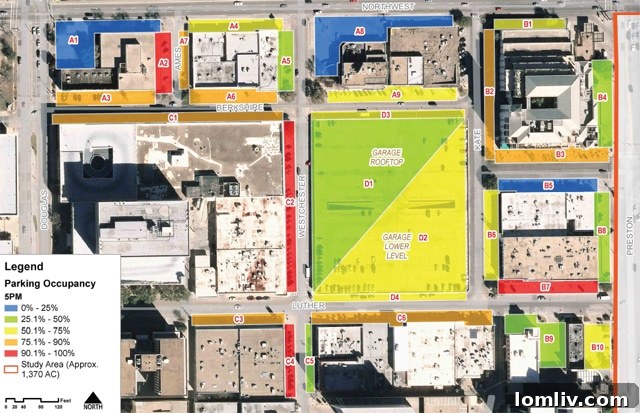
By 5:00 PM, as the workday concludes, the parking situation largely reverts to the vacancy rates observed at 10:00 AM, with the central garage once again offering an abundance of space. The busy spots, often marked by red lines in parking analysis, are typically concentrated around popular take-away restaurants, as commuters make quick stops for dinner on their way home. This pattern strongly suggests that the perceived parking “problem” at Preston Center is often a matter of convenience and preference rather than an actual deficit of spaces. The comments received, such as “Force valet to use more distant parking spots in Preston Center,” further underscore this point, implying that the issue isn’t availability, but rather the desire for the most immediate and effortless parking options. Recognizing this dynamic, the task force has commendably requested consultants to conduct a full week of parking lot monitoring in January, hoping to provide definitive data to inform future strategies and perhaps challenge entrenched perceptions.
A Vision for Preston Center West: Beyond the Current Challenges
While the debates over zoning and parking consume much of the task force’s energy, it’s crucial to acknowledge the overarching need for a transformative vision for Preston Center West. Currently, the area presents as a somewhat disjointed, aesthetically uninspiring district—a “hodge-podge of individual landowners” that lacks cohesive appeal and a unified sense of place. Its aging infrastructure and complex one-way street system contribute to a logistical nightmare that hinders both pedestrian flow and vehicular efficiency. For Preston Center to truly prosper and serve its affluent surrounding neighborhoods in the best possible way, these foundational issues must be addressed proactively and holistically.
The city’s direct control over the appearance of privately owned properties is limited, but it does possess significant influence over public infrastructure, including the central parking structure and the arterial roadways. This presents a unique opportunity for strategic intervention. As many urban planners and community members have advocated, a bold and visionary proposal involves demolishing the existing central parking structure—a facility that some argue is nearing the end of its functional life—and reimagining the space entirely. The suggestion is to submerge parking underground, creating a modern, efficient, and aesthetically integrated solution, while transforming the ground level into a vibrant greenspace. This new public parkland could be designed to host a variety of community events, from farmers’ markets to outdoor concerts, becoming a true focal point and gathering place for the district.
Such a transformative project would not only address the parking “problem” by modernizing and optimizing its functionality but also fundamentally alter the character of Preston Center West. The creation of a central greenspace would enhance walkability, improve air quality, and provide much-needed public amenity, elevating the district’s overall appeal and liveability. Moreover, the success of such a high-impact public improvement project could serve as a powerful catalyst, subtly nudging surrounding property owners to invest in rebuilding and renovating their aging properties, thereby triggering a wave of private sector revitalization. This synergistic approach, where public investment inspires private redevelopment, is a proven model for urban renewal, offering a promising pathway for Preston Center to shed its dilapidated image and emerge as a truly modern, integrated, and desirable urban destination.
The Road Ahead: Traffic and Beyond
As the Preston Center Task Force continues its vital work, the discussions around traffic management and infrastructure improvements promise to be equally, if not more, complex than the parking debate. The interwoven challenges of zoning, development, community engagement, and logistical improvements underscore the monumental task at hand. The future of Preston Center hinges on a balanced approach that respects historical character while embracing forward-thinking urban planning principles. Achieving this balance requires not just data analysis and expert consultation, but also a genuine commitment to transparent dialogue and a collective vision that prioritizes the long-term prosperity and liveability of this iconic Dallas district. The next installment will delve into the intricacies of traffic solutions, a topic that, by all accounts, promises to be a “lulu” in itself.
Engage With Us: Share Your Preston Center Story!
Do you have a unique perspective on Preston Center’s development, an HOA story, or insights into its rich history? Realtors, perhaps you have a listing in the area that perfectly encapsulates the blend of challenge and opportunity—whether it’s ripe for renovation or shines as a completed success story? We’re always eager to feature community voices and real estate insights. Feel free to reach out with your thoughts, stories, or even if you just want to pitch an idea. Marriage proposals are also accepted (they’re legal)! Connect with us: