In the vibrant and ever-evolving real estate landscape of North Texas, a peculiar and rather disheartening paradox is unfolding. Just as property listings begin to feature encouraging “price improvements” and the time homes spend on the market slowly extends, a formidable force is simultaneously at play, significantly eroding potential homebuyers’ purchasing power: soaring interest rates. What might have once been sufficient capital to secure a desirable $400,000 home is now barely enough to consider options in the $300,000 range, painting a stark picture for many aspiring homeowners. This challenging scenario is further illuminated by the latest housing affordability report from the esteemed Texas Real Estate Research Center, which unequivocally states that regional home prices continue their upward trajectory at a pace that significantly outstrips income growth. Consequently, elevated interest rates are dramatically constraining the potential for home purchasing, making the dream of homeownership increasingly elusive for a broad segment of the population.
The economic forces at play are complex, but their impact on the everyday consumer is acutely felt. The hopeful signs of price adjustments are often overshadowed by the increased cost of borrowing, which translates directly into higher monthly mortgage payments. This effectively cancels out any benefit derived from slightly lower home prices, trapping many potential buyers in a cycle of diminishing affordability. For North Texans navigating this tricky market, understanding the interplay between listing prices, interest rates, and personal income is crucial in charting a realistic path toward securing a home.
Decoding the Income Gap and Its Impact on Housing Affordability
A comprehensive analysis provided by the Texas Real Estate Research Center’s report, which specifically encompasses the expansive Dallas-Fort Worth-Arlington Metropolitan Statistical Area (MSA), paints a clear and concerning picture of the widening chasm between housing costs and earnings. The data reveals that the median home price within this bustling region has surged by an alarming 13.3 percent year-over-year. In stark contrast, the median family income has only managed a modest increase of 9.4 percent over the same period. This significant disparity highlights a fundamental imbalance that is placing immense pressure on the housing market and prospective buyers.
Dr. Clare Losey, an assistant research economist at the Texas Real Estate Research Center, meticulously explains the underlying causes of this growing gap. According to Dr. Losey, “The growth in the gap between median home price and family income has been fueled by significant home price appreciation (particularly during the initial stages of the COVID-19 pandemic) and relatively sluggish growth in incomes.” This insight points to a combination of factors: an unprecedented surge in demand and limited supply during the pandemic era drove home values sky-high, while wage growth, though positive, simply could not keep pace with this rapid acceleration. The long-term implications of such a sustained imbalance are profound, contributing to increased wealth disparity and limiting opportunities for many to build equity through homeownership. To effectively bridge this divide and restore a healthier market equilibrium, Dr. Losey suggests that “either home prices must decrease, or family income must increase (or both).” While these solutions appear straightforward, achieving either outcome on a large scale presents considerable economic and policy challenges, indicating a potentially protracted period of affordability struggles for North Texas residents.
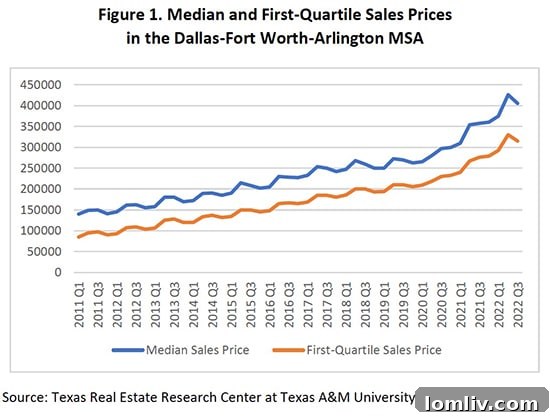
However, as Dr. Losey astutely points out, the widening gap between home prices and family incomes represents only one critical facet of the complex affordability narrative. The meteoric rise in mortgage rates stands as an equally significant, if not more immediate, impediment to homeownership. For context, the average mortgage rate in the third quarter of 2022 climbed to 5.62 percent. This represents a substantial increase not only from the first quarter’s average of 3.82 percent but also a noticeable jump from the second quarter’s 5.27 percent. Such rapid and significant increases in interest rates have a profound impact on affordability, directly translating into higher monthly payments for the same loan amount and effectively shrinking the pool of eligible buyers. Even though the year-over-year median home price growth moderated somewhat to 13.3 percent compared to the more staggering 20.4 percent seen in 2021, the pervasive presence of inflation means that the ultimate measure of housing affordability will increasingly hinge on a potential buyer’s capacity to consistently meet their monthly mortgage obligations. Inflation erodes the purchasing power of money, meaning that even if the housing market cools slightly, other essential costs are rising, creating a challenging financial environment for households.
Dr. Losey further elaborates on this point, explaining the insidious nature of inflation in the context of housing. “We’re already starting to see a moderation in home price appreciation. With inflation, households’ purchasing power diminishes — in other words, households spend a higher proportion of their income on basic goods and services.” This phenomenon creates a challenging duality for prospective homeowners. While inflation might not directly impede a household’s ability to technically qualify for a mortgage loan—as qualification is primarily assessed based on an applicant’s income, wealth, and creditworthiness—its indirect effects are substantial. If inflation significantly depletes the funds allocated for crucial necessities such as groceries, transportation, and medical care, a buyer could find it increasingly difficult to consistently make timely monthly mortgage payments. This puts a severe strain on household budgets, making the commitment to a significant long-term debt like a mortgage a much riskier proposition, even for those who initially meet the qualification criteria. The broader economic environment thus plays a critical role in defining true housing affordability, extending beyond just the sticker price of a home or the prevailing interest rate.
First-Time Buyers: An Evolving Demographic Facing Unprecedented Hurdles
Compounding the challenges of affordability and income disparity, a significant shift is underway within the demographic of first-time homebuyers, as highlighted by two crucial reports released concurrently. The insights from the Texas Real Estate Research Center are echoed and expanded upon by the National Association of Realtors (NAR) in its influential 2022 Profile of Buyers and Sellers. This comprehensive report reveals a troubling trend: first-time buyers are not only fewer in number but are also significantly older than ever before, signaling a fundamental change in the entry point to homeownership.
NAR’s meticulously compiled data illustrates this stark reality. First-time buyers now constitute a mere 26 percent of the entire housing market. This represents a notable decline from the 34 percent recorded just last year and a dramatic fall from the peak of 50 percent observed in 2010, a period bolstered by the First-Time Home Buyer Tax Credit. Furthermore, the average age of a first-time buyer has climbed to 36 years, a three-year increase from 33 in 2021. This demographic shift underscores the increasing difficulty younger individuals face in entering the housing market, a challenge exacerbated by a confluence of economic pressures.
Jessica Lautz, NAR Vice President of Demographics and Behavioral Insights, articulates the underlying reasons for these trends with clarity. “It’s not surprising that the share of first-time buyers shrank to the lowest level ever recorded given the housing market’s combination of historically low inventory, persistently high home prices, and rapidly escalating interest rates.” Lautz’s statement underscores the ‘perfect storm’ confronting new entrants. She further emphasizes that “those who have housing equity hold the cards and they’ve fared very well in the current real estate market.” This highlights the significant advantage possessed by existing homeowners, who have benefited from years of appreciating property values. For first-time buyers, the pathway to homeownership has become increasingly arduous, often necessitating prolonged periods of saving for a substantial down payment or, increasingly, relying on a “generational transfer of wealth” – a crucial financial boost from family – to overcome the formidable financial barriers.
The implications of this shift extend beyond just the entry into homeownership. According to the NAR report, these older and rarer first-time buyers are also anticipating a much longer tenure in their newly acquired homes. Their expected stay has stretched to an average of 18 years, a substantial increase from just a decade a year prior. This prolonged residency has significant ramifications for market fluidity and future inventory levels, potentially further tightening an already constrained supply of starter homes.
Dr. Clare Losey offers further insights into this phenomenon, aligning with the NAR’s findings. “Given the significant headwinds facing potential buyers — still-elevated home prices, higher mortgage rates, and still-constrained supply (i.e., inventory for sale), it’s of no surprise that 1) first-time buyers comprise a smaller proportion of buyers overall and 2) the average age of buyers is trending older.” Dr. Losey elaborates on the first point by noting that “first-time buyers tend to be younger and of lower income. In other words, these buyers have not matriculated through the labor force and therefore achieved peak earnings.” This suggests that younger buyers are typically still in the earlier stages of their careers, with less accumulated savings and lower incomes compared to older, more established buyers. “Income, wealth, and credit all tend to pose a constraint for first-time buyers, and with still-elevated home prices, first-time buyers are going to particularly struggle in overcoming the wealth barrier (i.e., making the down payment).” The sheer capital required for a down payment, coupled with closing costs, presents an insurmountable hurdle for many without substantial external assistance. Furthermore, “still-elevated home prices and higher rates raise the income required to qualify for a mortgage loan,” meaning that even if a buyer manages a down payment, their monthly income might not meet strict debt-to-income ratios imposed by lenders.
Regarding the second point, Dr. Losey succinctly explains, “‘Older’ buyers tend to have higher savings and to be of higher income. This simply makes qualifying for a mortgage loan much easier, and therefore homeownership is more accessible to them.” This highlights a growing divergence in the housing market: those with established careers, accumulated wealth, and greater financial stability are better positioned to navigate the current challenging conditions, while younger and less financially established individuals face an increasingly uphill battle. The collective impact of these trends points to a North Texas housing market that is not only expensive but also increasingly stratified, where the opportunity for homeownership is becoming concentrated among a more affluent and older demographic. Addressing these multifaceted challenges will require a concerted effort from policymakers, industry stakeholders, and communities to foster a more equitable and accessible housing market for all.