Every proposal for a zoning change initiates a vital civic process: the dispatch of official ballots to all property owners situated within 500 feet of the proposed development site. This mailing list, meticulously compiled and supplied by the city’s planning department, serves as the cornerstone for gathering crucial public feedback. Given that all documentation related to zoning cases is a matter of public record, developers and their representatives frequently acquire this list. Their purpose is multi-faceted: to inform neighbors about the project, address potential concerns, influence opinions, and ultimately secure valuable feedback that can shape their plans and gain community support.
Navigating the intricacies of public sentiment in zoning cases is a delicate and often complex endeavor. What begins as initial opposition can, through thoughtful engagement and compromise, sometimes transform into enthusiastic support for a project. As previously highlighted in my earlier writings, response rates for these official zoning ballots are notoriously low. In instances where a zoning request is minor and its impact primarily confined to administrative city operations, the return rate can be almost negligible. Conversely, for more controversial projects, especially those stirring significant community opposition and benefiting from well-organized advocacy groups, the ballot return rates tend to be substantially higher, signaling active resident engagement.
The Critical Role of Zoning Ballots in Community Development
The balloting process carries significant weight for several compelling reasons, impacting the future landscape of urban planning and neighborhood dynamics. First and foremost, both the City Plan Commission and the City Council rely heavily on these ballots to gauge the sentiment of immediate neighbors. These are the residents who stand to be most directly affected by any proposed zoning change, making their perspectives invaluable. Beyond mere numerical opposition or support, city officials strive to understand the underlying rationale behind residents’ views, identifying common and valid themes. If a vast majority of respondents express strong disapproval for a particular aspect of a development – especially if it’s a changeable element – the city is empowered to leverage its authority to mandate revisions, ensuring the project aligns better with community expectations and public good.
Moreover, the balloting mechanism significantly elevates the burden on a proposed case to secure approval. Regardless of the absolute percentage of ballots returned, a specific threshold of opposition can trigger a higher legislative hurdle. Should more than 20 percent of the landmass within a 200-foot radius of the proposed development formally oppose a zoning change, it then necessitates a supermajority vote within the city council—typically three-quarters of the members—to pass. While not an insurmountable obstacle, clearing this heightened bar is considerably more challenging than achieving a simple majority, underscoring the power of organized community input.
Developer Engagement and the 20 Percent Rule
The potential for exceeding this 20 percent opposition threshold is precisely why developers invest heavily in extensive community outreach initiatives. The larger and more impactful a proposed project, the greater the likelihood of encountering significant resident opposition. Consequently, the intensity and scope of community engagement efforts escalate proportionally. These outreach programs often involve public meetings, informal discussions, and direct communication, all aimed at preempting widespread opposition and fostering dialogue. The goal is to identify and address concerns early, integrate community feedback into project designs, and ultimately build a consensus that can pave the way for successful project approval.
As previously reported last week, the city diligently posts ballot tallies for active zoning cases, providing a transparent look into public sentiment. A pertinent example involves the proposed development on the former Mi Escuelita Preschool site on Webb Chapel, just north of Walnut Hill. Developers David Gleeson and David Weekley Homes are seeking to construct 35 homes on a 4.4-acre parcel, a notable increase from the 19 homes currently permitted under existing zoning. While online access to individual returned ballots and their associated comments is not yet available, a visit to City Hall grants public access to these detailed records. Let’s delve into the initial insights gleaned from the feedback received thus far.
The Gated Community Dilemma: A Neighborhood Divide
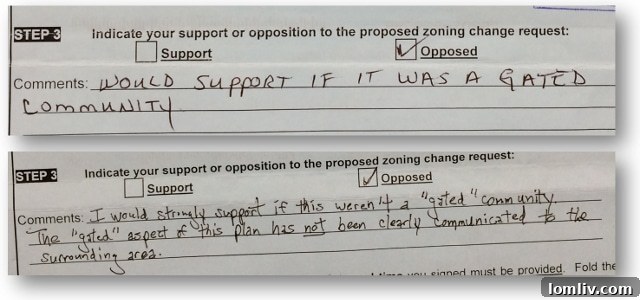
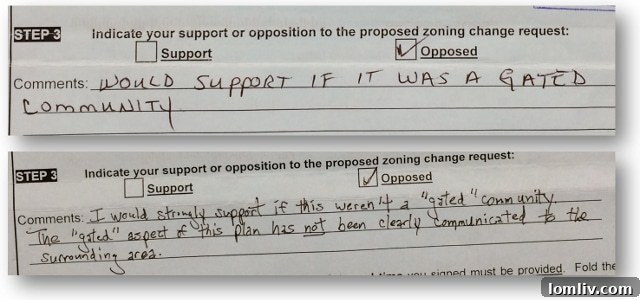
The lead image in this article perfectly encapsulates a key point of contention reflected in the early ballot returns: the issue of a gated community. Comments from two distinct ballots highlight this stark divergence. One resident expressed support for the development only “if” it were to be gated, signaling a desire for enhanced security or exclusivity. Conversely, another resident explicitly opposed the project precisely “because” it was gated, suggesting a preference for open, integrated neighborhoods. It’s worth noting that the project’s initial iteration indeed featured a gated design, whereas the most recent plans have shifted to an un-gated approach. This disparity in ballot feedback likely reflects the timing of their submission relative to the evolving project plans, rather than a change in core sentiment. Fundamentally, this reveals a classic tension within urban planning: one faction advocates for integrating new neighbors into the broader community fabric, while another prefers a degree of separation and controlled access.
Density: Confronting Urban Evolution
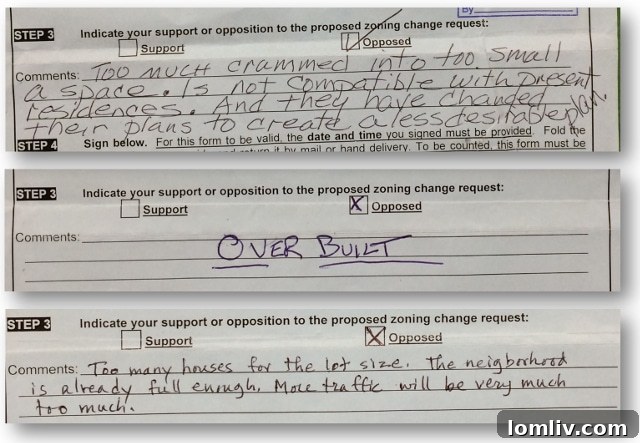
It is almost an unwritten rule that any zoning request aimed at increasing residential density will inevitably encounter opposition. This resistance often stems from ingrained perceptions about neighborhood character, infrastructure capacity, and quality of life. For context, it’s instructive to look at innovative urban planning strategies elsewhere. In January 2019, Minneapolis made headlines by effectively abolishing single-family zoning across the city, permitting up to three residential units on any lot. This bold move was driven by a clear policy objective: to proactively address the pressing need for diverse and affordable housing options before the city becomes ensnared in the spiraling housing costs prevalent in many coastal cities, where affordability is a distant memory and new construction caters almost exclusively to the luxury market. Dallas, and other growing metropolitan areas, would do well to carefully consider the implications and potential benefits of such forward-thinking urban policies.
In the specific case under discussion, the proposal involves adding 16 homes, bringing the total to 35 on a 4.4-acre parcel. Frankly, it is challenging to envision the argument against this level of density gaining significant traction or credibility. A total of 35 homes on 4.4 acres can hardly be classified as “overbuilt” by any objective measure, unless viewed through the narrow lens of a “Not In My Backyard” (NIMBY) mindset. Modern urban planning increasingly recognizes that moderate increases in density are essential for sustainable growth, offering a wider range of housing choices and supporting local businesses without significant strain on infrastructure.
Undoubtedly, these new homes will feature smaller lot sizes compared to their 50- to 60-year-old neighbors. However, it’s important to remember that the original homes, in their time, likely occupied lots considerably smaller than those of the preceding generation, assuming the land wasn’t previously open pasture. This is the natural progression of urban development. As cities mature and populations expand, urban areas inevitably become denser. Embracing 35 homes on this particular lot should be seen as a long-term benefit, a strategic investment in the city’s future. Proactive development now can prevent the cycle of increasingly higher density in future redevelopment projects within 10 or 20 years, effectively “stopping that clock” and allowing for more controlled growth.
Traffic: Unraveling the Perceived Problem
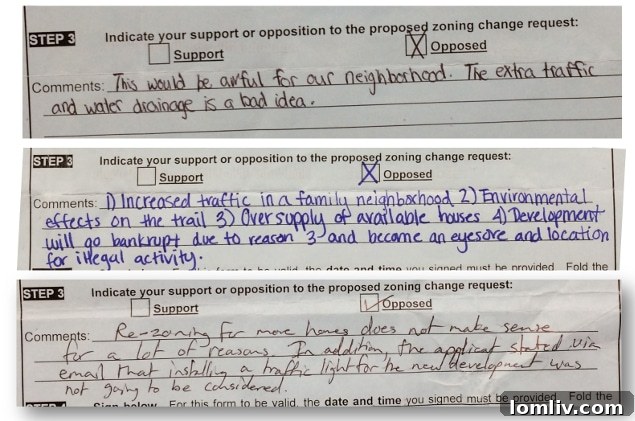
Among the concerns voiced by residents, traffic invariably stands out as the most prolific. There’s often a deeply ingrained, almost unrealistic apprehension about how new developments will exacerbate local traffic congestion. Let’s ground this concern in reality with empirical data. According to TXDoT measurements from 2014, the daily traffic volume on Webb Chapel, specifically between Royal Lane and Merrill Road (a few blocks north of the proposed development), was substantial. There were 8,547 vehicles traveling northbound from Merrill Road each day and 8,948 vehicles heading southbound towards Merrill (and eventually Walnut Hill Lane). This equates to an impressive total of 17,495 cars traversing this particular stretch of Webb Chapel Road daily.
Now, let’s quantify the potential impact of the proposed development. If the site were developed for the as-zoned 19 homes, assuming two cars per household and two round trips per car per day, this would generate an additional 76 round trips, or 152 individual journeys, daily. Adding this to the existing 17,495 cars represents an increase of approximately 0.87 percent—less than one percent—even at the highest end of estimation. The additional 16 homes proposed in the new plan would contribute another 64 round trips, or 128 one-way journeys, to Webb Chapel. This equates to roughly three-quarters of one percent more traffic. When combined, the total 35 homes would increase traffic on Webb Chapel by a maximum of 1.6 percent. Again, this is an estimation at the absolute high-end of potential impact.
What does this translation mean for the average commuter or resident? Simply put, no one will ever notice this marginal increase in traffic. The practical implication is that the city’s planning and traffic departments will not consider this minimal change a deciding factor in their approval process. Their assessments are based on significant, measurable impacts, and a 1.6 percent increase falls well within the normal fluctuations of urban traffic patterns, hardly constituting a legitimate basis for opposing the project.
Property Values and Resulting Taxes: Understanding the Economic Impact
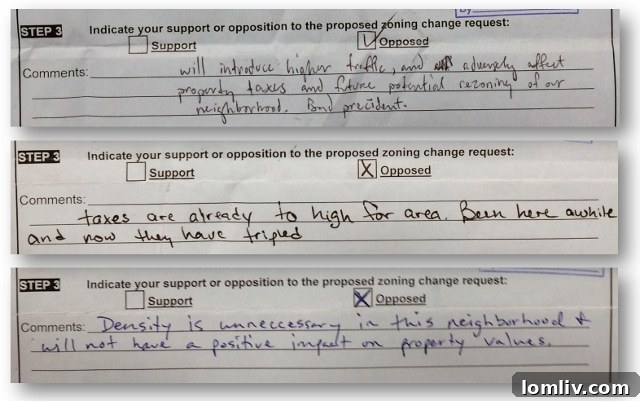
The discussion surrounding new development often ignites fervent debate regarding its potential impact on existing property values and, consequently, property taxes. Some respondents to the ballots express concern that a new project will accelerate their tax burden, adding to the already significant increases many homeowners have experienced. Conversely, another contingent believes that the proposed development will actually diminish the value of the surrounding neighborhood, fearing a reduction in their largest asset.
Speaking from personal experience—as someone whose assessed property value doubled within six years—it is critical to understand a fundamental principle of urban governance: cities cannot, and should not, base development decisions solely on their immediate impact on surrounding property values. If this were the primary guiding principle, urban growth would stagnate entirely, leading to systemic deterioration rather than progress. New development, particularly well-planned infill development, typically correlates with an increase in property values across a neighborhood, benefiting existing homeowners in the long run. It injects new capital, stimulates local economies, and can even spur improvements in public services due to an expanded tax base. While tax assessments are a complex topic often influenced by market dynamics beyond new construction, the broader economic health and vitality fostered by responsible development are overwhelmingly positive for property owners.
Architectural Harmony and Neighborhood Integration
Thus far, I may have appeared to be a “party pooper” regarding several resident concerns, largely because I find many of them to be rooted in unrealistic expectations or lacking a factual basis. However, there are two distinct areas where resident feedback holds significant potential for constructive engagement and positive outcomes.
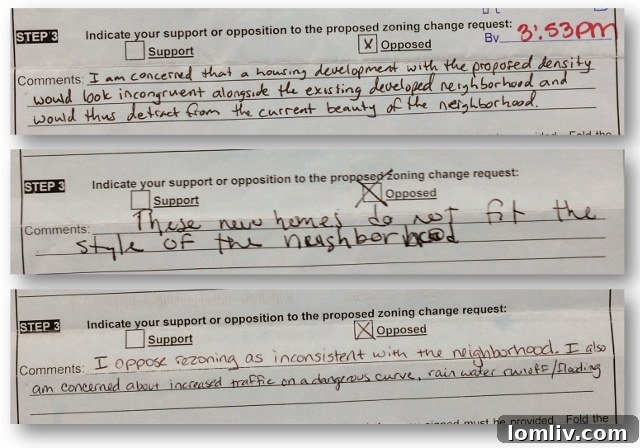
A recurring theme in several ballots was the concern that the proposed development might appear “out of place” when juxtaposed with the existing surrounding neighborhood. This apprehension is entirely understandable and, frankly, unsurprising. A span of half a century often separates the architectural styles and market trends that influence current development from those that shaped older, established neighborhoods. Therefore, there’s a legitimate need to bridge this aesthetic gap. As an advocate for thoughtful urban design, I would strongly demand access to the actual home plans for the proposed development. Engaging directly with the designers, in this case, Weekley Homes, to explore alternative home exteriors could be a highly productive exercise. The goal would be to identify design elements, materials, and massing that could better marry the aesthetics of the two distinct areas. In a previous column, I observed that placing 1960s ranches next to Weekley’s typical stucco, stacked stone, and 4-by-8-foot Hardie Board siding often results in an unnecessarily jarring visual contrast. Weekley Homes should demonstrate a willingness to collaborate with the neighborhood to develop compromise exteriors that serve both their contemporary design objectives and the existing neighbors’ desire for visual continuity and harmonious integration.
Preserving Privacy: Thoughtful Design Solutions
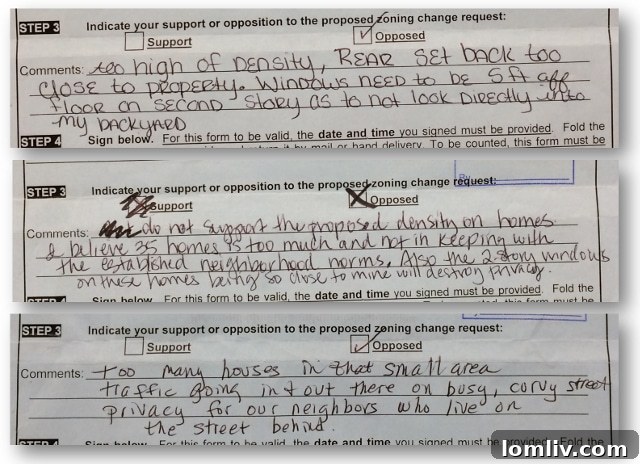
Finally, the issue of privacy emerges as another valid and highly personal concern. Many residents deliberately choose to purchase homes in single-story ranch neighborhoods precisely because their backyards offer a sense of seclusion, protected from the direct oversight of peering neighbors. While this concern shares some parallels with arguments against high-rise developments impacting views, the encroachment of privacy at ground level feels far more immediate and personal for homeowners.
Although it might be unrealistic to expect a developer like Weekley Homes to construct solely single-story homes where they back up to existing single-story residences, there should still be ample room for meaningful compromise. Creative architectural and landscaping solutions can significantly mitigate privacy concerns. For instance, can strategic window placements be designed to alleviate direct sightlines into existing homes? Can any of the existing mature trees on the property be carefully relocated or supplemented with new landscaping to increase natural screening and enhance privacy for adjacent properties? These are tangible solutions that can be explored through collaborative dialogue.
It has been identified that approximately 13 existing homes would potentially face some degree of privacy encroachment from the new development. Weekley Homes has a responsibility to engage directly with these specific homeowners to explore and implement solutions wherever feasible. While this level of hands-on engagement might exceed what a large-scale builder, constructing hundreds or even thousands of homes annually, is typically accustomed to, the effort is undeniably worthwhile. Any betterment in this area represents a win-win situation, fostering goodwill, improving neighborly relations, and ultimately enhancing the overall quality of the new community. It reflects a commitment to responsible development that goes beyond mere compliance.
Some residents may harbor the belief that by entirely thwarting Weekley’s plans, all issues will magically dissipate. This perspective, however, is misguided. The reality of urban development dictates that if one developer is deterred, another will invariably step forward, likely proposing a similar or even higher density project. The most pragmatic and effective goal for any neighborhood facing development should be to secure the maximum amount of meaningful compromise on issues that are truly impactful and controllable. This strategic approach necessitates jettisoning the often ignorable and counterproductive aspects of pure “Not In My Backyard” (NIMBY) sentiment in favor of constructive dialogue and achievable solutions that genuinely benefit the community in the long run.

Remember: My focus consistently revolves around high-rises, homeowners’ associations (HOAs), and property renovation trends. However, I also hold a deep appreciation for the dynamic interplay between modern and historical architecture, always viewed through the lens of progressive urban development and the growing YIMBY (Yes In My Backyard) movement. From 2016 through 2018, the National Association of Real Estate Editors recognized my contributions to real estate journalism with three Bronze (2016, 2017, 2018) and two Silver (2016, 2017) awards for my writing. Should you have a compelling story to share, a perspective to offer, or even an unconventional marriage proposal, please feel free to reach out via email at [email protected]. You’re also welcome to look for me on Facebook and Twitter, although a successful search remains an elusive quest!